Nature & Photography

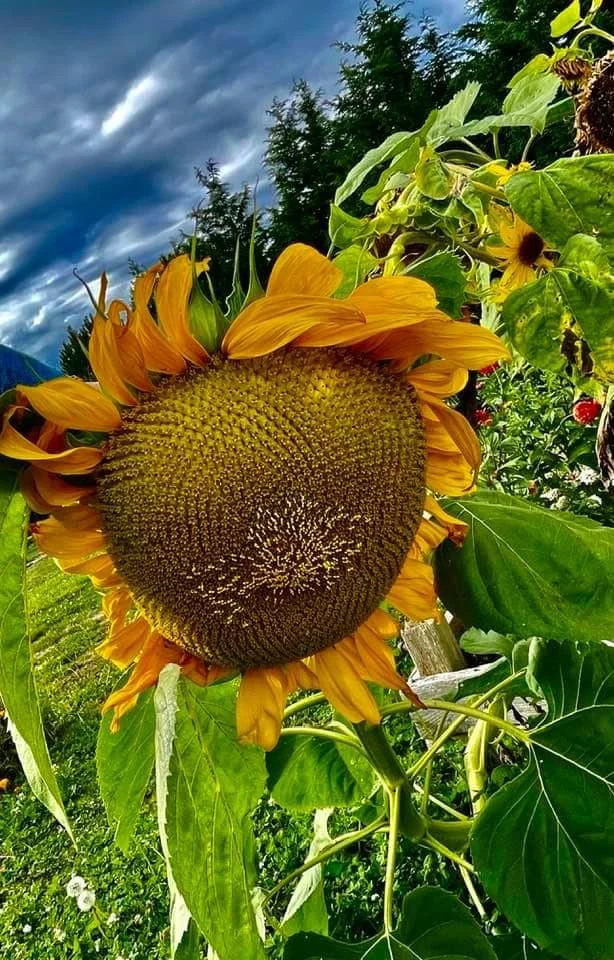
Sunflower Steals the Show at the tranquil and Aromatic Lavender Farm in Sequim, Washington

“Wherever life plants you, be like a sunflower and bloom with grace”

-Adapted from a French proverb

I took this photo at the Jardin du Soleil Certified Organic Lavender Farm in Washington’s beautiful Olympic Peninsula owned by former Californians Jordan and Paula Schiefen.

Back History of Sunflowers: They sunflower or Helianthus Annus are native plant of North America. The word helianthus refers to a plant which turns its flowers and leaves to the sun and the name Annus means annual. It is derived from the Greek language, with helios meaning sun, anthus meaning flower and annus meaning annual. Sunflowers are believed to have grown by Native American Indians in Arizona and New Mexico dating bacck to around 3000 BC. The seeds were ground or pounded into flour for cakes and bread or cracked and eaten as a snack, the meal was mixed with other vegetable and oils used from the seed used to make bread. Non-fused uses include dye for textiles and body painting. Some plants were used medicinally including seed oil for skin and hair and dried stalk for building material. It was also used to treat snakebites.

Sunflowers were taken to Europe by Spanish explorers around the 1500 and became widespread thoughout Western Europe for ornamental and medicinal use. In the 18th century they became popular in Russia. By the late 19th century sunflower made its way to the USA. THere are now over 80 species, ranging from lemon to golden yellow, orange, pink, red and almost black.

In Chinese culture sunflowers are said to symbolize good luck, long life and lasting happiness, while in native American culture, sunflowers symbolize harvest and provision. The sunflowers is the national flower of both Russia and Ukraine.

Almost Stepped on this Pacific Ringneck Snake During our After Dinner Walk

Almost Stepped on this Pacific Ringneck Snake During our After Dinner Walk Around the Lake where we live. It popped up in front of me. Though these secretive & hibernating reptiles are endemic to California, variations of them can be found in other parts of the country. They have a colorful underbelly and red rings around its neck perhaps to trick its predators into thinking they are toxic. I was relieved to discover they are not poisonous. They are venomous but their venom is not fatal. They seem to thrive in wooded areas and around the edges of ponds & lakes similar to the terrain our townhome is located.

Late Afternoon Solo Bike Ride to Vasona County Park Reservoir: Communing with Ducks, Herons, Clouds & a Waterfall

“Behold this day. It is yours to make." —Black Elk

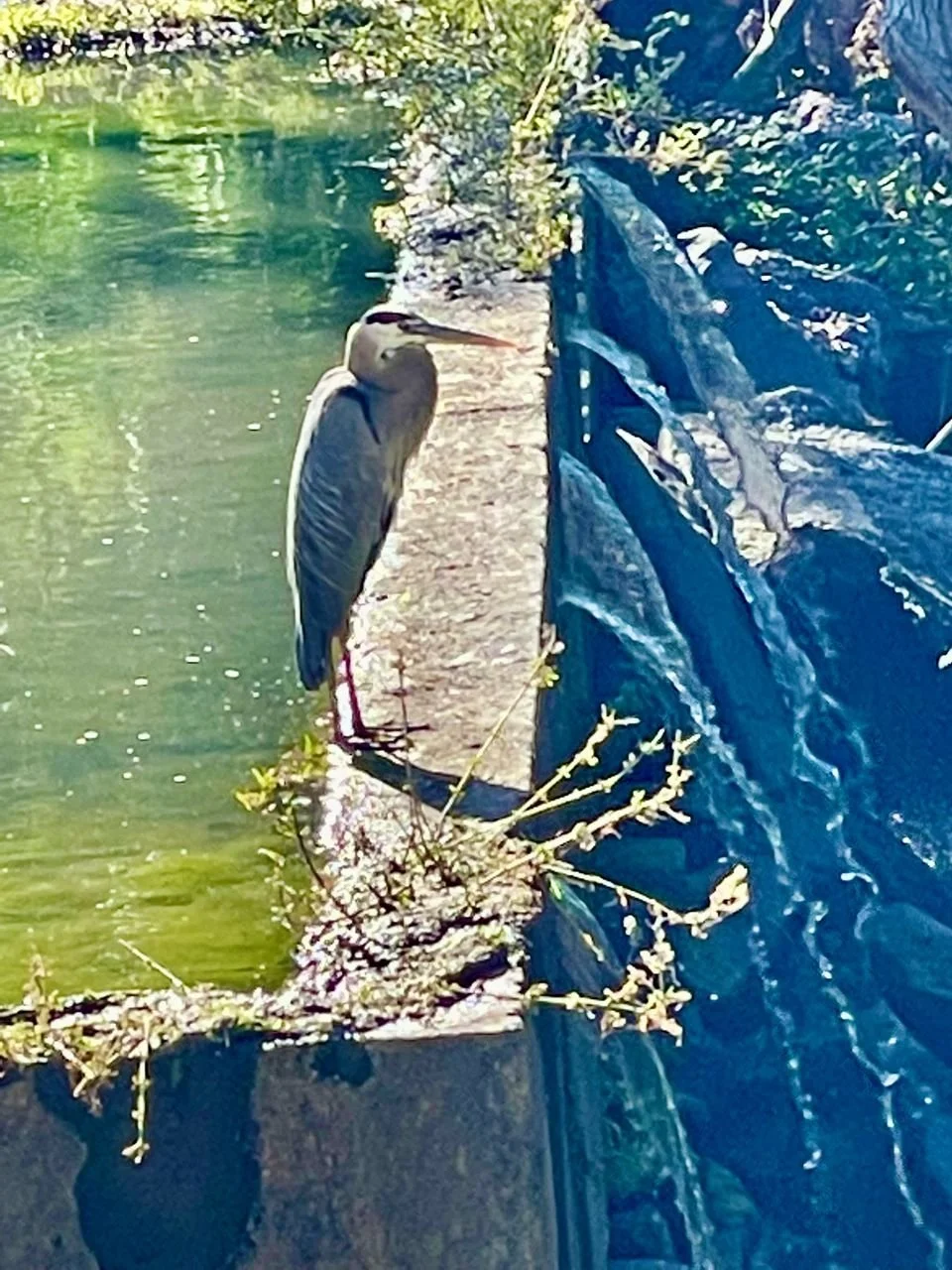
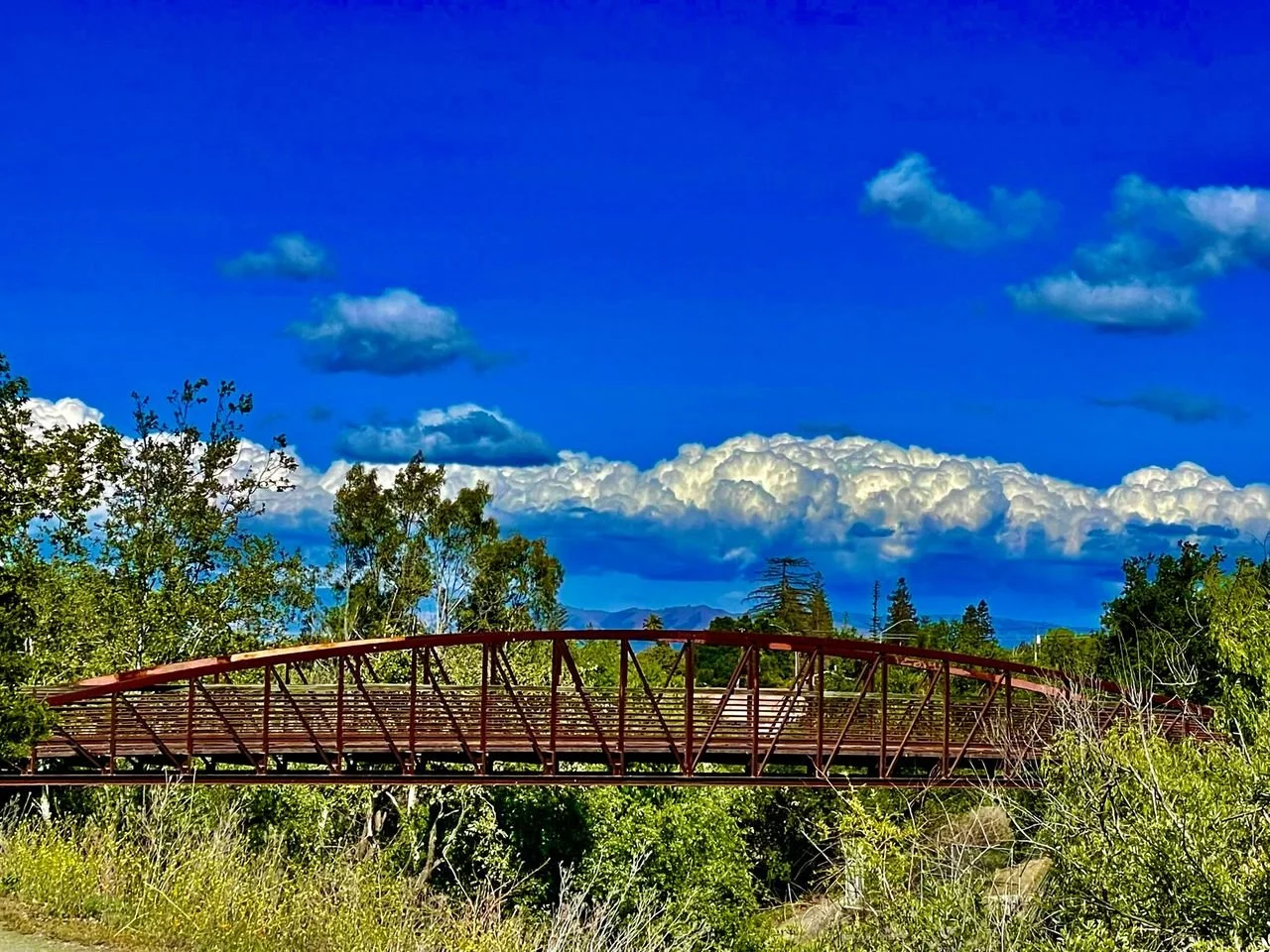
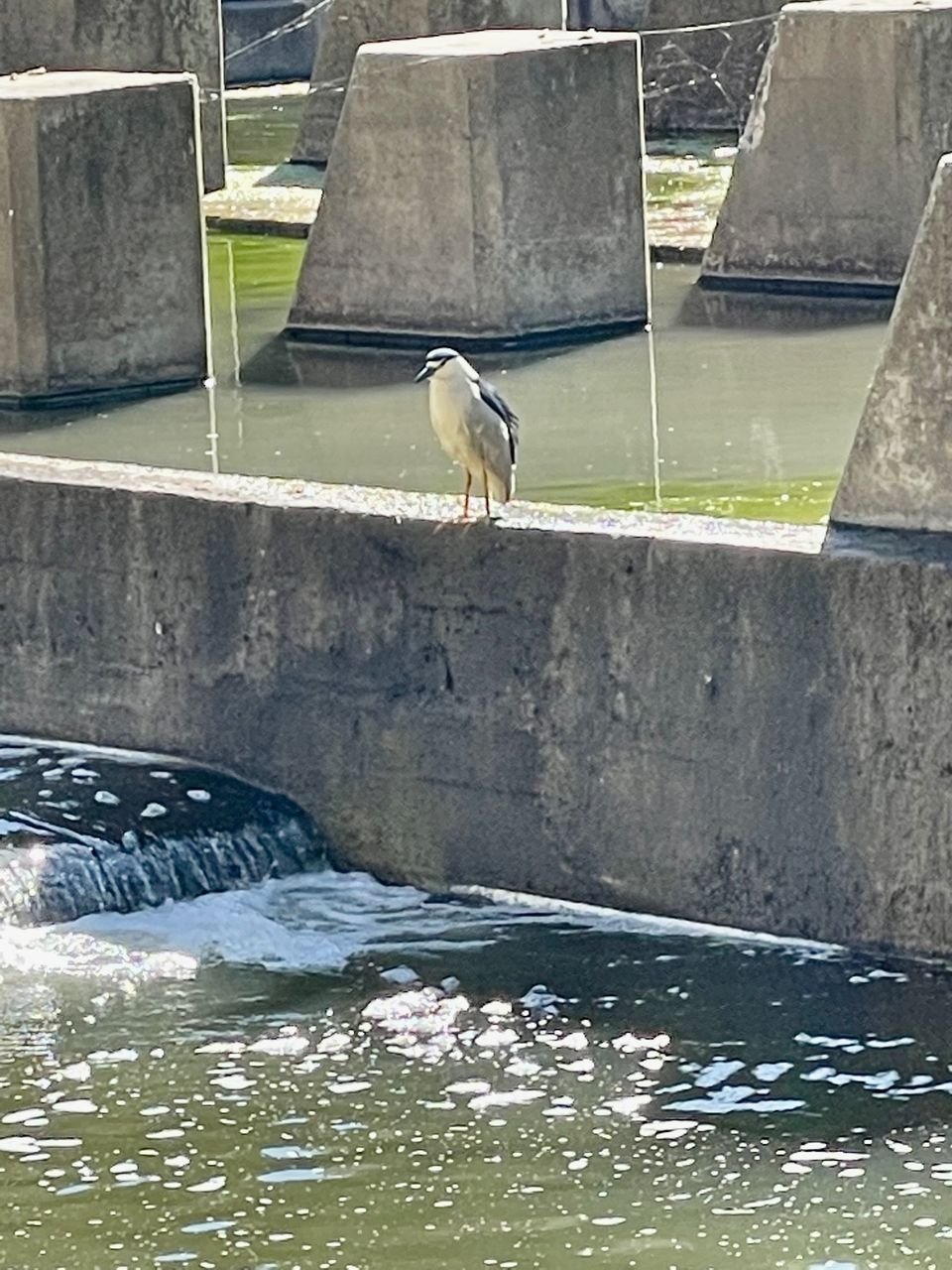
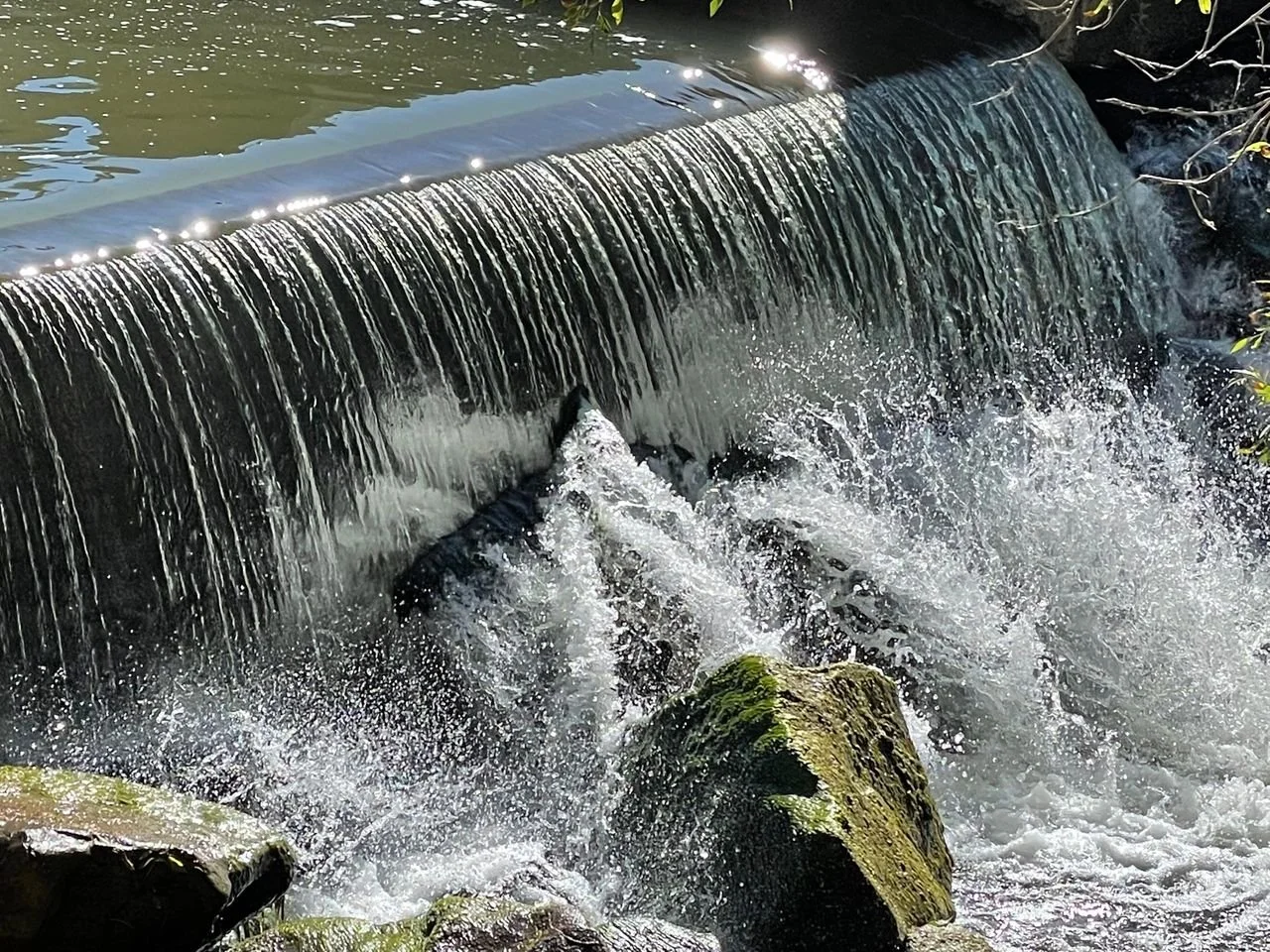
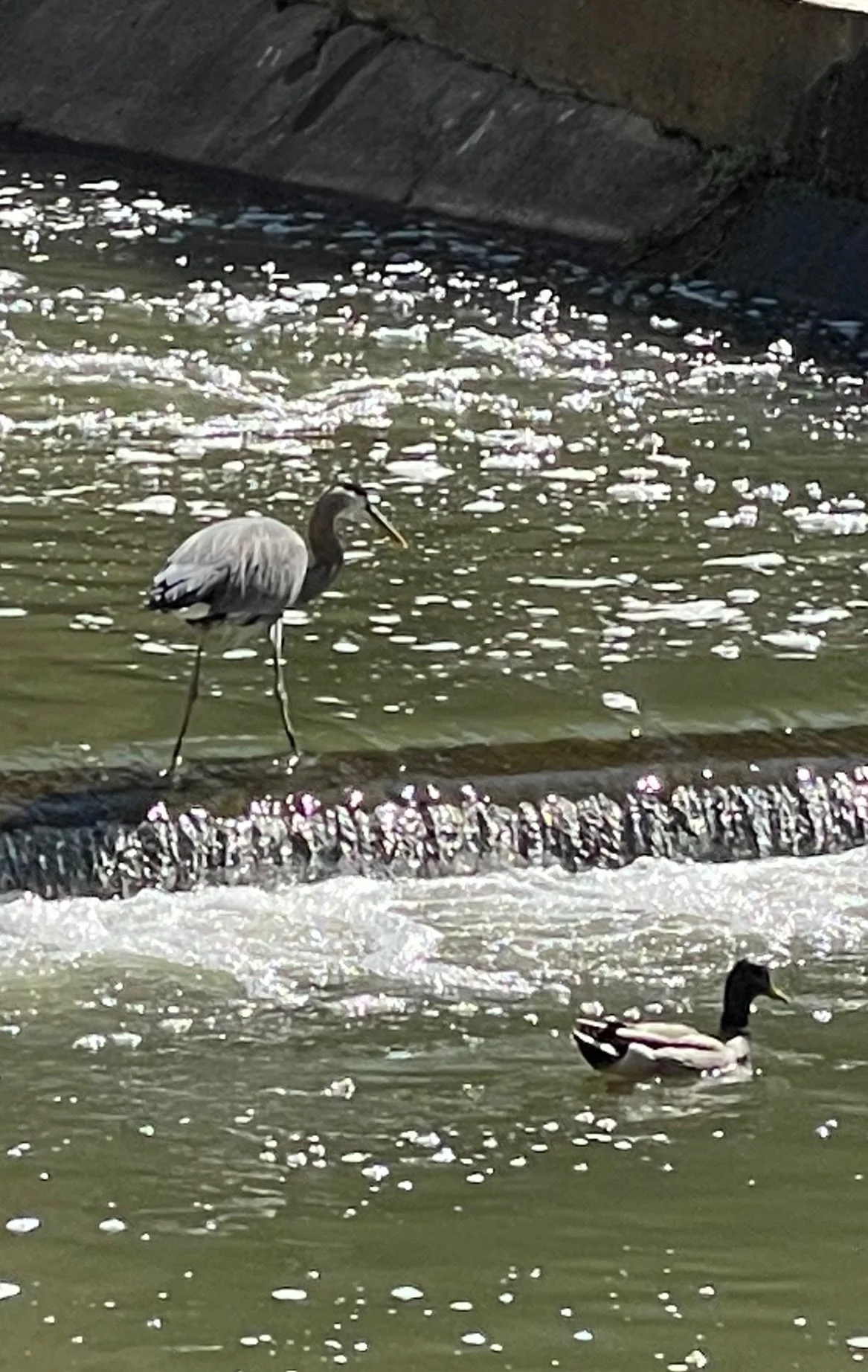
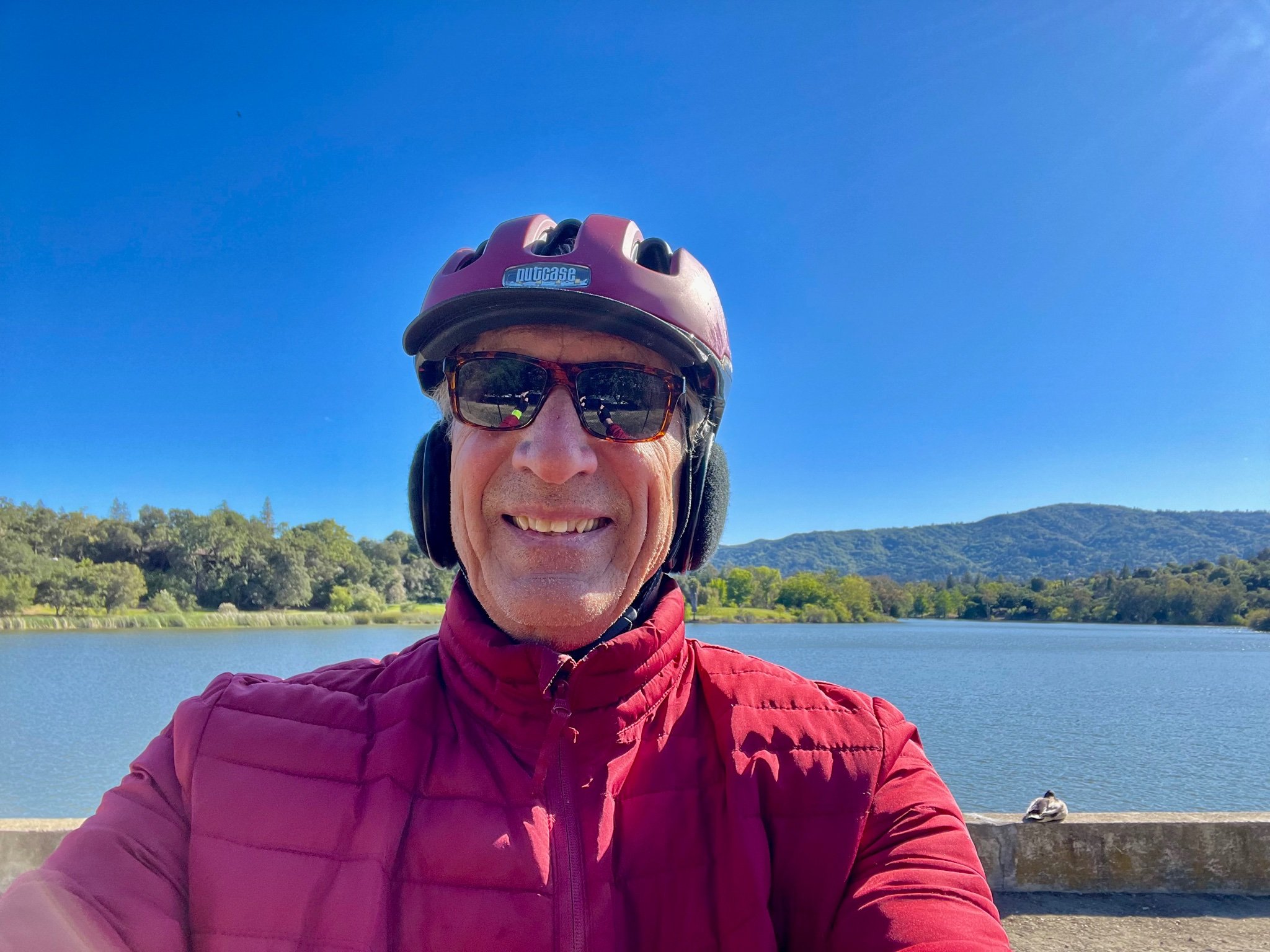
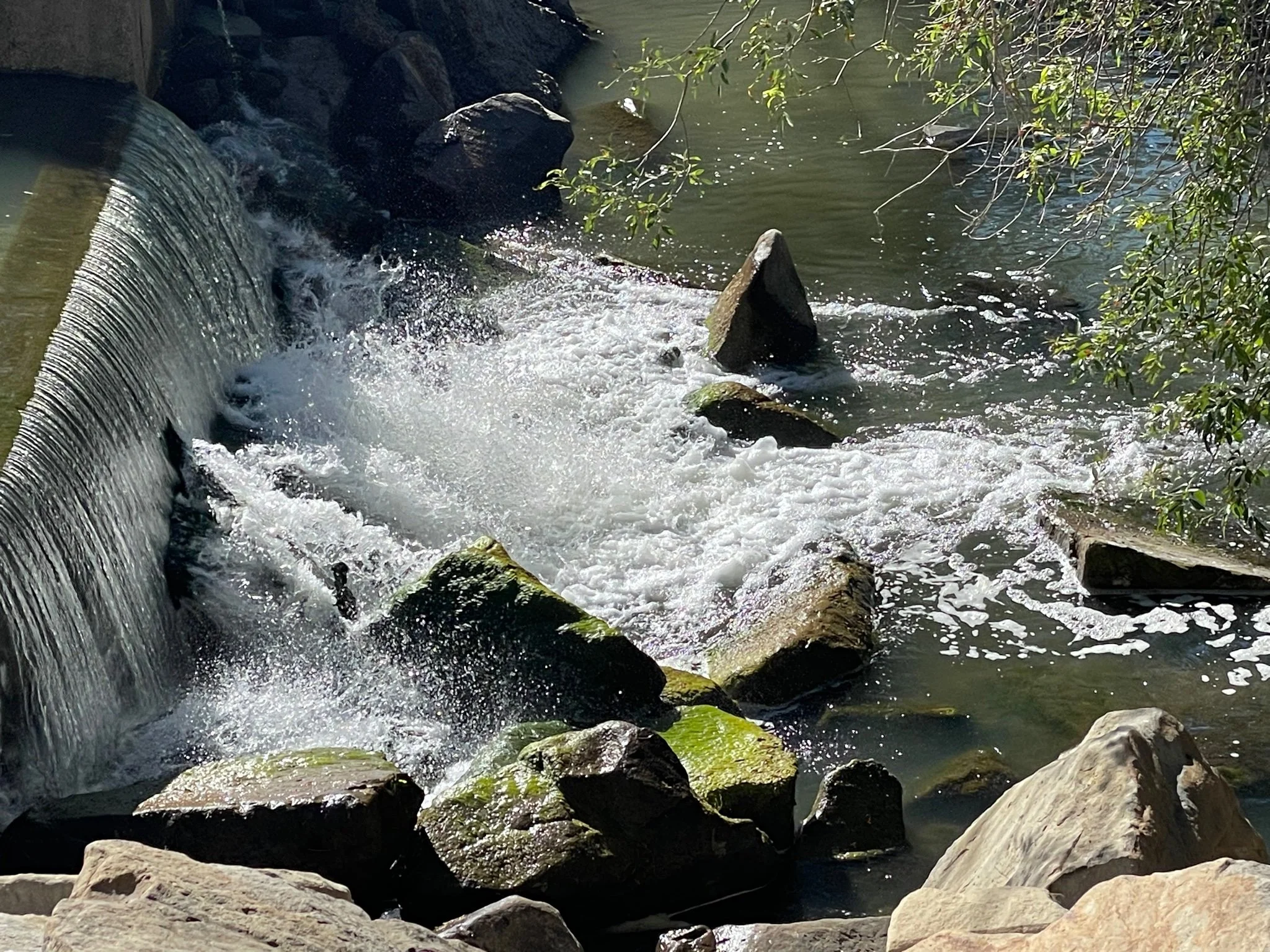
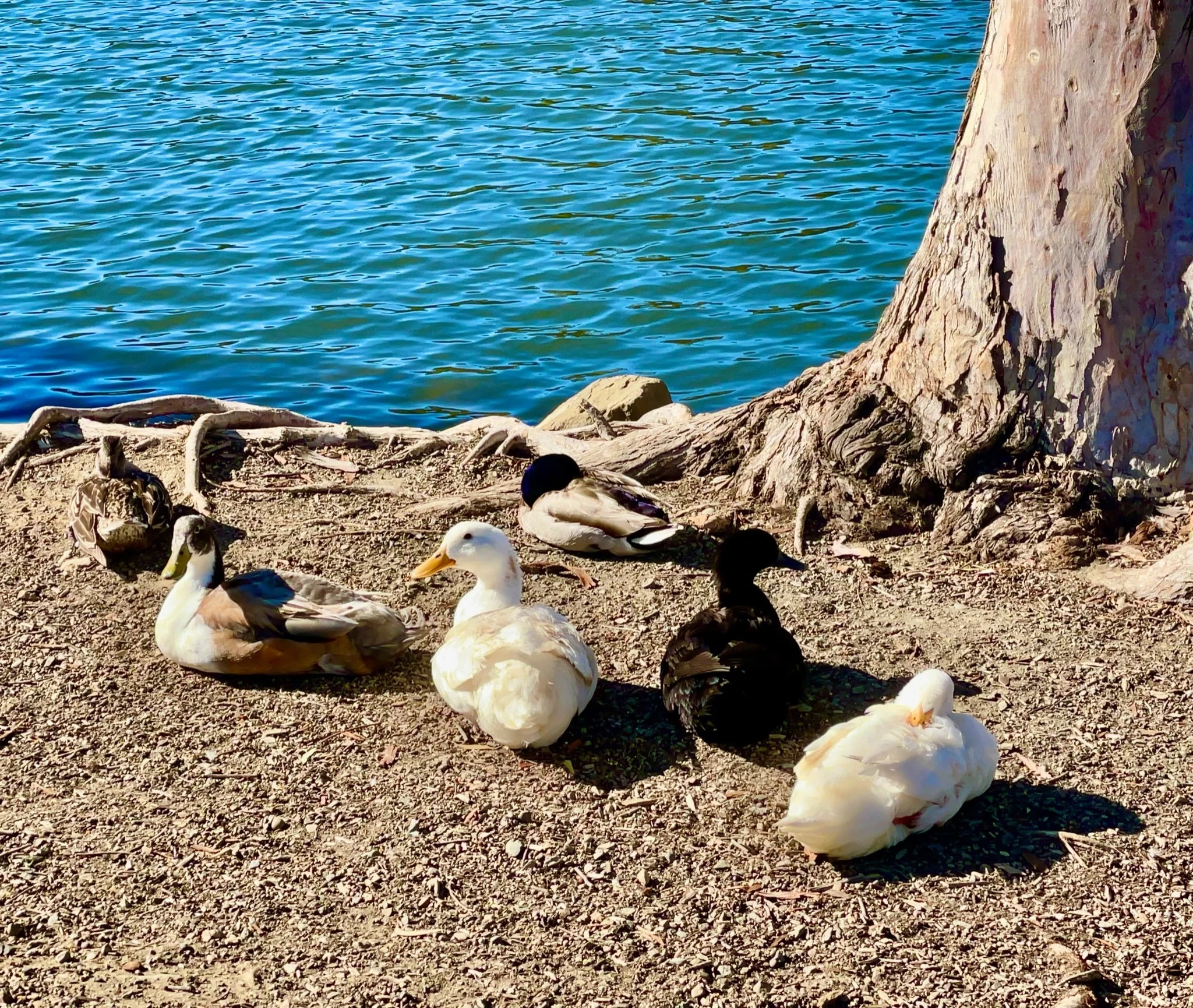
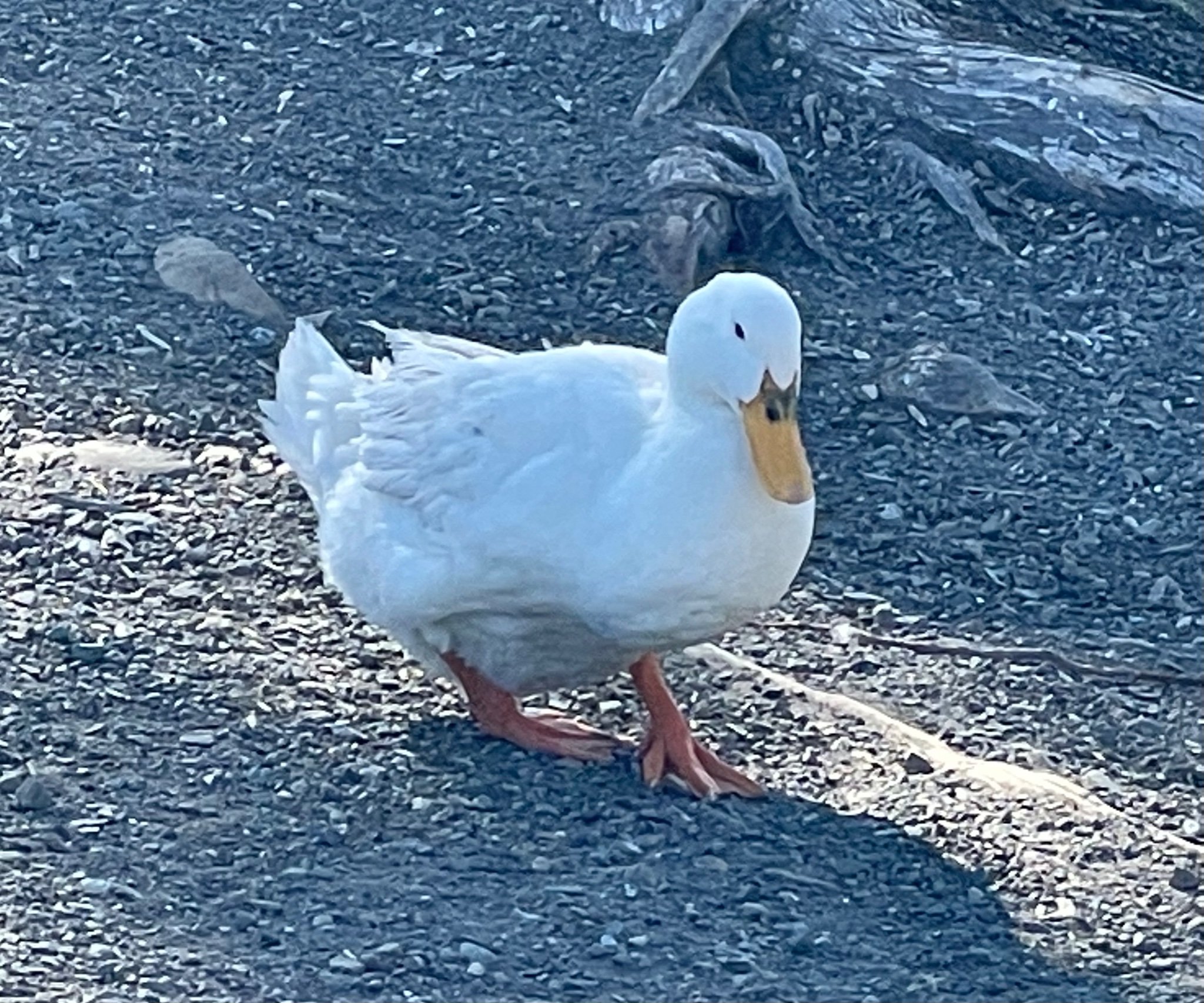
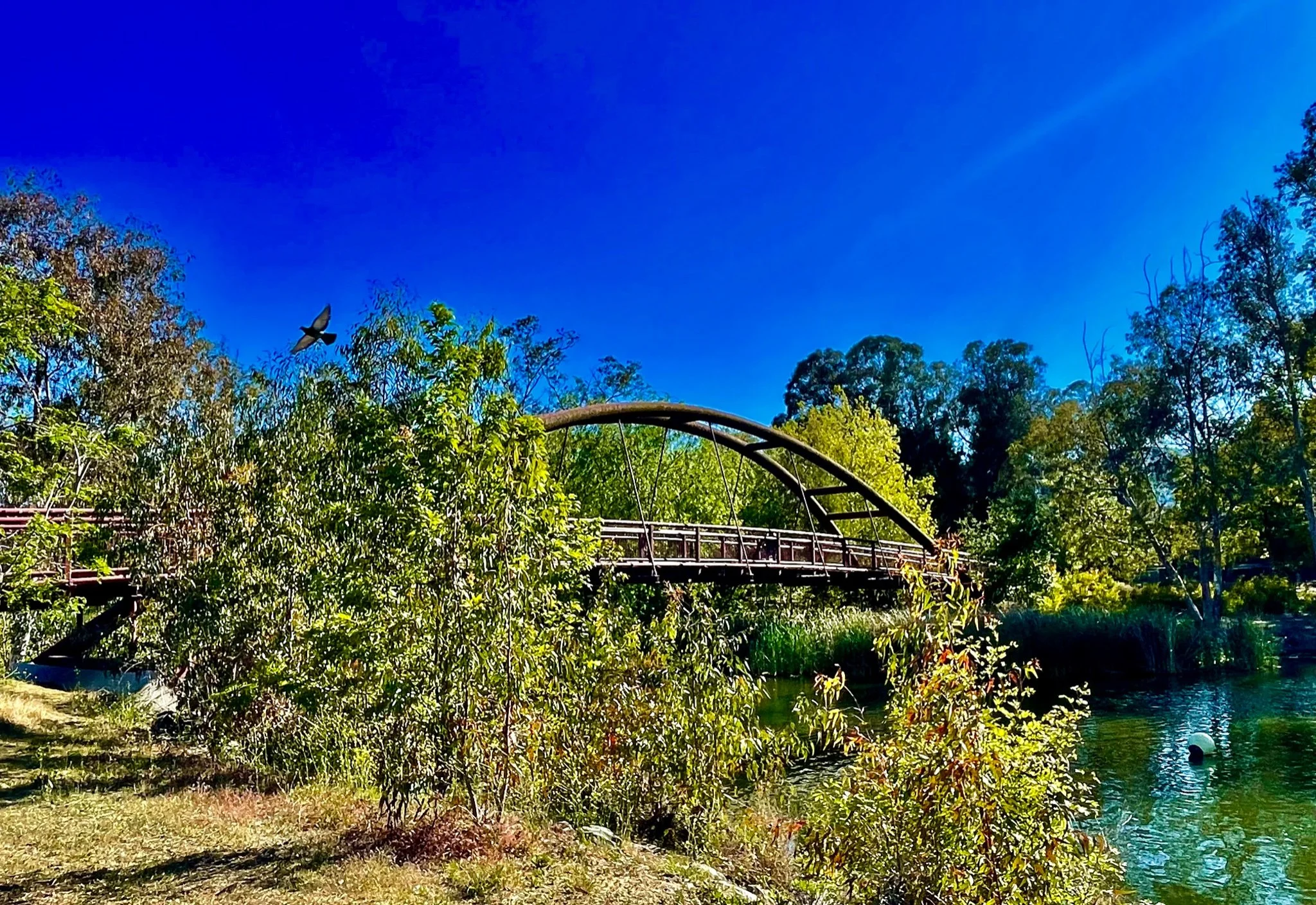
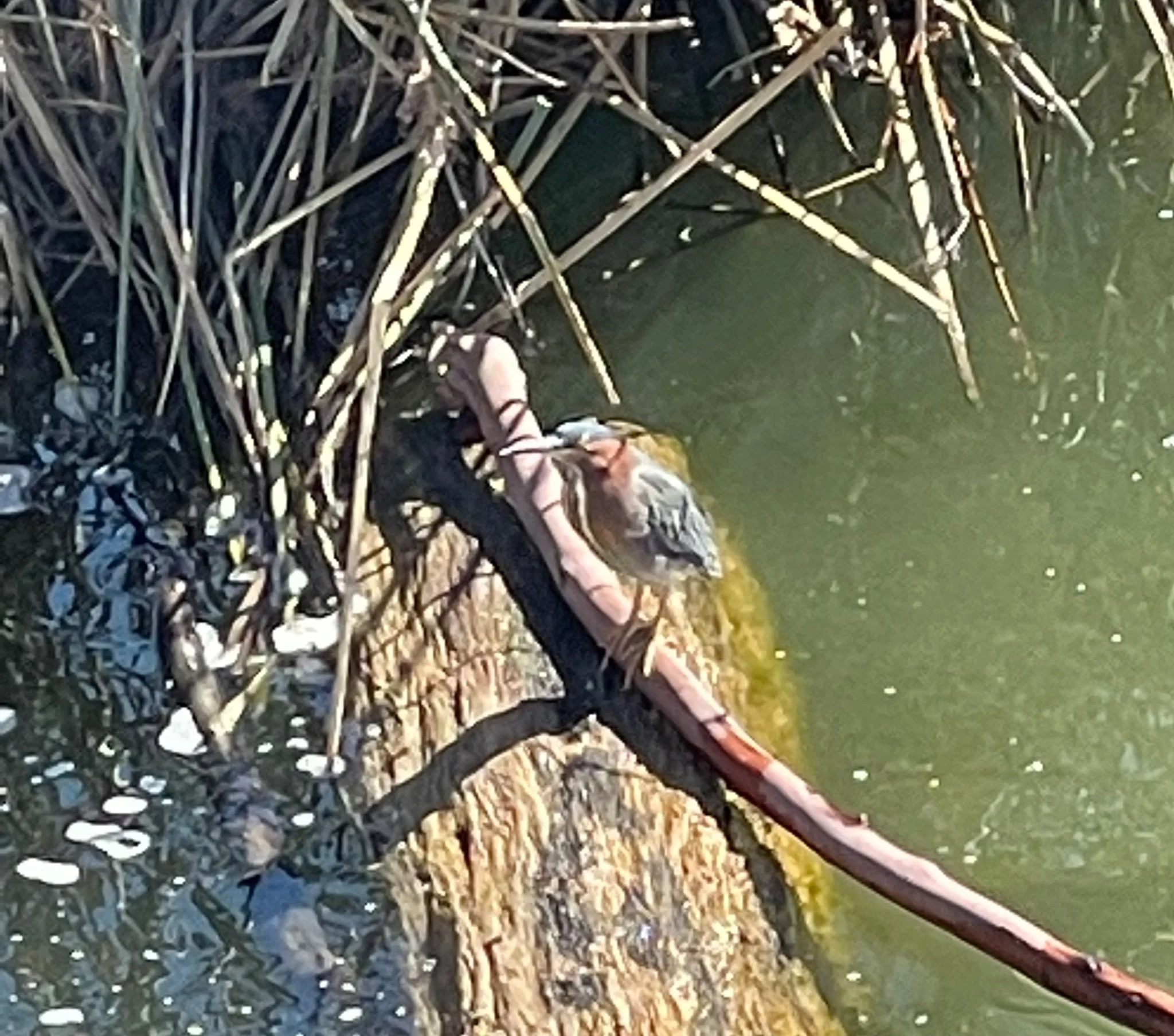
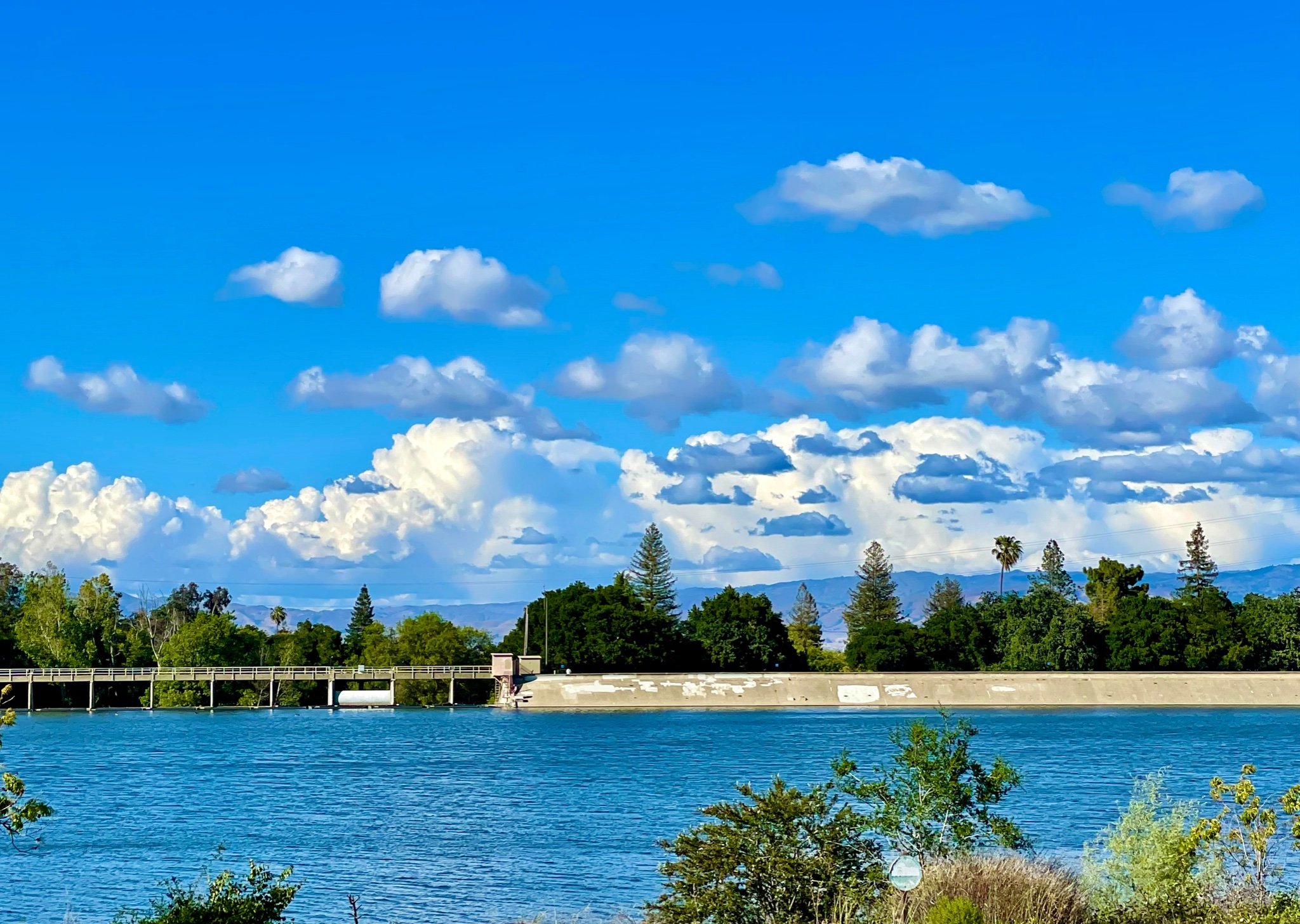
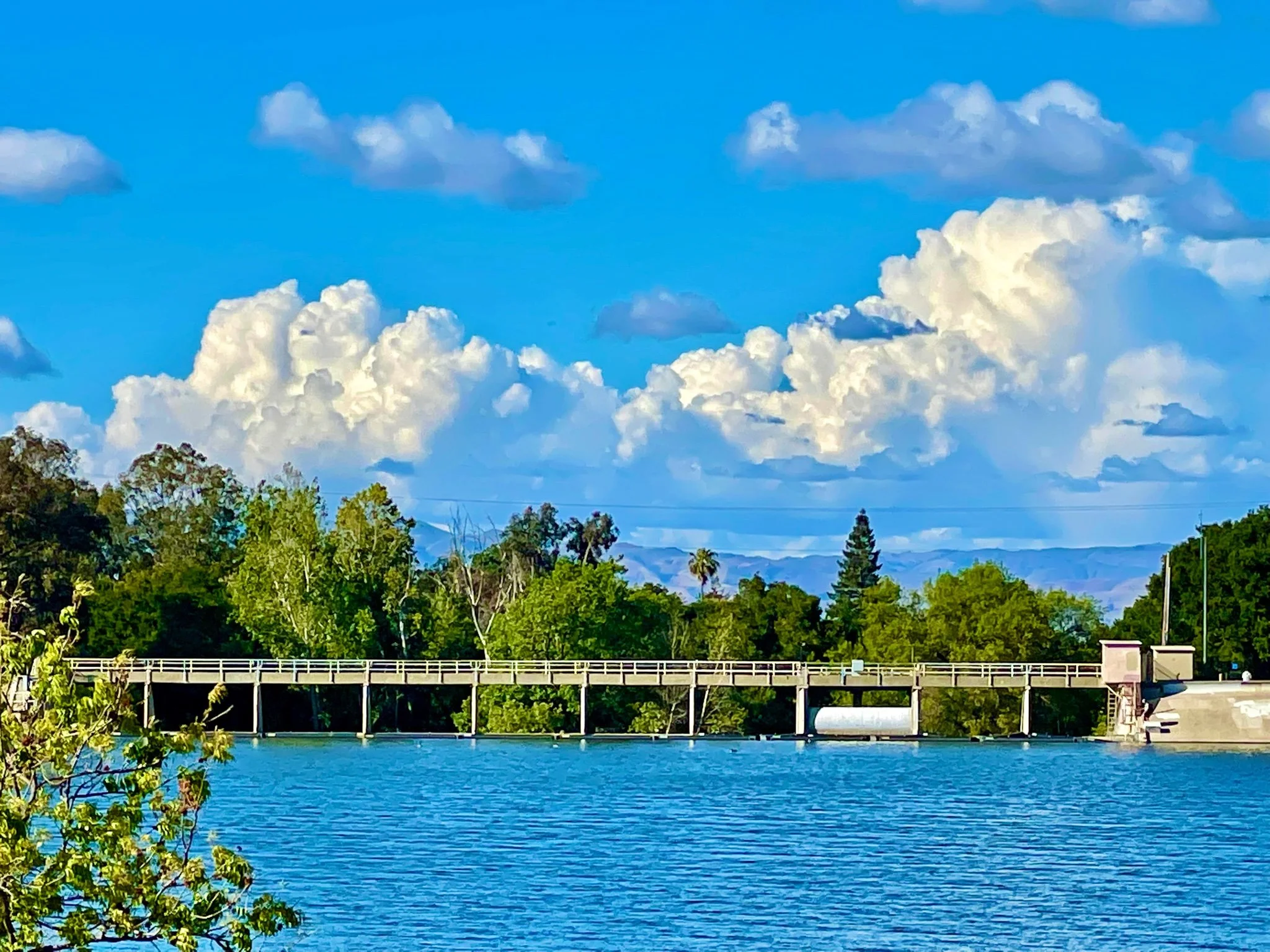
I love when I decide to take a bike ride on the creek trails with no expectations and most times-if I’m not in a rush-nature comes out to greet me. It was biting cold out, but I dressed warmly. White fluffy shapeshifting cumulus clouds were everywhere, but unlike this morning the sun made its appearance and the sky turned blue. There were an abundance of aquatic life everywhere. I was getting ready to pass the Vasona Reservoir spillway. For all practical purposes it is a waterfall, one that roars with excitement. I pass it all the time. This time I felt a call to get off my bike and climb down the embankment to get a closer view. Unexpectedly, there were two types of herons. One, a Great Grey Heron in the middle of the water feasting on tiny fish. It found its sweet spot. Their beaks are like spears, and every few seconds they use it to pierce their prey. Across the way, standing on a grey cement platform of the dam was a small black-headed heron standing still as if it were a sentry guarding the gate. I got back on my bike and rode closer to the rust colored pedestrian and bikers bridge where I saw a number of ducks of every conceivable color that were resting near the waters edge. One friendly one came right up to me.

There is an old Sioux Indian phrase, Mitkuye oyansin—“we are all related"—often voiced at the end of a prayer. It is an affirmation of the interconnectedness of all things, and respect for all things. From the earliest of times, it was understood that beyond the visible world, there exists the presence of an invisible world, where everything is infused with a sense of sacredness. Plains Indians believed that everything in nature has a spirit. This includes all animals, rocks, rivers, waterfalls, the sky, clouds, etc. Given the chance to be in nature, I’m all in, and one doesn’t have to drive or ride too far to experience it.

I hope you enjoy the photos which tells the story beyond words.

Encountering A Mourning Cloak Butterfly: A Symbol of Transformation

“Love is like a butterfly: It goes where it pleases and it pleases wherever it goes.”

—Author Unknown

“Butterflies…live most of their lives completely ordinary…then one day, the unexpected happens. They burst from their cocoon in a blaze of colors and become extraordinary…It shows us how empowering change can be.”

—Kelsyleigh Reber

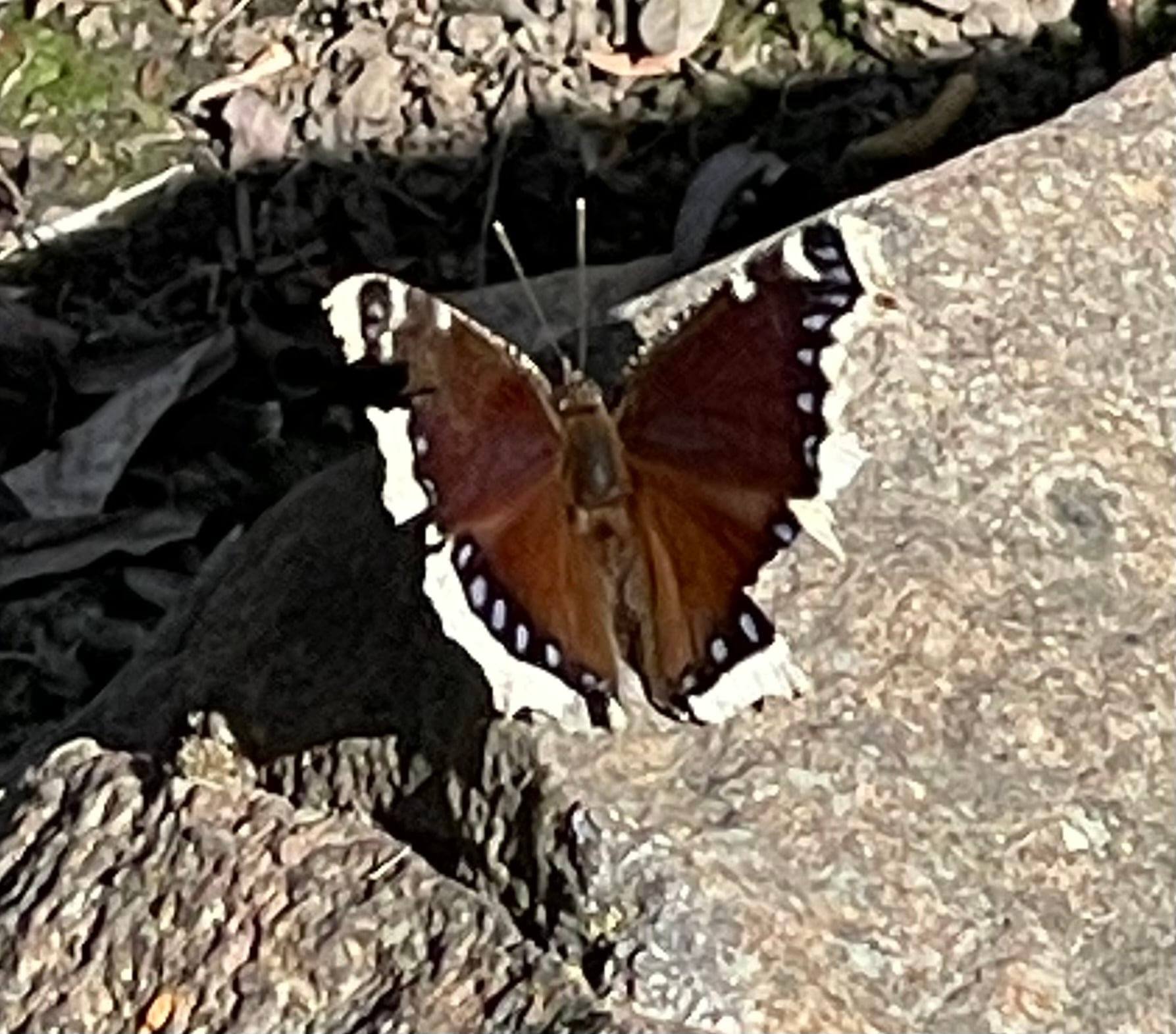
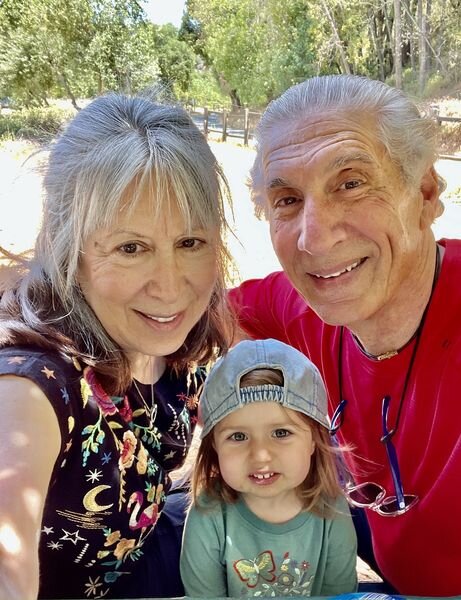
While taking our granddaughter Emmy for a stroll around the perimeter of Rinconada Lake where Cecile and I live, I spotted a mourning cloak butterfly.

Though it can be seen in forests, along streams, parks, and fields throughout the United States and Canada, this was the second time I have encountered one.

It gently zigged and zagged until settling on the edge of a rock. As I gently approached it folded its wings tightly together and was completely still. I found out after my first encounter of a mourning cloak a couple of years ago that it is their attempt to camouflage themselves from predators. After a few minutes it opened its’ wings again, long enough for me to capture its’ beauty before flying off again. Though I wished it could have stayed a bit longer, I felt so fortunate to have seen this beautiful creature for a brief moment in all its glory and beauty.

Postscript: The mourning cloak is a unique butterfly, with special markings that do not match those of any other type, making it easily distinguishable. It has a wingspan of up to four inches. The dorsal or top part of wing is dark maroon, with a black band with bright iridescent blue spots and a ragged pale-yellow edge. It is powerful flier with a life span of 11 to 12 months, one of the longest lifespan for any butterfly that appears in the early spring. The mourning cloak is so called because it resembles the cloak worn by people who mourn the loss of a loved one. Other older names for this species include grand surprise and white petticoat.

Capturing this Gorgeous and Freaky Sunset with Striated Cloud Formations

“Beautiful sunsets need cloudy skies.”

—Paulo Coelho

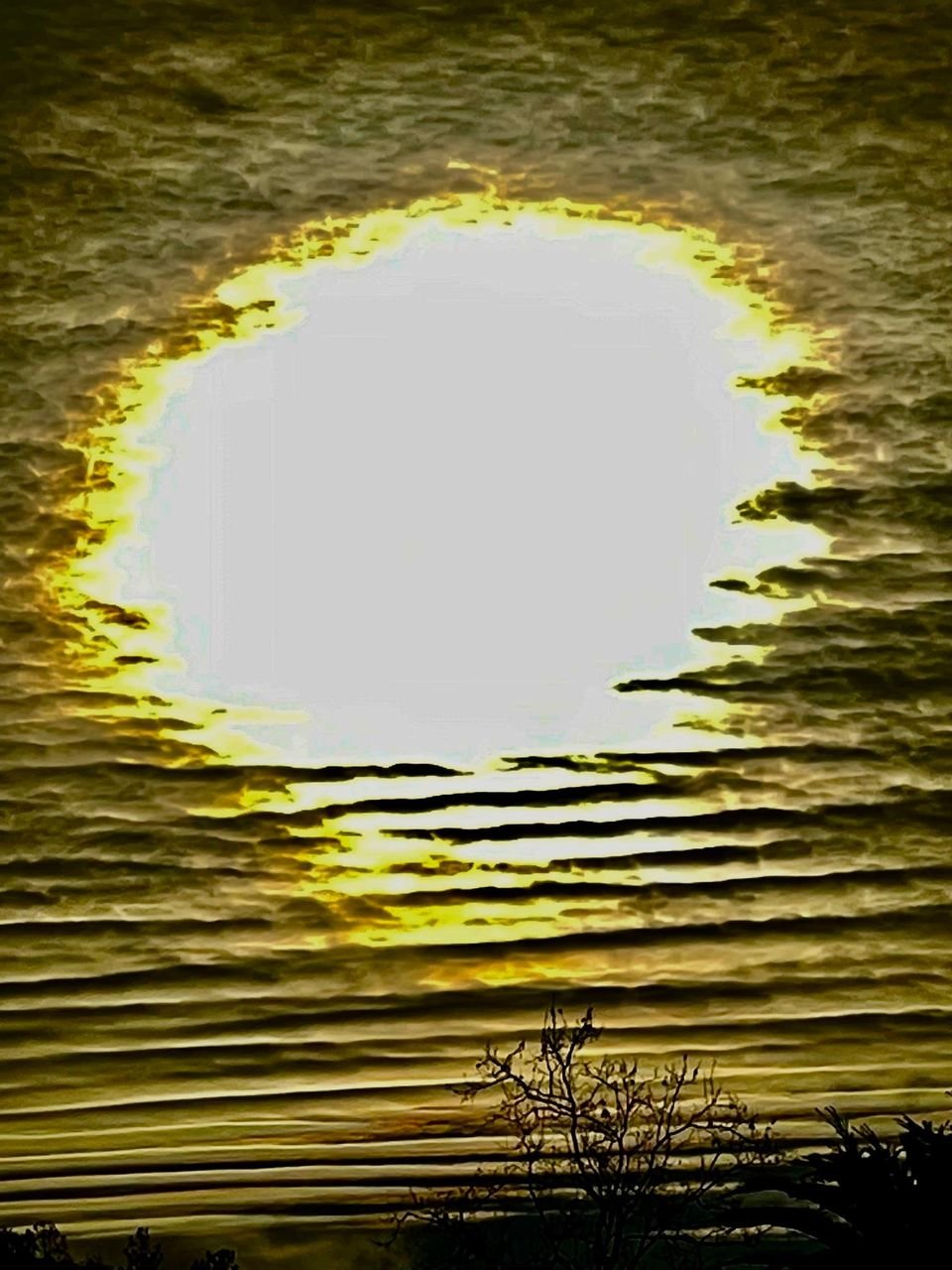
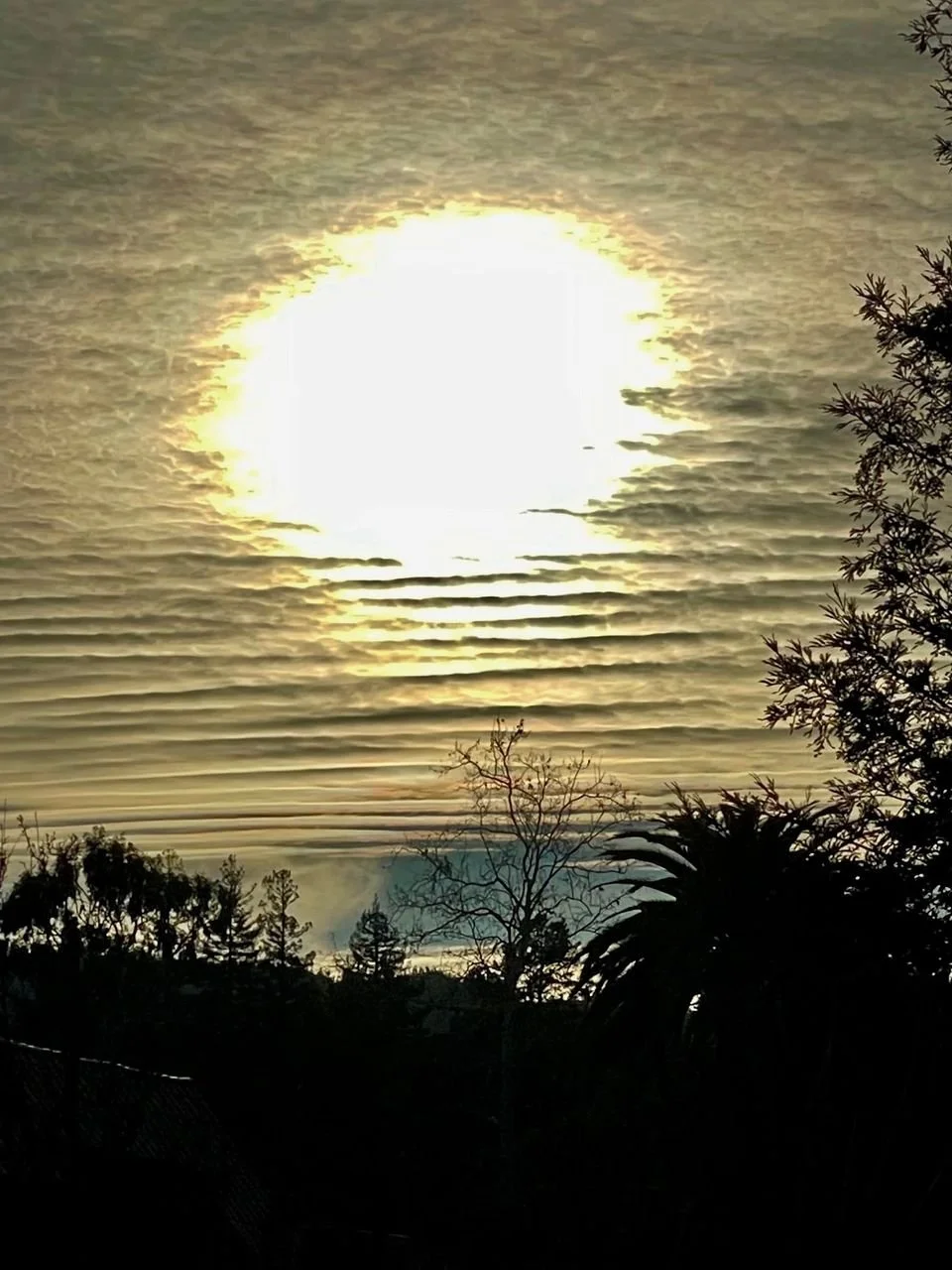
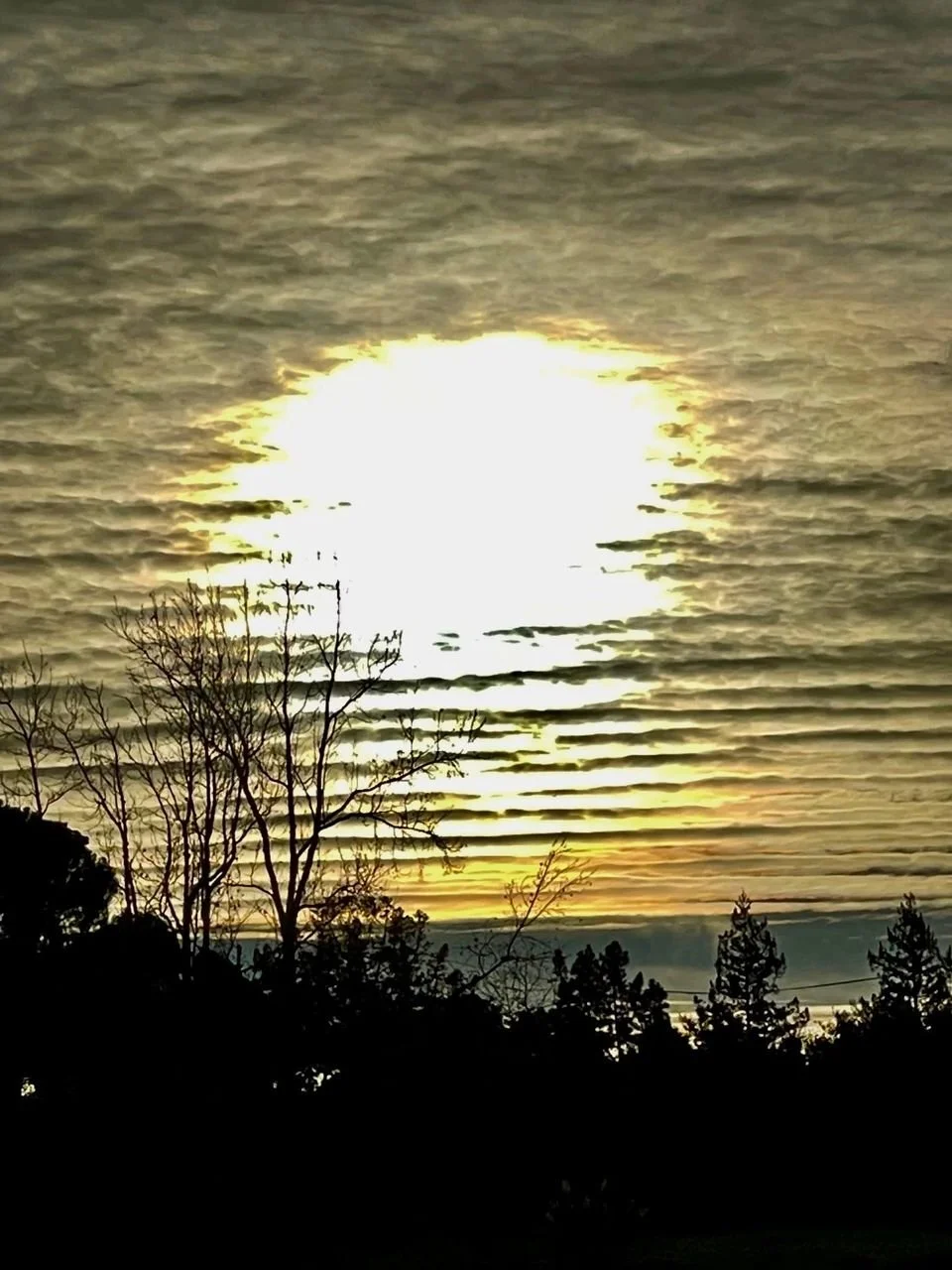
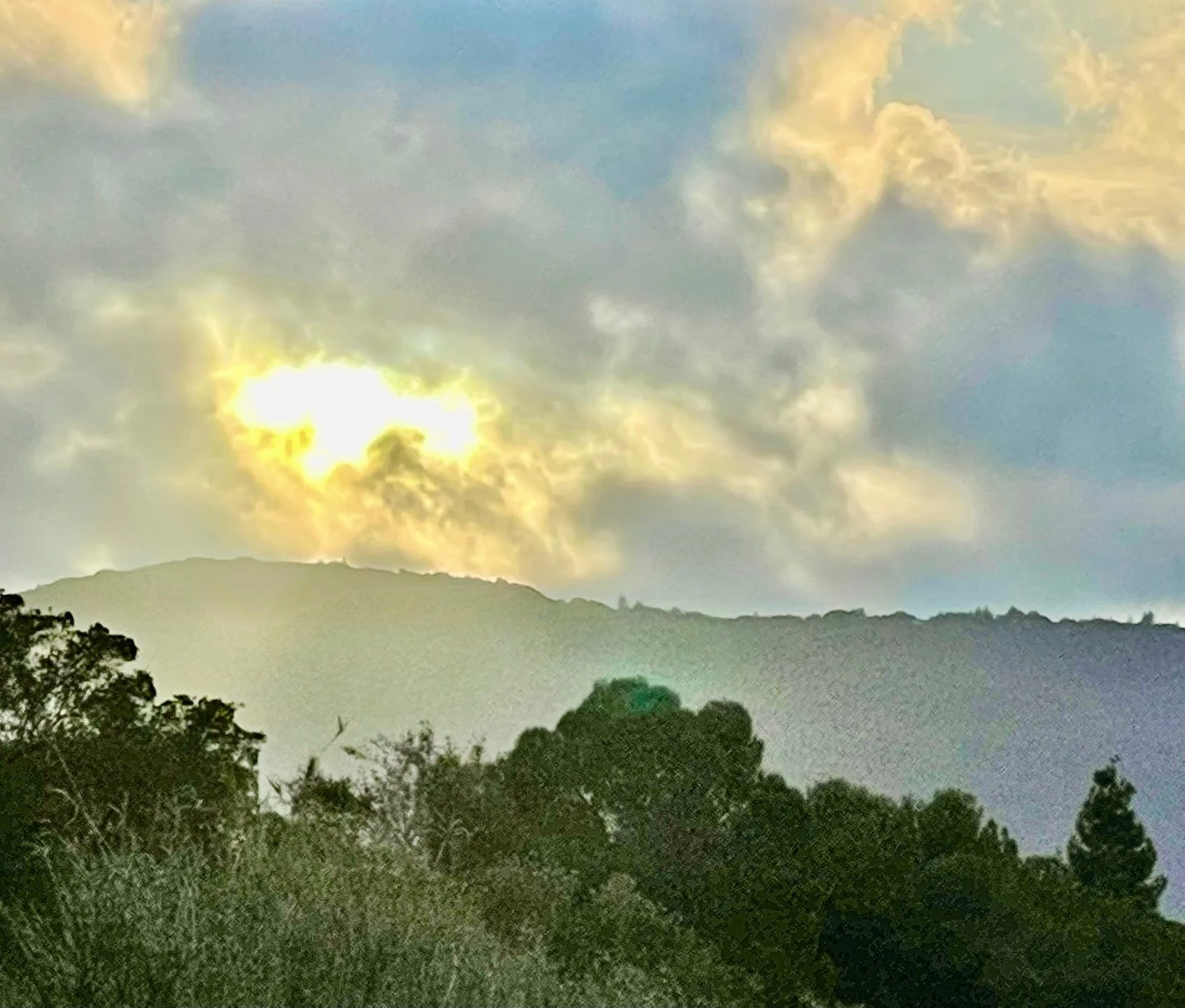
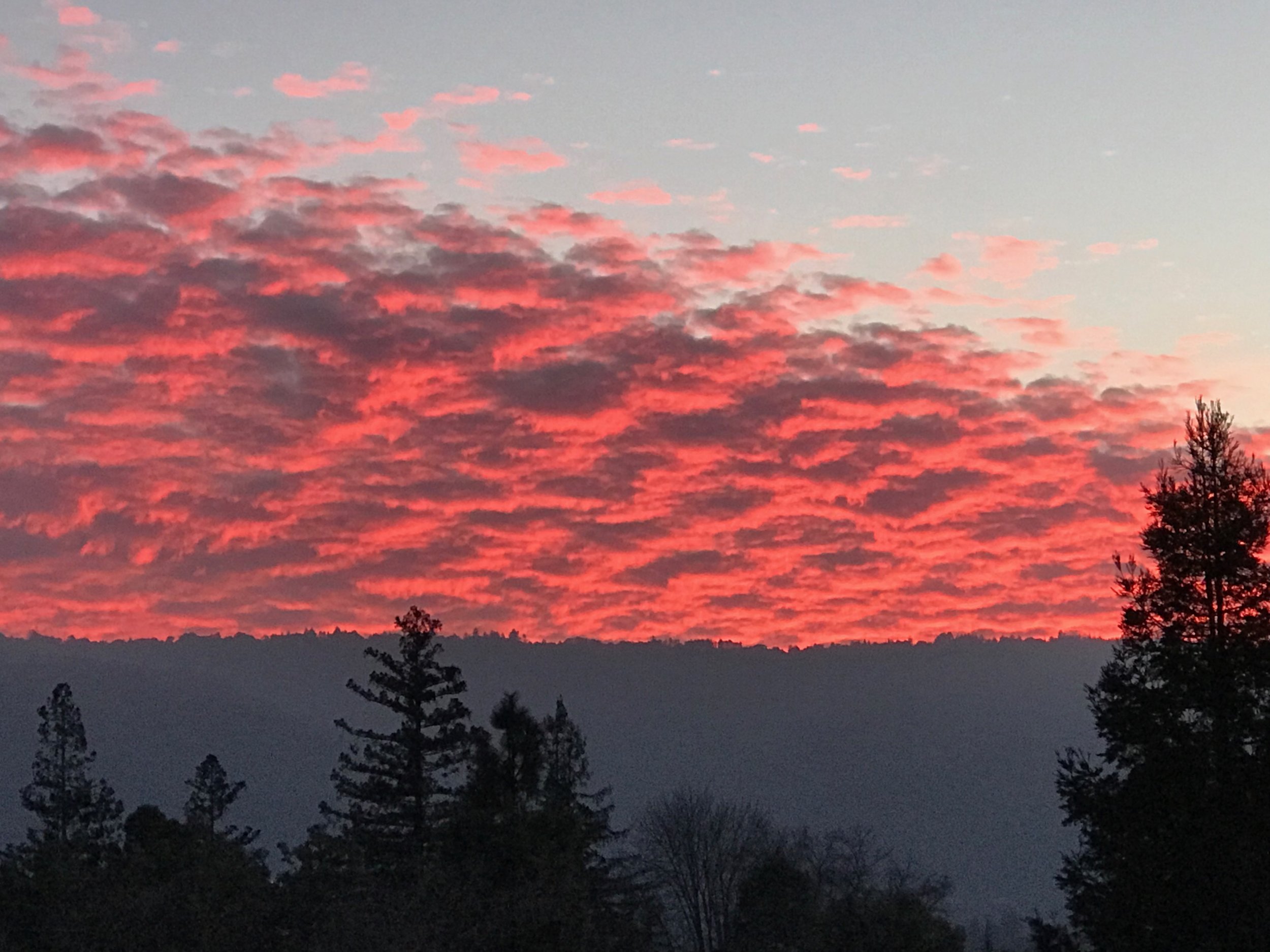
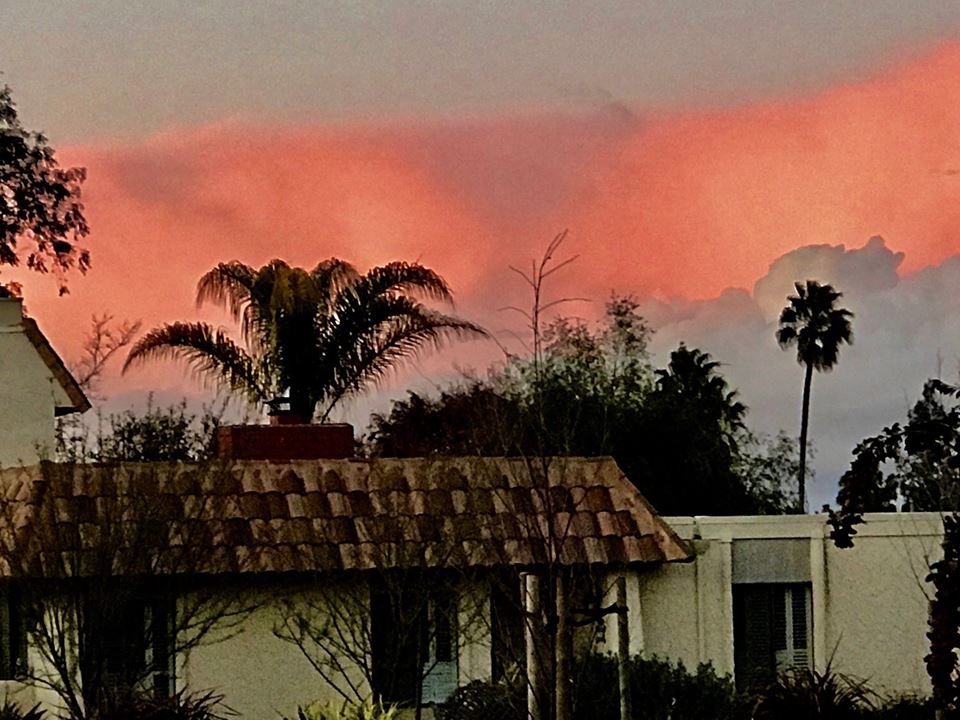
During my many bike rides I have had the opportunity to pause and photograph hundreds of sunsets. However, I have never seen anything as beautiful and as mysterious as this. It was taken yesterday during an early evening ride in the neighborhood where we live.

Striated clouds are a pattern of gray or bluish cloud sheets or layers that totally or partially covers the sky that are translucent enough to regularly reveal the sun or moon. But in this sunset a big part of sun also shone through without any of the cloud striations running through it except around the periphery creating the perception of a serrated edge.

What do the striations mean? Grooves or channels in cloud formation, arranged parallel to the flow of air and therefore depicting the airflow relative to a parent cloud. Part of the cloud nomenclature is the word Translucidus. It’s derived from the latin root, translucere which means to shine through or become transparent.

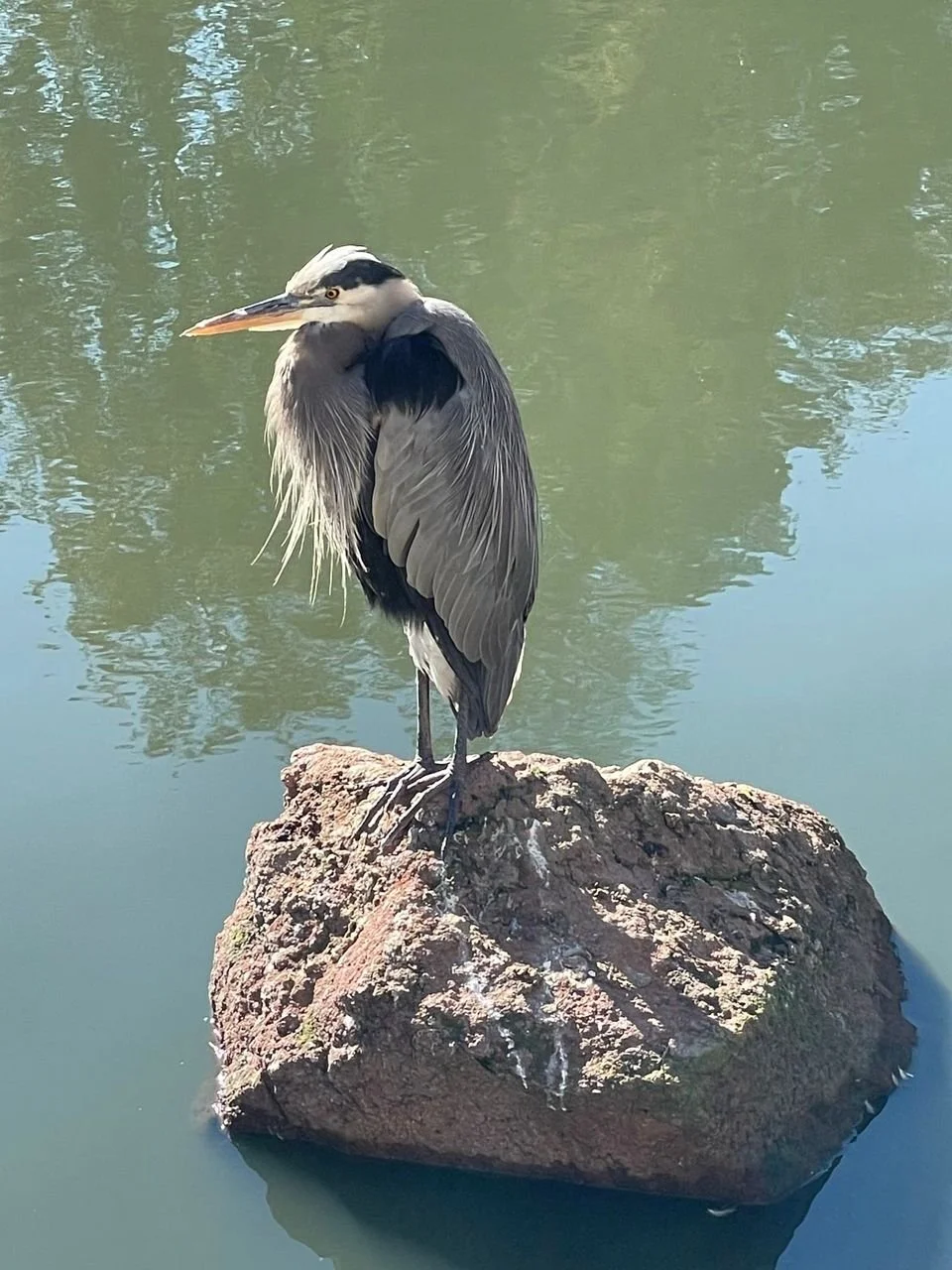
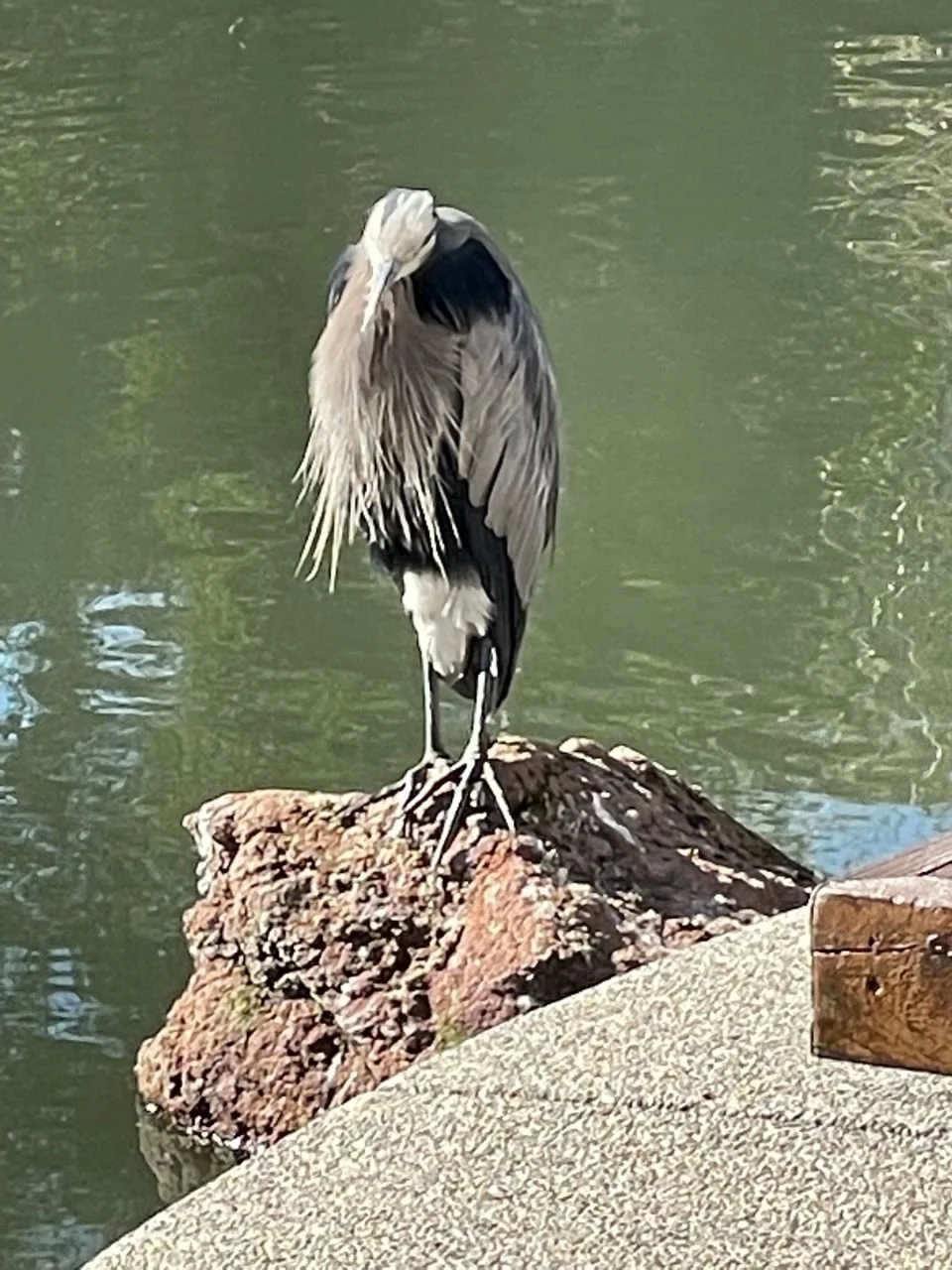
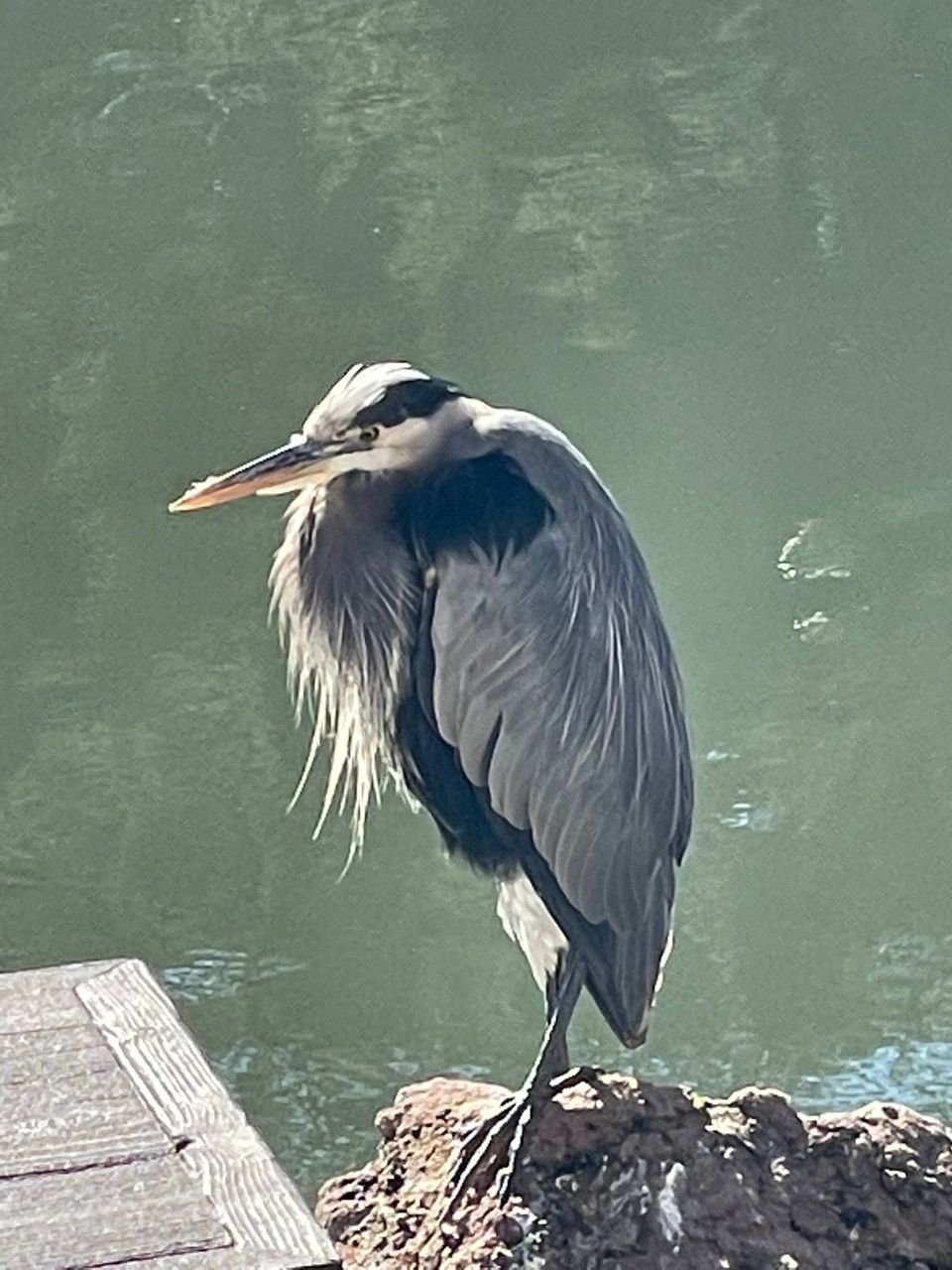
Captured this Prehistoric Looking Grey Heron Near our Townhome at Rinconada Hills Lake

"Stand tall, stand proud. Know that you are unique and magnificent. You do not need the approval oof others."

—Jonathan Lockwood Huie

Cecile and I were walking along Rinconada Hills Lake while strolling our granddaughter Emmy, and suddenly we hear the loud voice

of a friend from across the lake, calling our attention to a Grey Heron standing as still as a statue on a rock patiently waiting for its’ next meal. I slowly walked towards it, taking serial photos as I advanced. The heron is an easily recognized, grey-backed bird, with long black legs, bright yellow bill, and a black eyestripe that continues as long, drooping feathers down its’ long white neck. They make quite a fashion statement. Herons nest in colonies called 'Heronries,’ often seen in the top of trees, where they make their large, ungainly nests out of twigs and lay 3-4 eggs. The young will fledge from the nest after about one and half months. If you spot one enjoy it while you can as it’s average lifespan is only 5 years.

These birds have always been the center of fashion. Sadly, in the early 1900’s, they were killed by the thousands so their flashy breeding plumes could adorn women’s hats. These plumes were quite the fashion statement of the day. Thanks to the Migratory Bird Treaty of 1916, that put a halt of the senseless slaughter of these and other migratory birds.

Heron Symbolism: Autonomy, persistence, peace, self-reliant, solitary, stability and resourceful. Whatever heron wants, heron gets.

Bicycling the Palo Alto Baylands Nature Preserve & Across the New Bike Overpass Once called a "Mythical Bridge.”

“The goal of life is living in agreement with nature.”

—Zeno

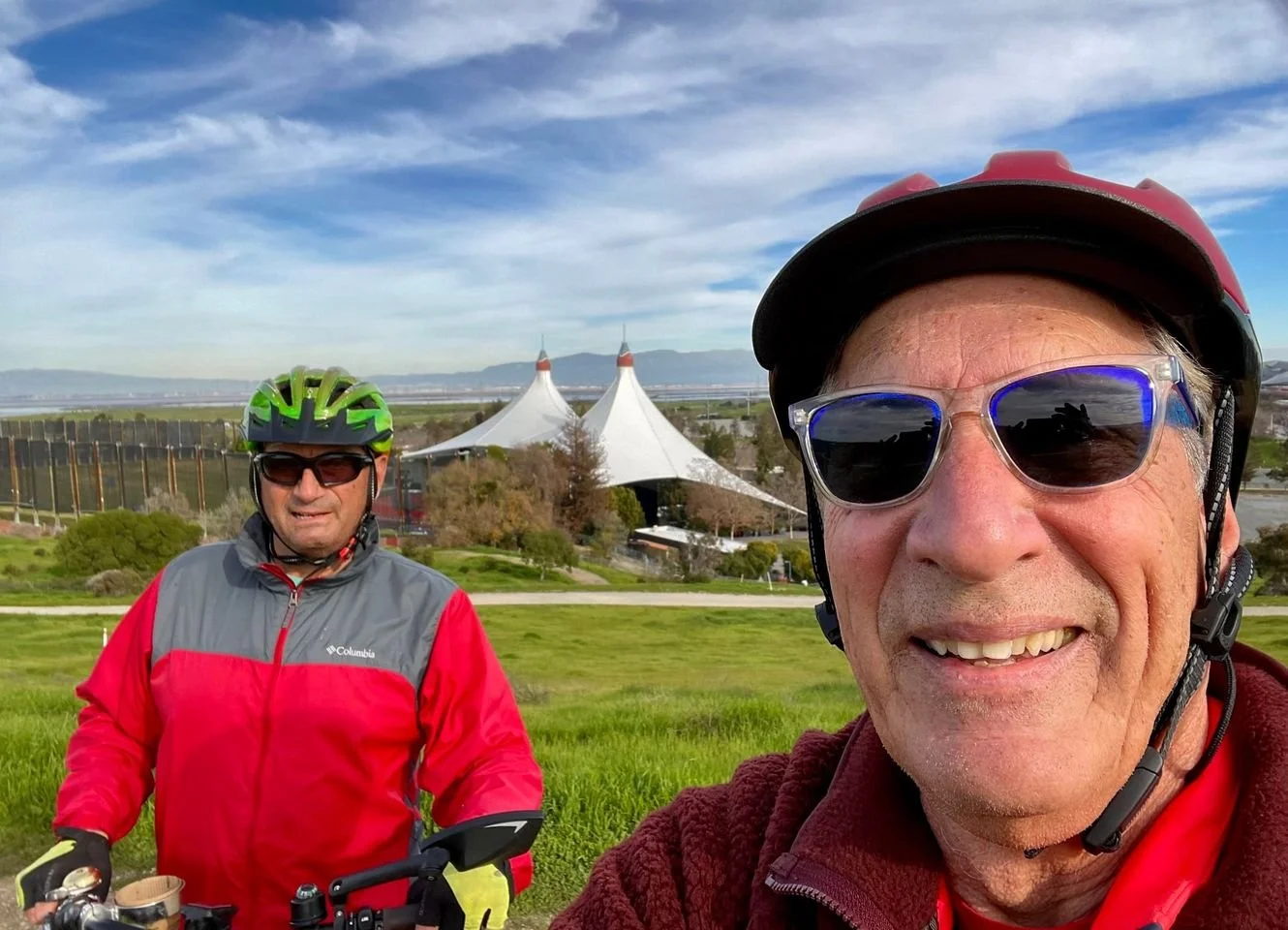
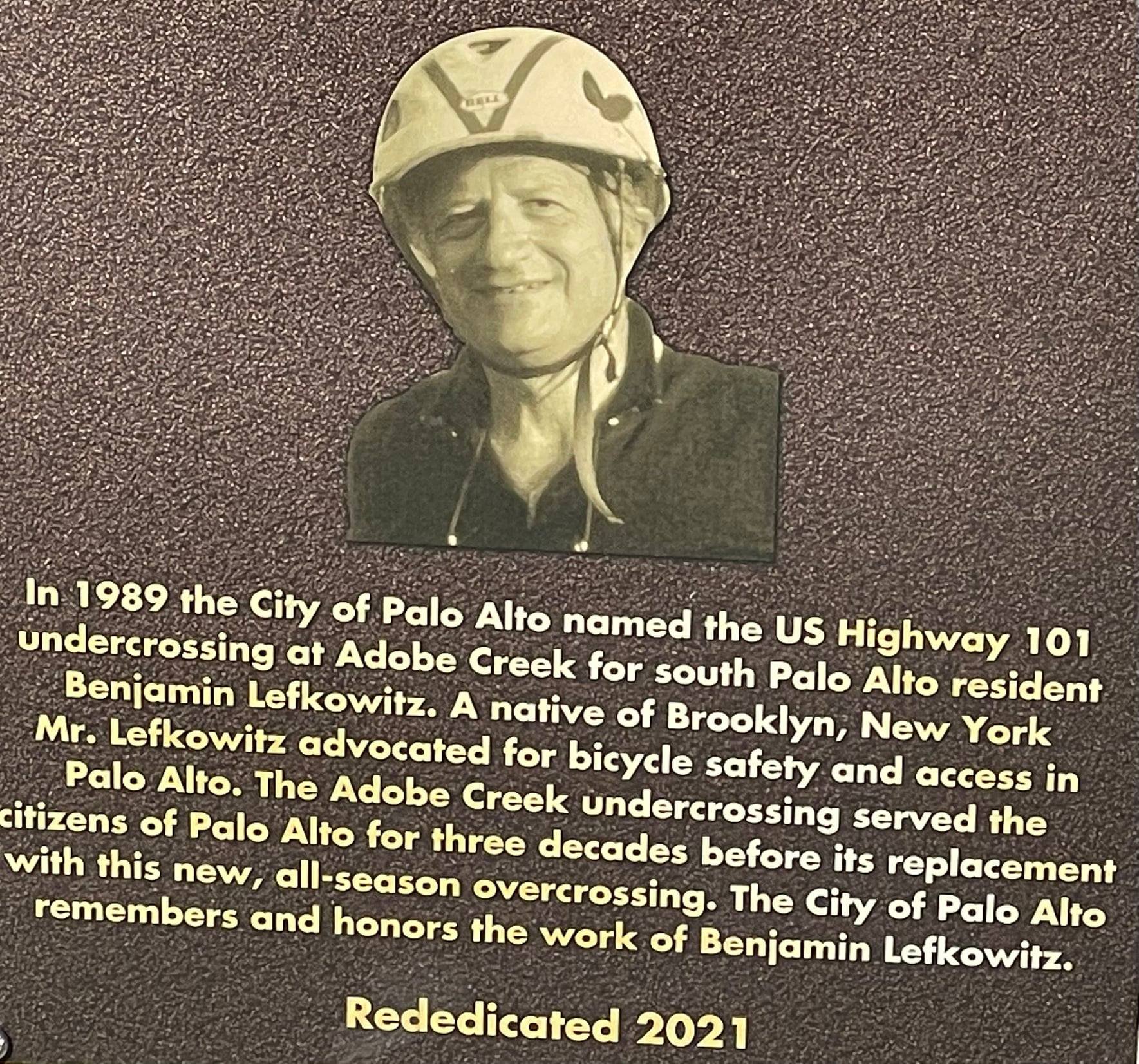
My friend Bill Rothenberg and I rode out to Palo Alto Baylands Nature Preserve, with the intention of riding across the new 1,400 foot long,12-foot-wide bridge that crosses over US Highway 101 that Bill had been reading about. The new pedestrian and bike bridge that cost $23.1 million to build replaces the Benjamin Lefkowitz underpass that was built in 1989, which was only open an average of six months a year due to seasonal flooding. Once called the “Mythical Bridge” because of long bureaucratic delays, the new bridge finally opened in Palo Alto on November 20, 2021. It will provide Palo Alto with year-round access to the Baylands, the Adobe Reach Trail and other outdoor amenities. The new bridge was rededicated to Lefkowitz, a native of Brooklyn, New York who advocated the cause for bicycle safety and access in Palo Alto.

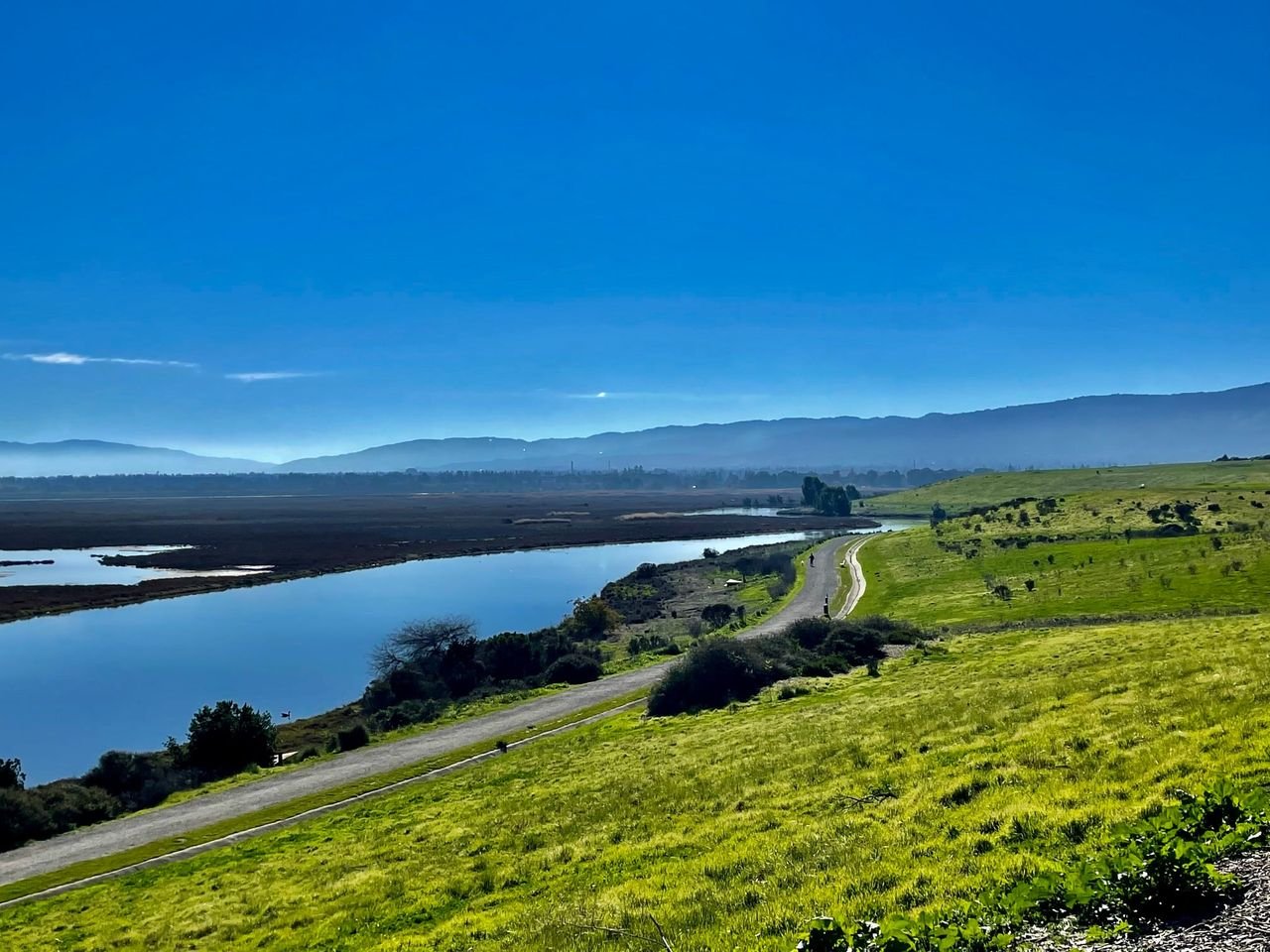
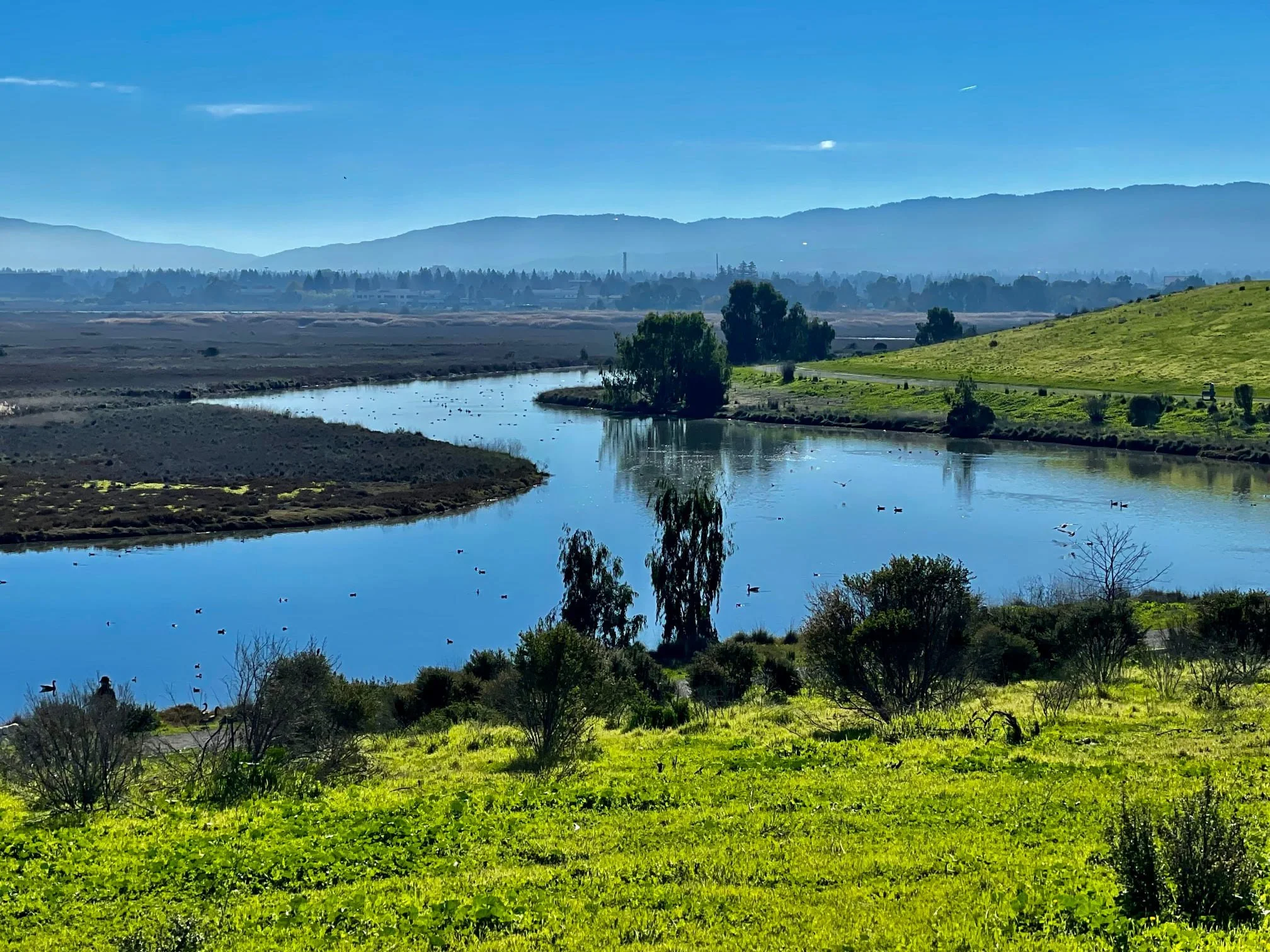
To get to Baylands Nature Preserve, we parked at Shoreline Lake. The Preserve, that begins beyond the perimeter of the lake and near the South Bay is the largest tract of undisturbed marshland remaining in the San Francisco Bay. An amazing fifteen miles of multi-use trails provides mixture of tidal and fresh water habitats. Additionally, the Preserve encompasses 1,940 acres in both Palo Alto and East Palo Alto. It is an important habitat for migratory shorebirds and is considered one of the best birdwatching spots on the West Coast.

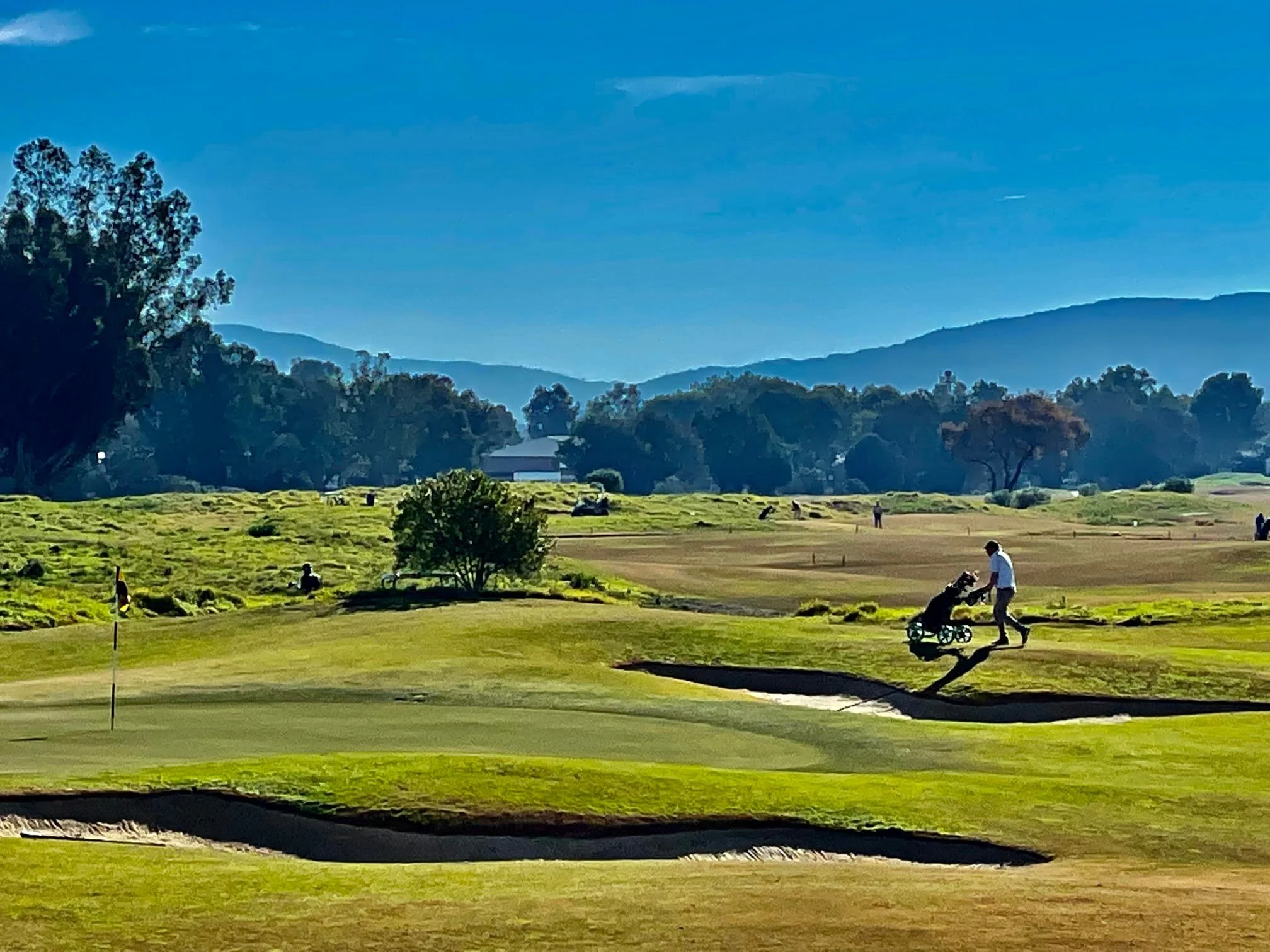
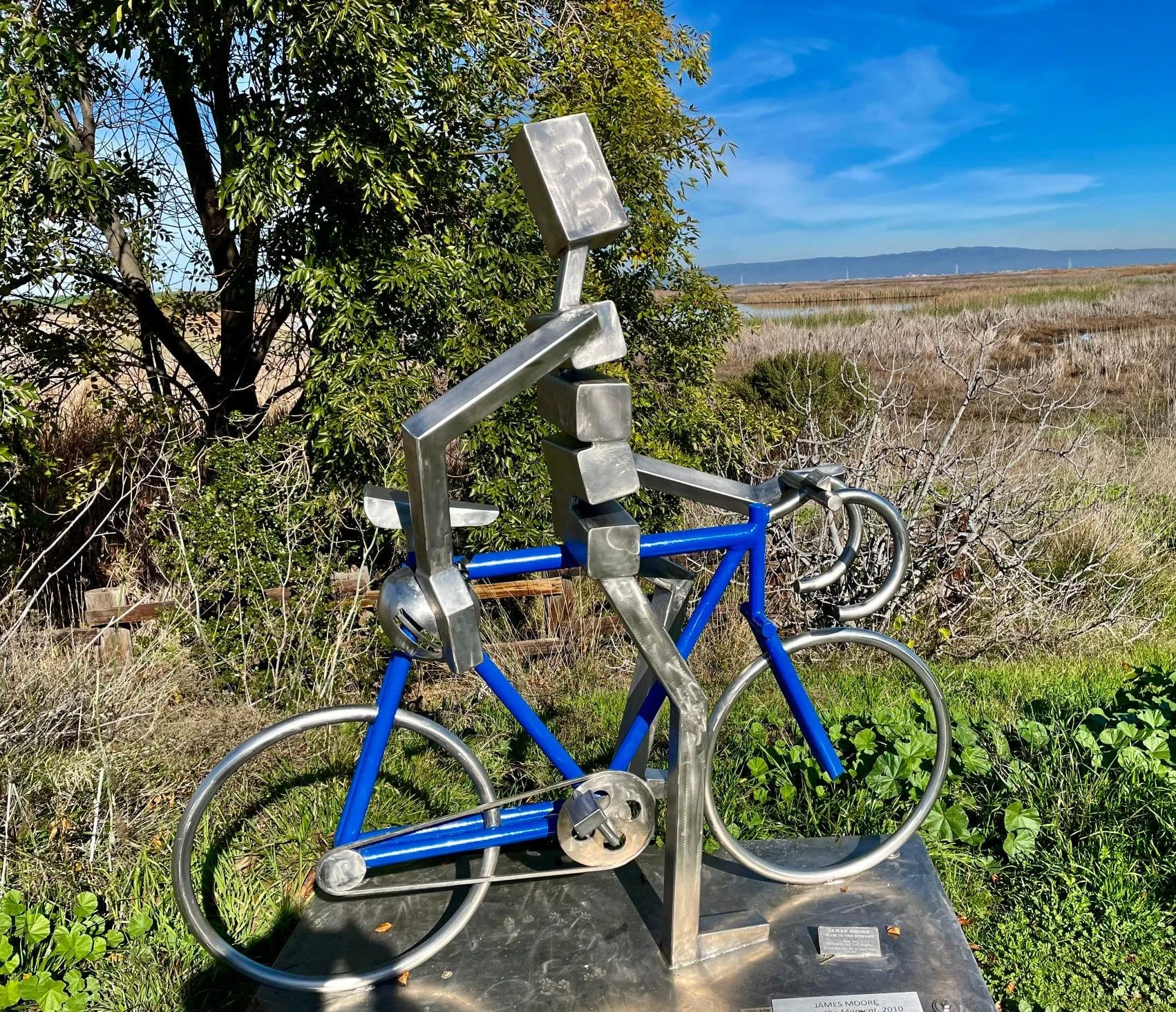
After riding the rutted and bumpy little sand dunes close to the water’s edge, Bill and I circled the commuter Palo Alto airport, watching private pilot owners, the titans of Silicon Valley tech companies, and private equity executive being flying in and out. We also passed a large golf course, and stopped to revisit and pay homage to the abstract bike sculpture by artist James Moore, called “Bliss in the Moment.” This shrine commemorates renowned Bay Area cyclist William Bliss and his work on the San Francisco Bay Trail and bicycle safety issues. Shortly beyond this point we made our way across the new bridge.

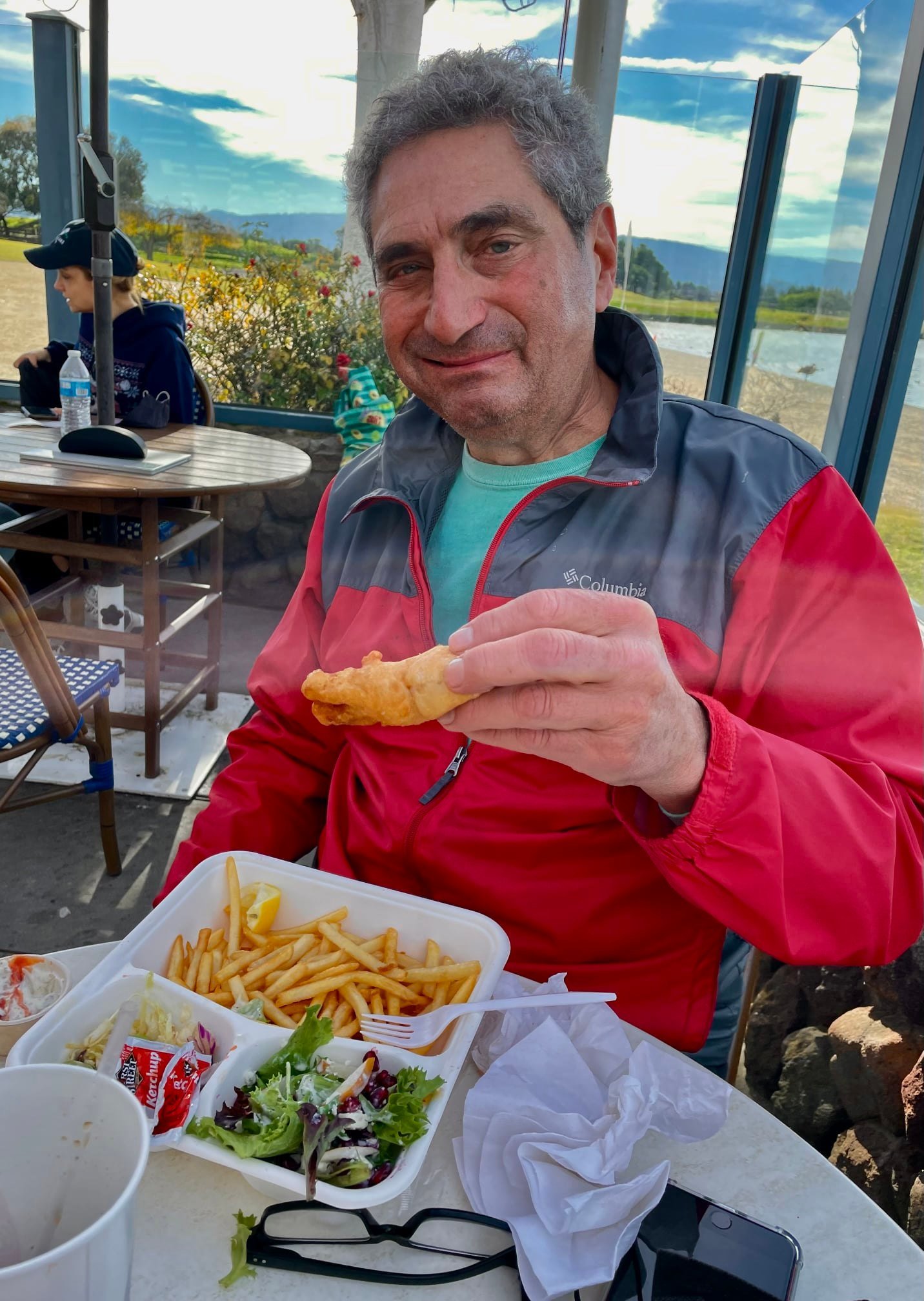
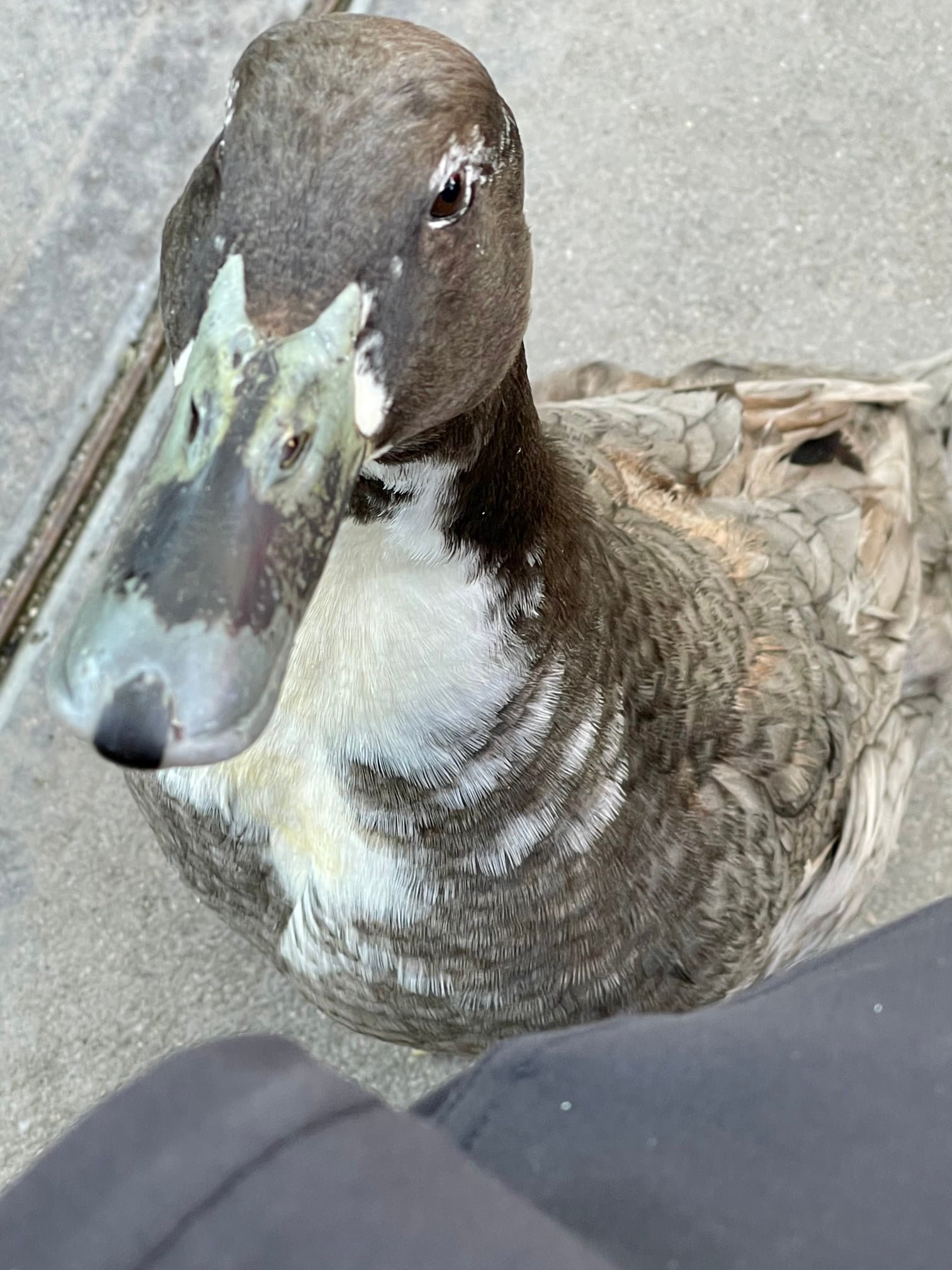
When we completed our ride, we headed back over the new bridge, toward Shoreline's Bistro Cafe. I commented to Bill, that we didn’t see many birds close-up like we usually do. But, many of our bike rides to the Baylands usually brought with it, some unexpected surprise. Suddenly, as if I was granted a wish by the universe, as we approached the boat rental dock, there appeared an amalgamation of birds rarely seen together in this spot (see video clip). There were American coots, shore birds, bright white Egrets lining the shore like sentries at the gate, squawking seagulls, and my favorite, the great white Pelicans. It was nature at its best and our bike ride felt more complete. When we got to the Bistro Cafe right on the lakefront, we placed our bikes to the side, and ordered lunch. Bill had fish and chips and I had a chicken fillet sandwich on sour dough with lettuce, caramelized onions, a feta salad on the side with pomegranate fruit, and taro chips on the side as a pesky, but interesting looking duck began begging for food. I offered a couple of taro chips and it went on to the next busier table.

Afterwards, we were still hungry for more—riding that is, and rode a few miles through the Permanente Creek Trail under pass tunnel and beyond, before returning to Shoreline to upload our bikes on Bill’s SUV for the ride home, feeling fulfilled, and appreciative for a pretty special day and all the city planners and visionaries who made this possible.

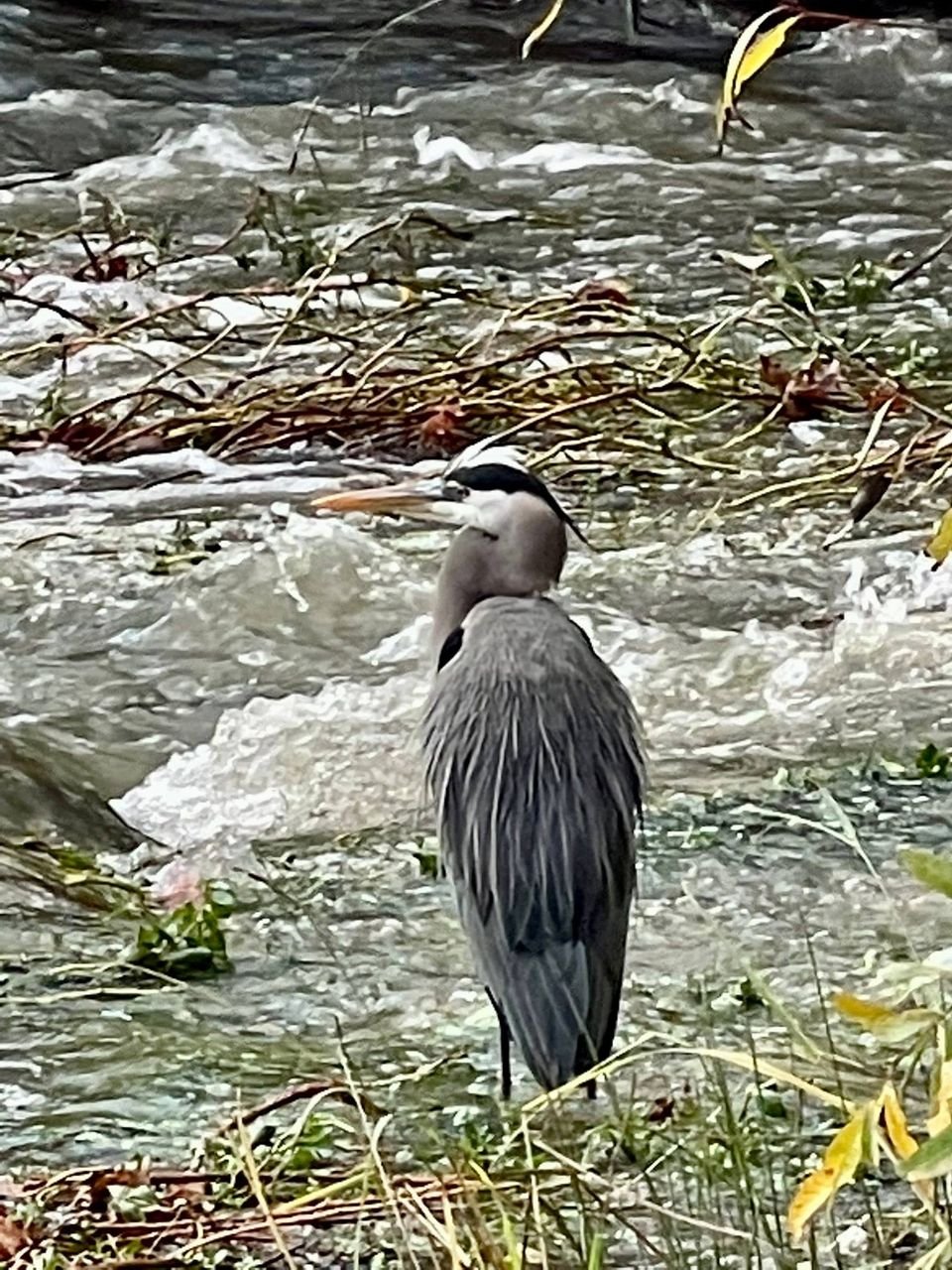
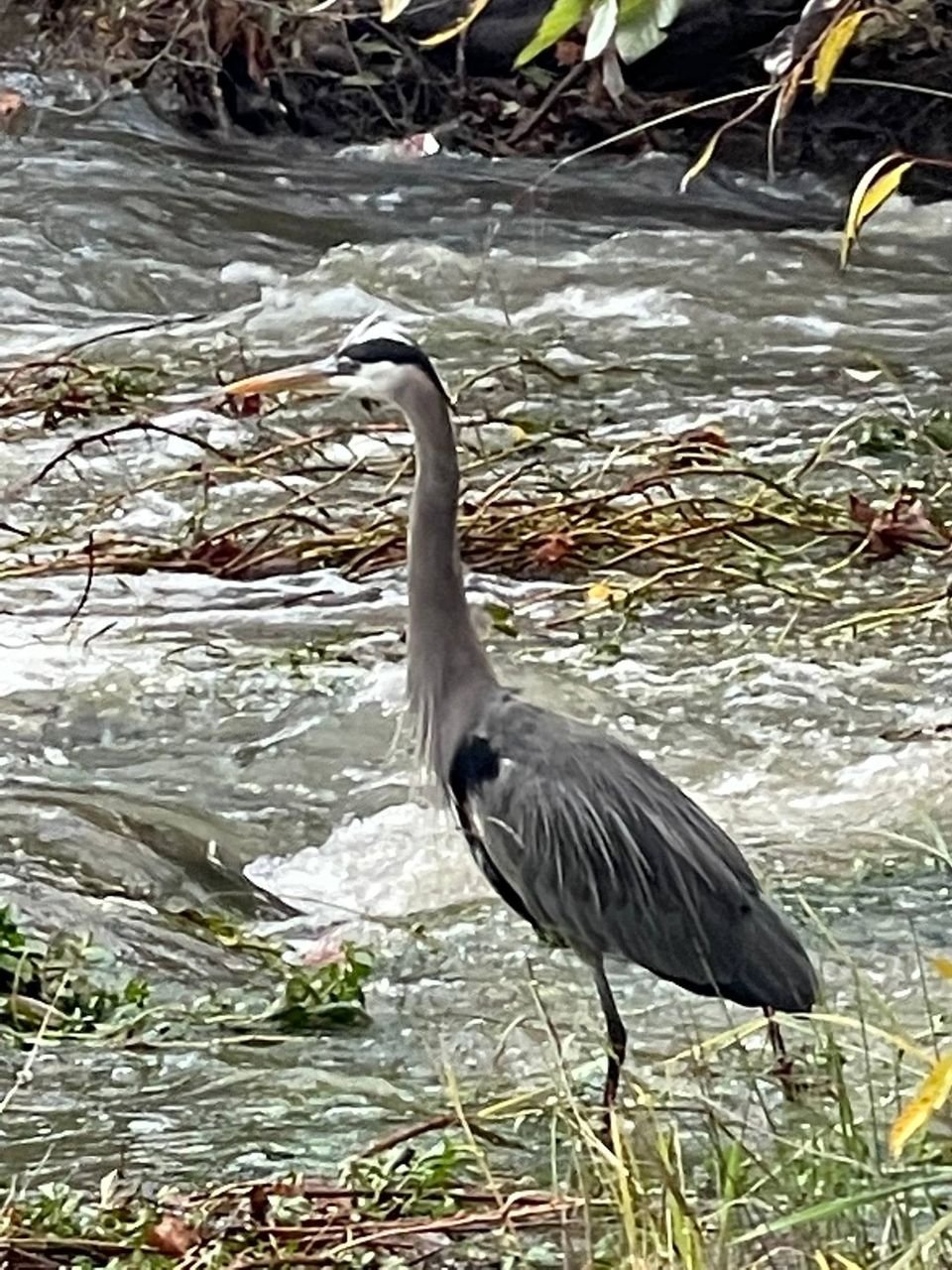
Video Clip of my Up Close Encounter with an Elegant Great Blue Heron in the Creek

It was cold outside (46 degrees) by Northern California standards an I was debating weather to take a late afternoon bike

ride. I had just lost my best childhood friend and wanted to be in nature. Even the wine colored Patagonia Fleece Jacket my son

bought me for Christmas didn’t cut the feeling of what seemed like cold Arctic air. Then I felt a drizzle. At this point I wasn’t totally committed to continuing the ride and I was prepared to cut it short. The drizzle ceased and I made my way to the Los Gatos Creek trails just past the spillway of Vasona Lake Reservoir.

Everything was green and the creek beds were flowing like a rapid river. I stopped to check out the flow and as I turned around I spotted a stunning Great blue heron wadding in the water amongst the reed and rocks. I took a few photos from a distance and decided to make my way down the ravine to get closer. I was being careful not to scare it off because they cans be skittish. But, with the sound of the rushing water it didn’t hear me.

Or, maybe it did hear me since it began to move on its’ long stilted legs. I decided to take a short video to record its’ movement and the sound of the roaring water rushing into the creek from the spillway. It was so calm and elegant. When it got to a small boulder, I saw it quickly move its head and yellow beak down beneath the water and pierce a silvery gray small fish. If I blinked I woulld have missed it. It had been stalking its’ prey. Persistence paid off for heron and me. Instead of riding 5 miles, I did ten. I didn’t feel cold any more. For the heron it was his evening meal. It felt like a moment of grace and observing the natural order of things.

What I learned from the Great Blue Heron:

Wade into life

Keep a keen lookout

Don’t be afraid to get your feet wet

Be mindfully patient

Look below the surface

Enjoy a good reed

Go fish

Video Block
Double-click here to add a video by URL or embed code. Learn more

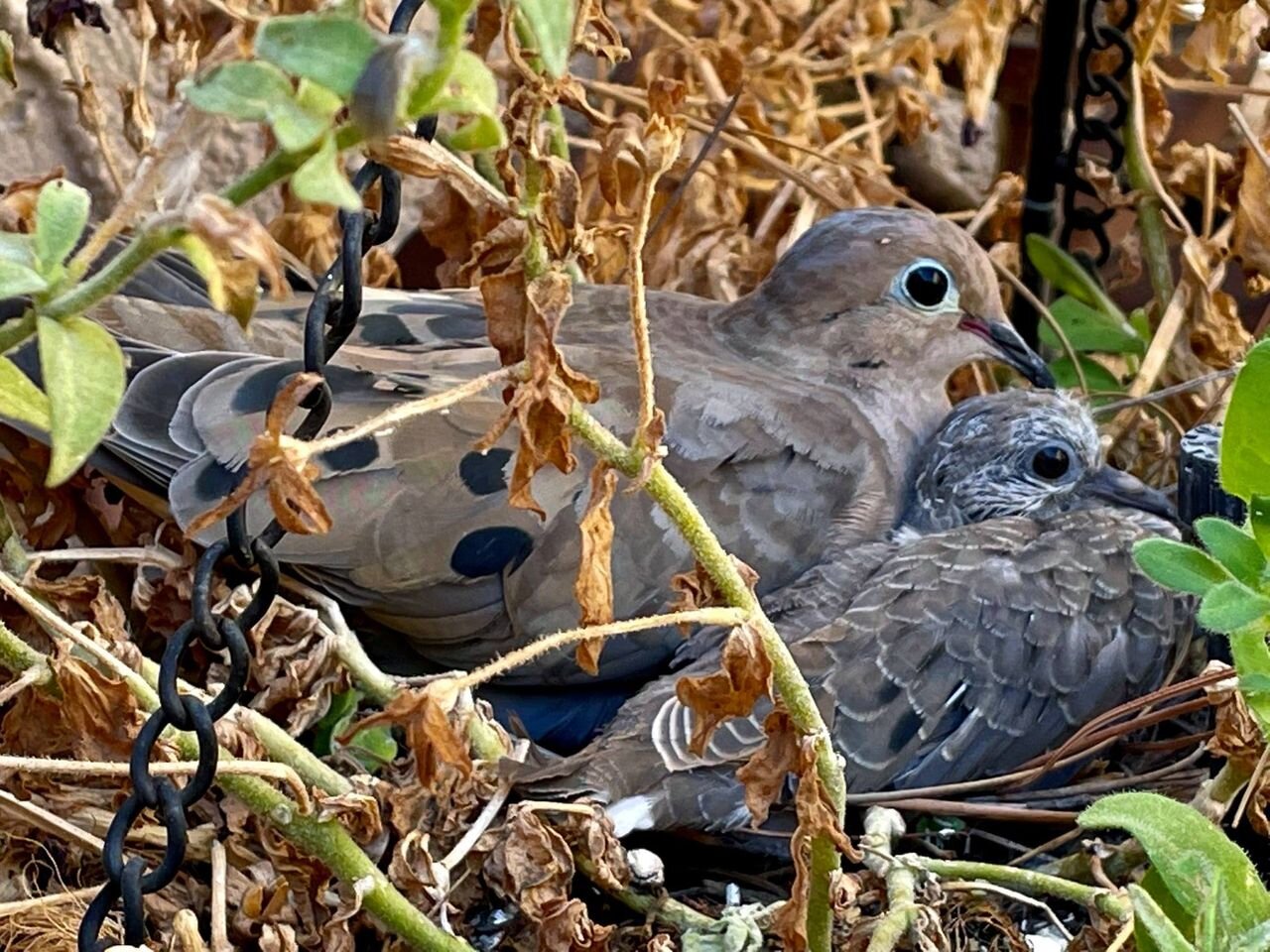
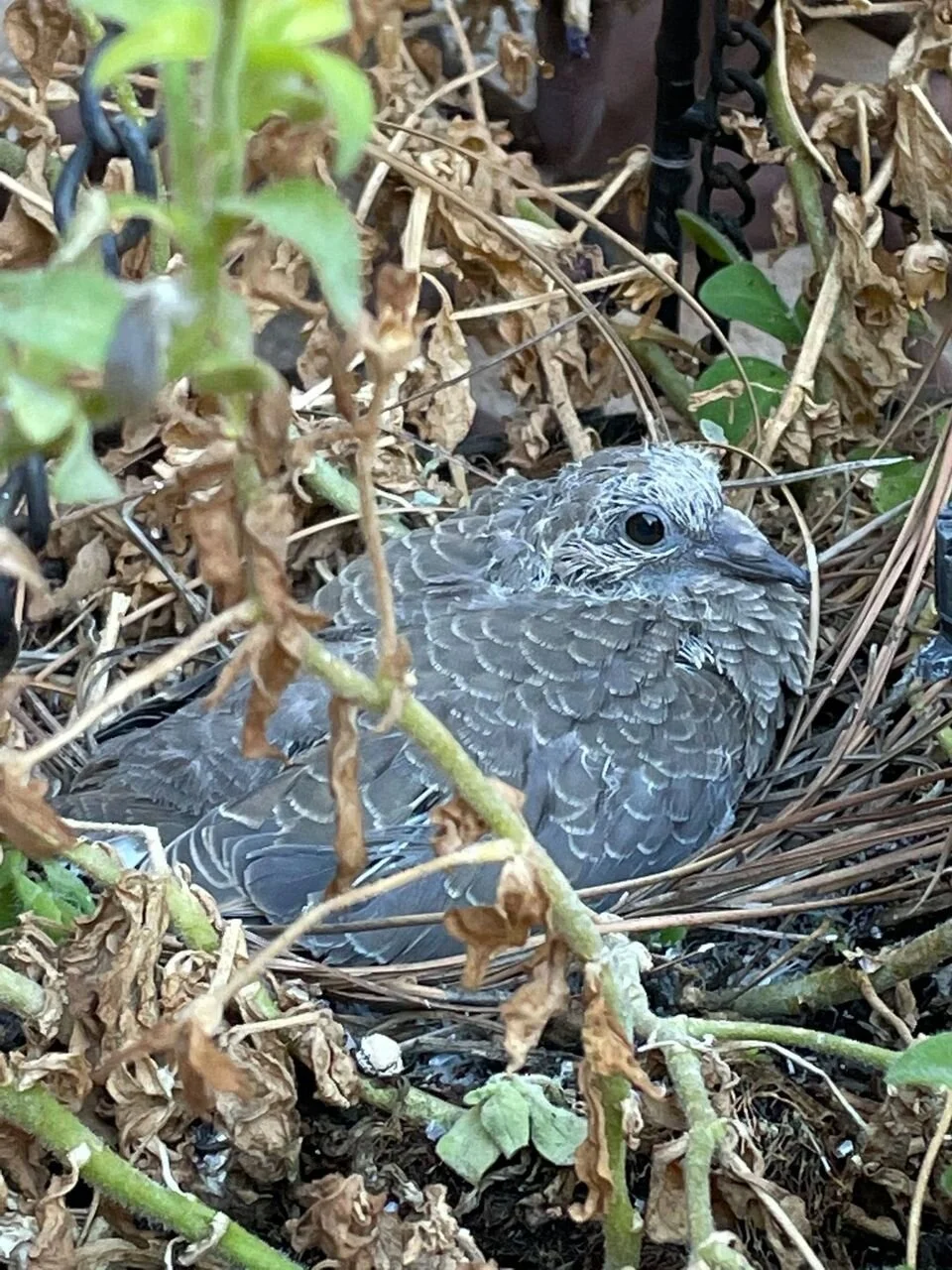
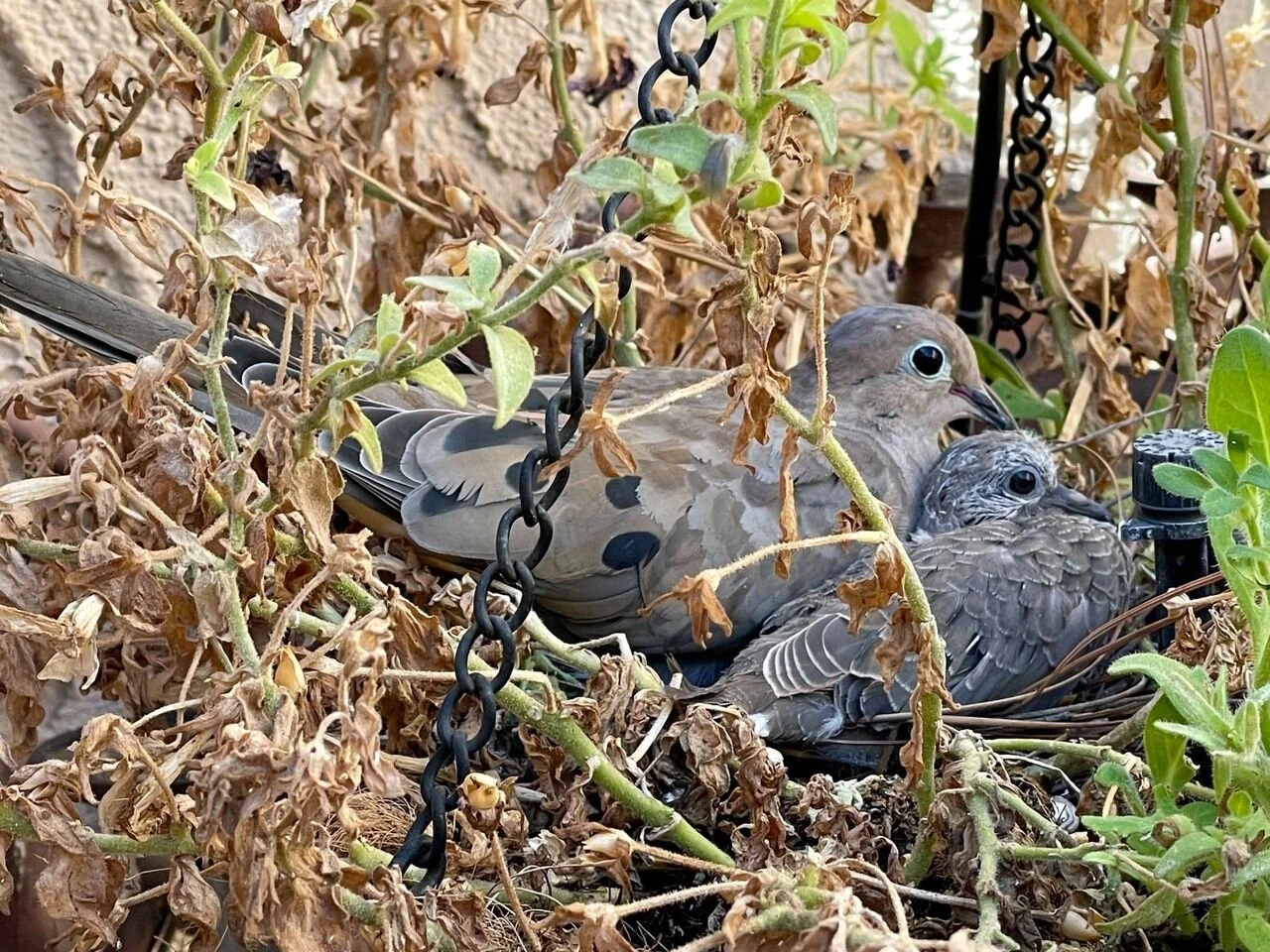
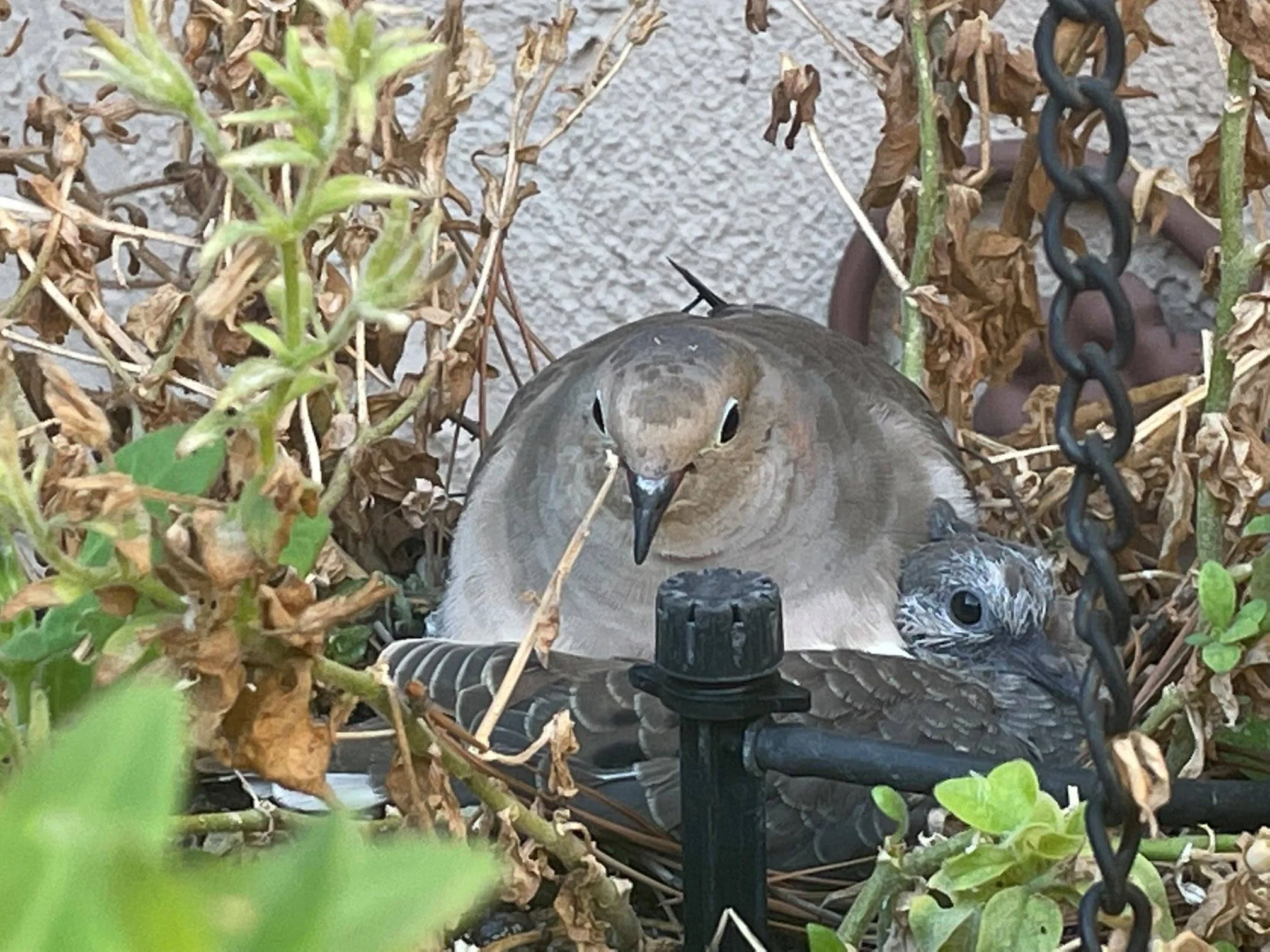
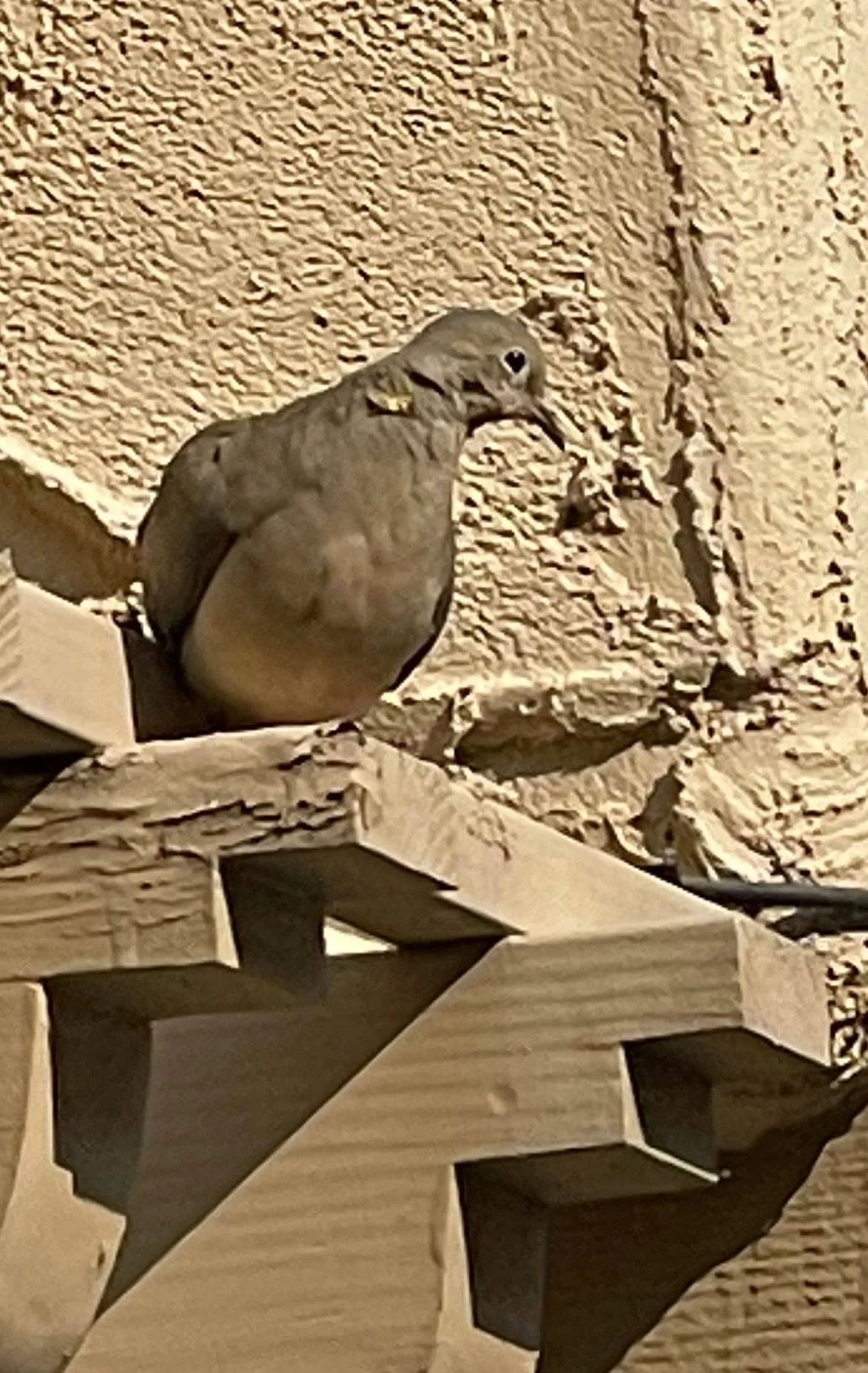
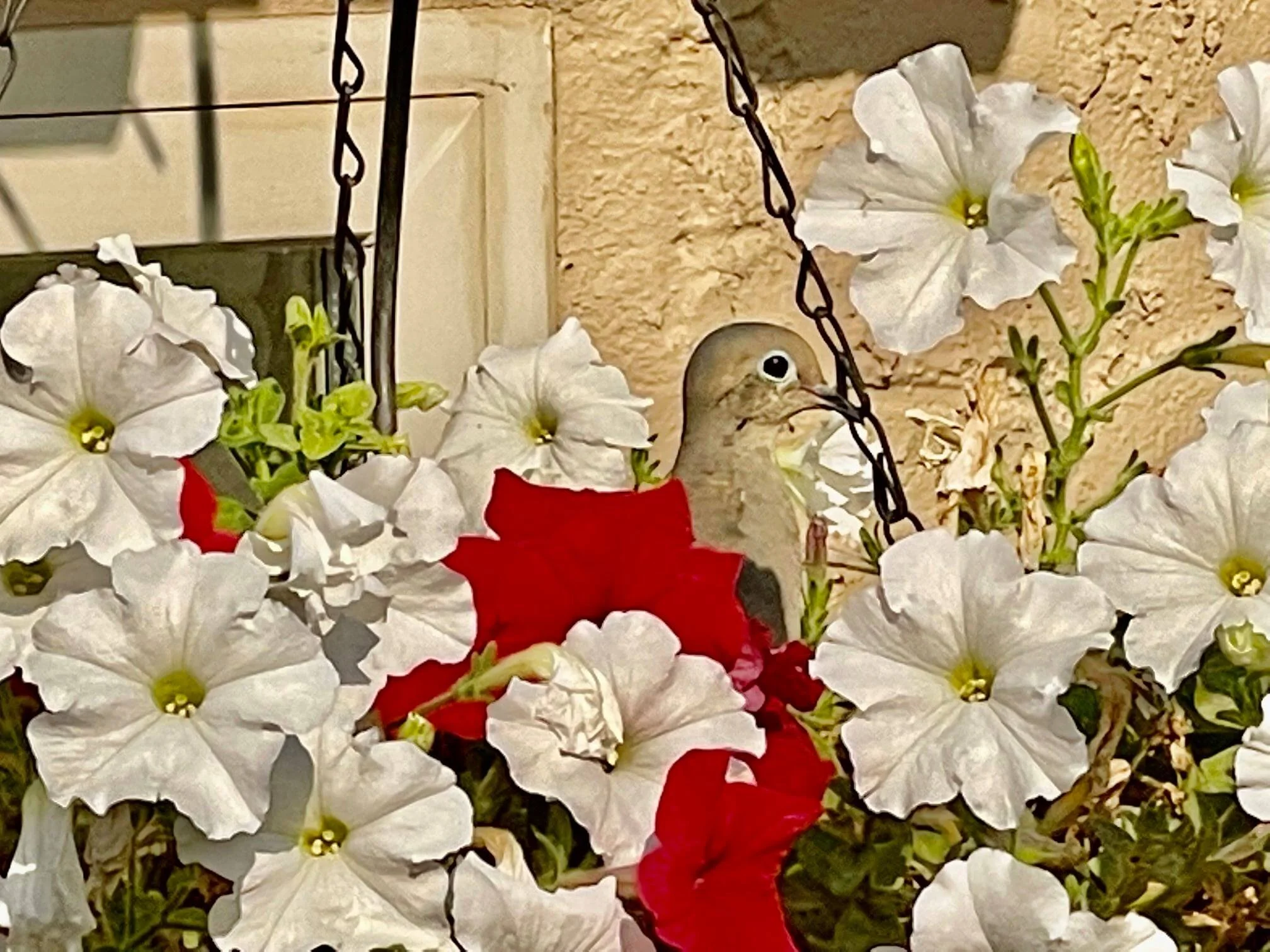
Mourning Doves Give Birth and Take Refuge in our Open-Aired Atrium

within reach they sit, yet forever beyond my grasp. I’m filled with a quiet happiness when I see them. I am comforted when they sing to me.”

—Mary Oliver

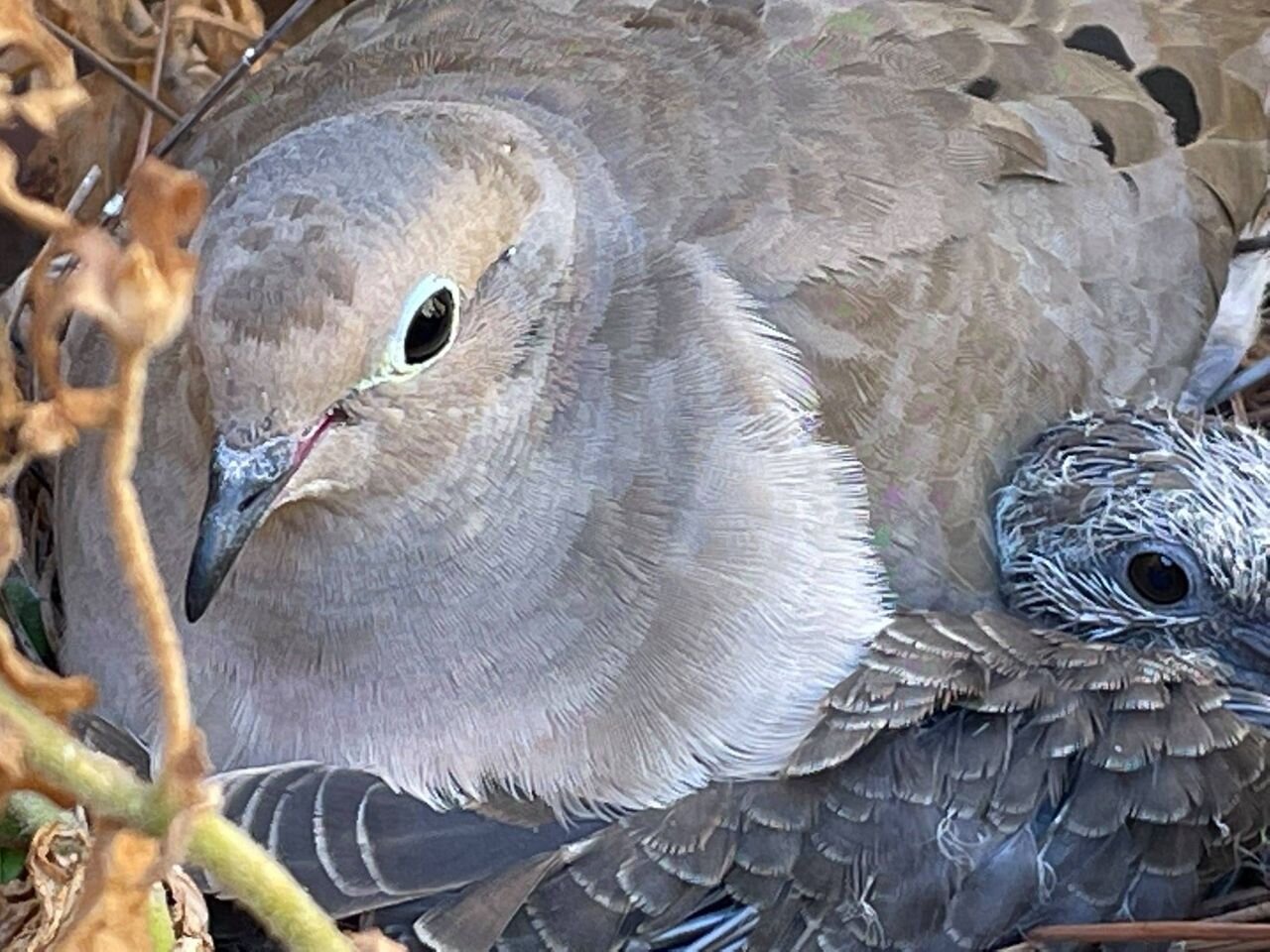
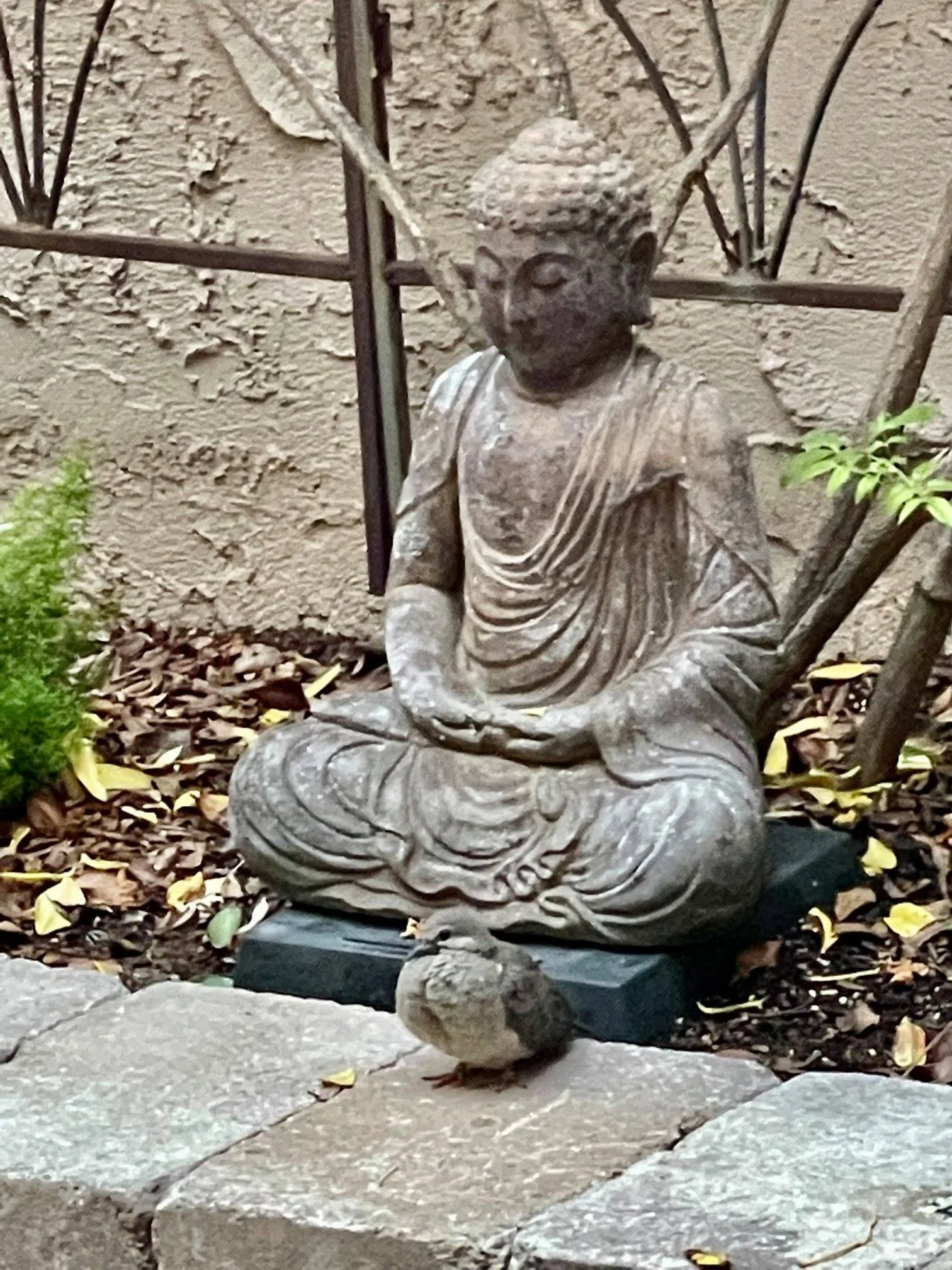
The last time I saw the baby dove, at this point a fledgling ready to spread its’ wings, it was sitting calmly taking refuge in front of the buddha statue in our garden (photo), and in the blink of an eye it was gone, but not forgotten.

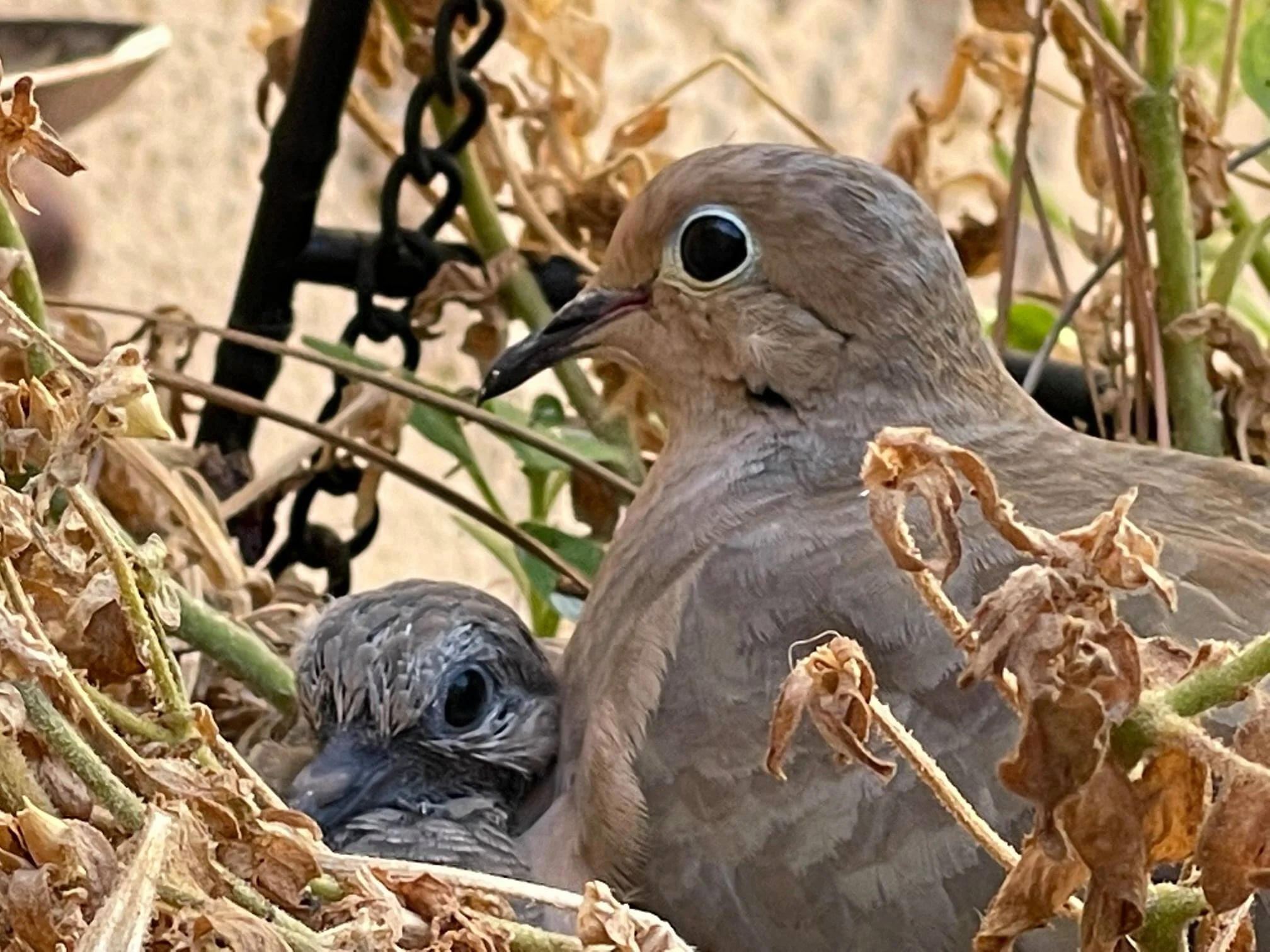
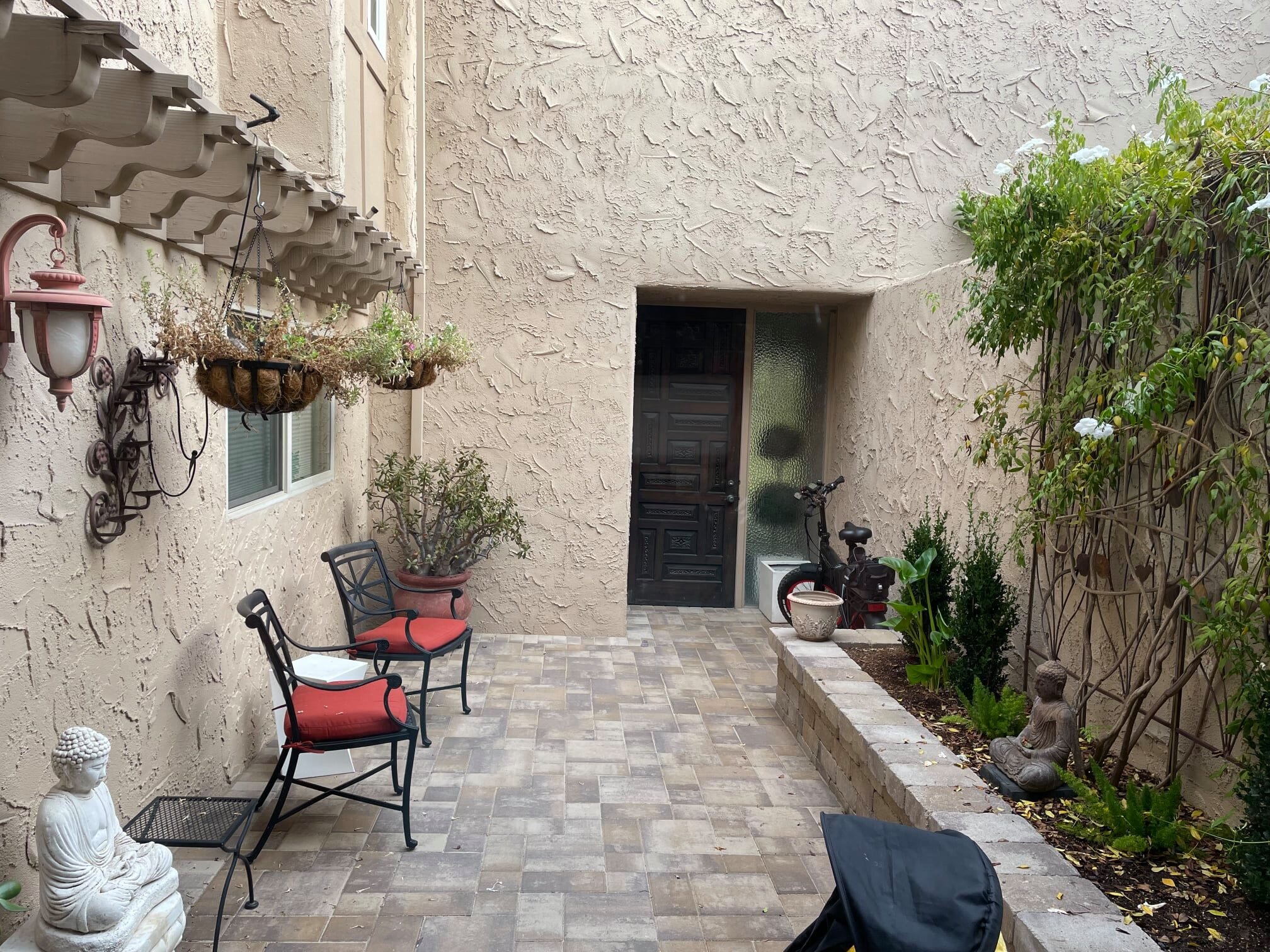
Many cultures see doves as a sign of love, hope, peace, grace, gentleness and purity.This is the second year in a row that mourning doves built a cozy little nest in the same hanging flower planter in ouropen air atrium in our front patio recently remodeled with Tuscan style pavers and stone planter box.Mourning doves begin building nests early in the spring season and continue as late as October. This one was born around September 11. I’ve learned that doves who have raised a brood will return to that same nesting site year after year and that the nesting parents don’t range far from the nest. Both the male and female dove cooperate in nest-building and brooding. Their flimsy or should I say dense delicate nests are made of pine needles, twigs and grass. Mourning doves have three broods in a single year, each one in a new nest. The female lays two eggs—one in the morning and one at night. The father sits on the nest during the day and the mother takes the night shift. They hatch in 14-16 days, and the babies fledge in another two weeks. However, the parents continue to provide care if needed for another week or two. The baby as seen here is laying under its’ mother’s wing. Cecile and I often witnessed their presence from our kitchen window that looks out to our atrium. I often used a small step stool to quietly monitor their progress.

The mother dove didn’t flinch, but her and her baby looked so vulnerable.When I took serial photos over time with my iPhone she did blink her eyes at the soft sound of the click. New research suggests that some birds may know who their human friends are, as they are able to recognize people’s faces and differentiate between voices. Being able to distinguish between friend or foe could be the key to the doves ability to survive. Cecile and I like to think we were trusted friends who had their best interest at heart.

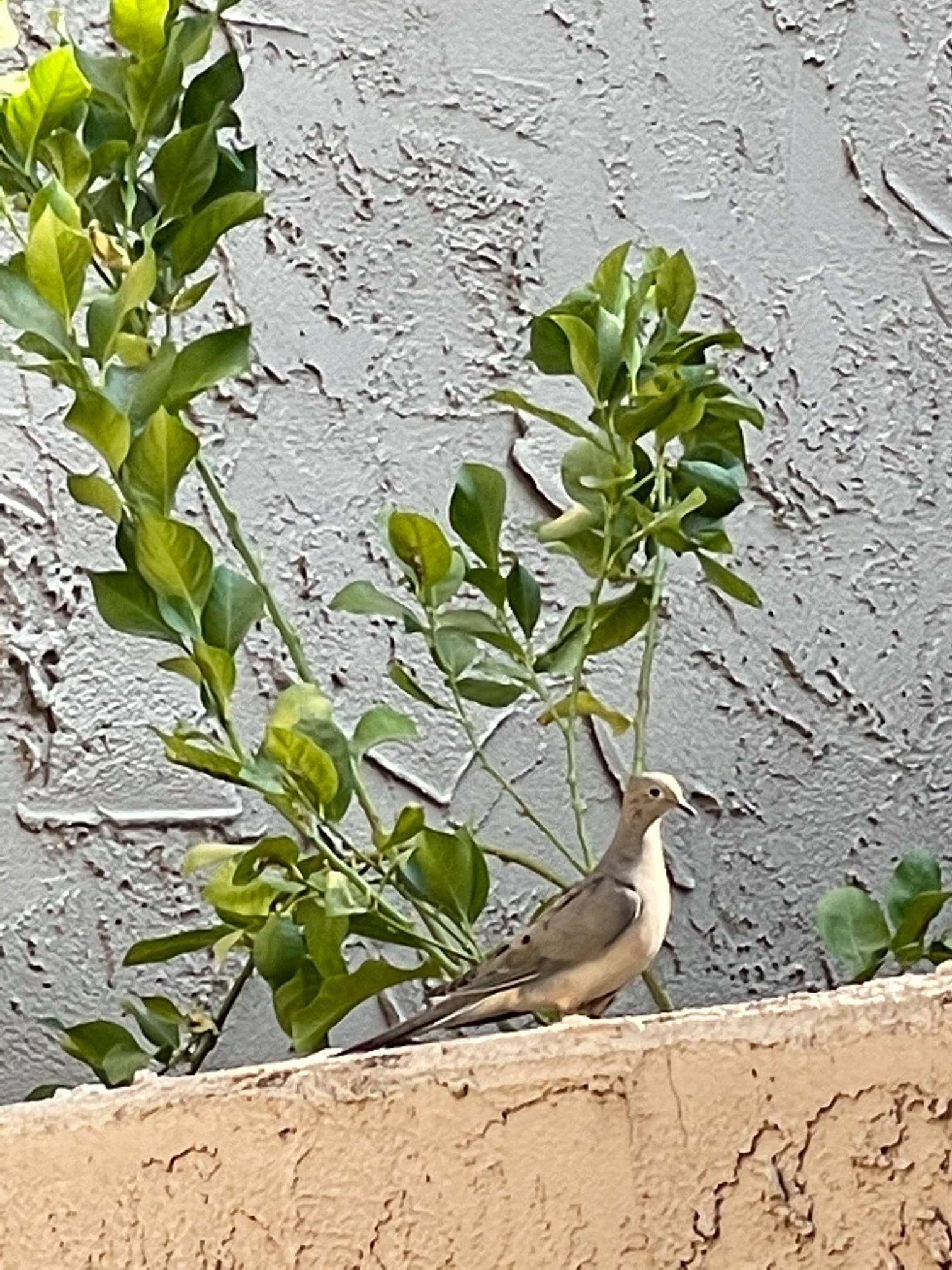
Postscript: The low-pitched, owl-like cooing sound frequently heard in early March give the mourning dove its name. The sound is referred to as an “advertising coo” or “perch coo.” Cooing males advertise their presence and readiness to breed. Their single-minded purpose is to attract a female. Unlike last year, the nest only had one egg instead of two leaving us wonder if one egg wasn’t viable or was raided by a predator. It is true that doves do mate for life, but the life span is very short, lasting several years.

Exploring Organic Gardens and Visiting Enchanting Farm Animals at Hidden Villa with our Granddaughter Lyla

“Study nature, love nature, stay close to nature. It will never fail you.”

—Frank Lloyd Wright

“It was a really nice day, a really nice outing.”

—Lyla (after our picnic lunch)

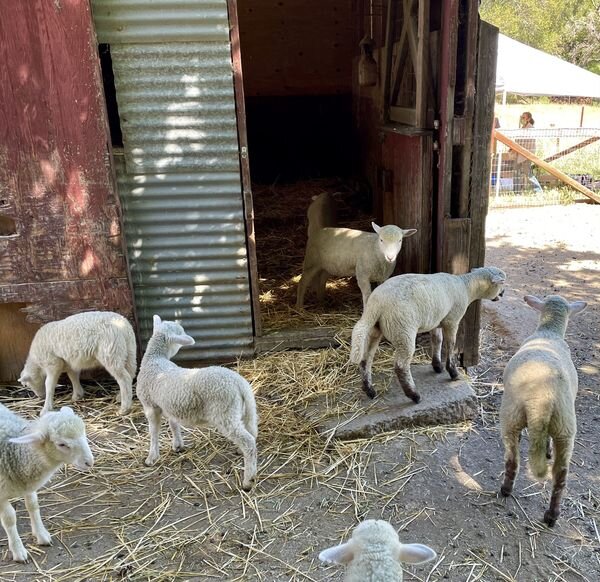
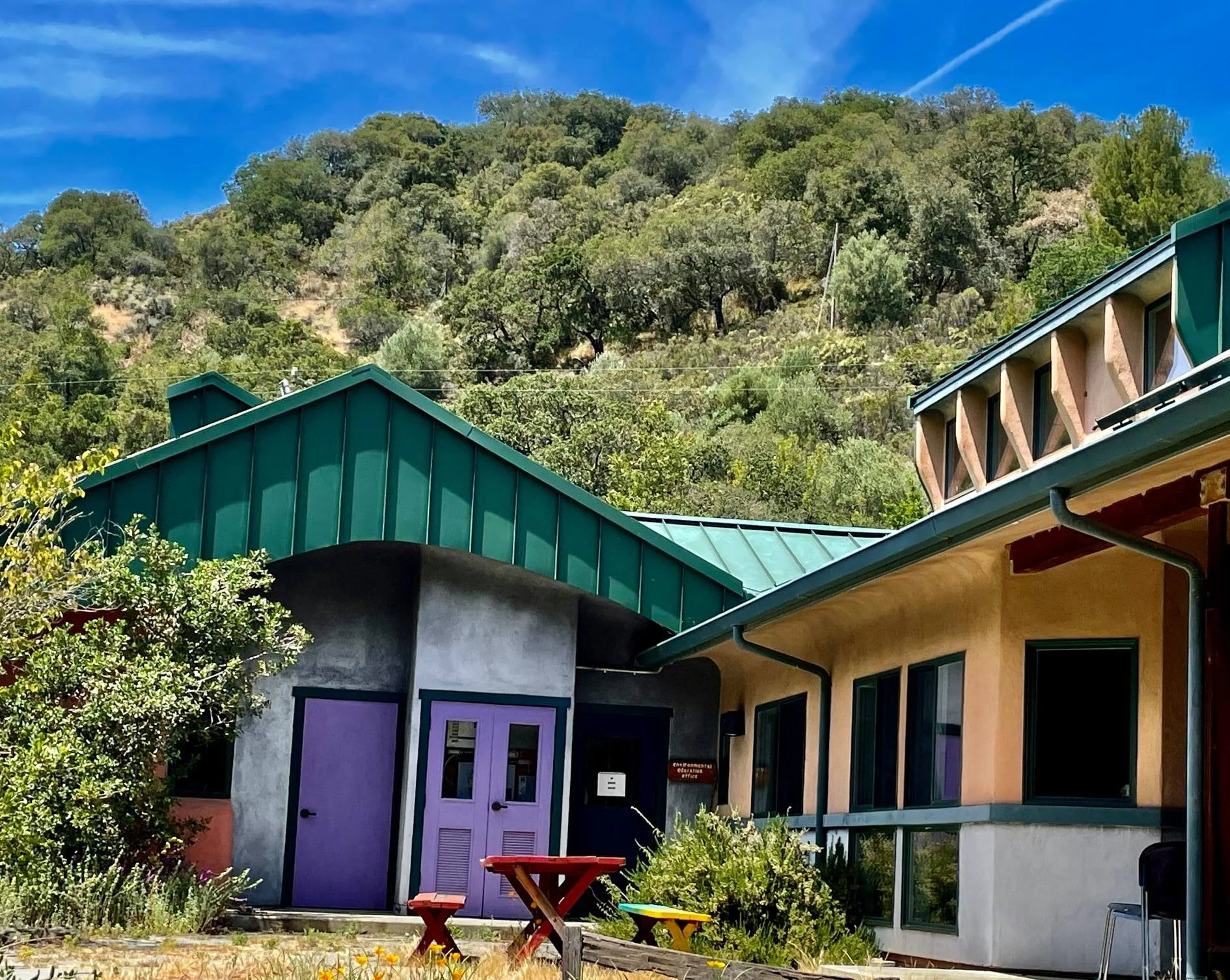
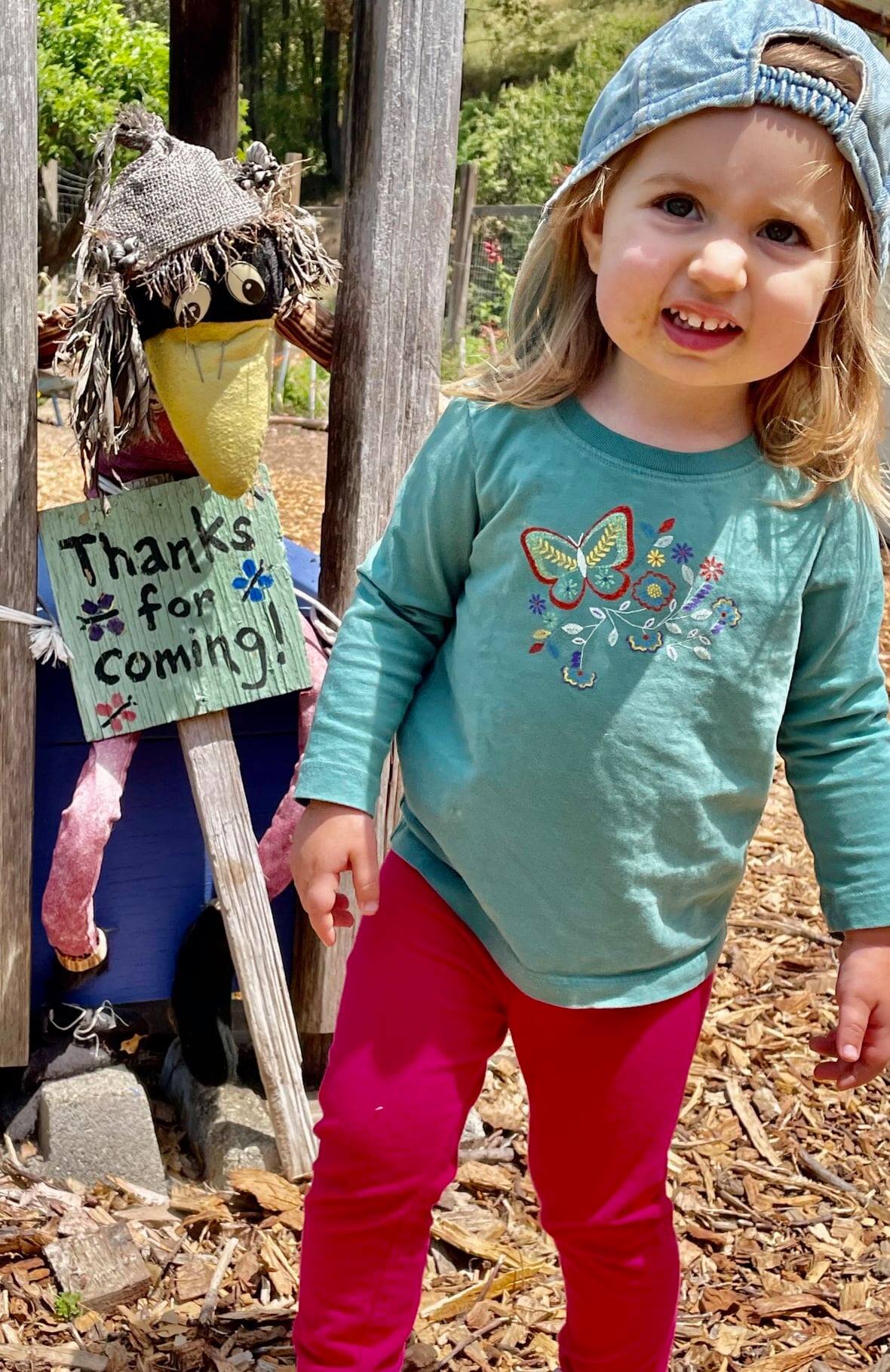
Cecile and I took our granddaughter Lyla to Hidden Villa, a farm and wilderness preserve in Los Altos, to explore an organic farm, gardens and greet the

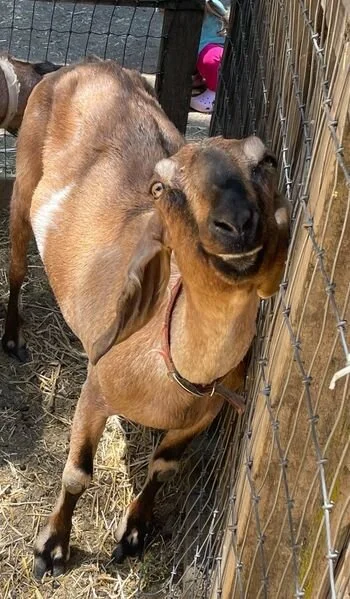
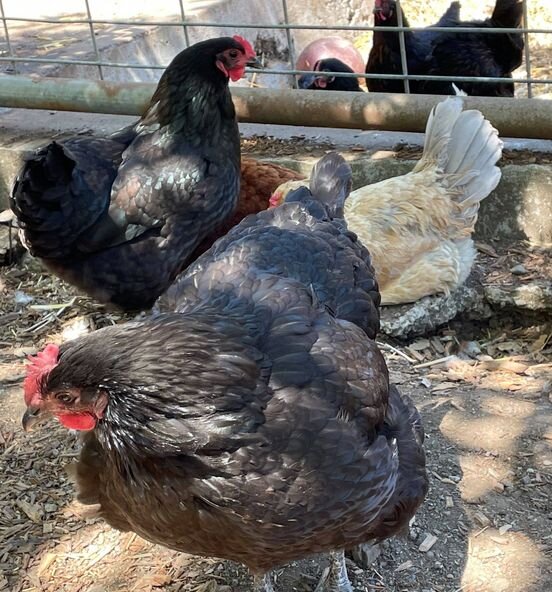
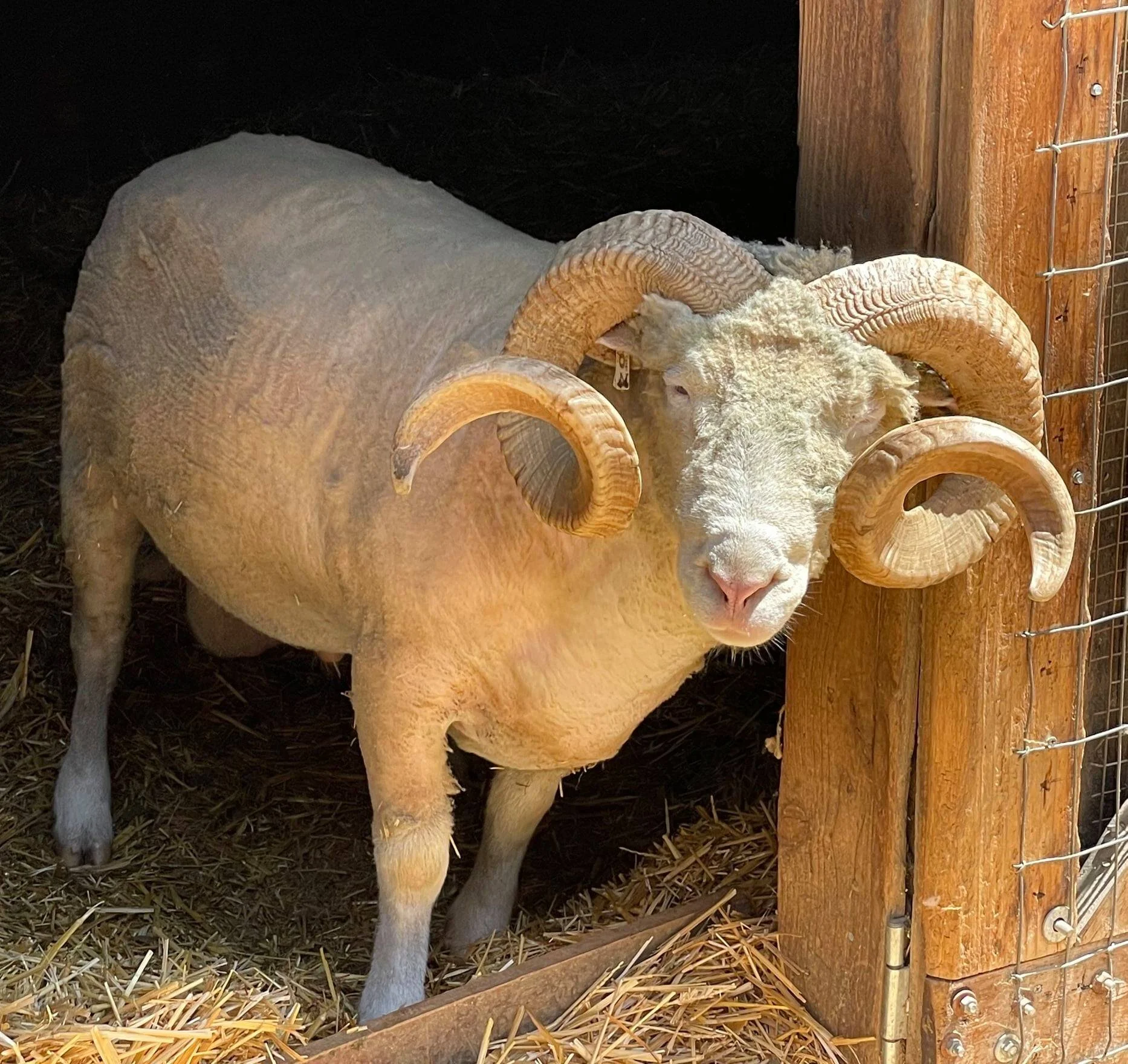
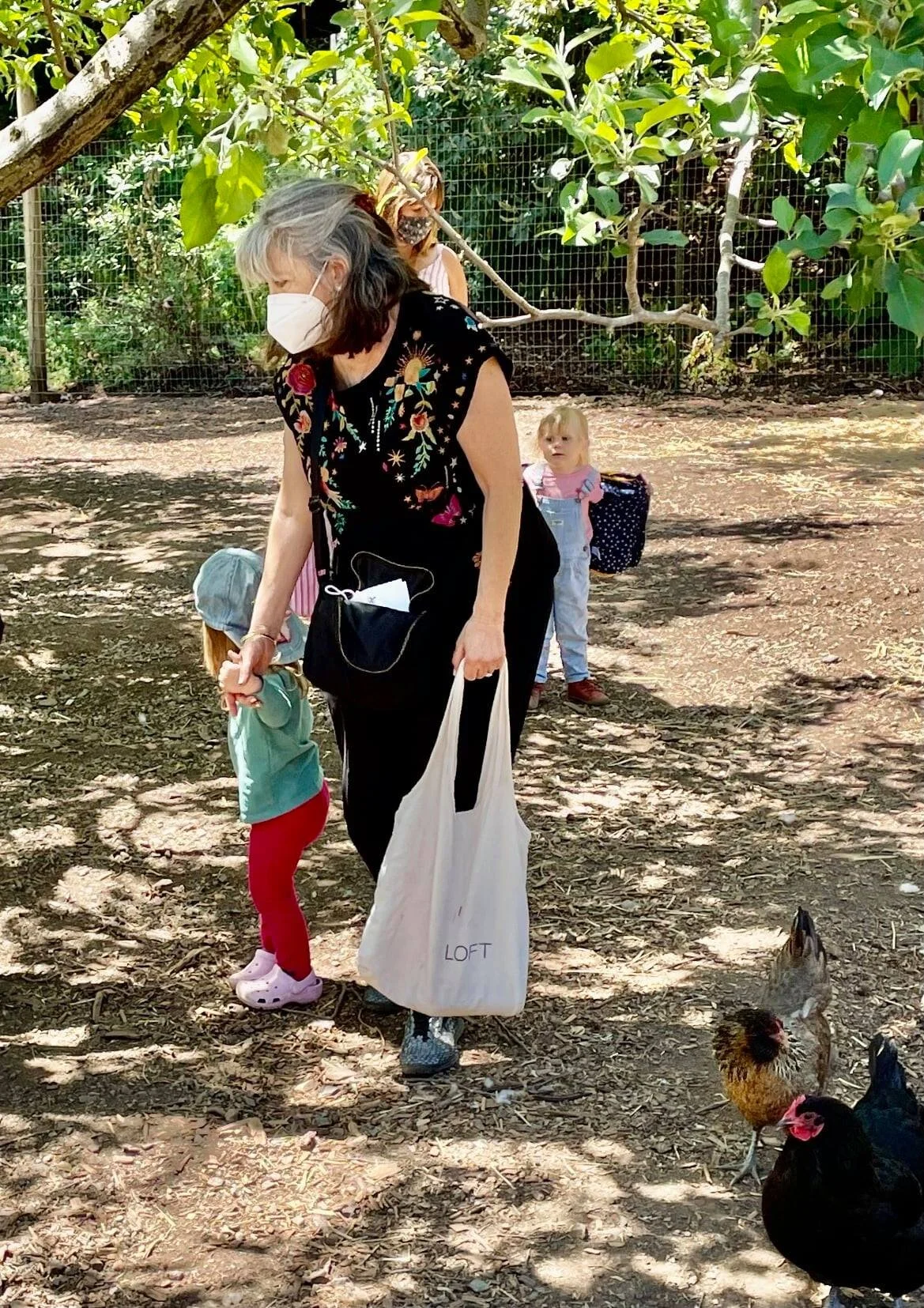
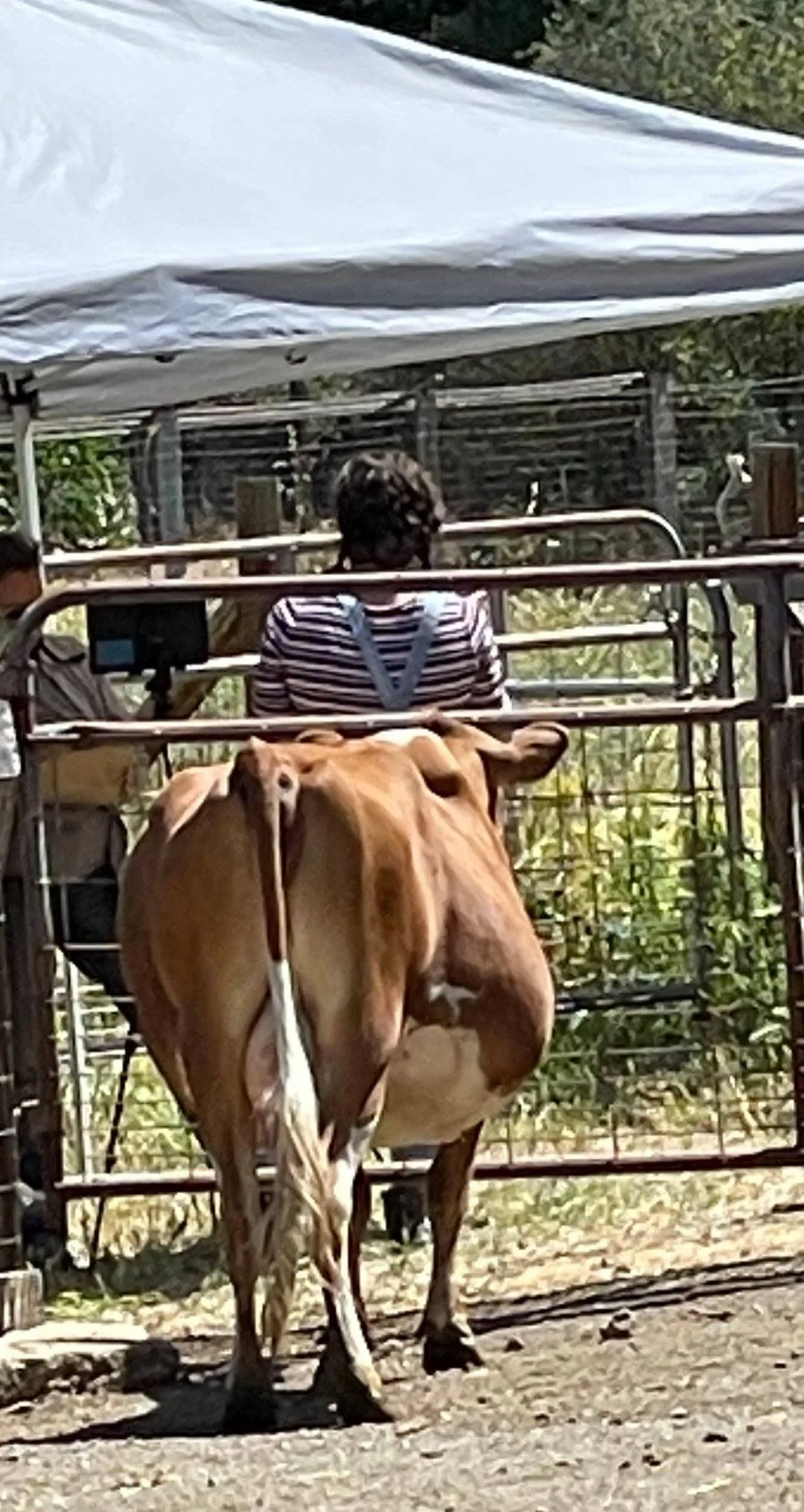
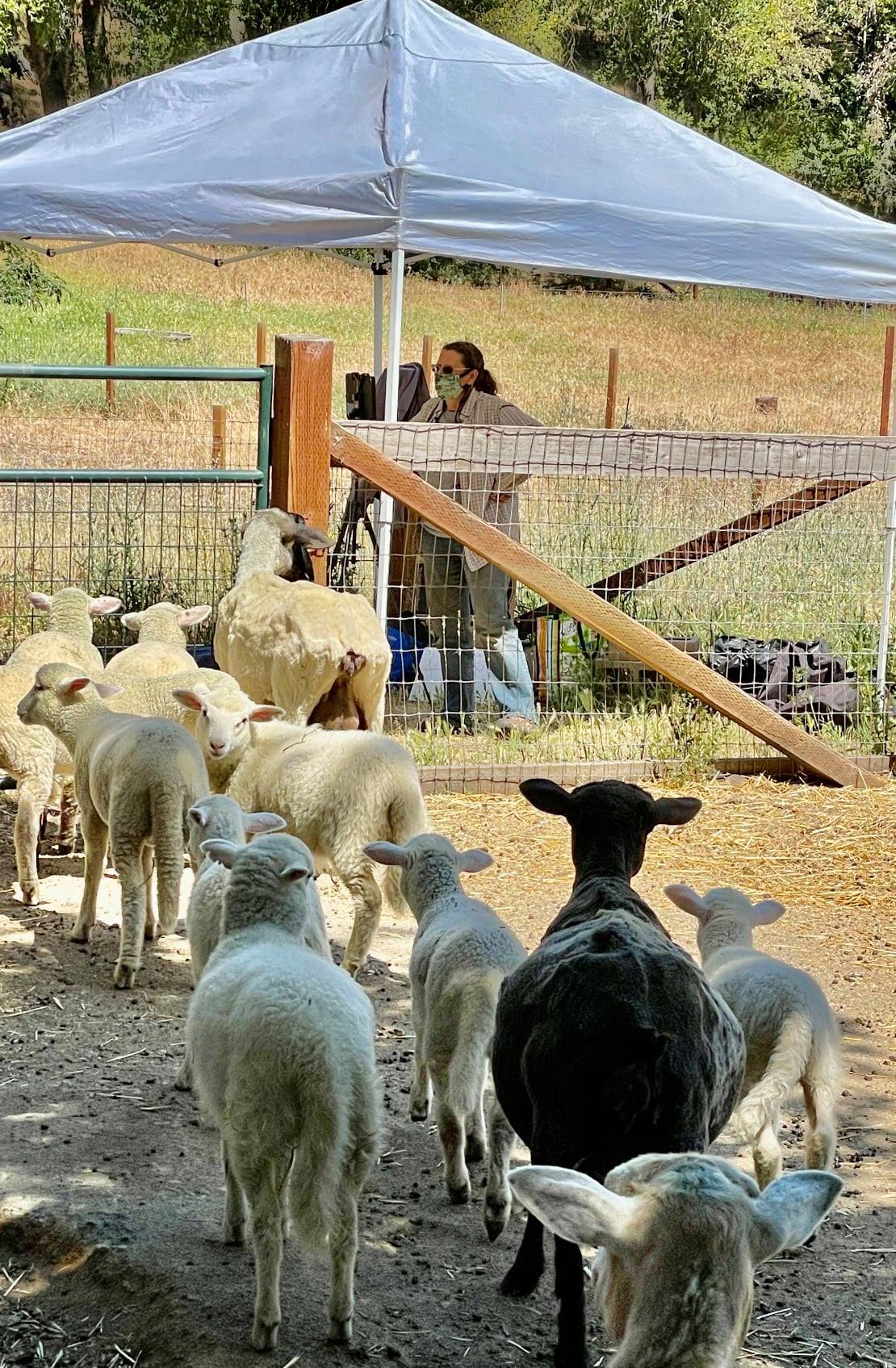
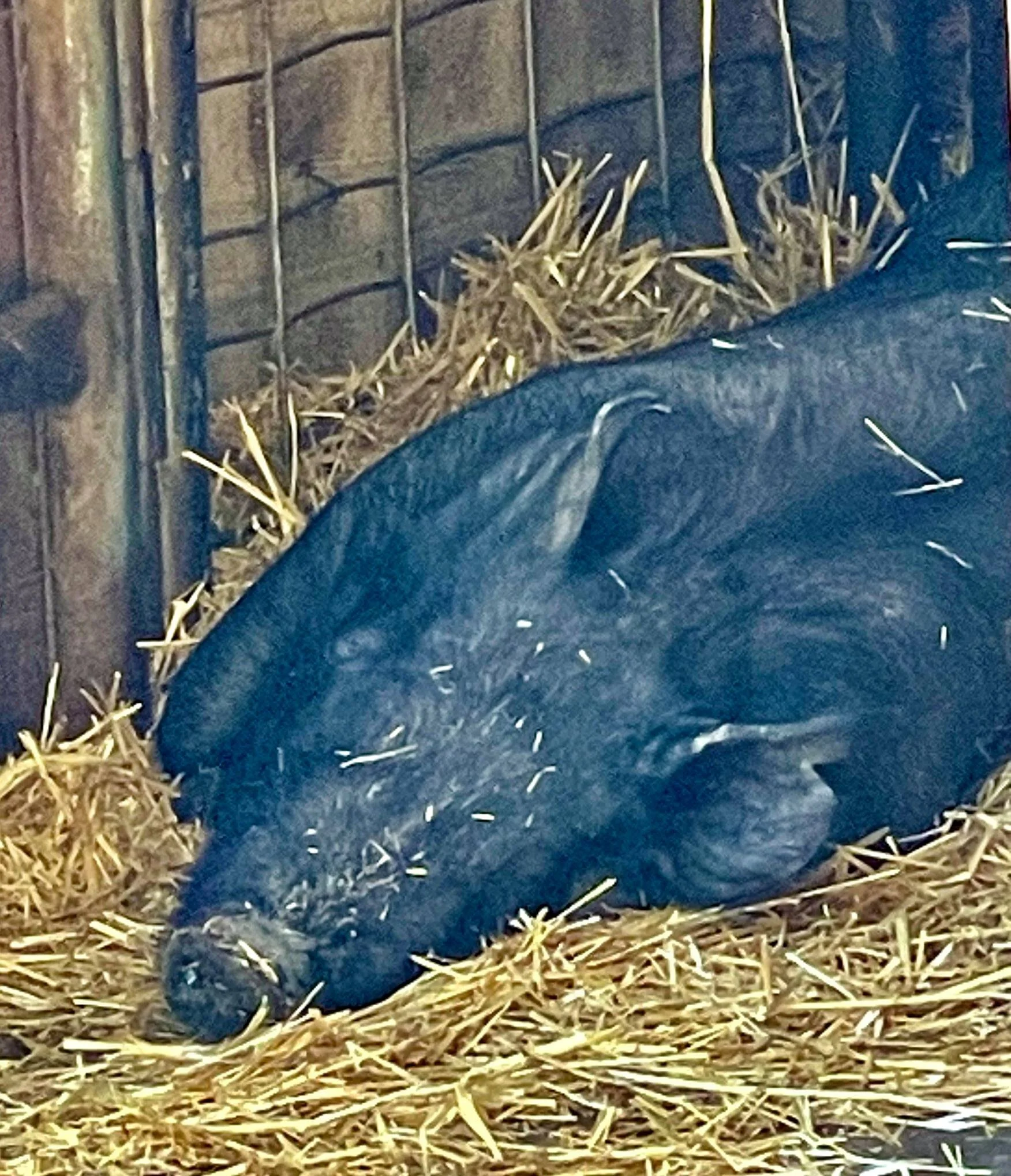
farm animals. They including lounging pigs, a regal looking ram, playful smiling goats, mellow chickens, gentle sheep and miniature jersey cows.

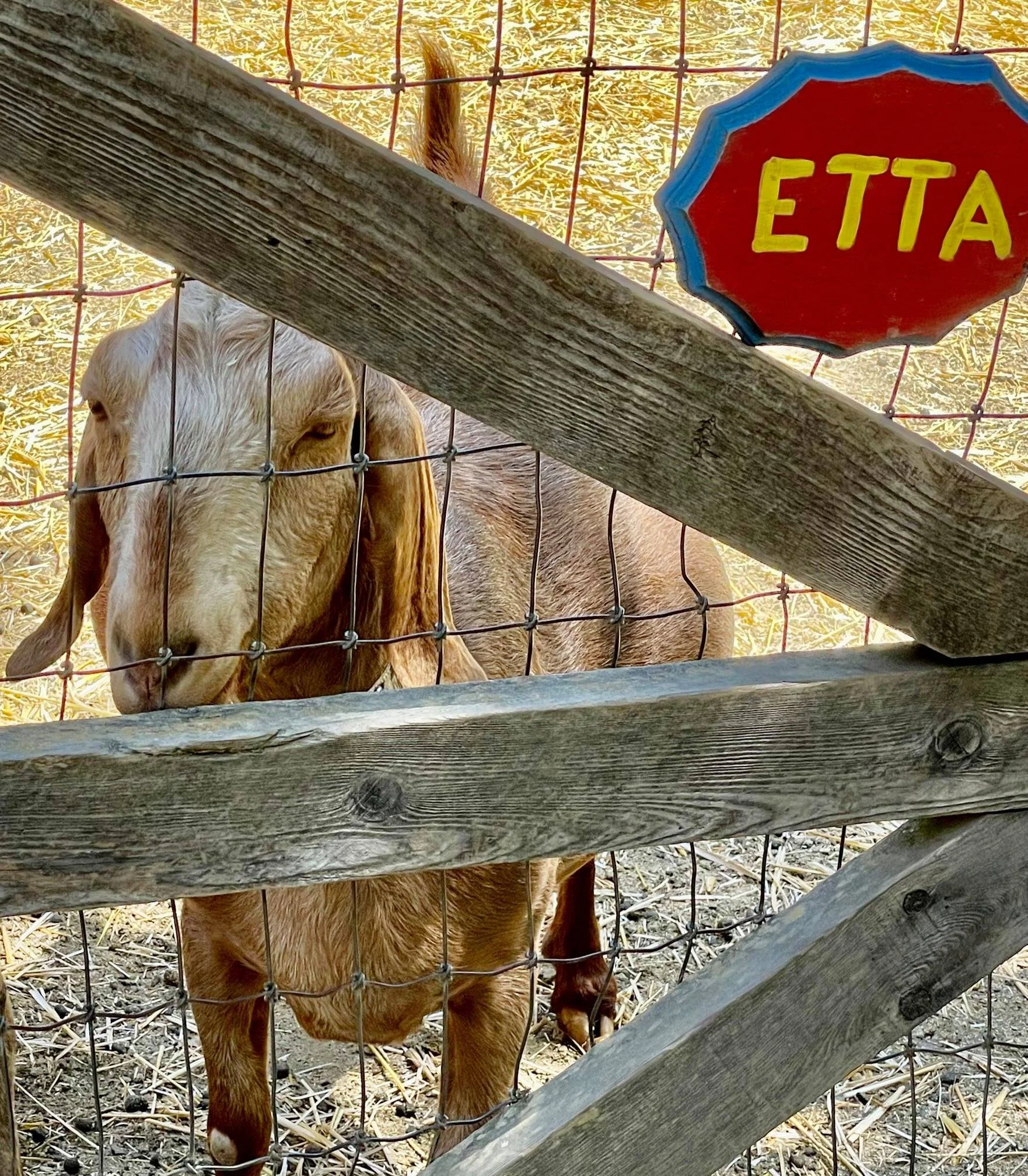
Some had colorful stage names like Etta the goat, Gordan Ramsey, the Horned Dorset Ram, and cows, Emelie and Harvey Milk. Nothing compares to nature’s

beauty and intelligence, from spring’s hopeful blooms, and seasonal vegetables and herbs and the whimsy

and joy of well-kept farm animals that bring joy and calm to so many visitors.

The recent four consecutive day 90-degree heat wave had eased up by 10 degrees. There was a mild breeze and plenty of open space to explore.

Farms are a magical place for little eyes and hands. I have fond memories of vacationing on a farm owned by family friends in the foothills overlooking the Amalfi coast when I was a child. The benefits of visiting an organic farm gives a child the opportunity to discover where the food comes from, how it is grown; and spending some time

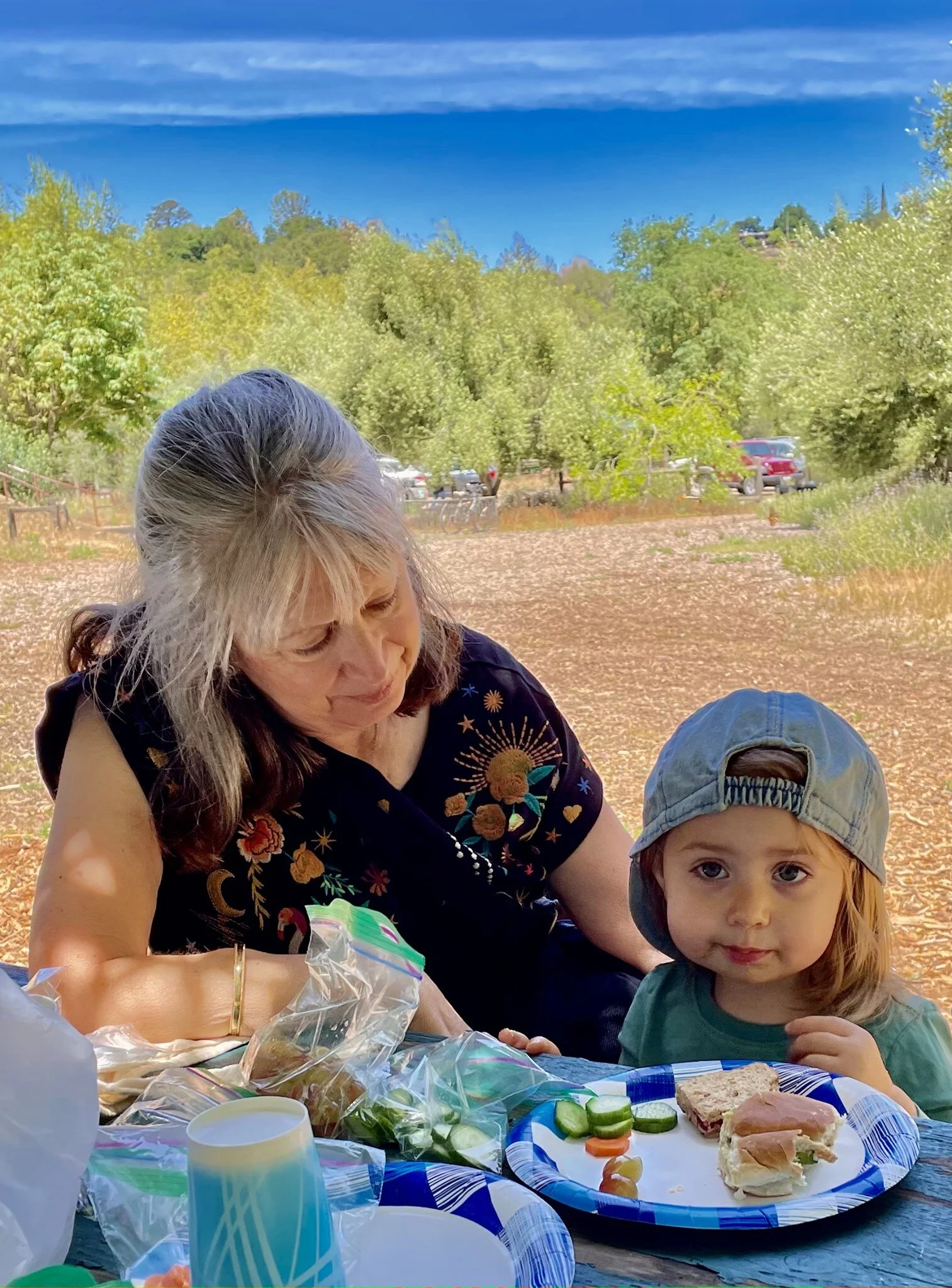
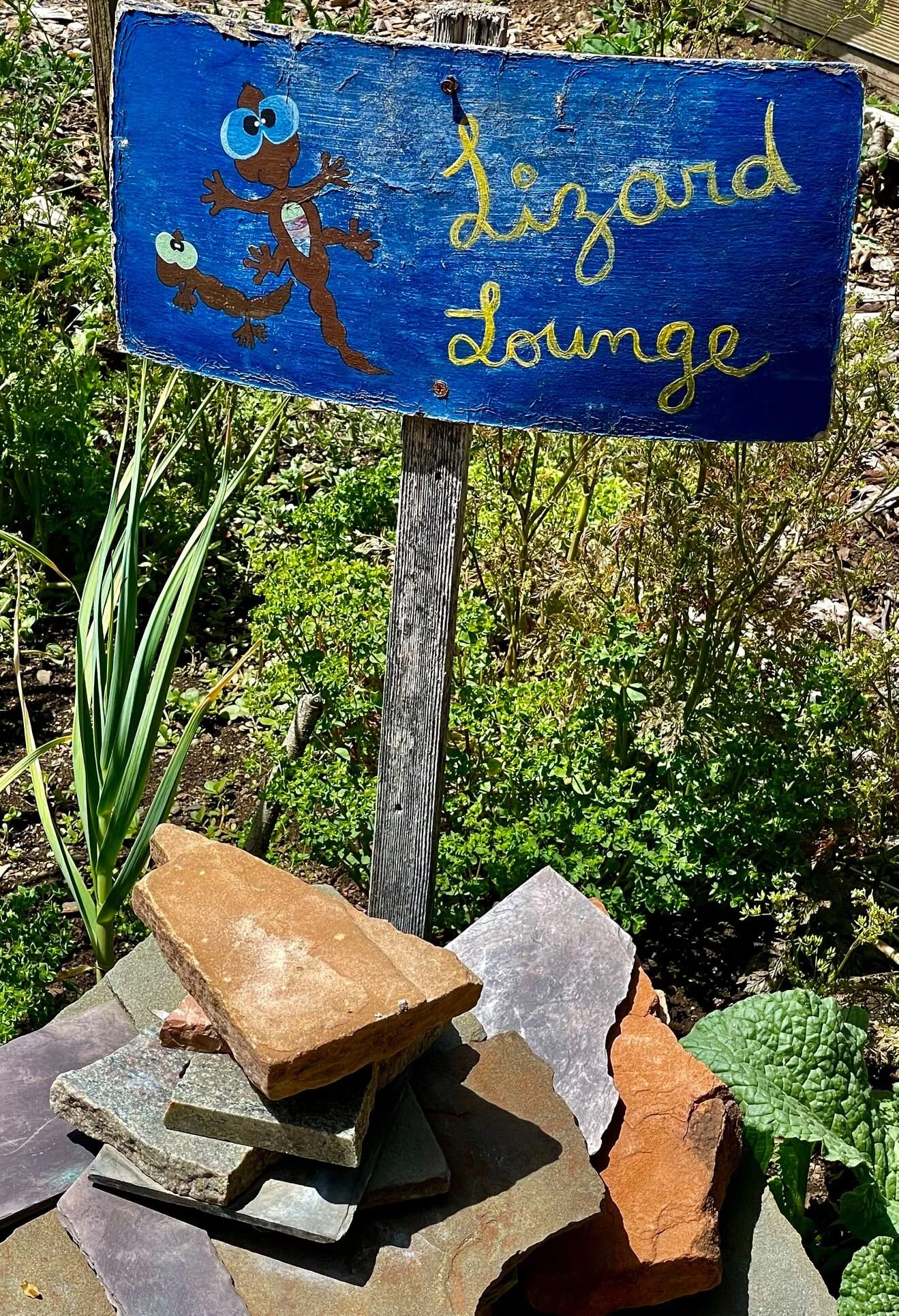
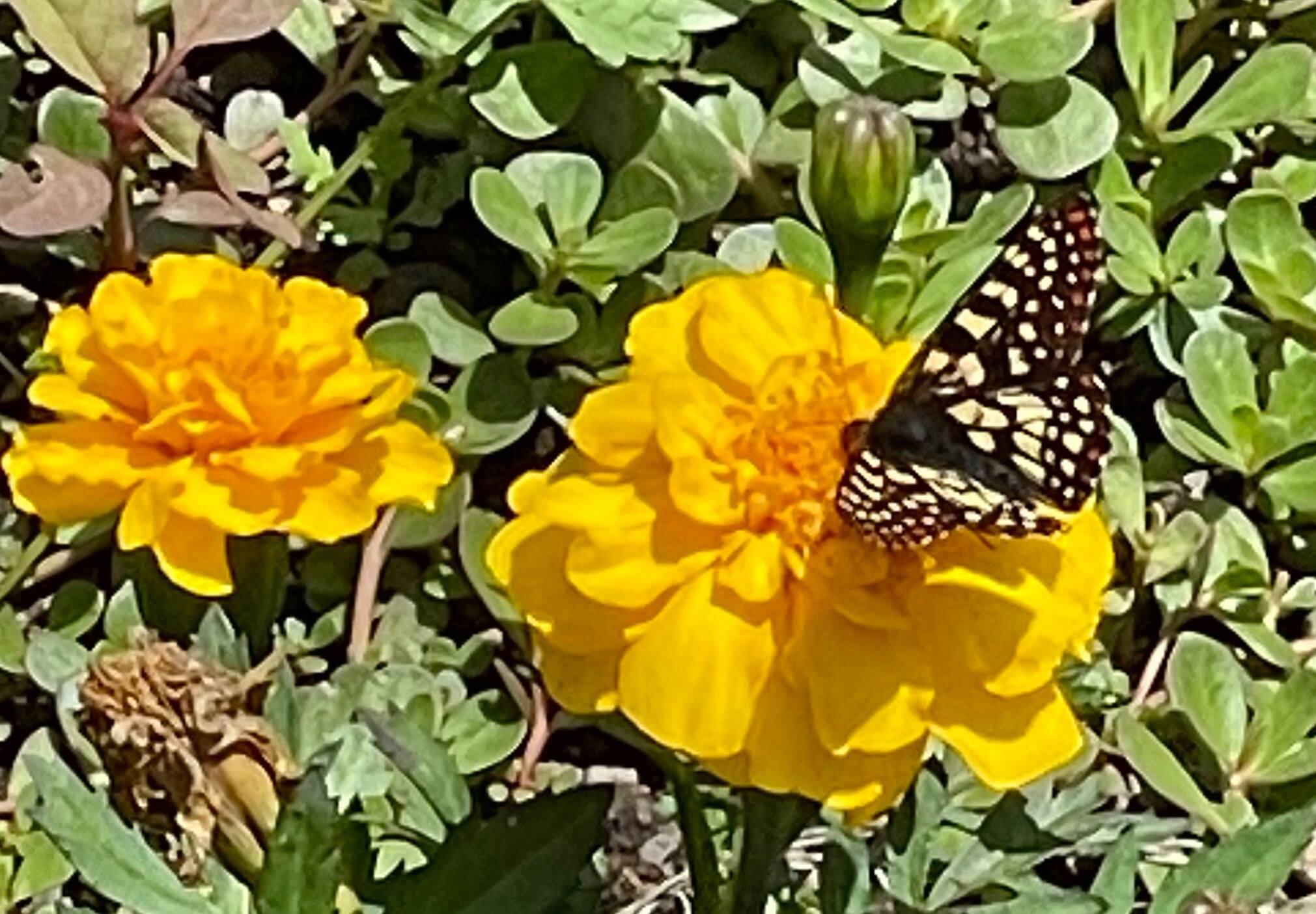
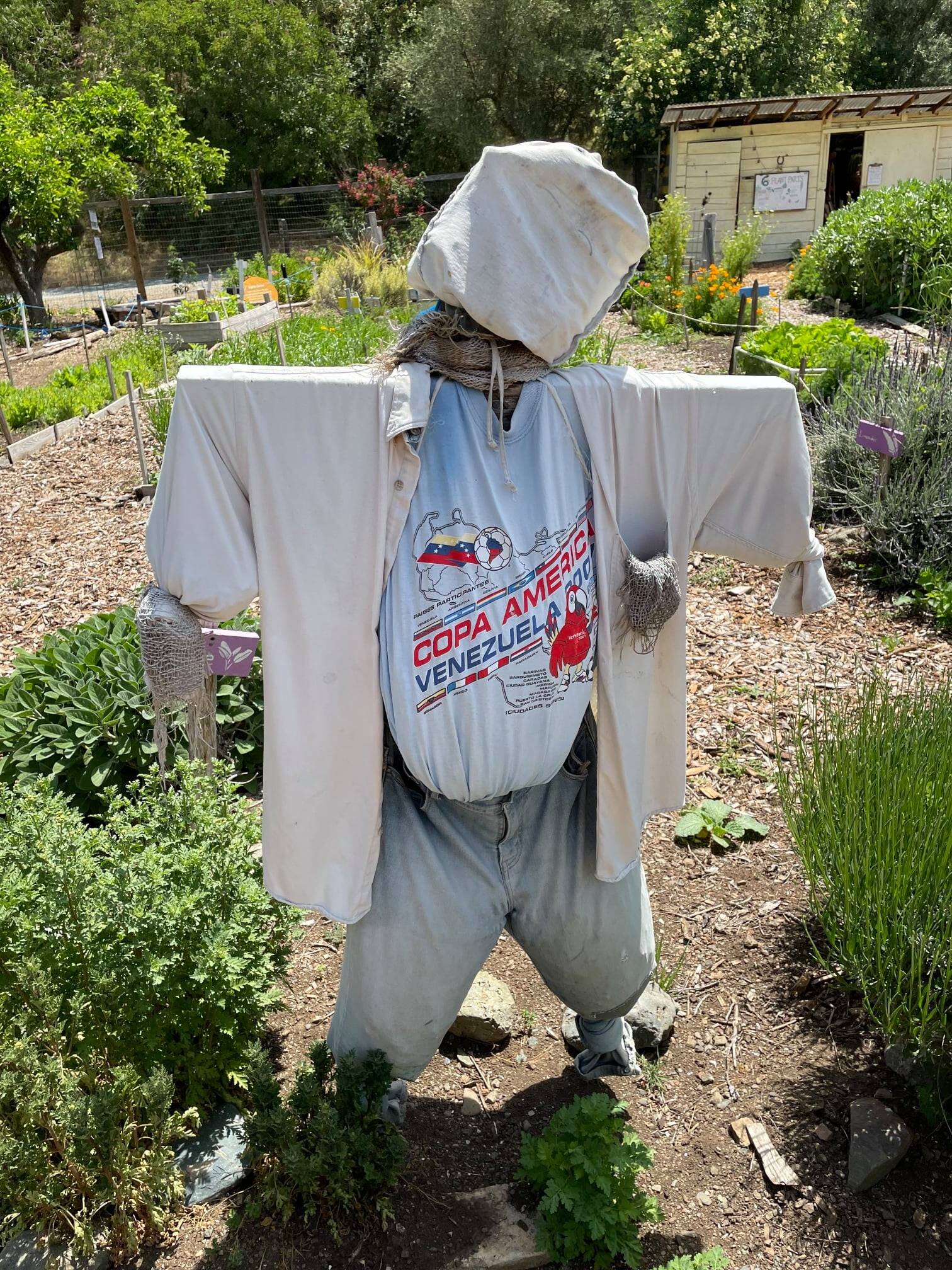
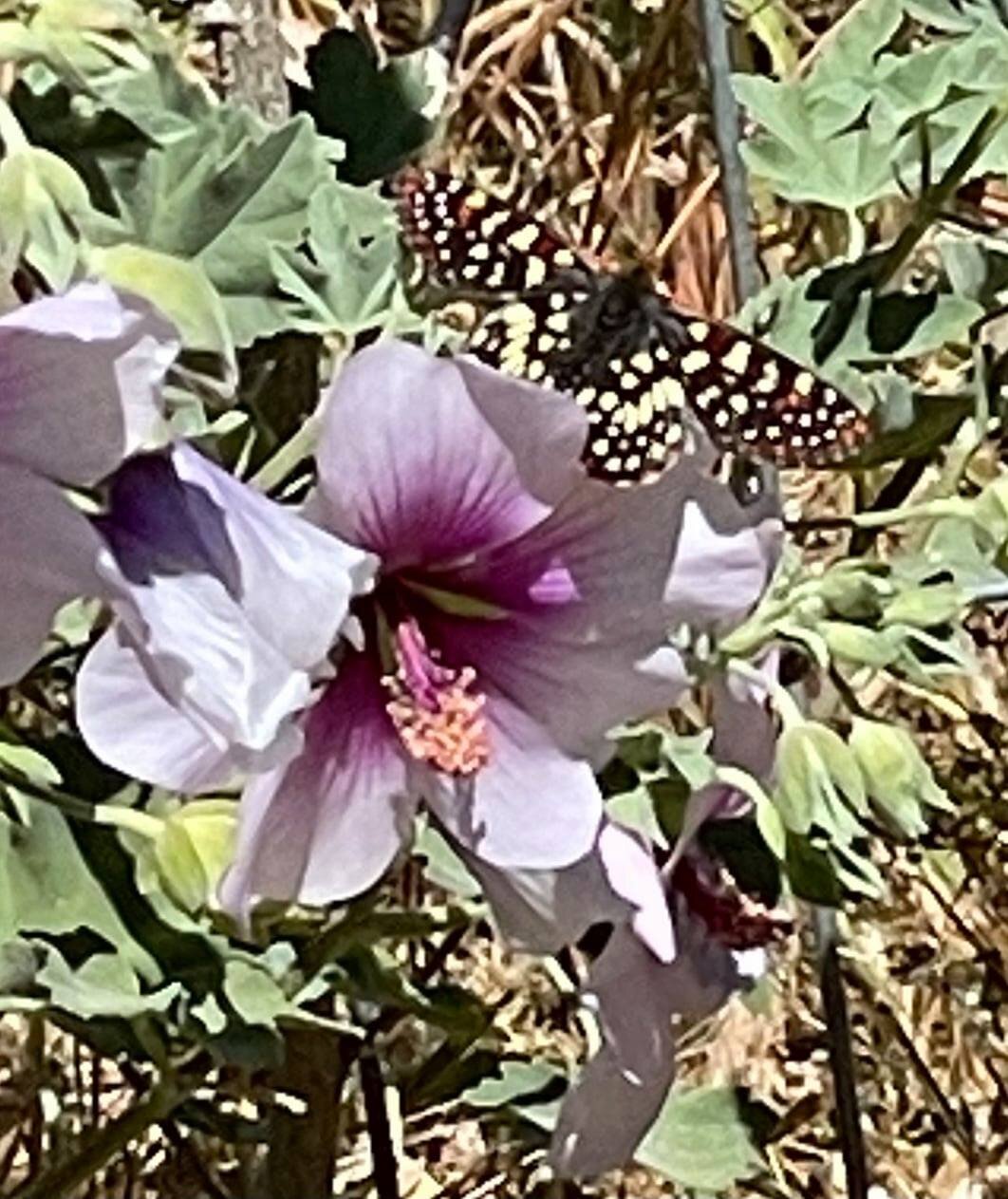
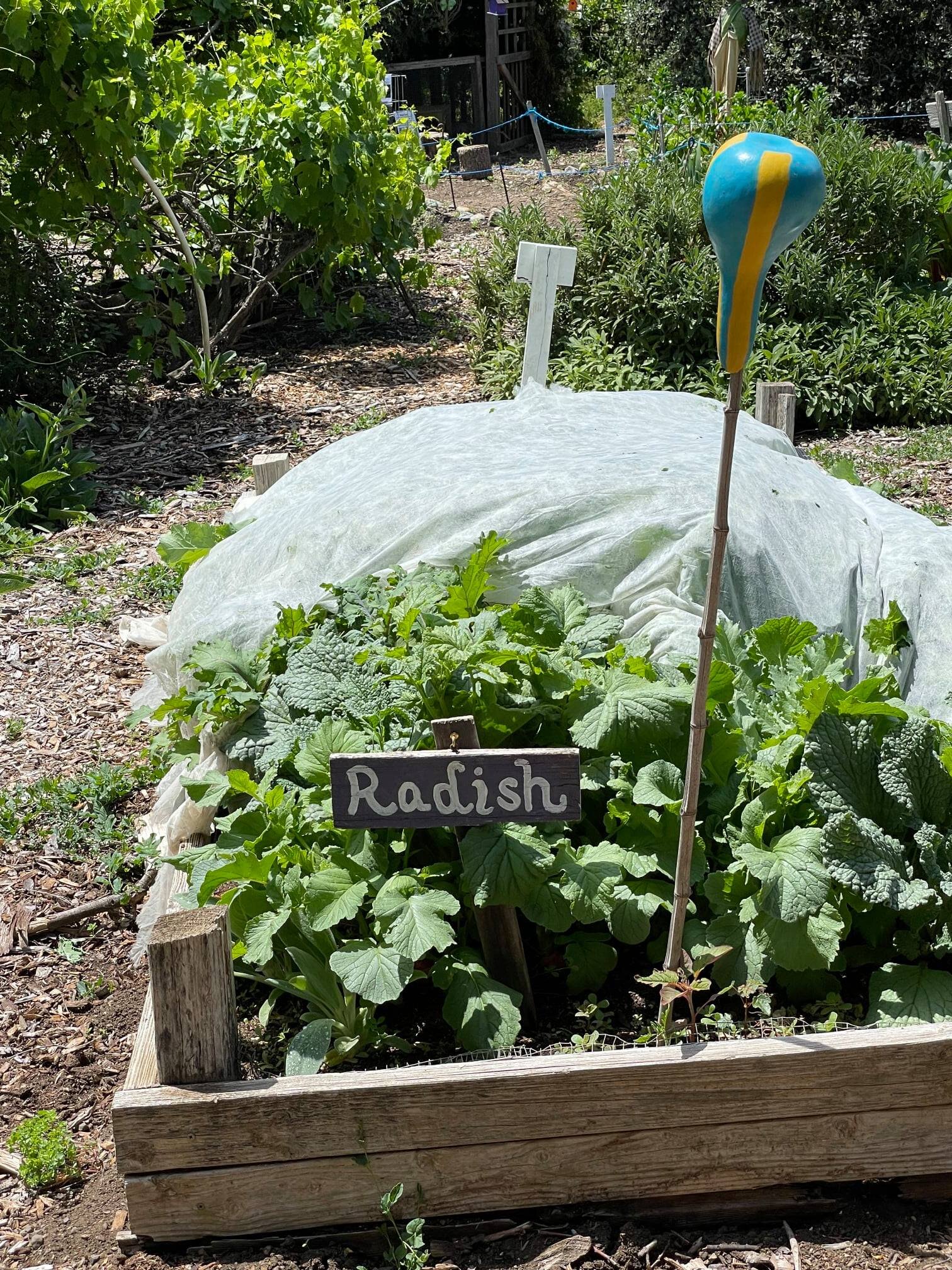
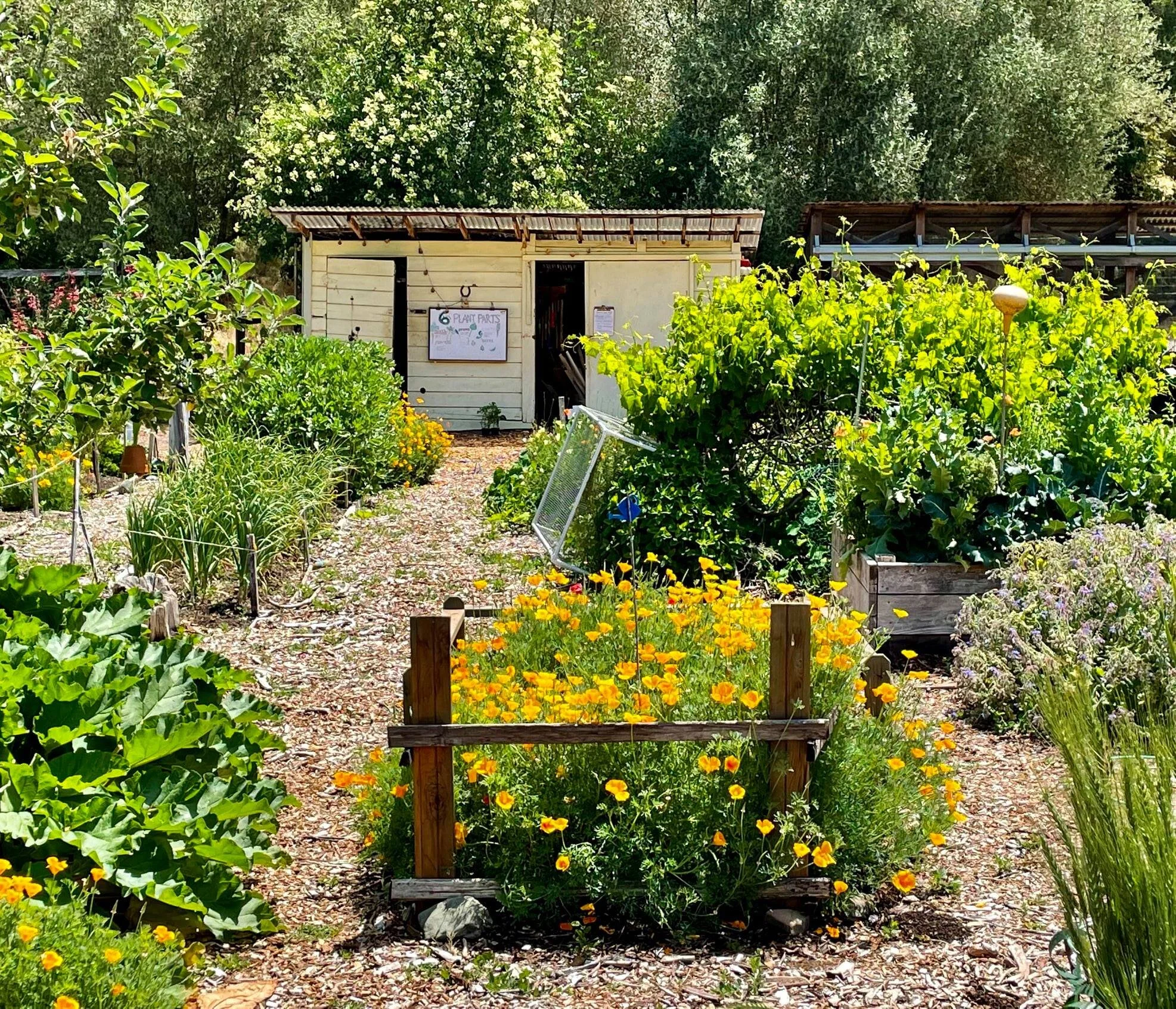
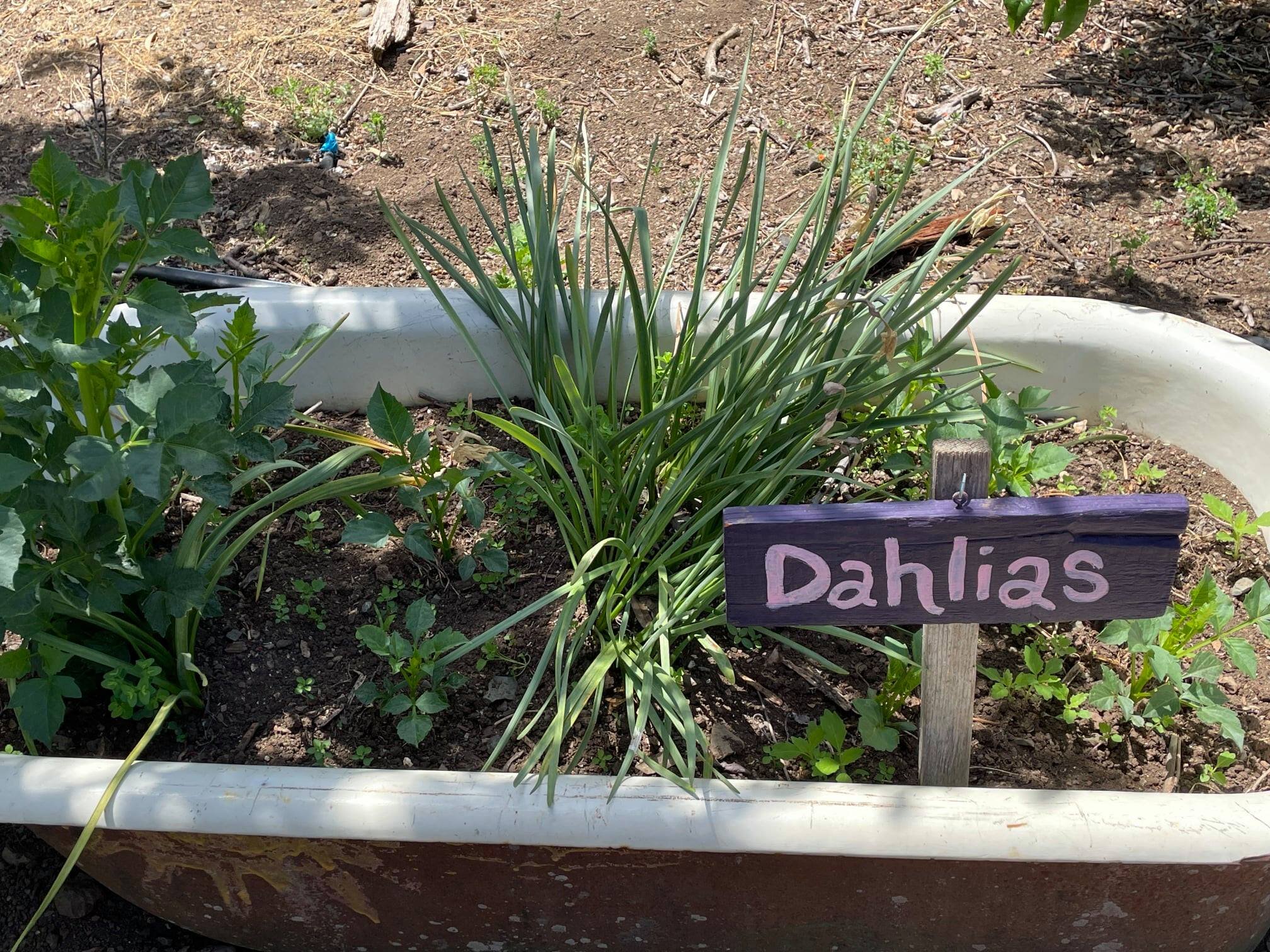
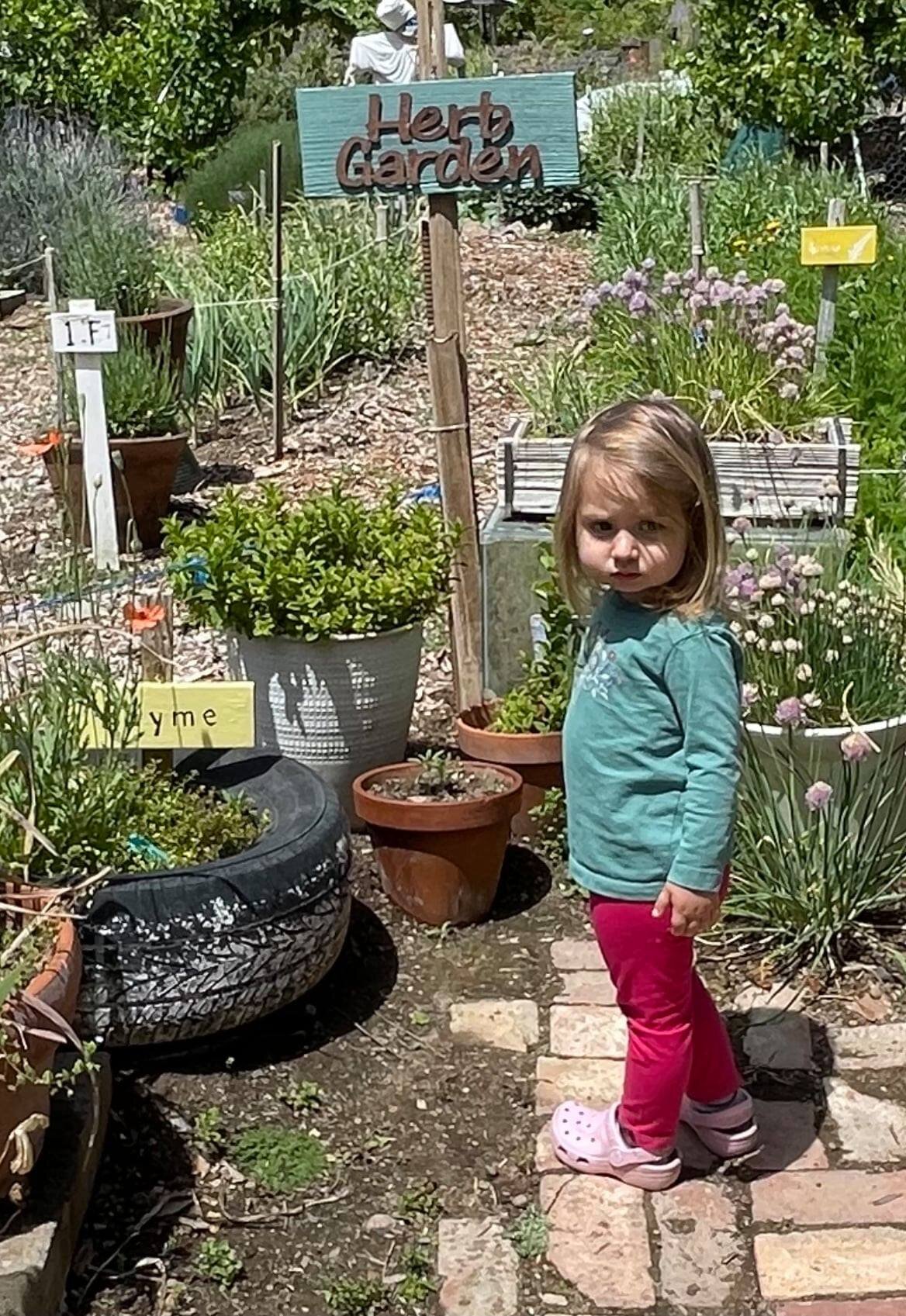
outdoors in the fresh air. It is fun for kids and adults. Hidden Villa is part botanical garden, hiking grounds, retreat hostels and nature center. My wife Cecile, a former Chicago school teacher used to volunteer chaperoning kids in middle school field trips when are kids were young. Hidden Villa was a favorite destination. She would assist them in growing vegetables and herbs. Toward our two-hour visit, I took Lyla to the gardens while Cecile was setting up lunch at a picnic table nearby. After we ate, she joined Lyla and me to revisit the gardens that were teeming with life. The bees were pollinating, little lizards were slithering about, butterflies were gracing one flower after another, and hummingbirds were hovering above a water feeder and zipping about. Every conceivable herb and vegetable were labeled and growing in abundance.

After lunch, prior to making our way back home Lyla said: ”It was a really nice day, a really nice outing,” which reminded me of the biblical quote: “Out of the mouth of babes.”

Cecile and I are truly convinced if you bring joy to a child, they will mirror it back to you in unexpected moments.

Hidden Villa is the legacy of the late Frank and Josephine Duveneck who purchased the property near Los Altos, CA in 1924.

It is an educational nonprofit whose land stretches over 1600 acres of open space in the beautiful foothills of the Santa Cruz Mountains.

Their mission was sharing the land and creating humanitarian programs that have inspired many generations. Their vision was

to create a just and sustainable future for all by preserving the wilderness and manage the farm as a family ranch. Hidden Villa

today focuses on environmental education and sustainable agriculture, while sharing an abiding respect for all living things.

The earliest known stewards fo this land are the Ohlone Indians and Franciscan missionaries. Every year, 30,000 people participate in one of their programs and an

additional 20,000 visitors come to explore the organic farm and gardens, hike the beautiful trails and greet the farm animals including school groups and summercampers.

Postscript: Flower Supermoon Total Eclipse Visible from the Bay Area May 26, 2021, 1:47—6:01 AM

Named after the abundance of flowers blooming this month. It also happens to be a “Supermoon" because its elliptical orbit brings it to earth
Cloud Appreciation & a Bird Feeding Frenzy by a Mother & Child

Clouds have no families, no responsibilities. Born wanderers. Die, wanderers. They absorb every vapor (pain) in themselves and cry them out in the form of rain only when they’re full to their brim. White, translucent, innocent.”
—Akita Bala

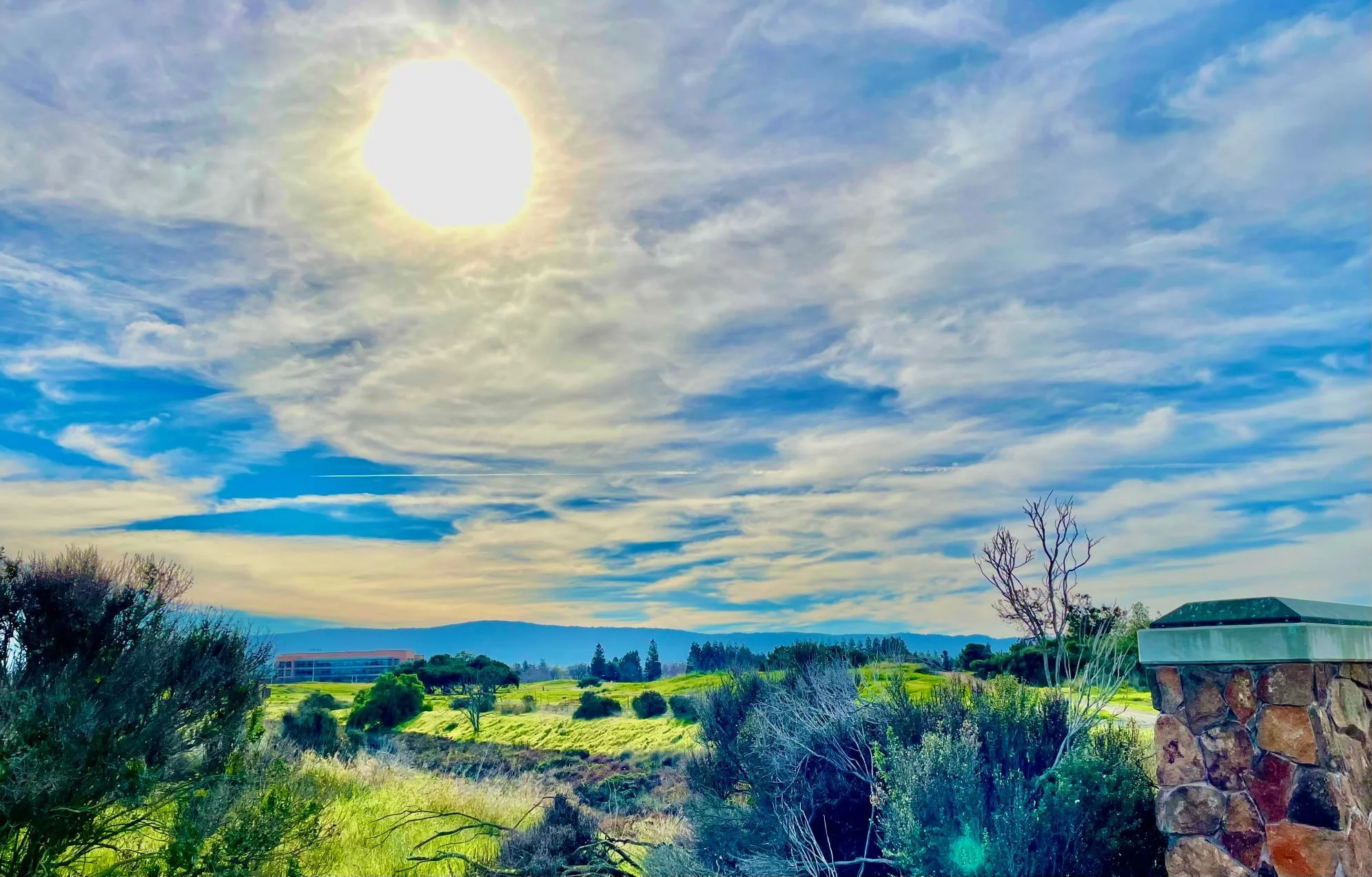
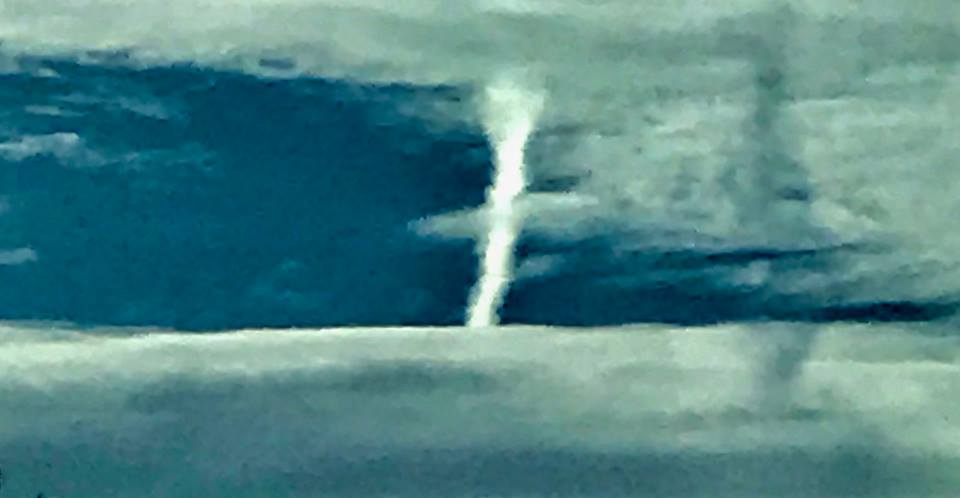
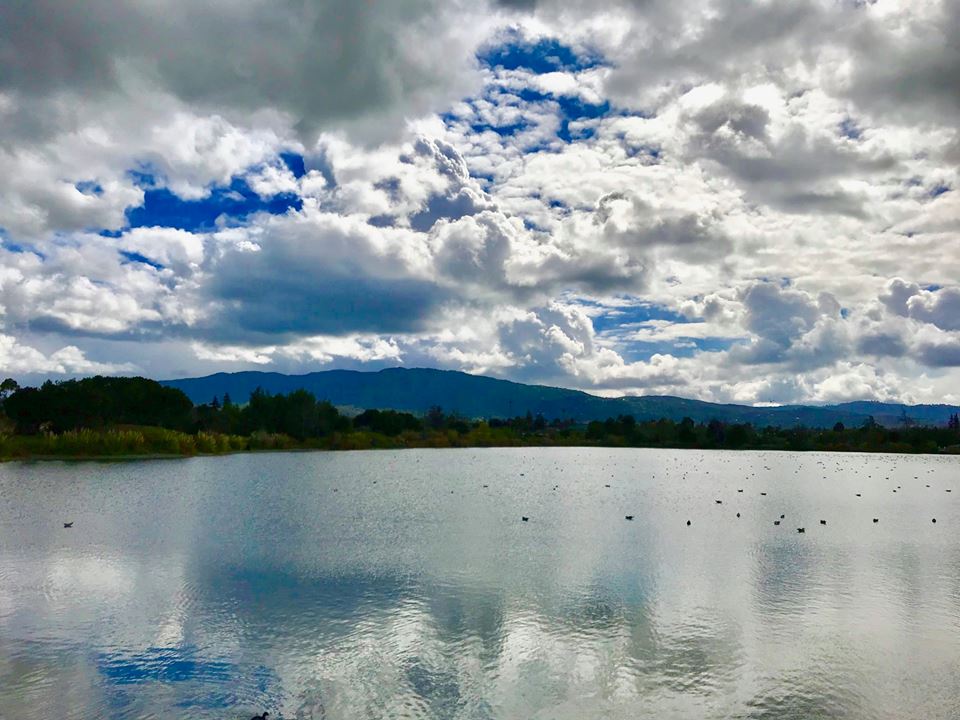
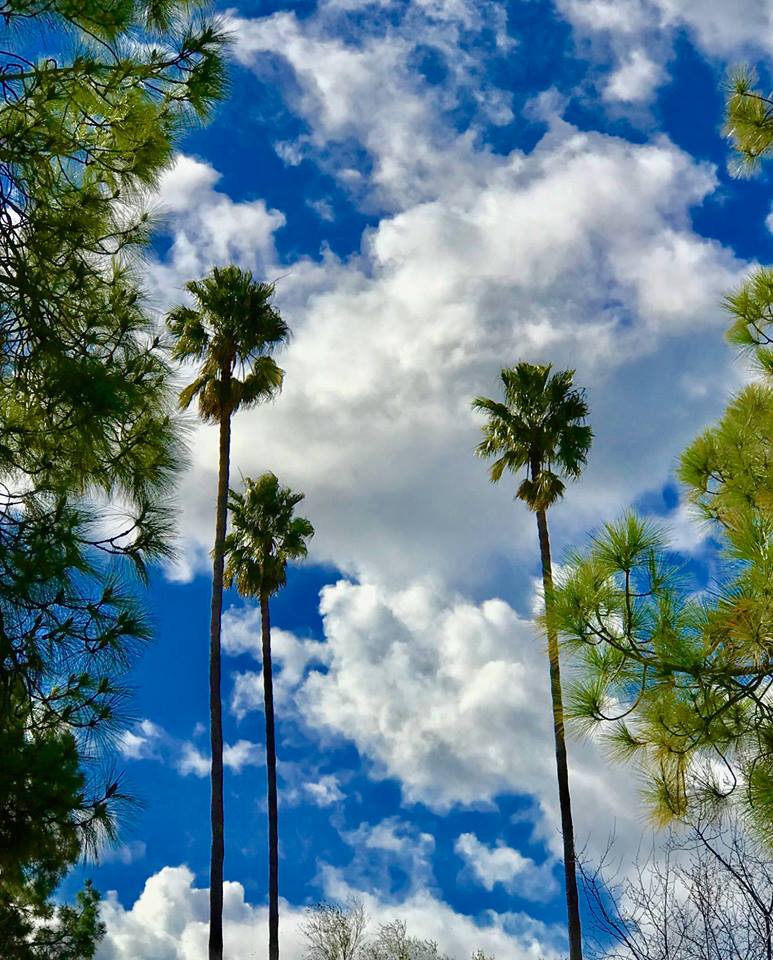
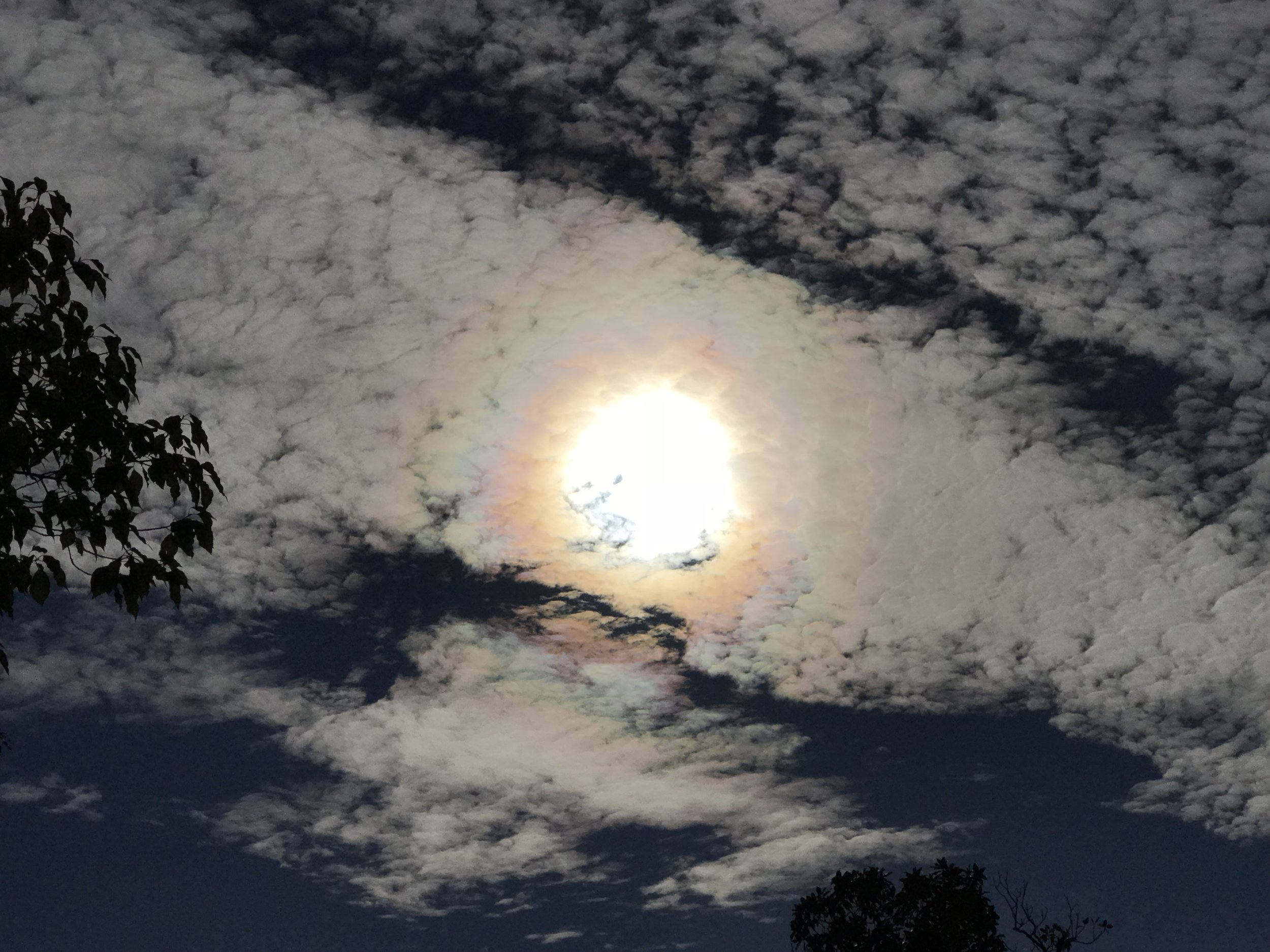
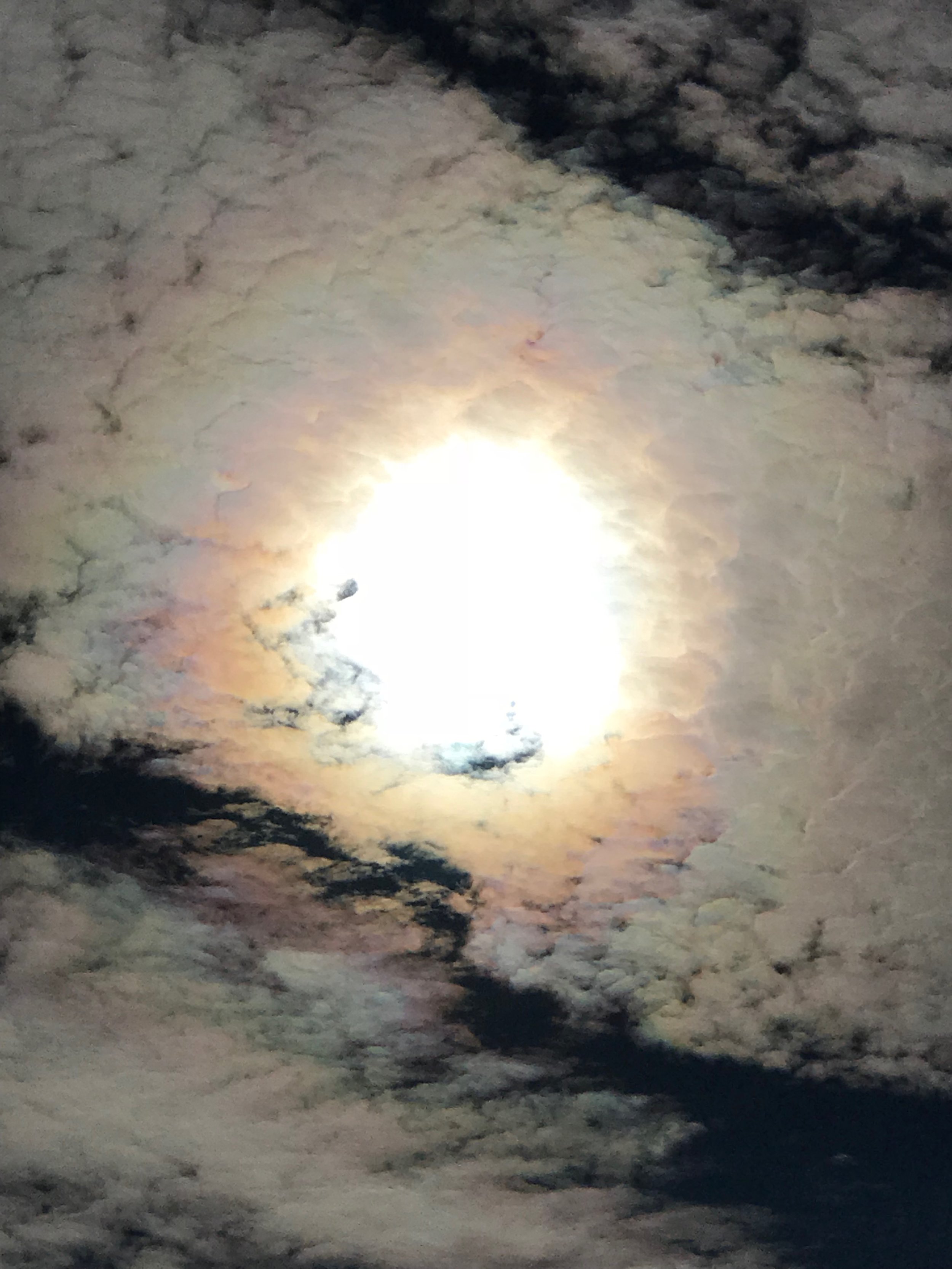
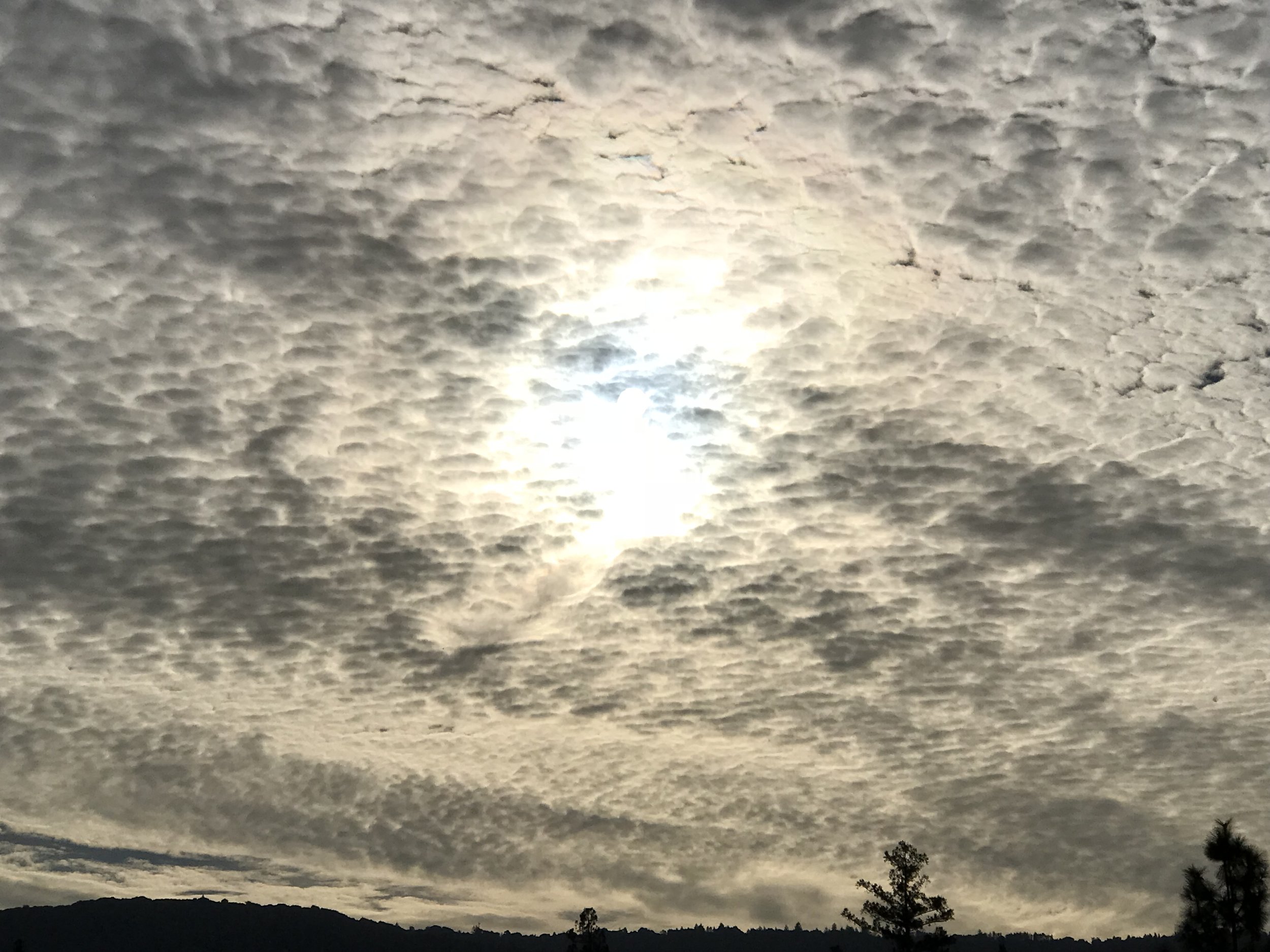
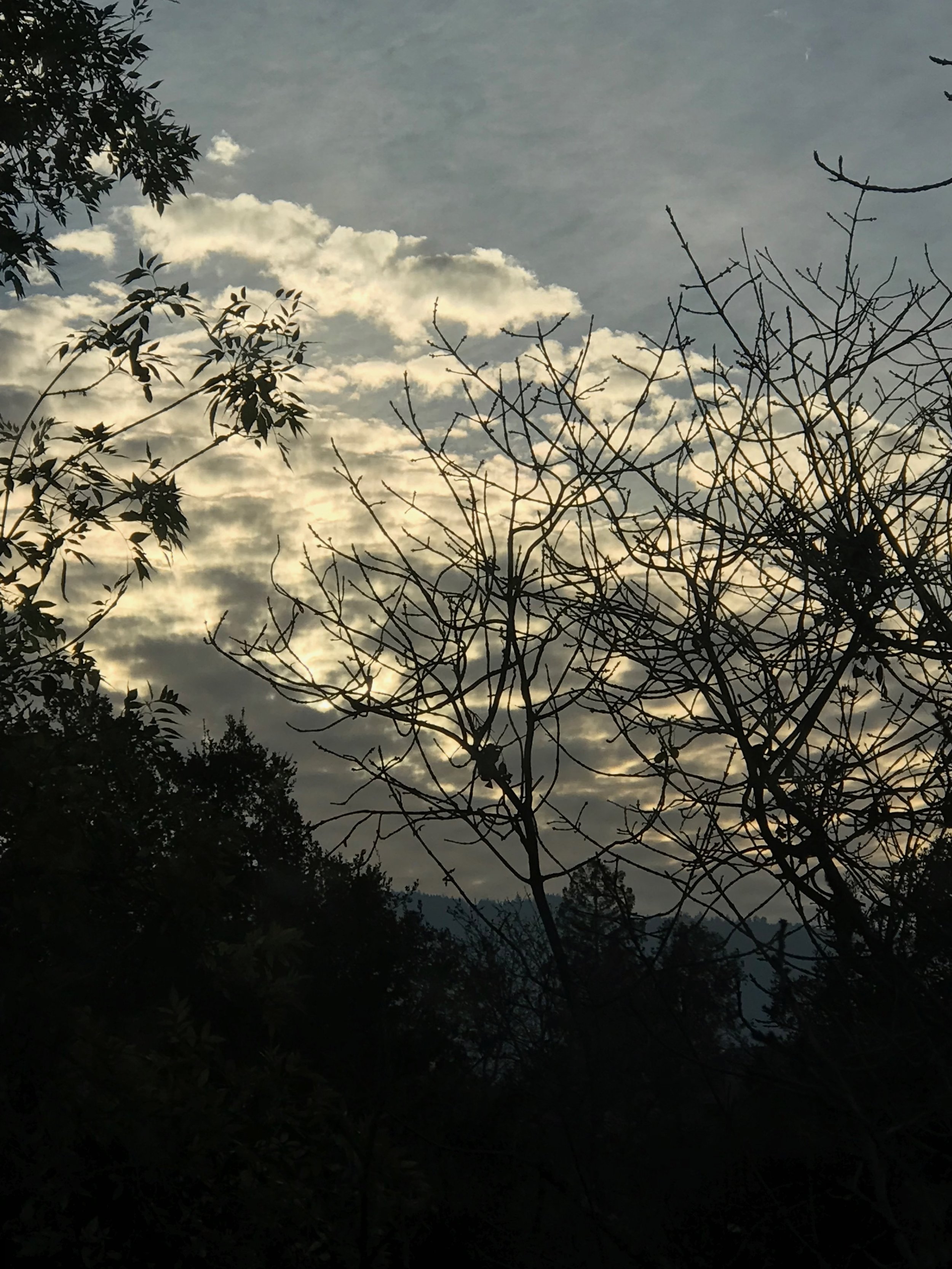
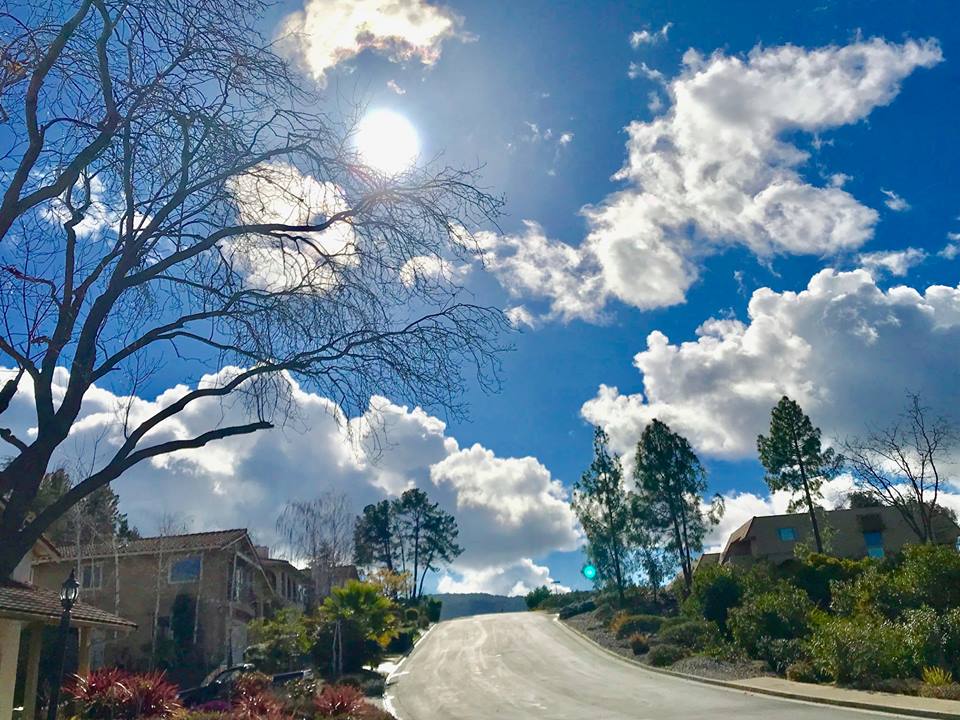
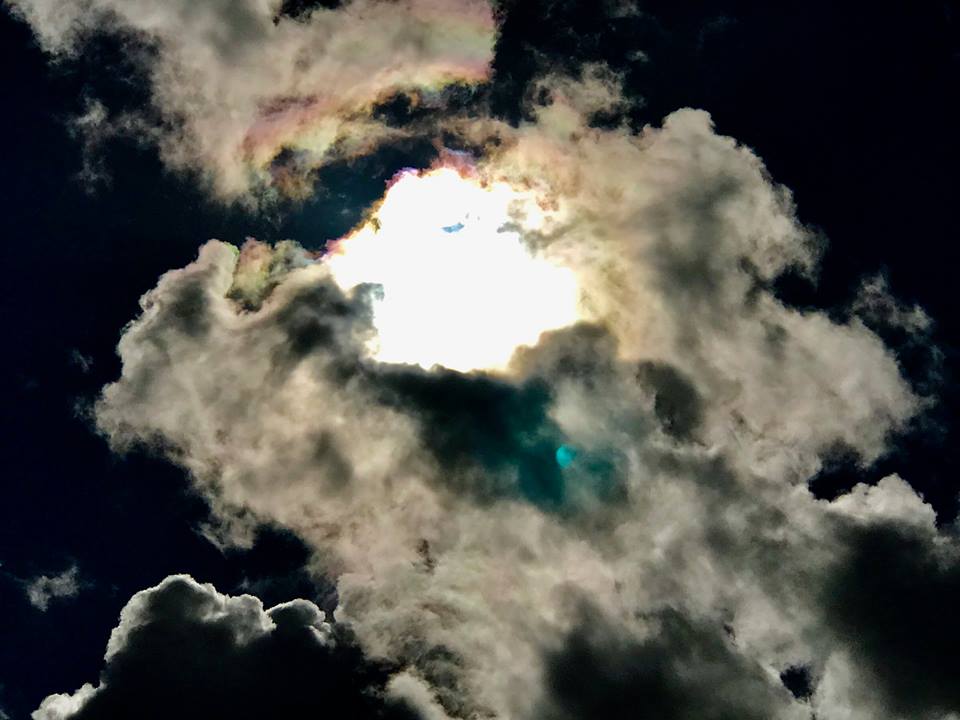
All this weather turbulence of late has brought about some amazing and hypnotic cloud formations. Some of these photos—mostly of clouds—were taken on the Los Gatos Creek County Park and trails in between the latest rains. Once a former South Pacific Coast railway line, this urban green space is home to the Los Gatos Creek Trail, a mostly-paved route that runs about 10 miles from San Jose to the Lexington Reservoir. Other cloud groupings were photographed in the community where we live. Anyone can look and see the clouds, but it is worth the extra effort to seek out places where the clouds can be seen unobstructed by buildings. telephone lines and the like.
Clouds have been doing what they do for millions of years. Our cave swelling forbears have enjoyed the same sort of cloudscapes that we do now.

Cloud formations, for all who take time to engage them, are a magical part of creation, capable of altering our moods and reflecting our inner landscape of thoughts, feelings, and emotions. Staring deeply and mindfully into clouds or other parts of nature takes me away from my incessant chattering mind and into that sweet, still place within, that fills me with the experience of feeling alive and connected to all that is. 
In an interview with KQED news, Gavin Pretor-Pinney, founder of the Cloud Appreciation Society, said he believes the world needs more cloud-enthusiasts. Cloud gazing, he says, provides a much-needed respite from the fast-paced, digital age. I happily agree. 
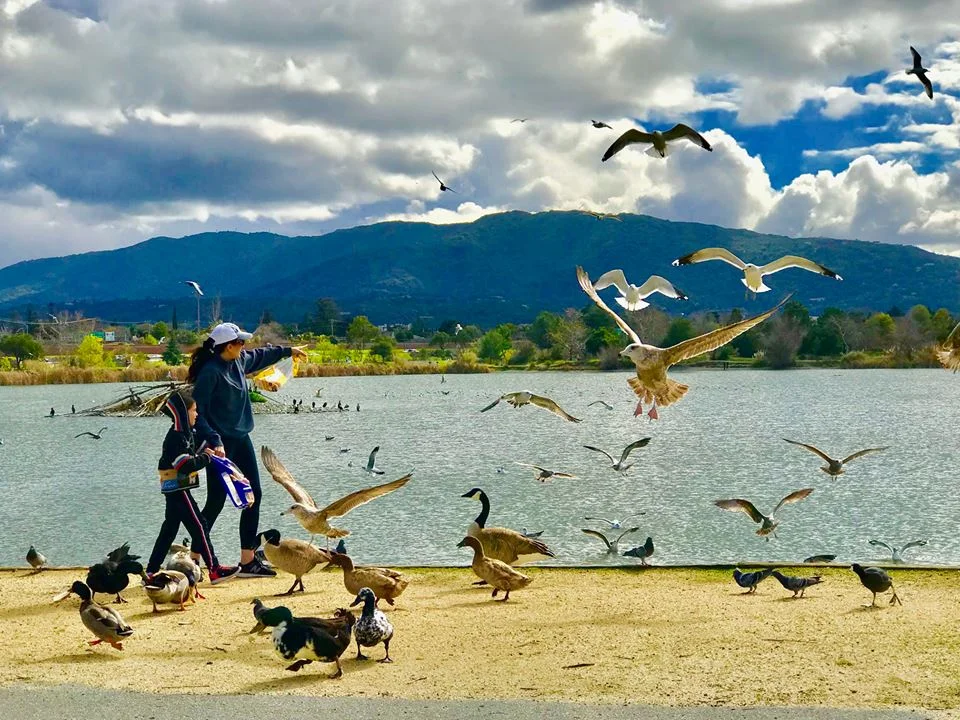
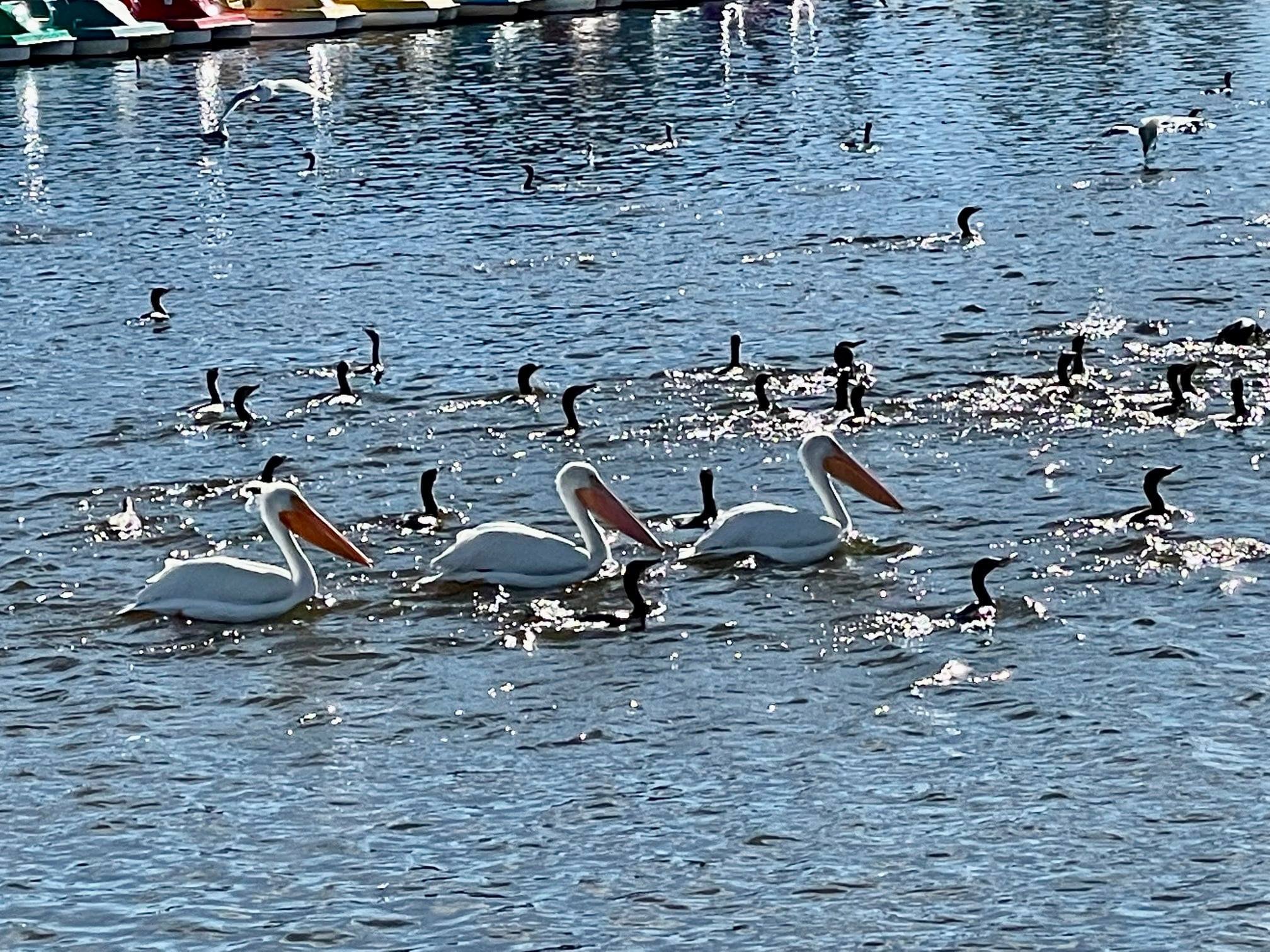
Postscript: One of my favorite pix is the one I took of the mother and child feeding the seagulls, geese, ducks, and pigeons. I couldn’t ask for a better set up.

Capturing the Great Blue Heron in Stillness and in Flight

“In order to see birds it is necessary to become part of the stillness.”—Robert Lynd

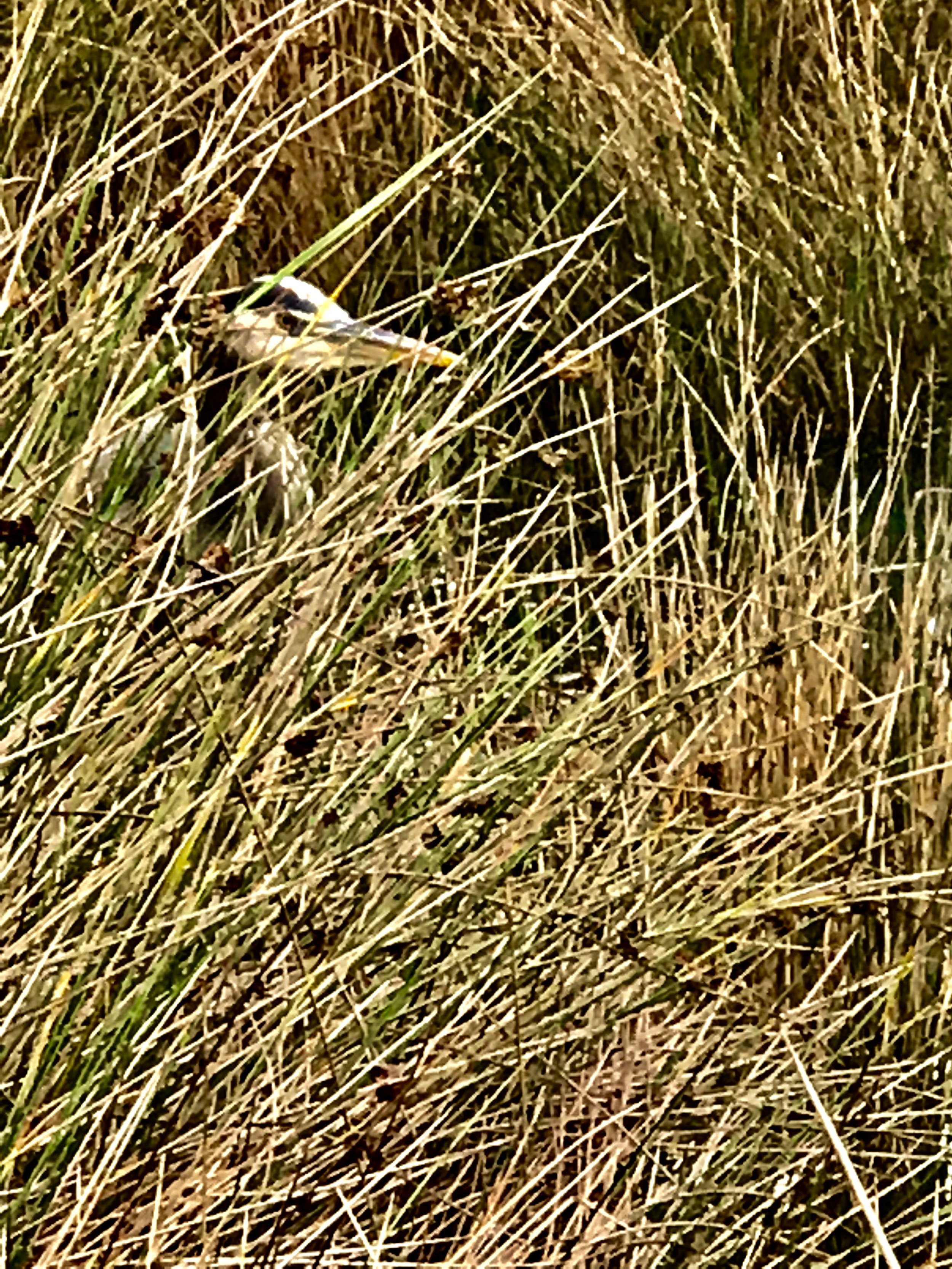
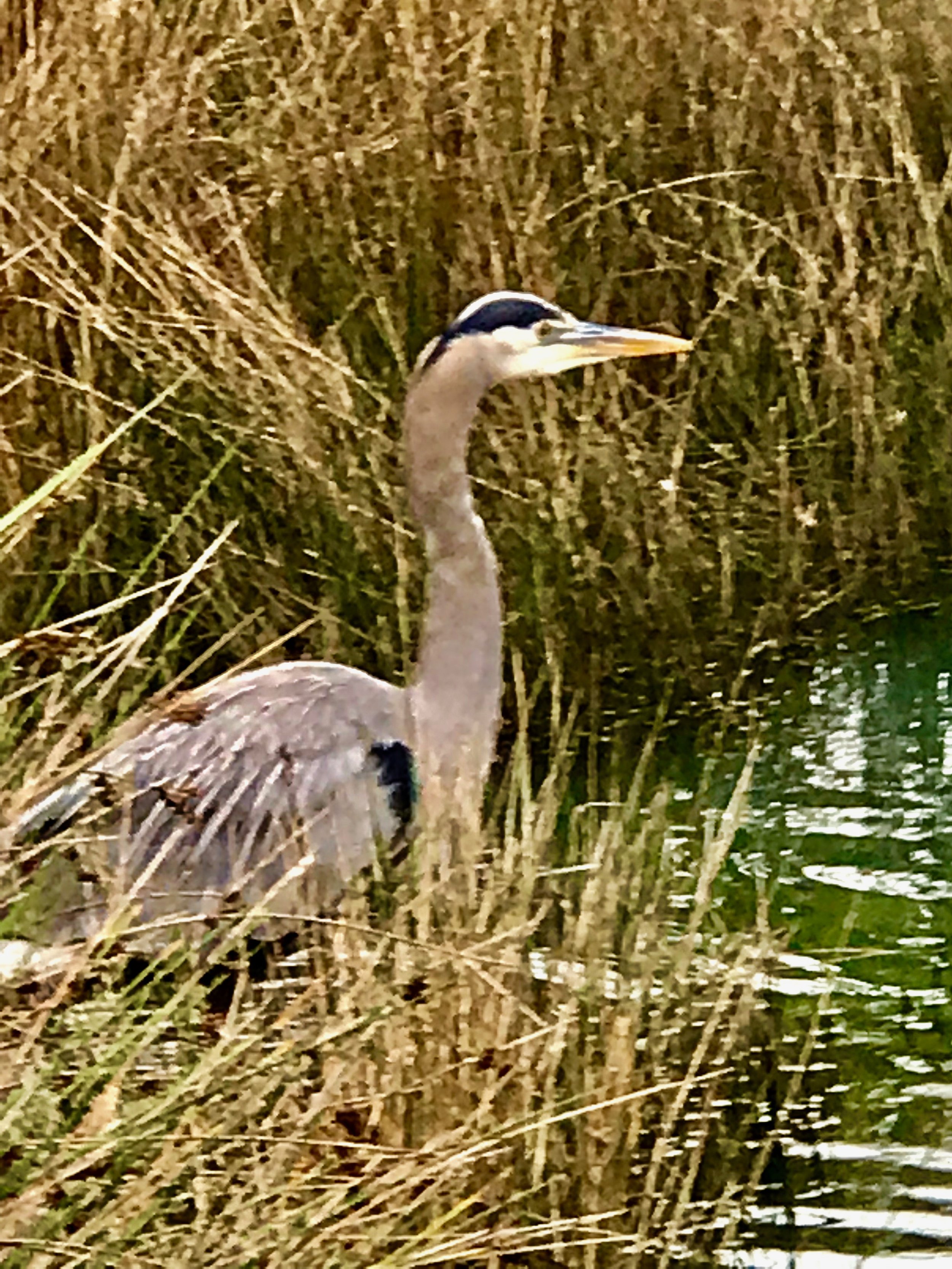
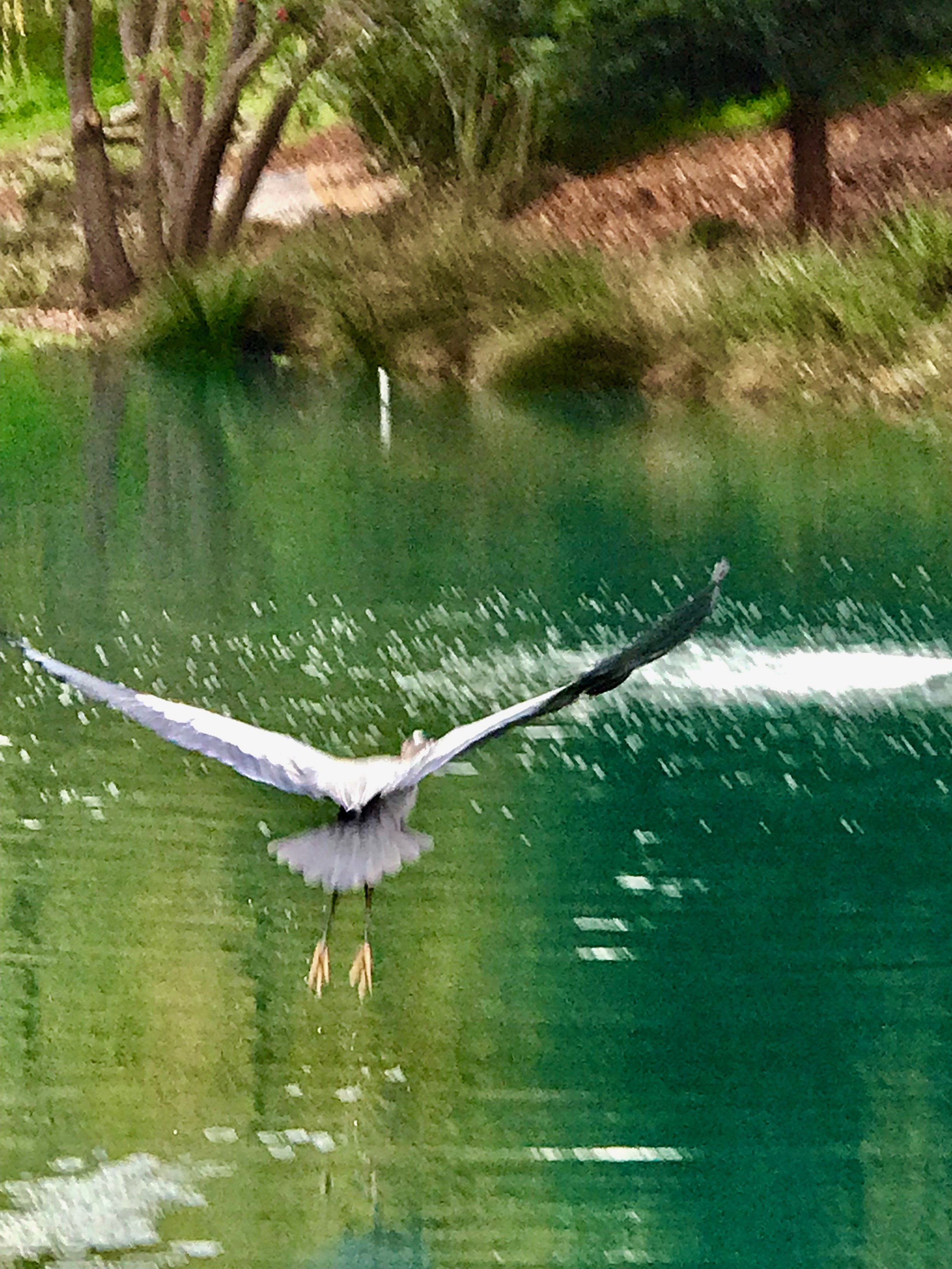
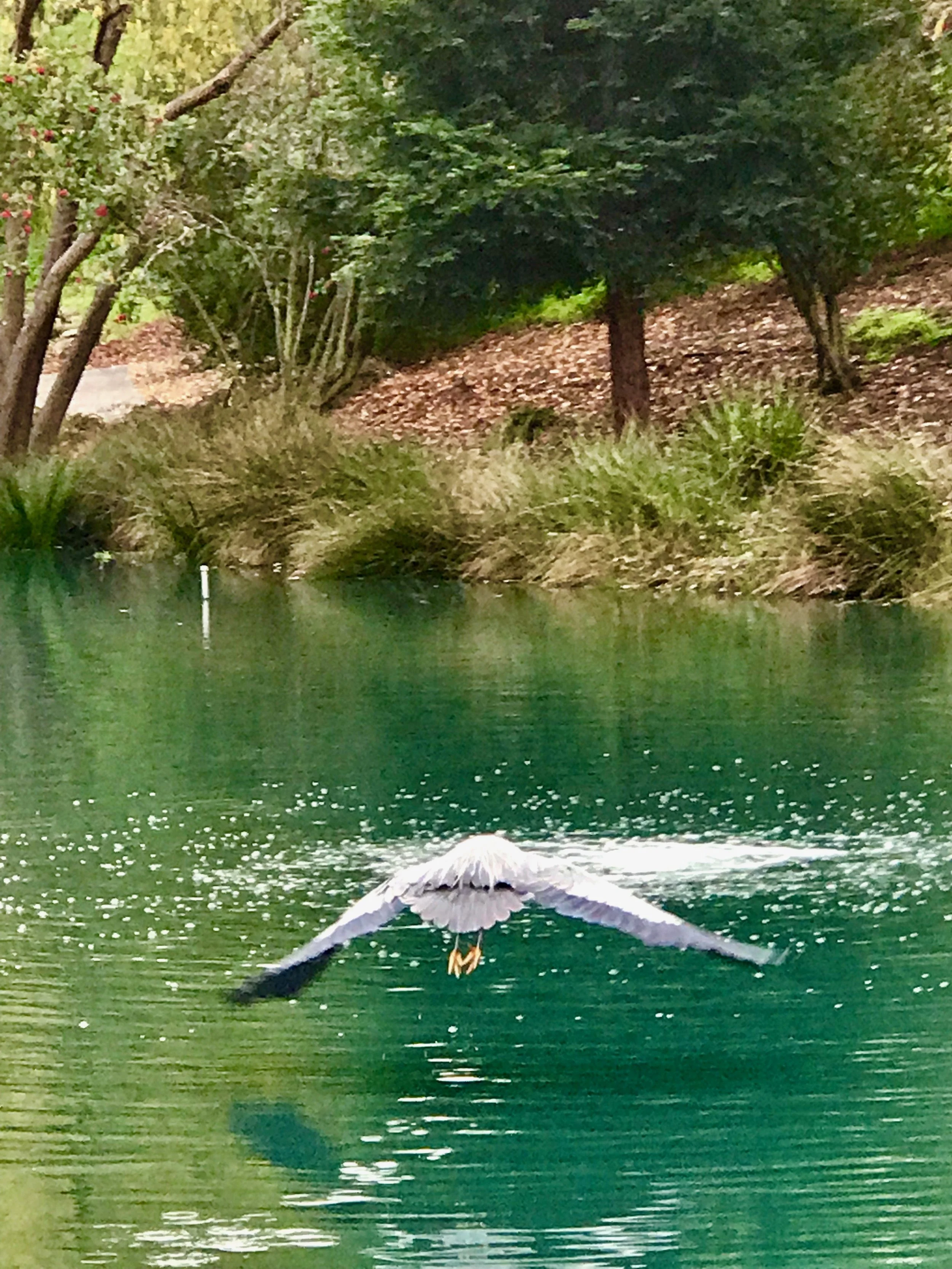
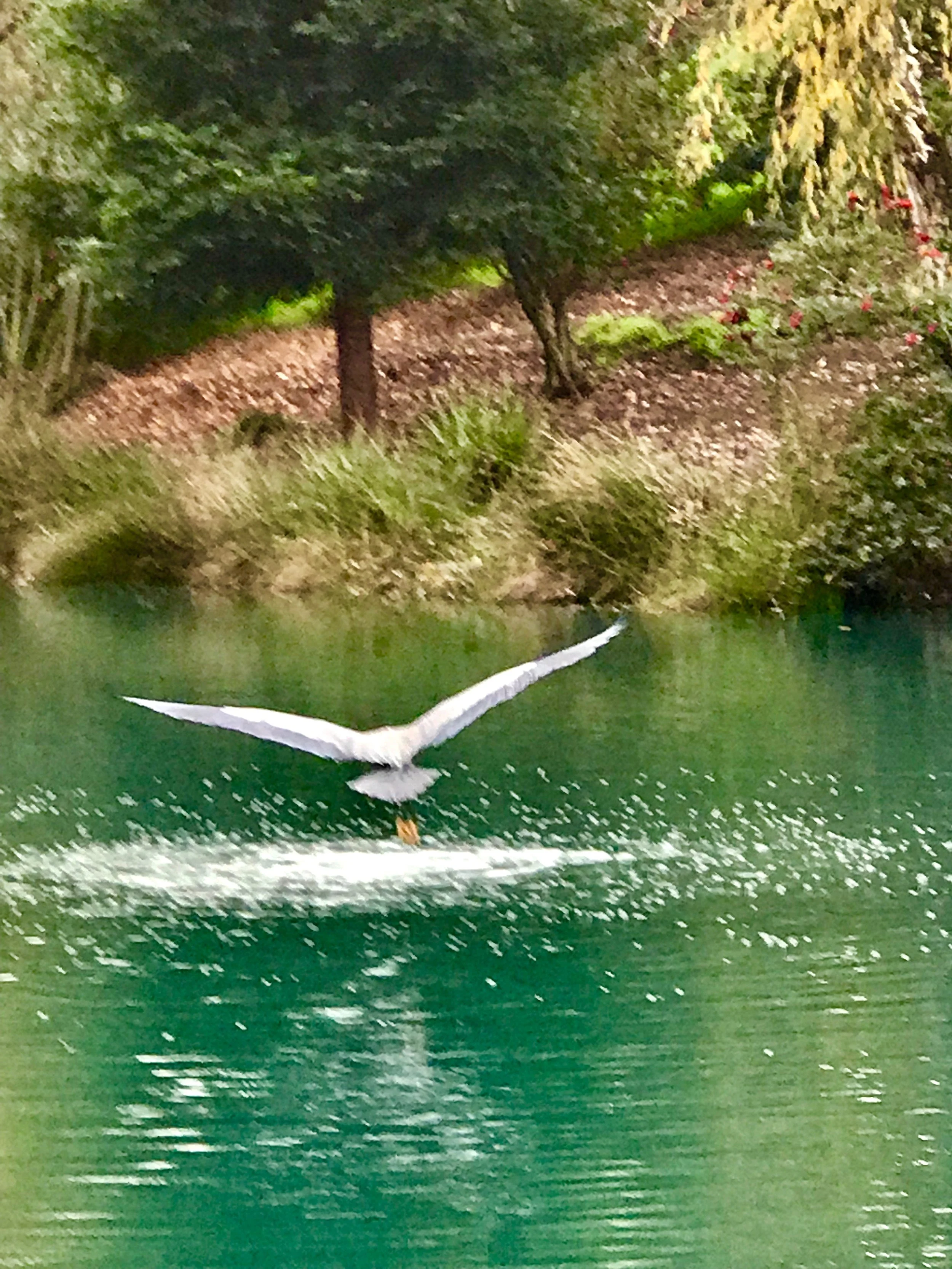
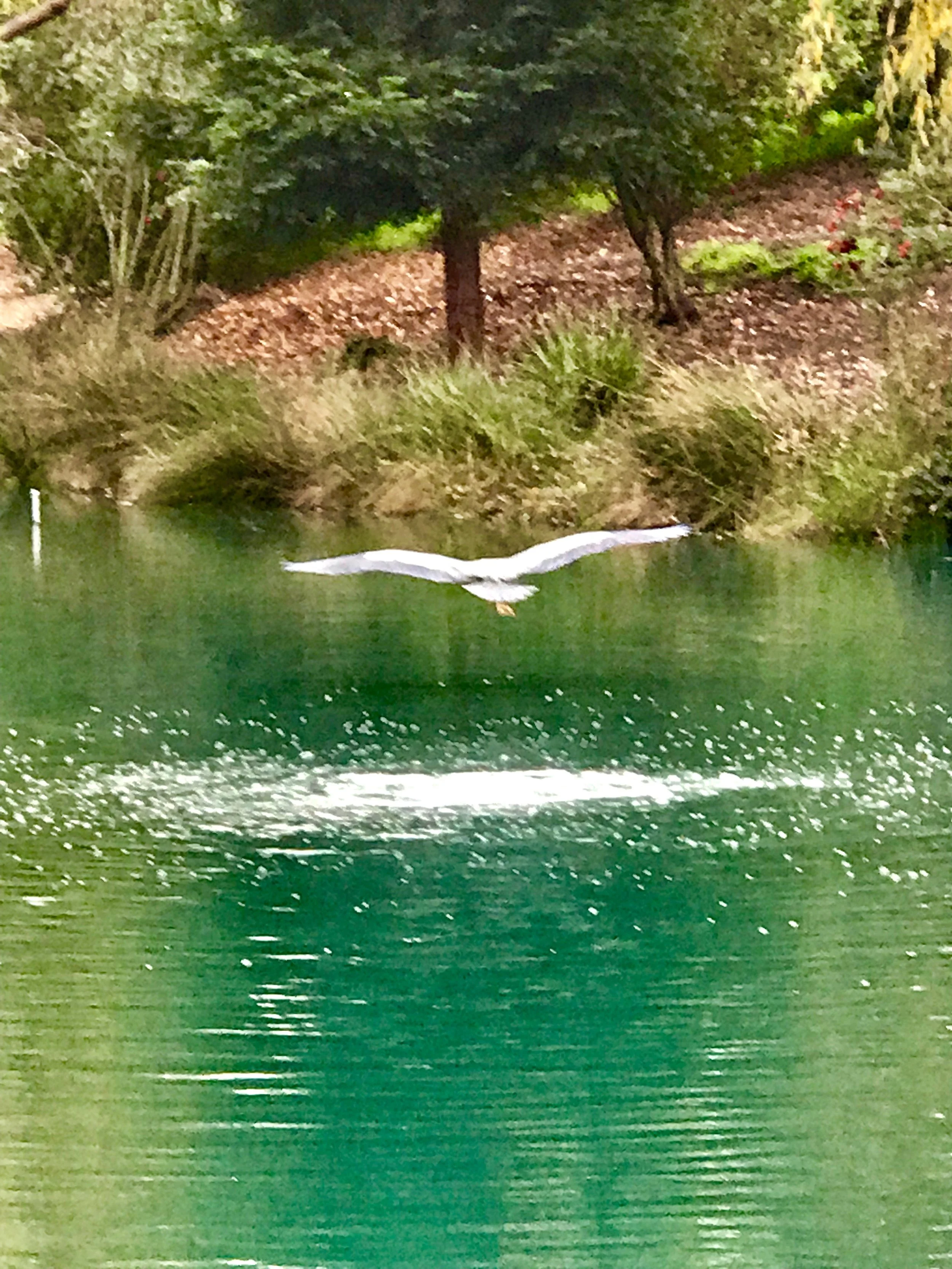
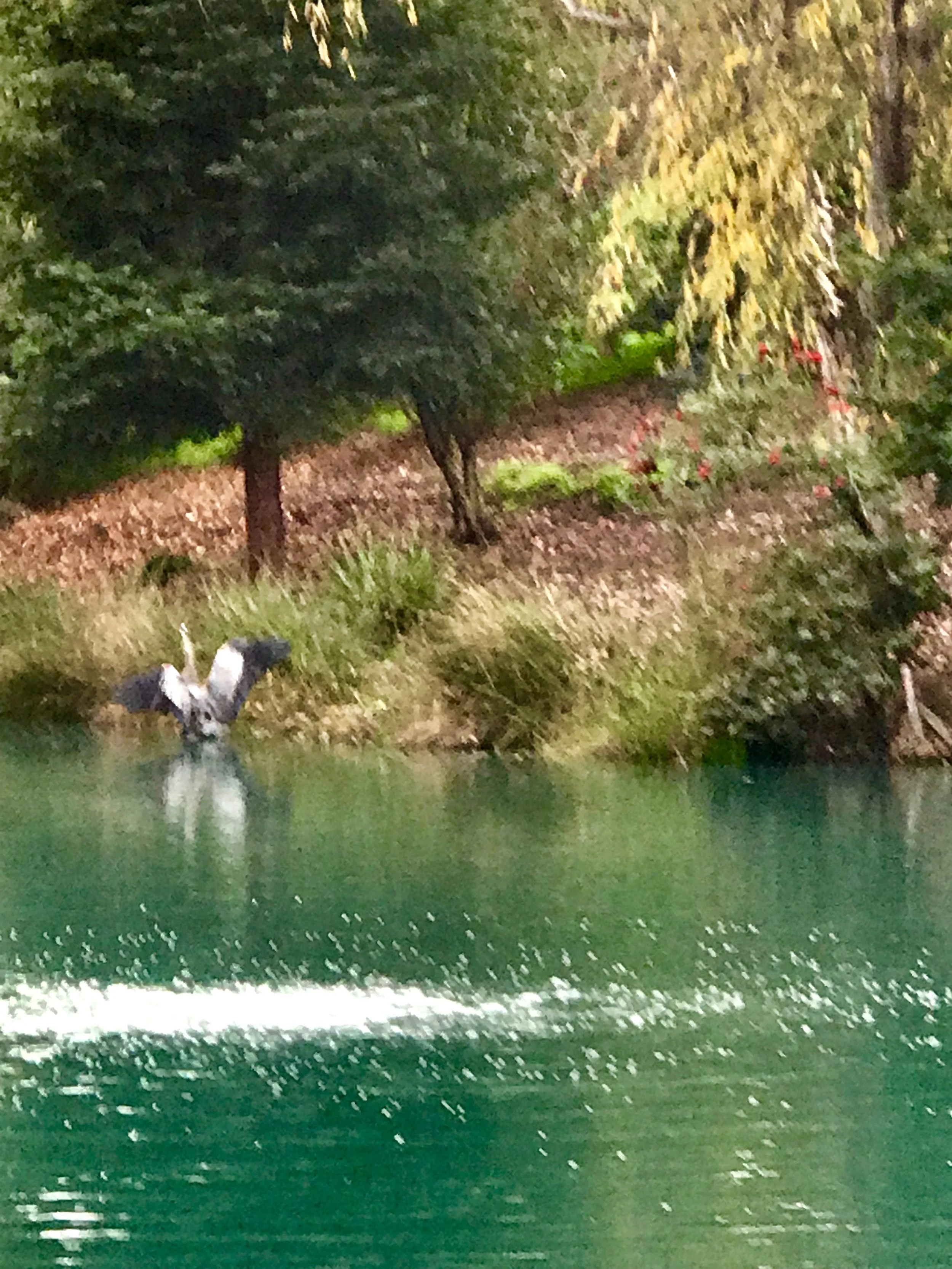
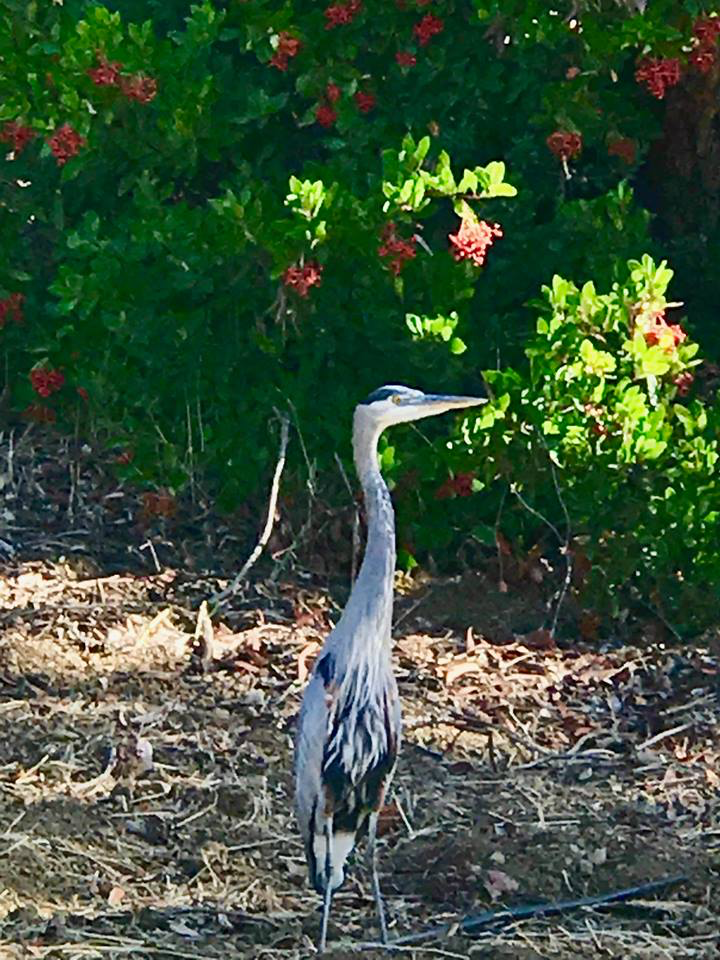
I spotted this magnificent Great Blue Heron while walking along the nature trails around the perimeter of the lake where we live. It was standing motionless in the weathered reeds, gazing into the water for prey with all the stillness of a monk meditating in a forest monastery.
When I first made my approach, only its’ head was visible.
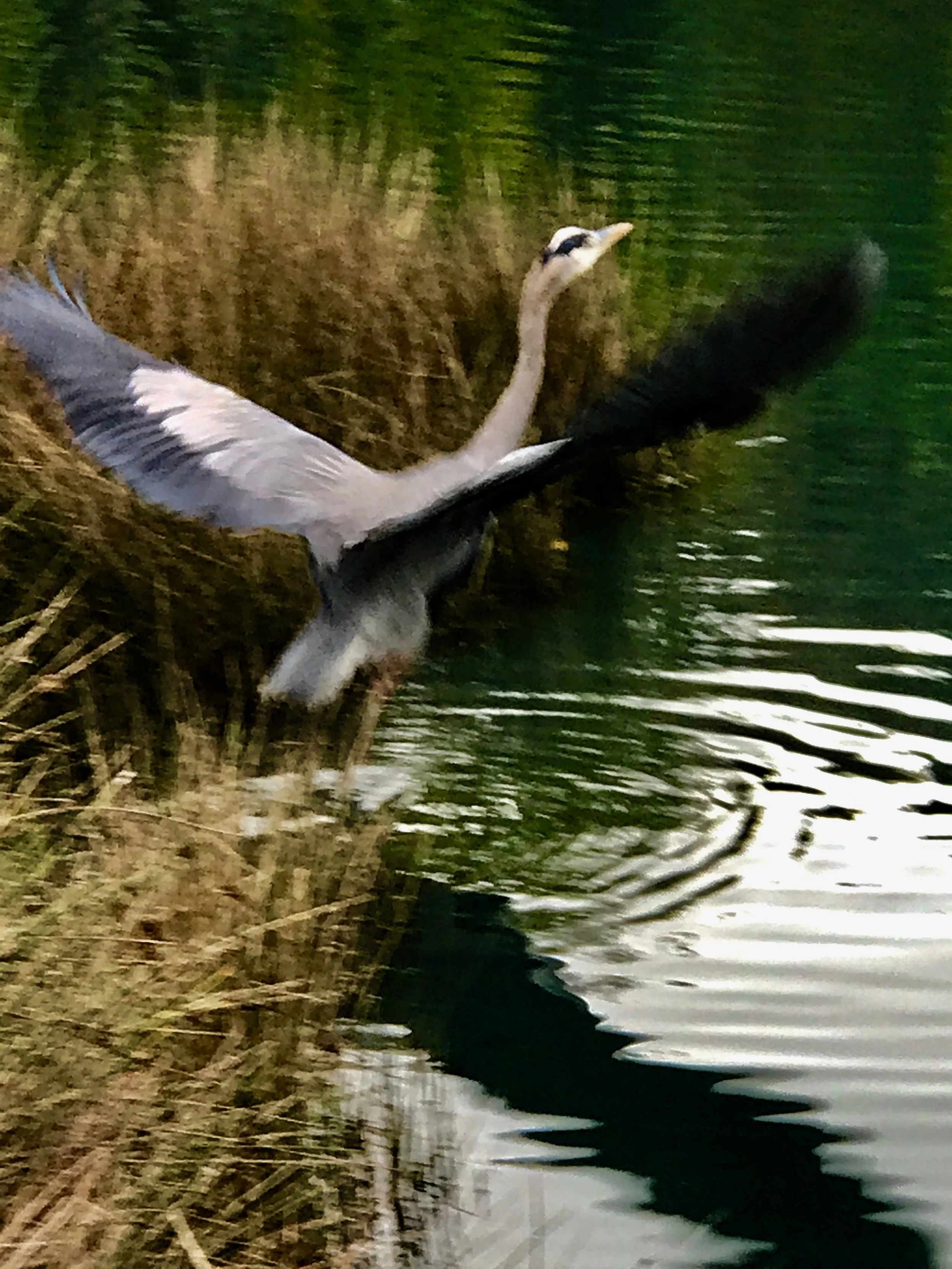
Then, sensing my presence it began to walk towards the water. Suddenly, it spread its wings, and was ready for take off. It then folded it neck into a “S” shape, lifted itself, and soared to the other side, trailing its long legs behind. I had hoped to capture a few still shots and was fortunate enough to photograph the sequence of its majestic flight path.

Symbolic Meaning of the Great Blue Heron:

Calm
Graceful
Patient
Versatile
Tranquil
Mindful
Determined
Independent
Confident
Resourceful

Herons live in the NOW and teach us the vital practice of maintaining stability, calm, focus, and fluidity in our lives.

An excerpted Poetic offering called Heron Rises from the Dark, Summer Pond
by Mary Oliver

So heavy
is the long-necked, long bodied heron,
always...a surprise
when her smoke-colored wings
open
and she turns
from the thick water,
from the black sticks,
of the...pond…
and slowly into the air
and is gone.
Then, not for the first or the last time,
I take a deep breath
of happiness…
this decision,
this trailing of the long legs in the water,
this opening up of the heavy body
into a new life: see how the sudden 
gray-blue sheets of her wings
strive toward the wind; see how the clasp of nothing
takes her in.

Photos of the Blue Heron taken at Rinconada Hills
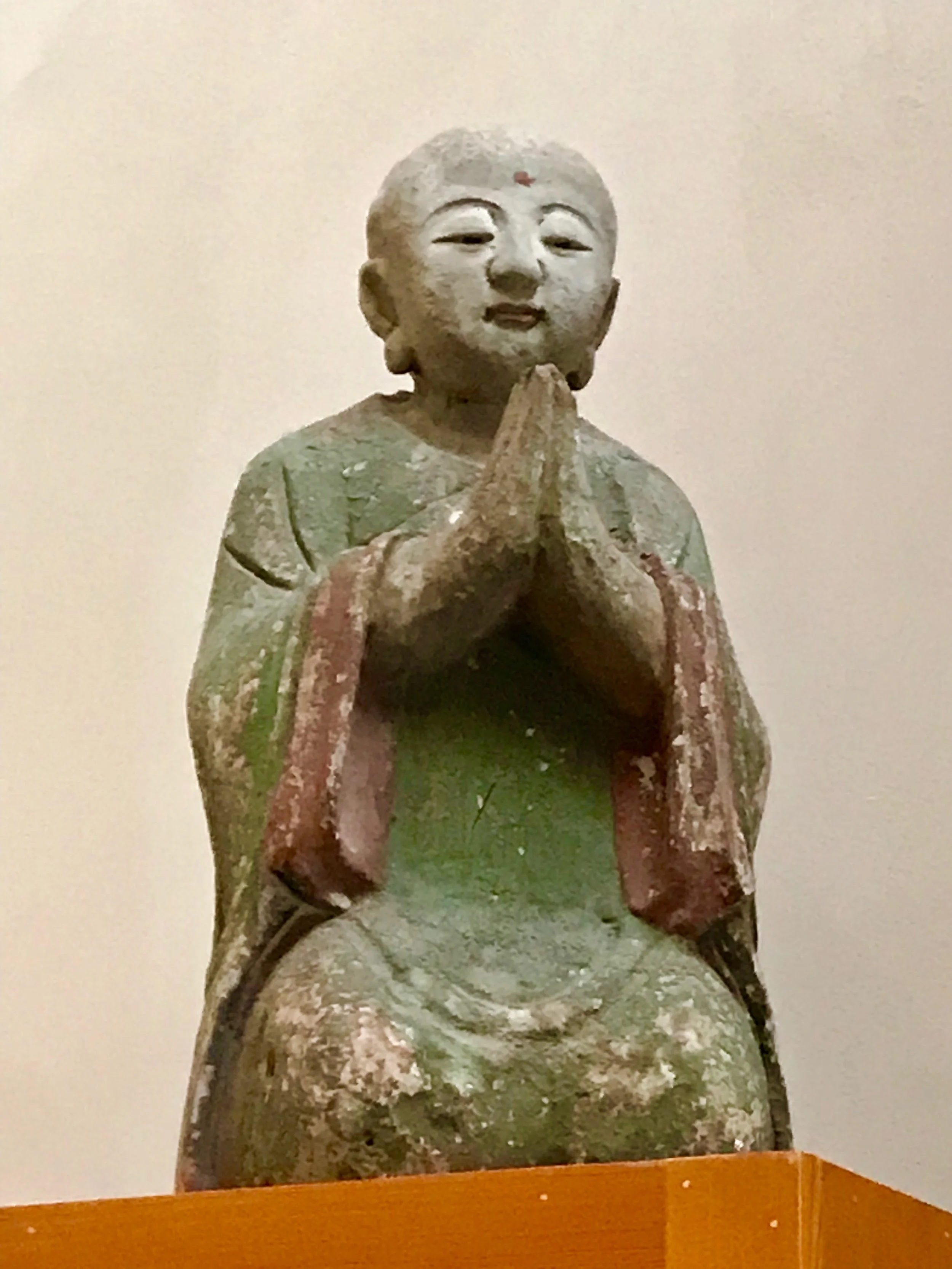
Photo of the statue of the monk taken at Breathe Together Yoga studio

Our Beautiful Golden State is Burning: Turning to Poetry to Make Sense of it All

"The natural world is violent and dangerous as well as serene and benign."—Thomas Berry

I awoke the other day with my eyes burning and a queasy feeling in my stomach. Cecile wasn’t feeling none the better. We normally keep our sliding door on the second
floor of our town home open to get fresh air when we sleep.
The news hadn’t hit us yet about the two raging fires that were hitting both sides of the state.
In spite of the sour smelling air we took our son’s dog, Daisy for our usual early morning two-mile walk.
When we rounded the bend to the front of the Clubhouse of our gated community. 
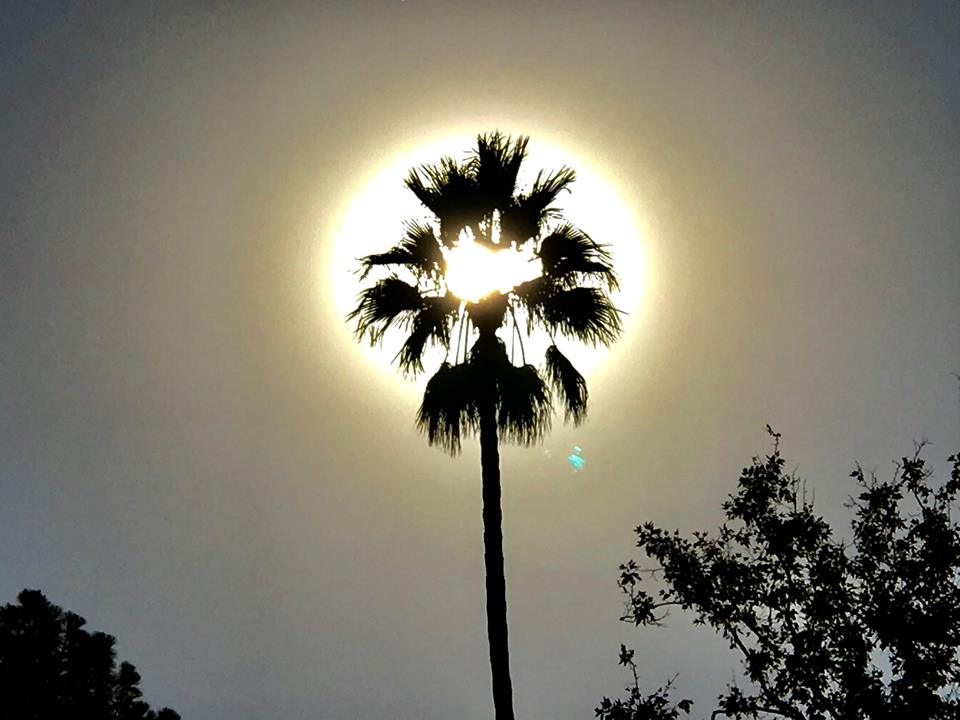
I photographed the sun blazing through the back of the fronds of a tall, solitary majestic palm tree, giving it the appearance of being on fire. It had a mystical quality to it.

Later, we learned about the catastrophic Woolsey fire in and around Malibu that had engulfed Southern California.
As if that weren’t enough, we heard news of the Camp Fire in Northern California that consumed 80-90% of Paradise, located in Sierra Nevada Foothills, making it the deadliest wildfire in the state’s history.

It didn’t take long before the seasonal winds carried smoke-filled air from the raging fires to entire East Bay including Silicon Valley where we live.
Even those who were lucky enough to buy an N95 mask that filters soot from the air, health officials were still advising people against being outdoors.
Die-hard Oakland Raiders and San Francisco 49er fans attended their respective games. The risk of exposure to poor air quality in the unhealthy range is that microscopic particles seep deep into our lungs and enter the bloodstream.

In times like these when a fire makes a mockery of the name Paradise, by unmercifully burning the small, residential town down to the ground, I turn to the solace and irony of poetry.

"California night. The Devil’s wind, the Santa Ana, blows-in 
from the east raging through the canyon like a drunk
screaming in a bar.
The air tastes like a stubbed-out cigarette. But why complain?
The weather’s fine as long as you don’t breathe.
Just lean back…lights turned out, windows shut against the [fire] storm and count your blessings...
Relentlessly the wind blows on. Next door catching a scent, the dogs begin to howl. Lean, furious, raw-eyed from the storm, packs of coyotes come down from the hills where there is nothing left to hunt.”
—a poem by Dana Gioia

Our hearts go out to all of those who lost their homes and loved ones during this horrific calamity and a deep sense of gratitude to the firefighters and other first responders who risked their lives.

Photo 1: I captured in front of clubhouse where we live.
Photo credit 2: Helicopter over blaze by a TV news team 
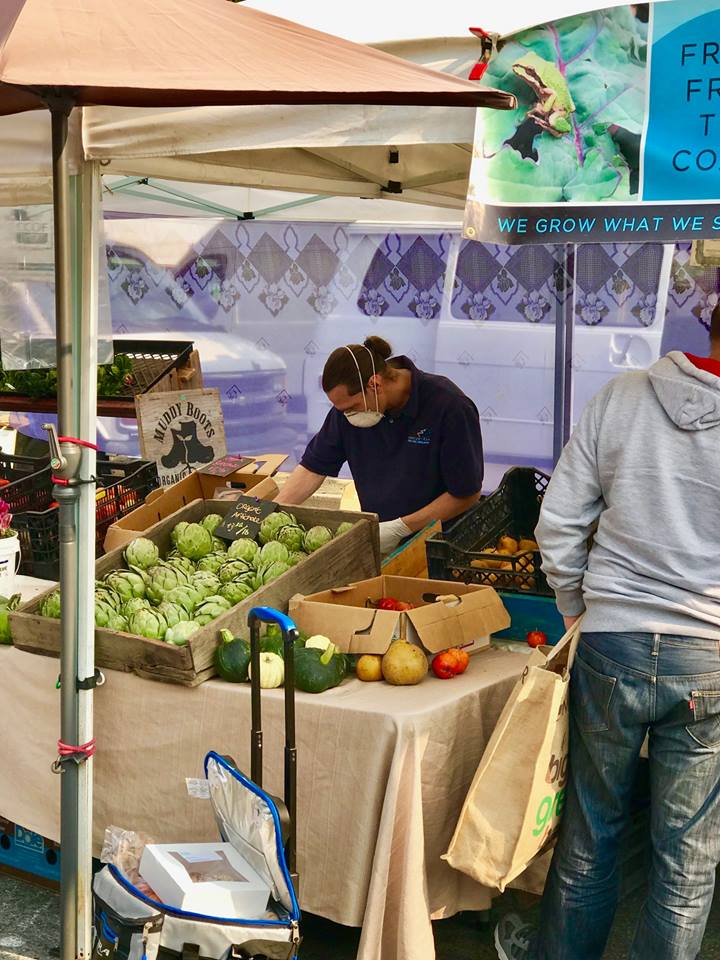
Photos: 3 & 4 were taken of vendors with masks at the Saratoga Farmer's market

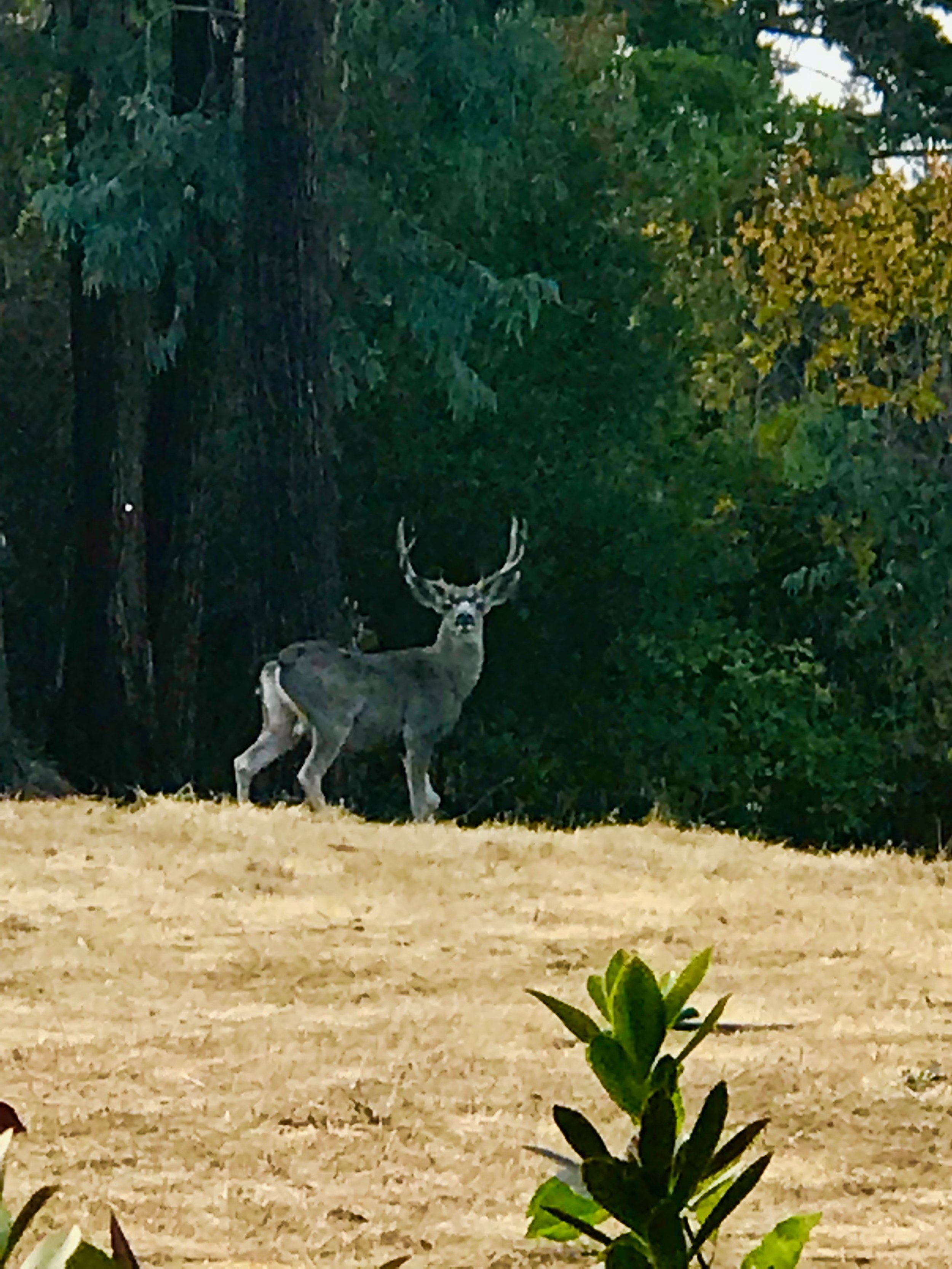
My Encounter with a Majestic Deer in the Open Meadow at Rinconada Hills

It’s been said that if there is a race between a lion and a deer, the deer often wins because a lion runs for food and a deer runs for its’ life. Purpose is often more important than need.

Cecile and I were just beginning our early morning walk. She was trailing behind me with Jason’s dog Daisy.
Suddenly, I heard a loud rustling noise in the bushes far to my right, and the flash of a large animal appeared through the trees. It was a stag. Startled, It made a sharp turn across the road to the left. I could hear its hooves making contact with a long white catch basin as it clumsily tried to gain its footing. It rumbled across the terrain like a 350 pound thoroughbred then disappeared into the bush.

I walked further down the path hoping against hope to get another glimpse. After all, a deer sighting of this kind is not a common occurrence on this large tract of land where we live. Just as I was ready to give up, there it stood, out on the open meadow on my left, maybe 40 feet between us. It stared back at me, as if daring me to make the first move. It's elegant rack etched out against the back drop of the field and the trees like a king of the forest.

Time seemed to stand still. I retrieved my camera hoping to capture its image before it fled. I snapped a few shots.
By this time Cecile and Daisy had caught up to me and I pointed to this majestic creature. I had wished I had a greater zoom lens, worried that my iPhone camera wouldn’t capture its essence. Then, I told myself to relax, experiencing this moment in time with this beautiful creature is the “essence.” 

I felt like I was in a dream like state, watching something unfold that was surreal and imbued with some sort of meaning. In Buddhism, the deer symbolizes harmony, happiness, peace and longevity. If one were to look up the symbolic meaning behind “stag,” you’ll find repeatedly that the animal represents an in-between state, a world connecting dreams and wakefulness—the world of intuition. The antlers are like a crown, that grow beyond the body, bringing it closer to the sky revealing its sacredness. The fact that the antlers fall and grow again also makes the deer a symbol of regeneration.

Antlers are said to act as a spiritual antennae, urging us to be more mindful of our thoughts and perceptions and directing us to a higher state of awareness. In this faced paced world of technology it seems to be a message worth heeding.
Ecstatic Flower Blossoms & Stalking the Elegant Great Egret for a Winning Photo Shot

“Flowers are sweet. They have short beautific lives. They offer much pleasure. There is nothing in the world that can be said against them. Sad, isn’t it, that all they can kiss is the air. Yes, yes! We are the lucky ones.” —Mary Oliver

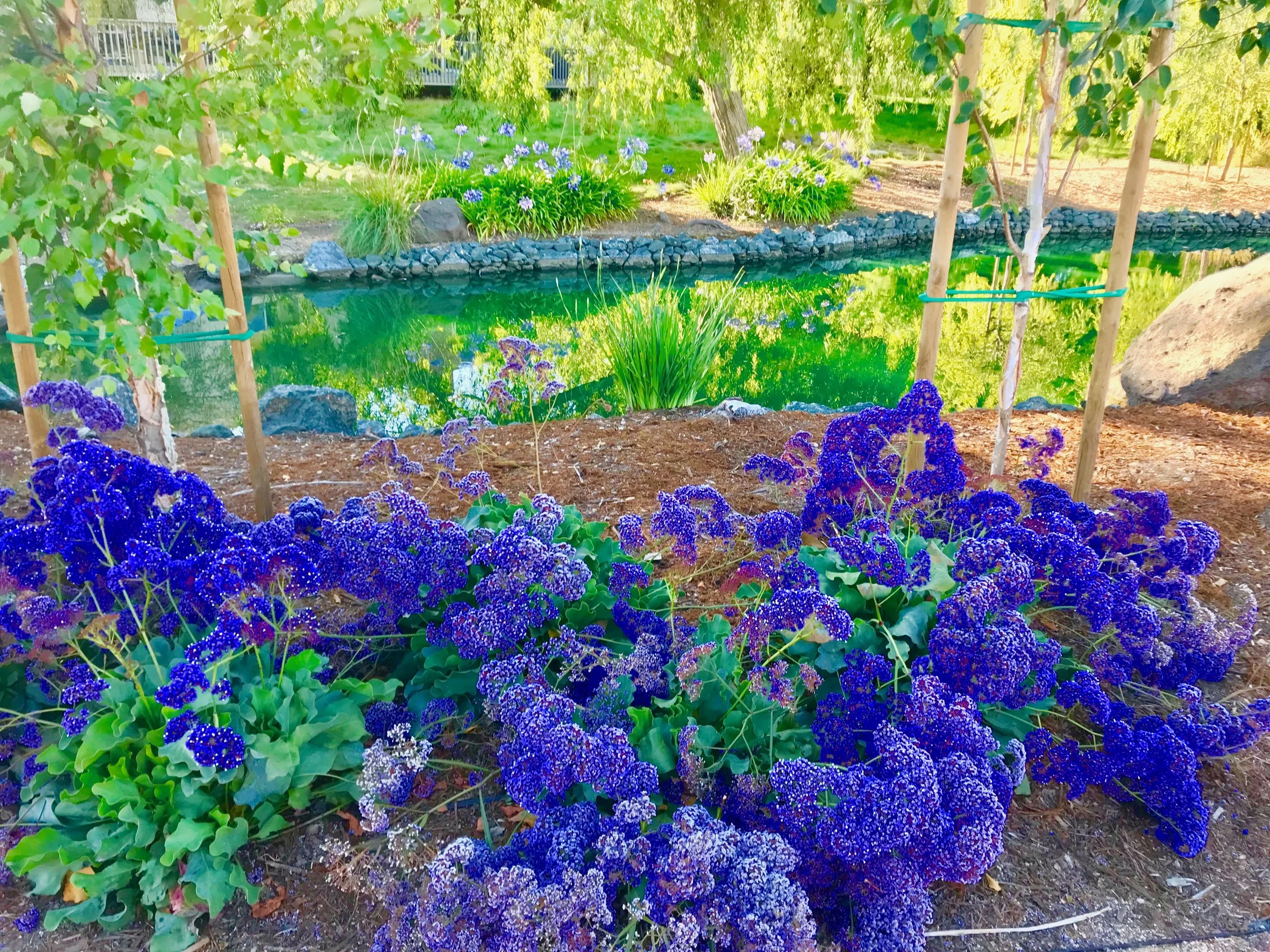
Cecile and I passed this Royal Blue Hydarangeas on the walking trails with the blue green pond in the backdrop near our townhome. These classic flowers—first discovered in Japan—coalesce together to form a signature globe-shaped head resembling pompoms. They symbolizes heartfelt emotions, used to express gratitude to others for our being understood. 
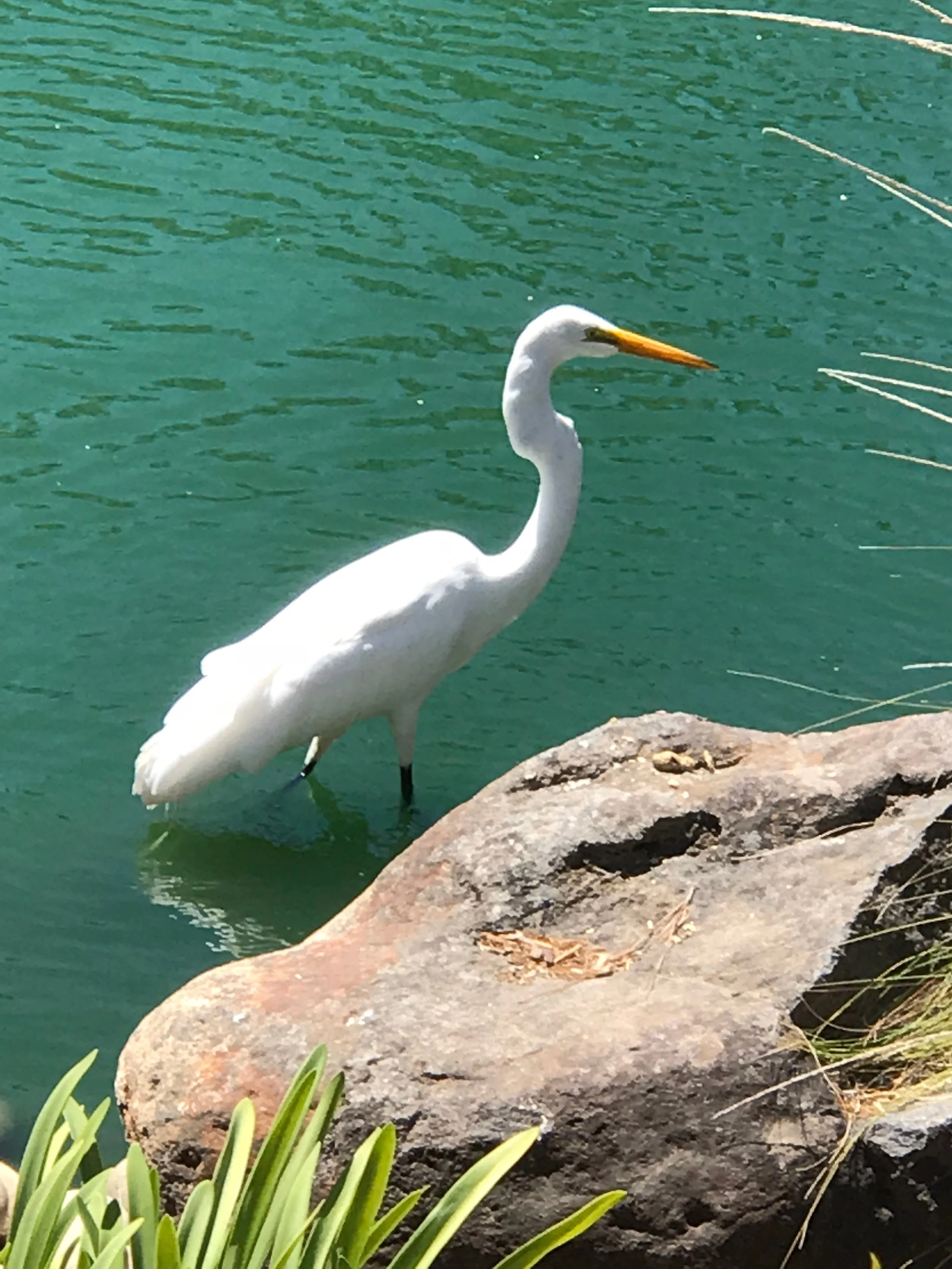
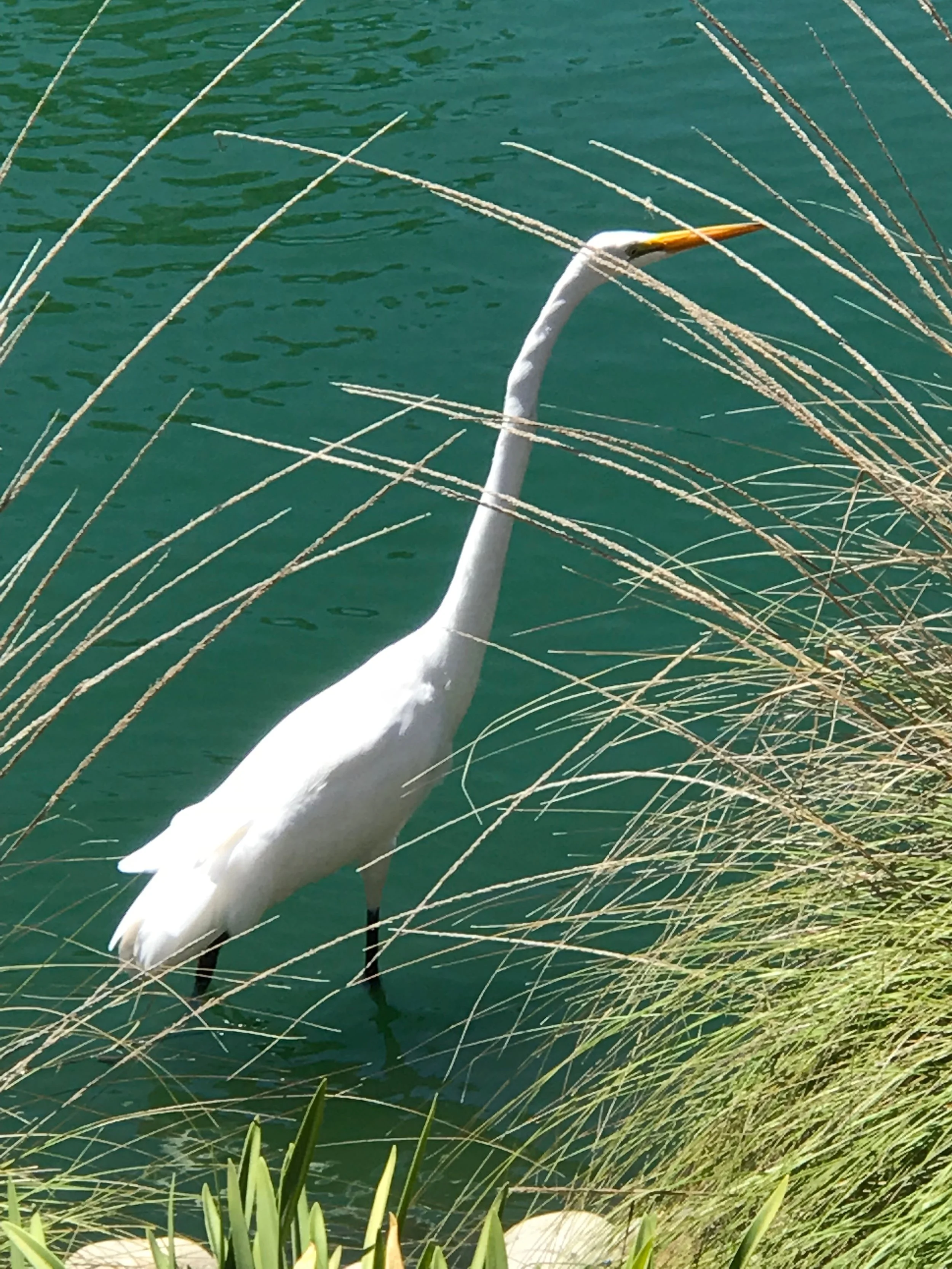
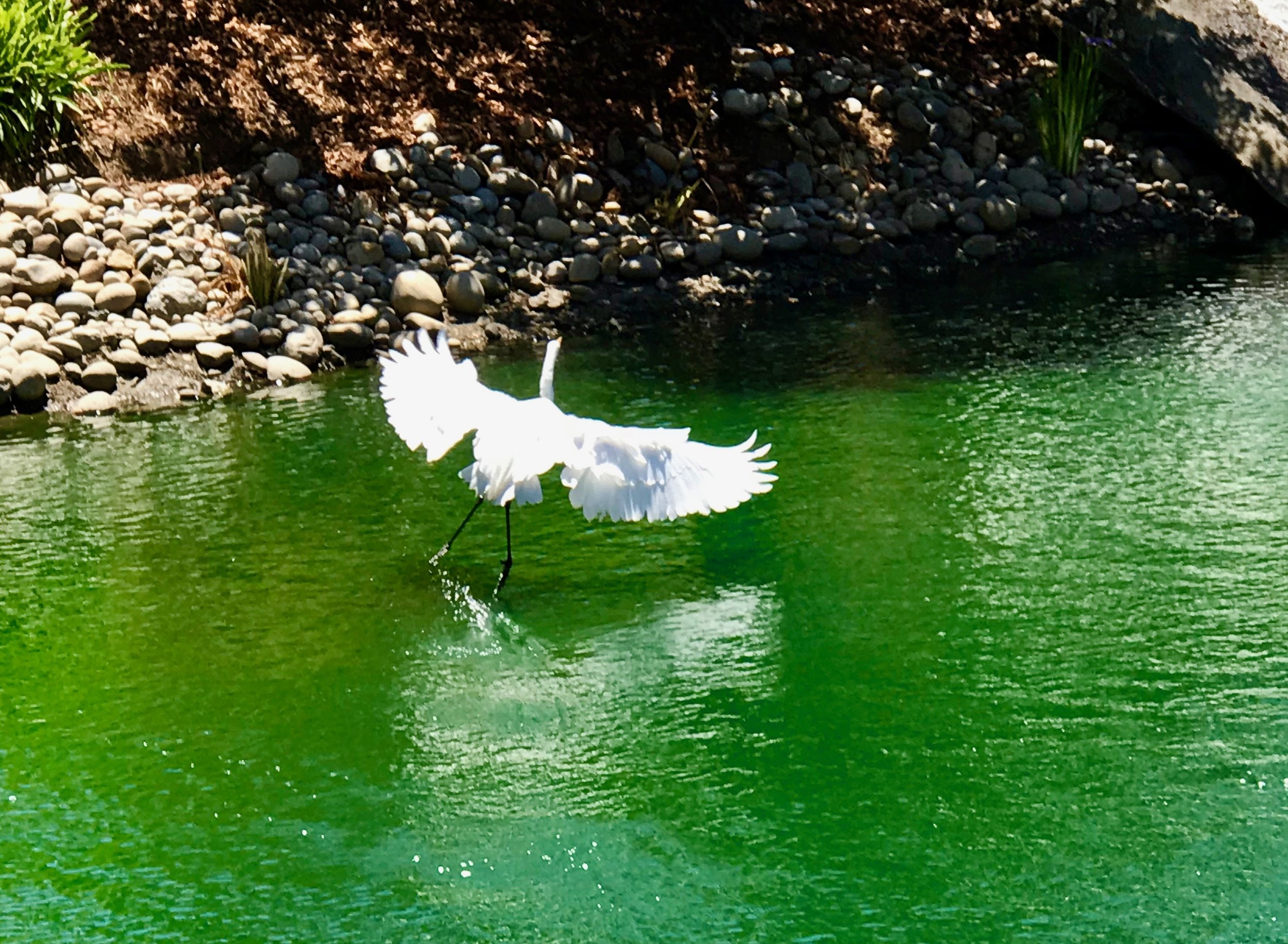
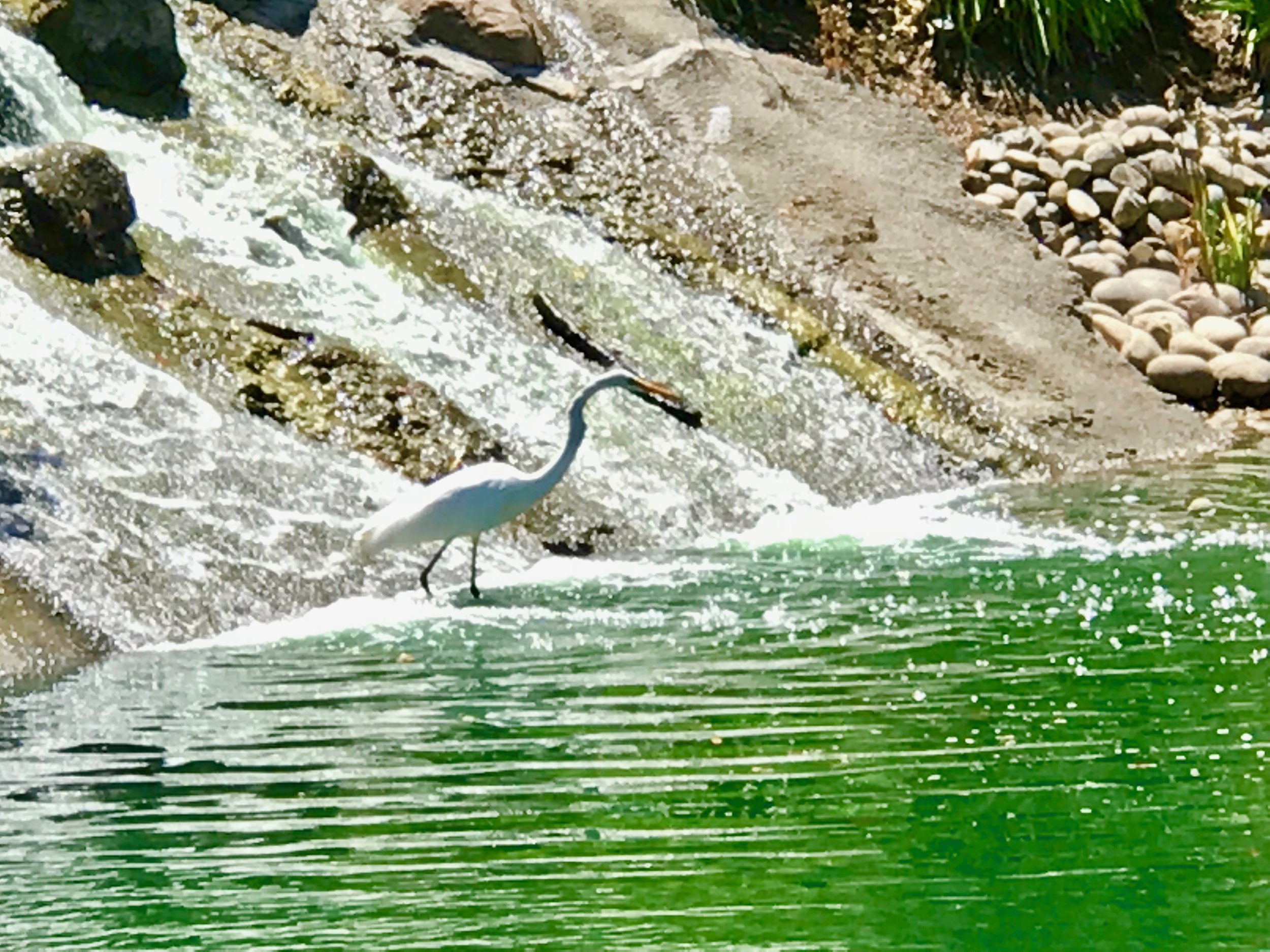
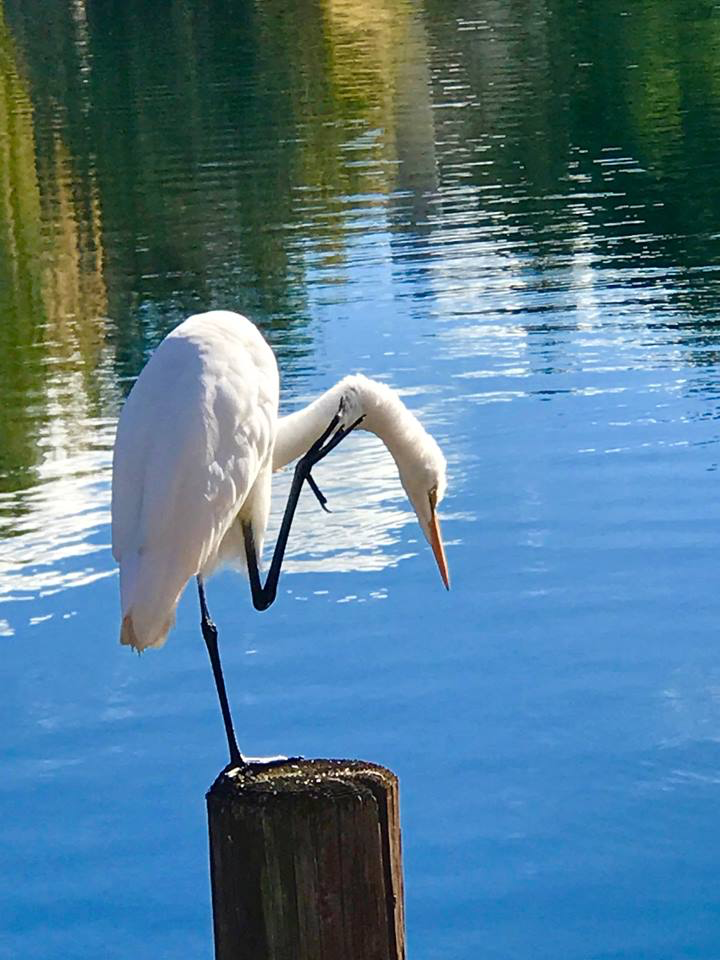
The Great Egret visits us from time to time. They boast a showy brilliant white plummage and are found around the world. I have sighted them in Asia, Canada, Africa and Australia. Locally, we have seen them at Shoreline and Vasona Lake. They have long black legs and feet, long graceful necks and straight, pointed, yellow bills.

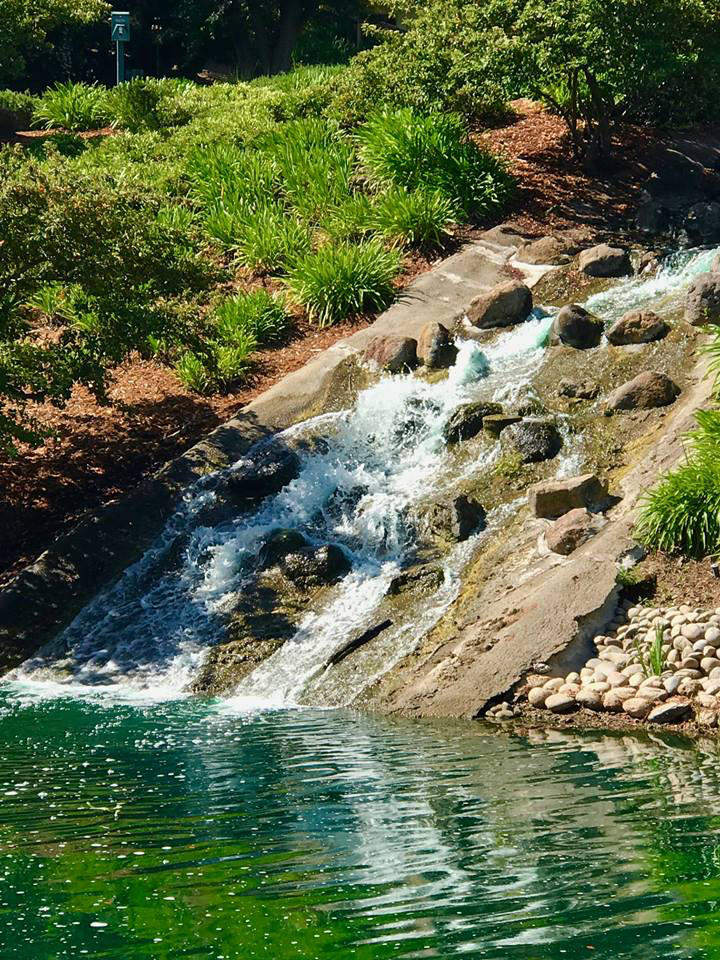
I discovered this one wading patiently in the shallow water of the pond stalking fish. I watched it stab and grab a tiny fish into its mouth. Egrets also prey on reptiles, amphibians and small mammals. I was doing a bit of stalking myself—for that perfect photograph. I managed some nice closeups but was hoping to capture it in front of the waterfall.
Well, I got my wish. Feeling I got just a little too close, the egret took off in flight. I not only managed to get a photo of it landing, but when it reached the opposite shore it began moving toward and then in front of the waterfall. Bingo! I had my “money shot.” Now that is what I call a happy accident or was it the power of my intention in operation? When they fly, their neck draws back in to an S-shaped curve. 

Their feathers are stunning. Sadly, these elegant birds were hunted to near extinction towards the 19th century.
Their feathers were used to make hats. Following conservation efforts, their numbers grew well into the 20 century. The Great Egret was chosen as the symbol of the Audubon Society, the environmental organization that was formed to protect birds.

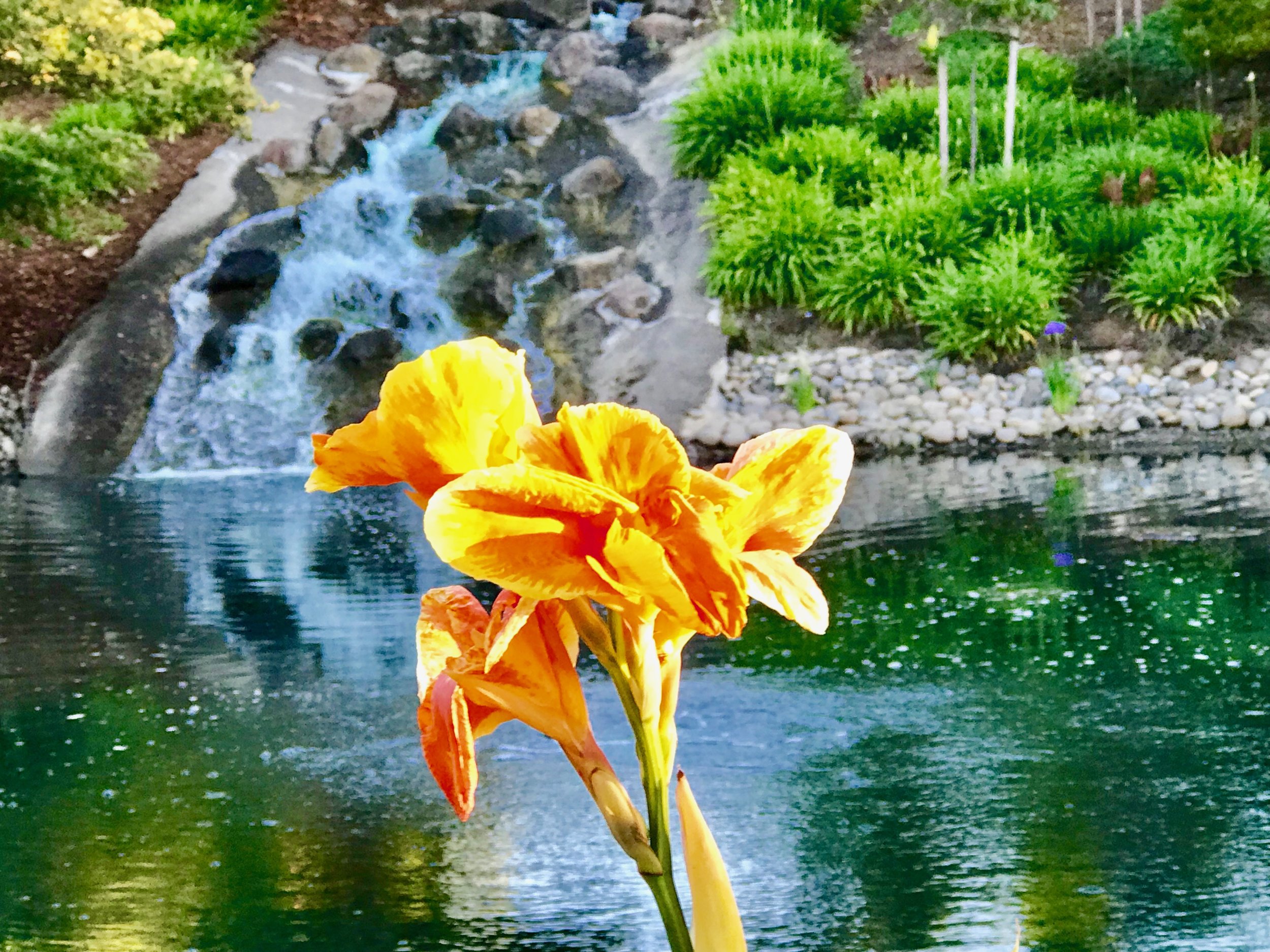
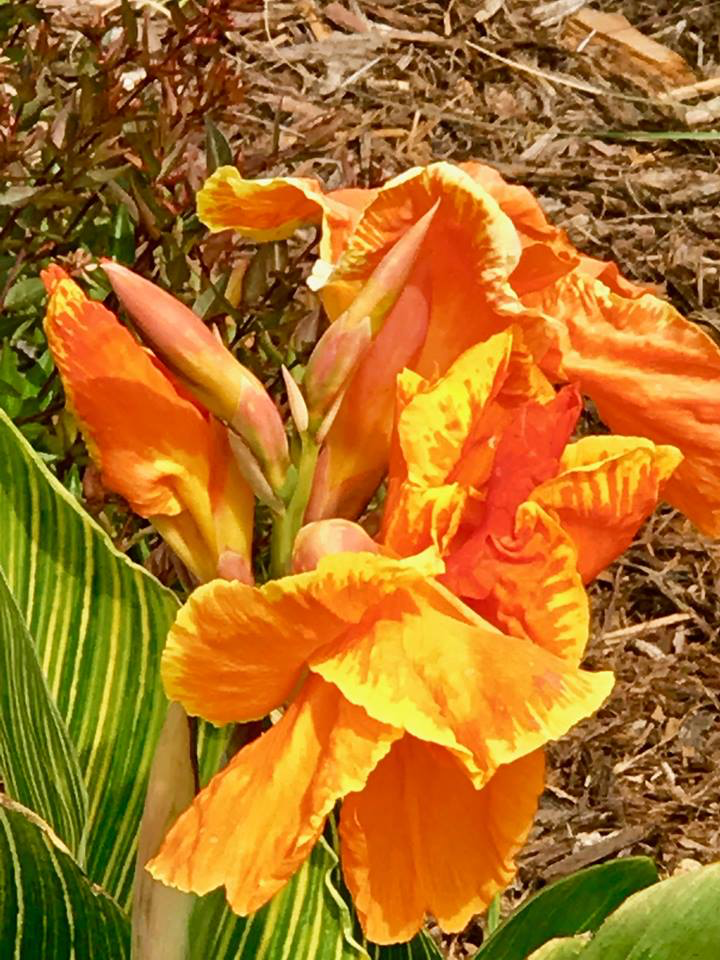
The glorious Tropical Canna Lily has bright large yellow-orange blooms and exotic multi-colored striated foliage. They symbolize magnificent beauty, brilliance of truth and sacredness. It is native to southern Africa. Canna Lilies are also known as the tantalizing water dragon and trumpet lily, though in fact it is not even a lily. It was misnamed by a famous Swedish botanist, Carolus Linnaaeus, and was later corrected by German Koch, a German botanist.

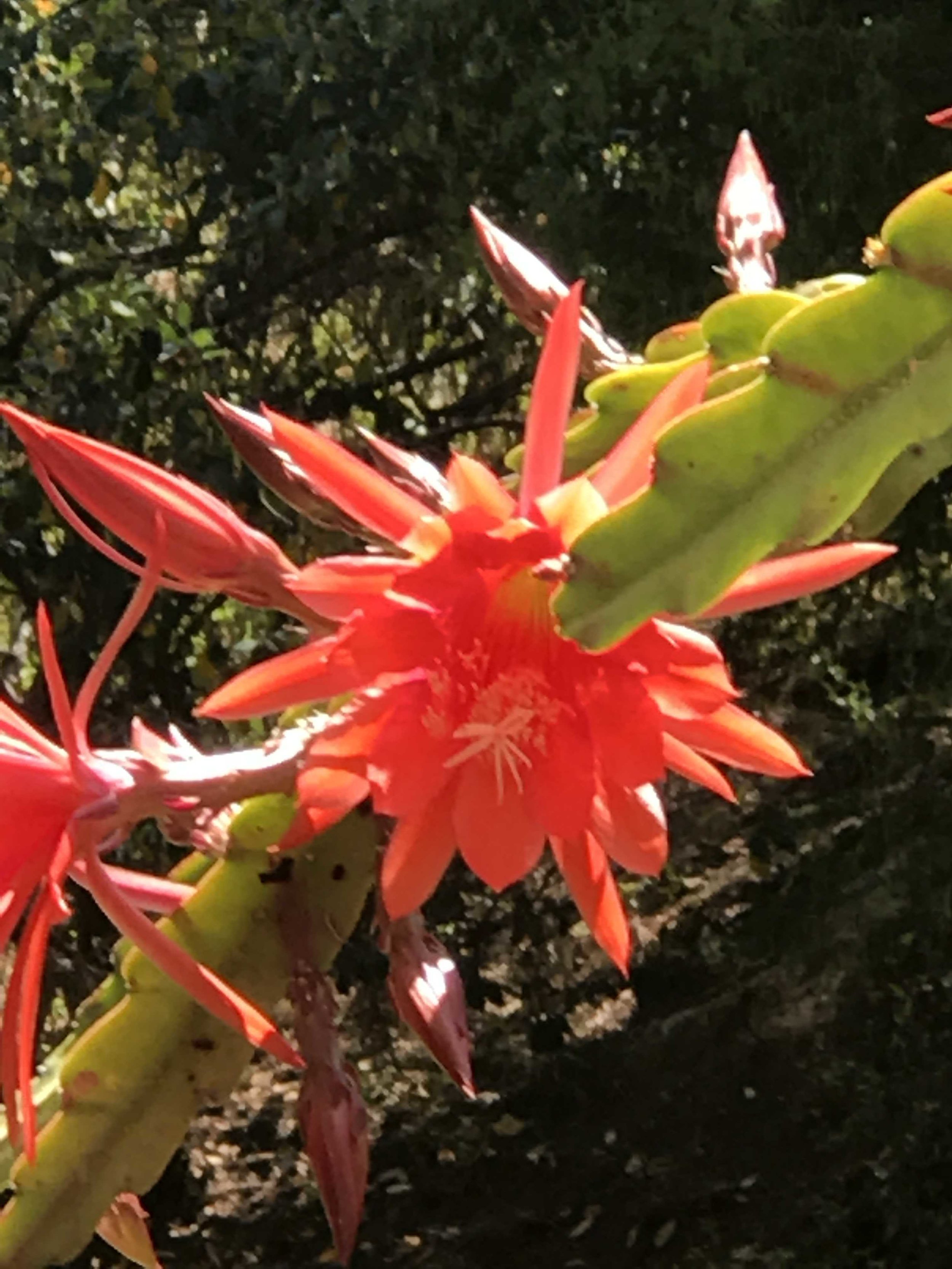
Last but not least is the red Epiphyllum Cactus Flowers (Jungle Cactus). Epiphyllums can be found in Mexico, the Carribbean and through Central America and South America. Hybrids like this one, are commonly referred to as “Orchid Cacti” due to their luminous blossoms resembling tropical orchids. They are hardy and easy to grow. I was first introduced to the Empiphyllum by my next door neighbor, Howard who hybridizes them. He has one growing in a pot and in a long planter on our neighboring patio wall. We get to enjoy them during their short blooming period. They take your breath away.


Enjoying the Breathtaking Ambience of Nature and Wildlife Outside our Door

“I could not be a poet without the natural world…For me the door to the woods is the door to the Temple.”
–Mary Oliver

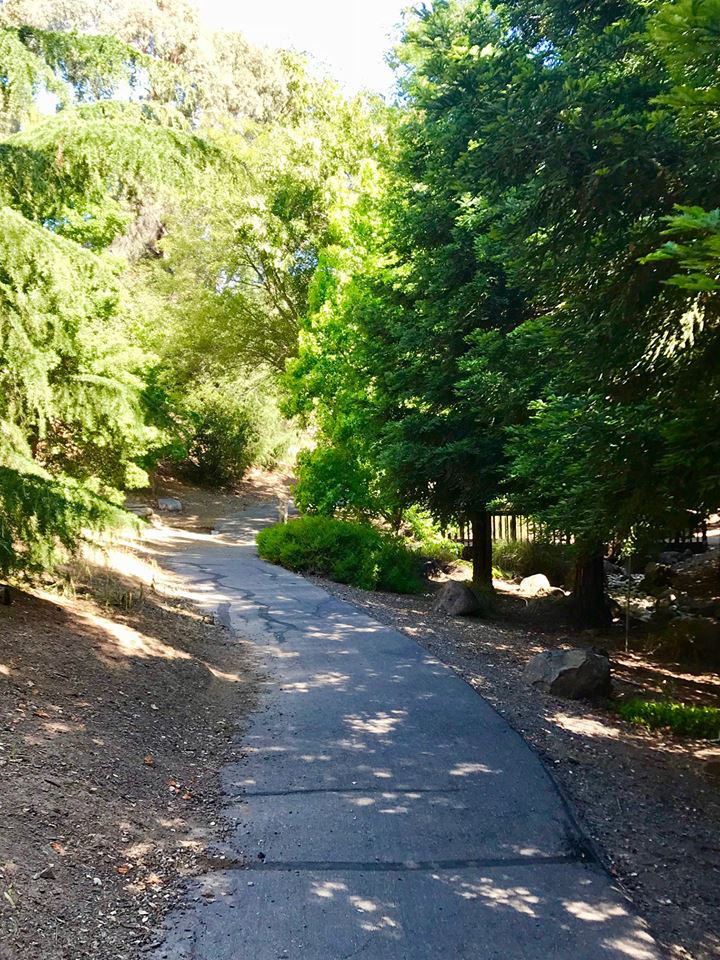
In the early morning, mid-day and after dinner, Cecile and I and Jason’s dog Daisy set out on the walking trails literally steps from our door.
We are immediately transported to a happy place in the midst of a 100 acre wooded area we call home at Rinconada Hills.
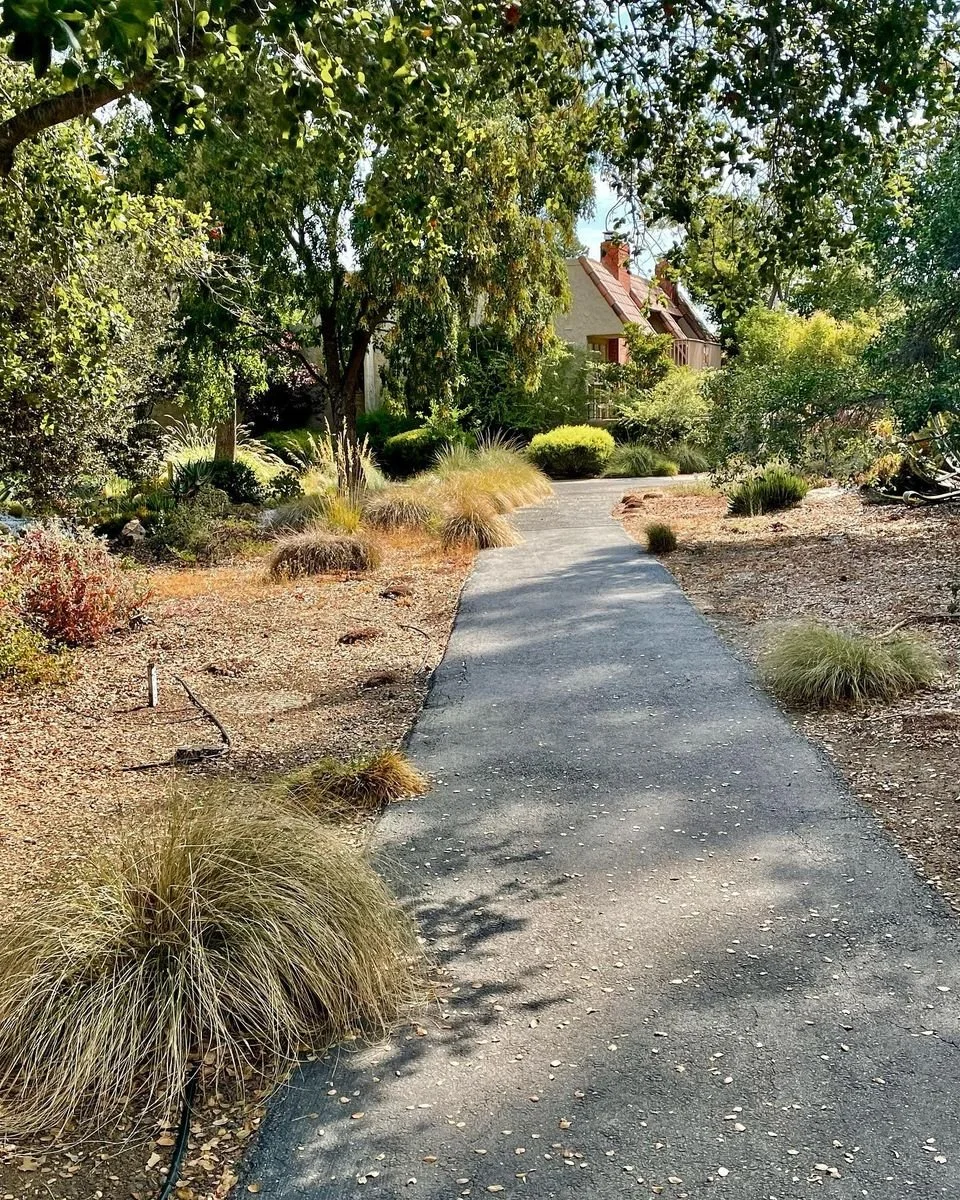
We pass the cactus gardens I can see from my home office window, a plethora of mature shade trees that line the self-guided nature trails that traverses a wide variety of terrain. 
The many tiny lizards flit about as they feel the vibration from out feet.
We could see and hear the mischievous squirrels shimmy straight up the tallest of trees in a way that defies gravity and then playfully jumping from branch to branch.
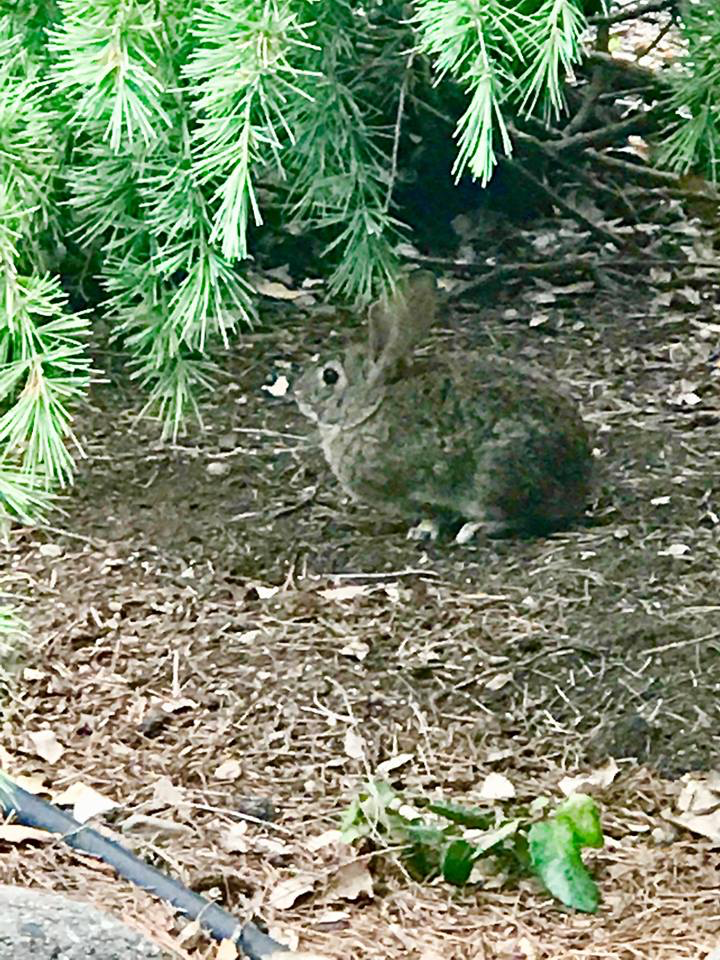
We see the many shy white cotton tail bunnies (we feared were wiped out by the coyotes) shift about trying to take cover as we draw near. The cherry trees and plum trees are bearing fruit, but too early to eat.
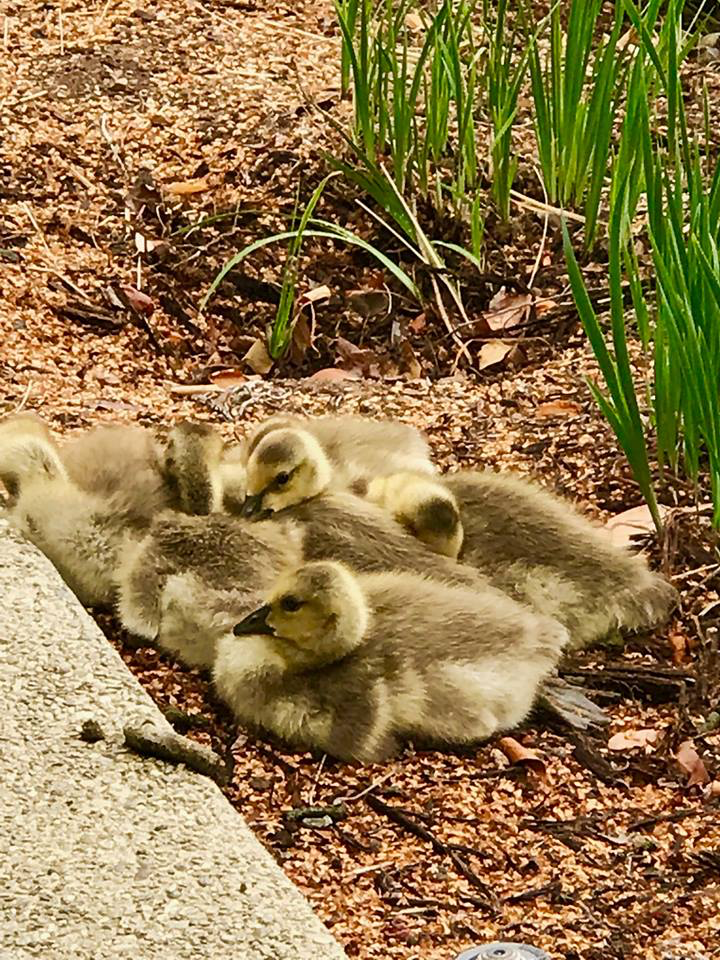
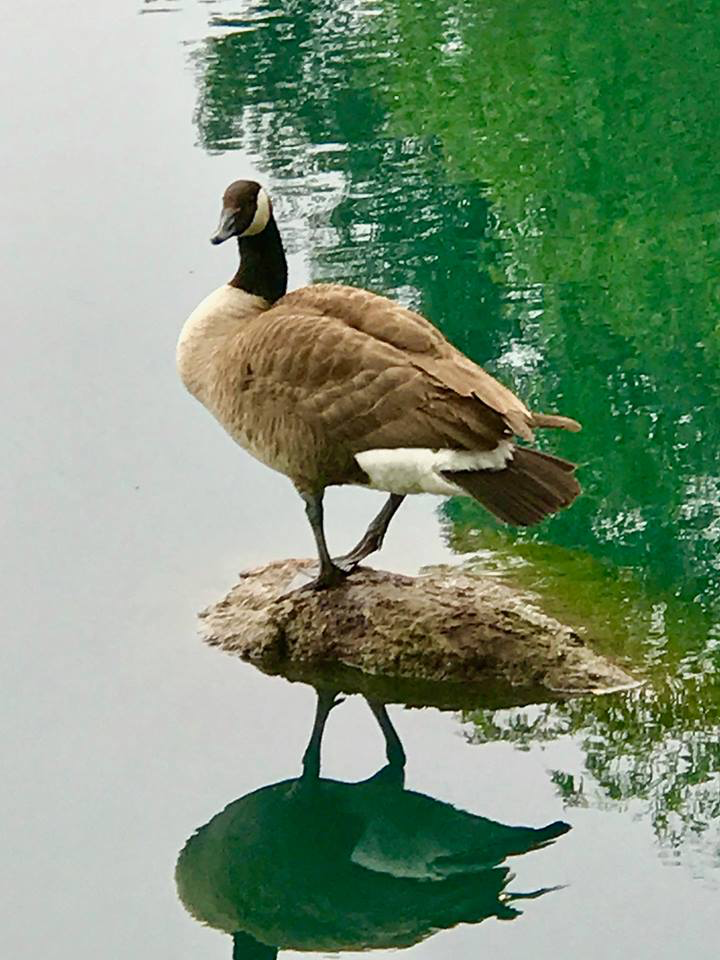
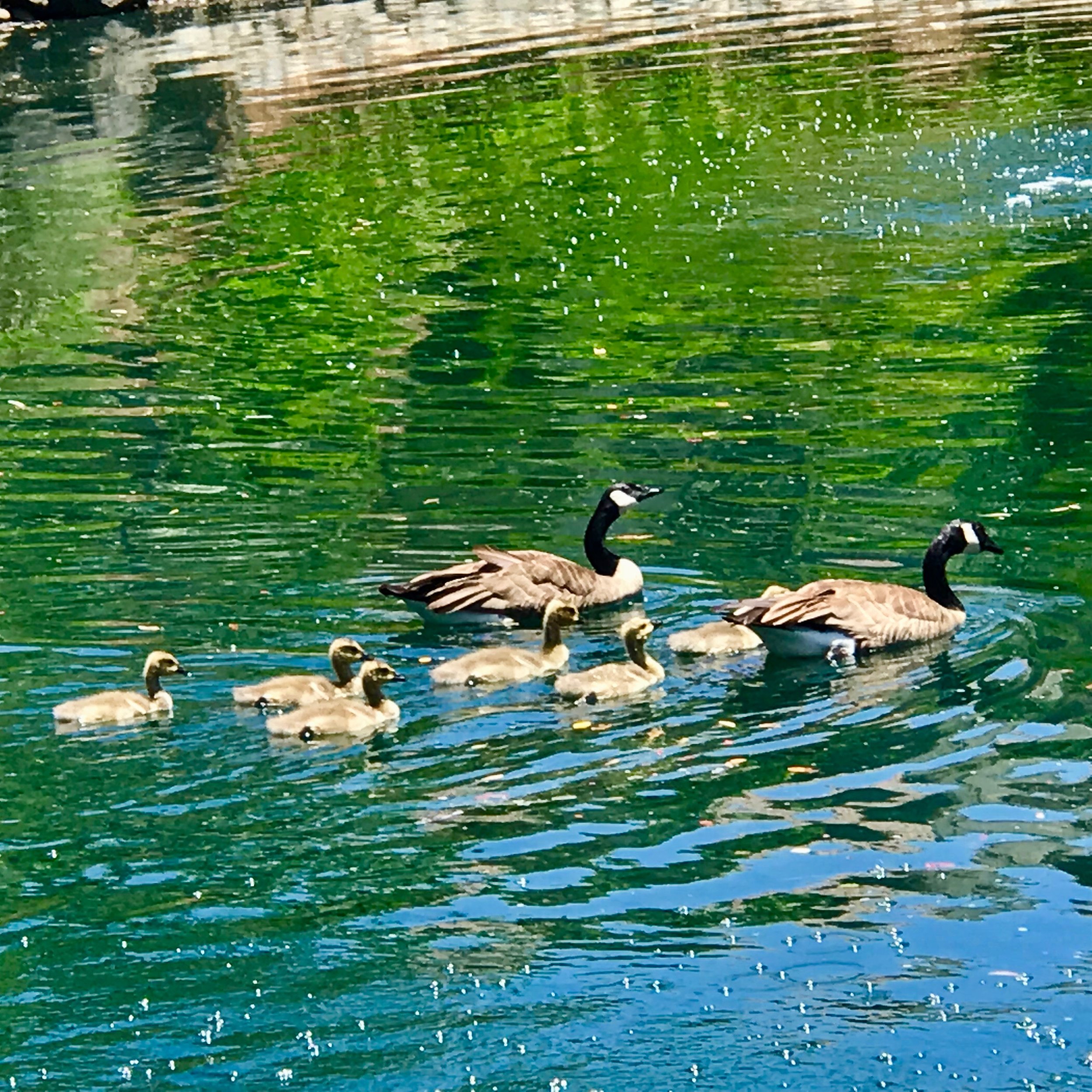
We climb the path to higher ground and then make our way down and around the pristine lake where the geese take their goslings for a swim when they are not grazing on
the grass. The aromatic smells from the pine and eucalyptus trees clears our sinuses.
Other than the few neighbors and their dogs we have come to know, we are alone to share the moment and majesty of this place. It reminds me of the poem by Mary Olliver called “When I Am Among the Trees,” that I have taken an exerpt from that goes like this:
"When I am among the trees,
especially the willows and the honey locust,
equally the beech, the oaks and pines,
they give off such hints of gladness,
I would almost say that they save me, and daily…
I never hurry through the world
but walk slowly, and bow often.
Around me the trees stir in their leaves and call out, “Stay awhile.”
The light flows from their branches.
And they call again, “It’s simple,” they say, “and you too have come into the world
to do this, to go easy, to be filled with light and shine.”

Capturing The Beauty of The Mahogany Mourning Cloak Butterly While It was Sunbathing

"Nevermore will a flying flower drift by you unnoticed..."
—Flutter-Blog 

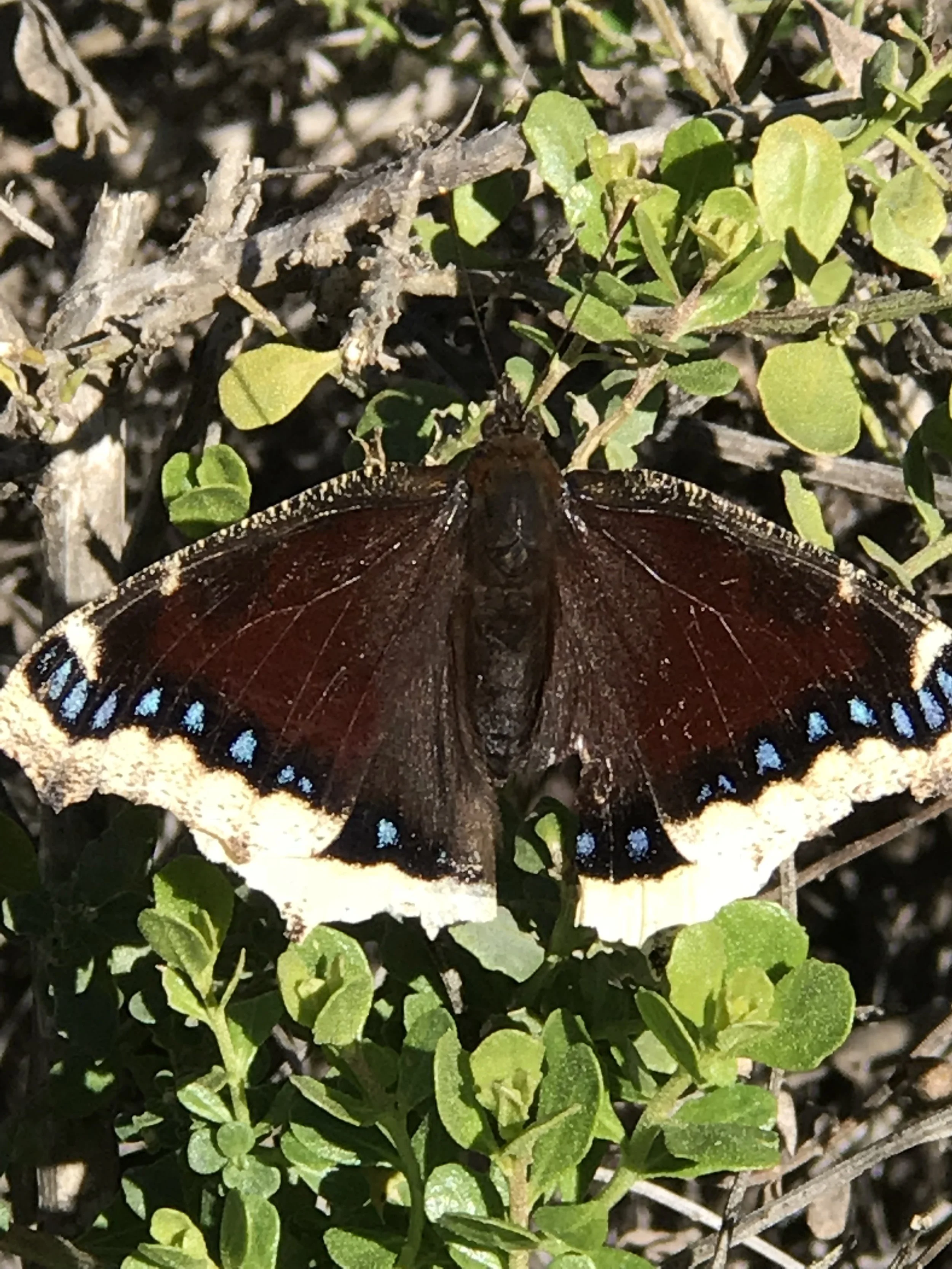
During a walk on the trails of Rinconada Hills with my wife Cecile, I experienced my first sighting of a Mourning Cloak Butterfly (Nymphalis Antiopa, 1758 by Linnaeaus) basking in the sun. It was laying flat atop a low lying green plant with dry woody stems near the water’s edge of a cascading pond near our town home. I was amazed it allowed me to get close enough to photograph it without flying off.

This Mahogany brown butterfly with light tannish yellow edges is named after the funeral shawls worn over a pale dress or petticoat by grieving widows. The darker brown band around the main wing is accented with pale blue-lavender spots that adds to its beauty.

The Mourning Cloak butterflies, do not migrate long distances but hibernate over winter through a process called “cryopreservation,” that involves the secretion of chemicals which acts like anti-freeze during the winter months. In the spring they emerge as adults ready to mate (much sooner than other butterflies). Males mate with several females. Sadly, these stunning and graceful creatures live for about a year and die soon after mating. I discovered that the reason it was basking in the sun is to warm up its flight muscles making it possible for it to fly about. Actually all butterflies need to warm up before they can fly. It is theorized that the dark wings of a Mourning Cloak make it easier to absorb the spring sun. The Mourning Cloak is found in many regions of the world including California. One of the reasons it is so widespread is that this striking flier uses a variety of host trees such as the Cottonwood, Willow, Popular and Elm to flourish. Their main diet is tree sap and decaying fruit and they extract salts and minerals form mud. Their main predators are insect eating birds. The males are highly territorial and defend their territory from other males, other butterflies, hummingbirds and even Scrub Jays. They have also been seen head-butting a human hand, demonstrating that even a delicate butterfly can put up a fight if necessary.

I was invited to send my photo to inaturalist.org to help scientists interested in studying years fluctuations in the butterfly population. With more rainfall occurring in California following years of drought the Mourning Cloak butterfly has been making a comeback.

IMG_1815.jpg

Photographing the Cloud Play and the Sunset After the Rain Storms Hit the Bay Area

"Like moody states of mind, no cloud is so dark that the light can't shine through."

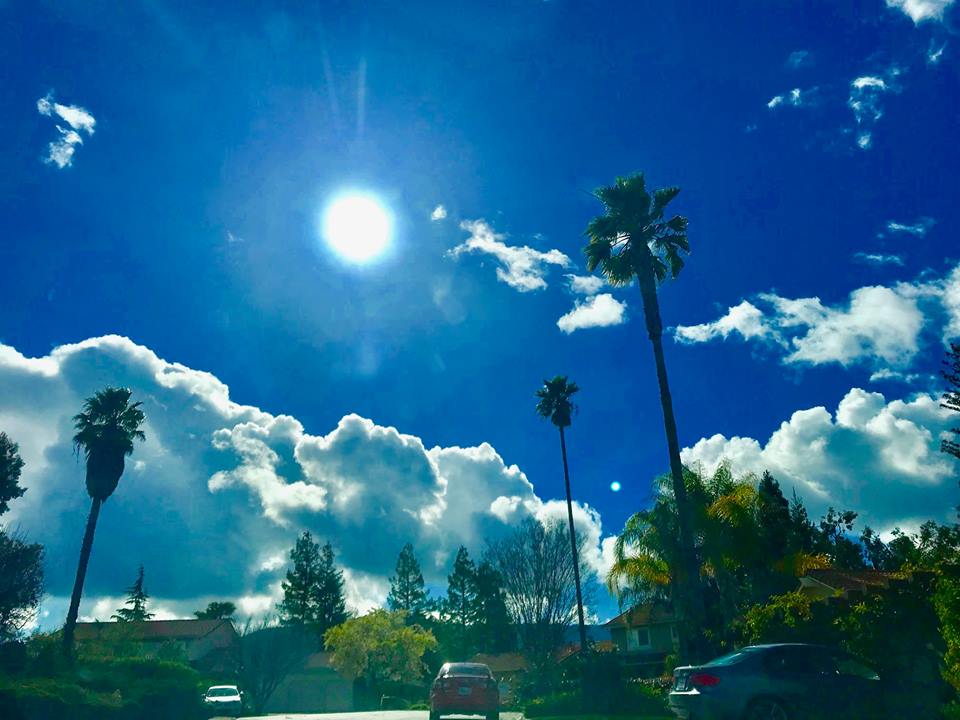
I’m a big fan of sunsets that are embraced by whimsical cloud formations, especially when they occur right outside our window or can be viewed from the street leading up to our home. A good sunset is one that has the power to stop you in your tracks and say OMG. It’s a romantic encounter with Mother Nature if only for a moment. You know it won’t last, so you savor every bit of its' fleeting presence. I thought I was done shooting and then the crescendo—fiery red clouds emerged as the sun went below the horizon line.

A Magical Encounter with an Uber Turtle and His Little Ride-Share Companion

“Try to be a turtle at ease in your own shell.”—Bill Copeland

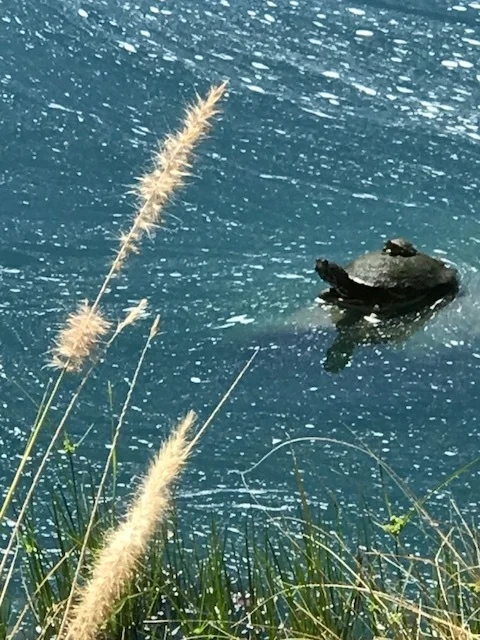
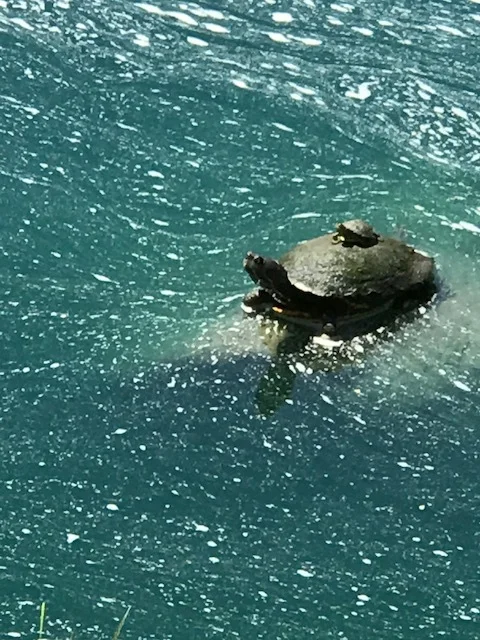
A Turtle can withdraw from the world just like humans until they feel safe. Only we lack the cover of a protected shell. At least they have a choice. When they want to bask in the sun to warm themselves they find a log or a rock. If there is no room they climb the back of a larger turtle.
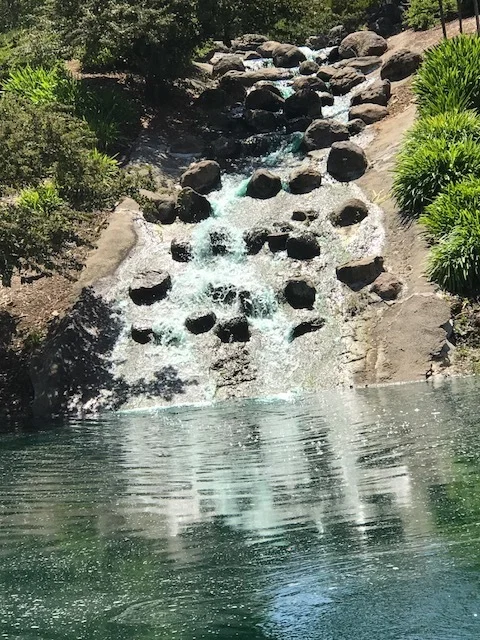
When they want to cool off, they float in the water like a moving island. Should they be hungry, they just scan the surface for insects. And, when a small turtle wants to travel it simply hops aboard an “Uber” Turtle to ferry it across the lake—in this case a stones throw from the waterfall near our home. Turtles have poor vision, but can feel every vibration—like a human sneaking up on them. I waited patiently to take these photos hoping these majestic creatures wouldn’t sidle into the water like many times before.
Luck or perhaps grace was with me this morning as I was able to capture the moment.

What Turtles Taught Me: Turtles are very symbolic, often viewed as the doorway between our world and mythic underworld. In fact, some cultures believe that turtles are actually holding up the world. They are the oldest reptiles dating back from 157 million year ago. It’s shell is modified ribcage and part of its vertebral column. Consequently, they cannot be separated form its shell any more that we can be separated from who we are.
Even though turtles don’t mind when other turtles stack on top of their shell, they are not social creatures. That being said, they do show us how to grow old gracefully and about living in harmony with our environment. When we feel anxious, the pace of life gets too hectic, and our minds are spinning out of control, they show us how to slow down and go with the flow. Peace!

Bumble Bees, Givers & Recievers of Pleasure & Ecstasy and Wise Messengers

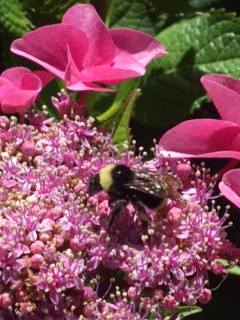
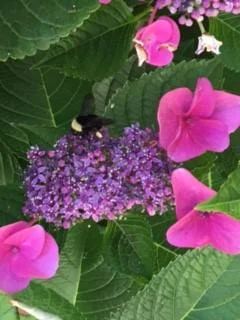
I had to get up real close and personal to capture the first two photos of a yellow-faced bumble bee. They are docile and peaceful by nature and tend to avoid human contact. However, if they feel cornered—with no avenue of escape—they will not hesitate to defend themselves. 

These beneficial insects are native to California, and are important pollinator of plants. They are here to help and teach us, not to hurt us. Bumble Bees zig-zag from flower-to-flower collecting its nectar. Their wings beat around 130 times per second. This allows them to perform a unique service called "buzz pollination," vibrating flowers until they release pollen. The pollen then attaches to its sensitive hind legs. The large load they collect is carried in “pollen baskets” which are dish-shaped indentations on their hind legs. The pollen is then passed onto other flowers, creating a process of fertilization.

The bumble bee symbolizes community, brightness and lightness of being. They remind us to slow down, smell the flowers and taste the sweet nectar of life. Their dance-like plant-to-plant movement represents the interconnectedness of all living things. Bumble bees are wise messengers
bringing the secrets of life and service. They teach us to be mindfully focused with the matter at hand, and to be fully engaged in our creative endeavors. They symbolize being productive while the sun is shining and to extract and savor the sweetness of life. Many ancient cultures considered bees to be messengers of the gods. 

The following poem by Khalil Gilbran speaks to the reciprocal relationship of giving and receiving between the bee and the flower:

“…Go to your fields and your gardens, and you shall learn that it is the pleasure of the bee to gather honey of the flower, but it is also the pleasure of the flower to yield its honey to the bee. For to the bee, a flower is a fountain of life, and to the flower, a bee is a messenger of love, and to both, bee and flower, the giving and the receiving of pleasure is a need and an ecstasy.”

Bee Kind!
Bee Happy!
Bee Yourself!

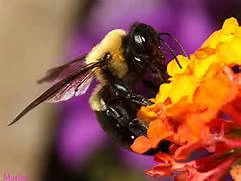
Photo credit 3: chumcubo.com (bee on gold flower)
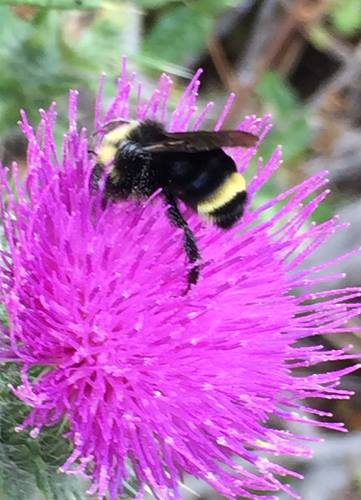
Photo credit 4: Liam O'Brien (bee on spike lavender flower)
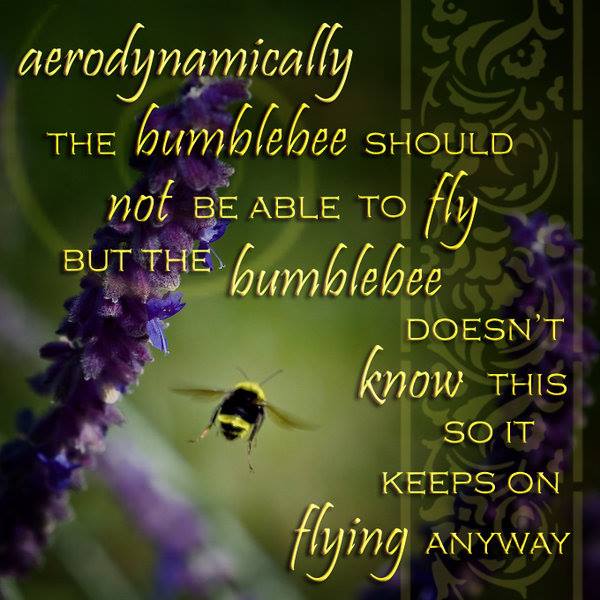
Quote credit 5: Mary Kay Ash (Aerodynamically...)