Lifestyle & Travel

Enjoying the Angkor Paradise Hotel, Riding a Buffalo Cart & Visiting the Floating Villages

"By reaching out to and connecting with communities around the world, we learn to appreciate firsthand...our commonality...and the understandings we gain can be life-changing."—Harriet Lewis

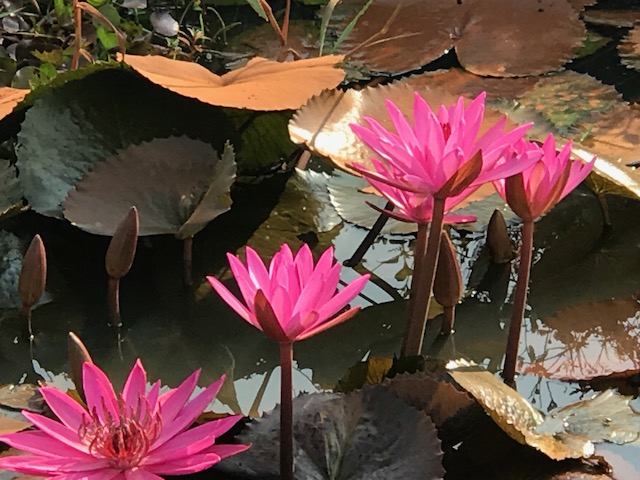
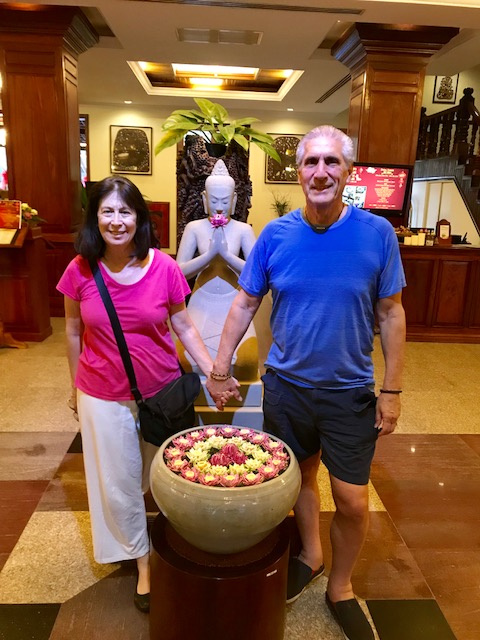
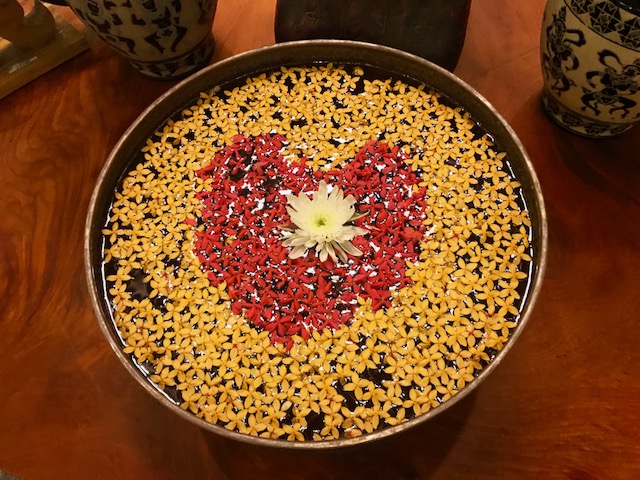
We checked into the Angkor Paradise Hotel yesterday after a four hour bus ride from Phnom Penh, Cambodia. We were greeted by staff with the traditional cold drink a cold towel. Cecile and I were captivated by the large vase of lotus flowers and a Buddha statue with hands in prayer as seen here and a young woman playing soothing local tunes on a decorative wooden xylophone. 
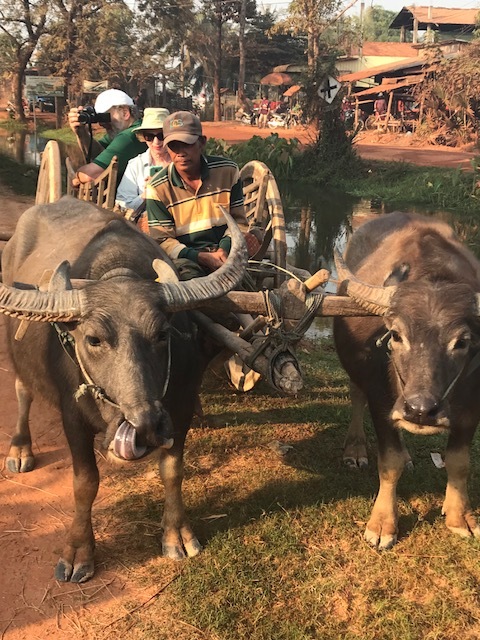
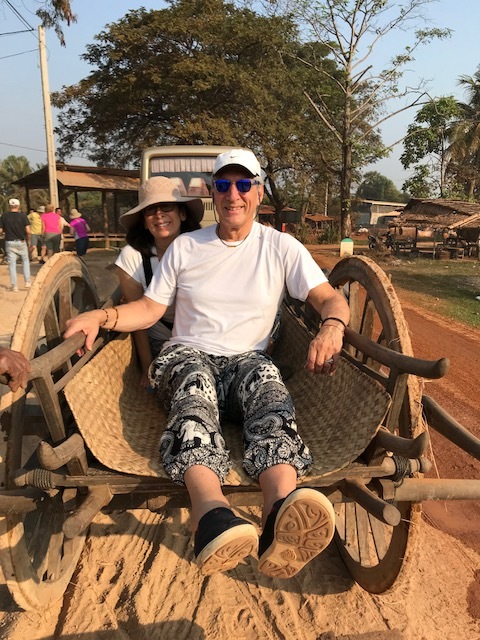
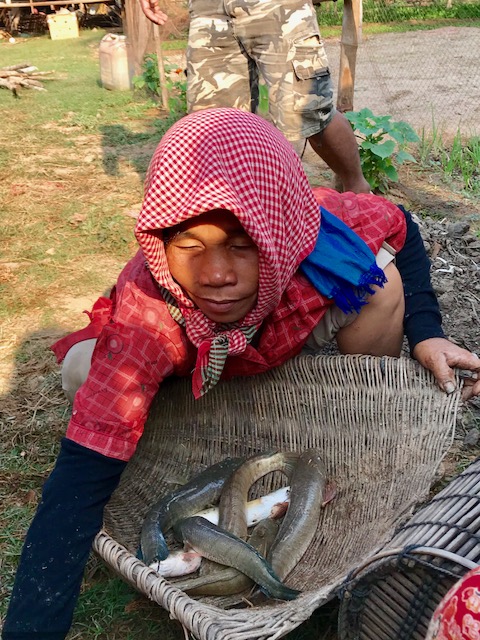
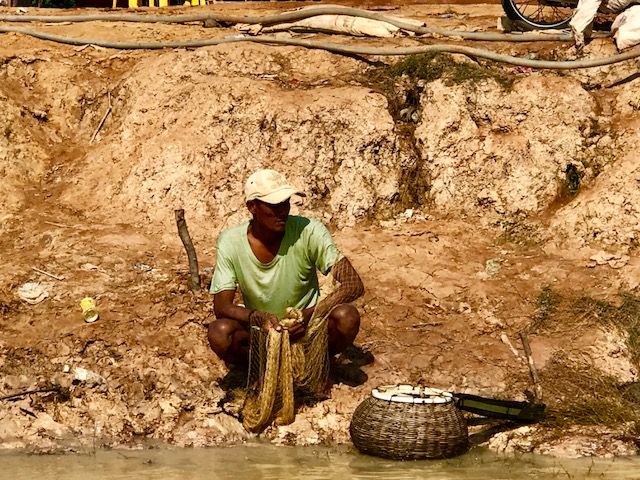
The next day we went to Tonle Sap Lake where we rode on a water buffalo cart for 35 minutes, visiting with rice patty farmers and women who were emptying fish traps of snakefish, a common variety of fish we had for for dinner the night before. Speaking of "buffalo" the delightful couple we were fortunate to meet riding in the cart behind us is Jerry and Eileen from the Buffalo, NY. 

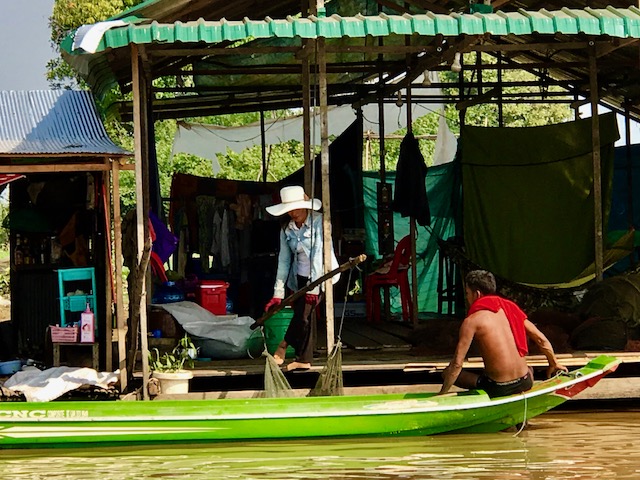
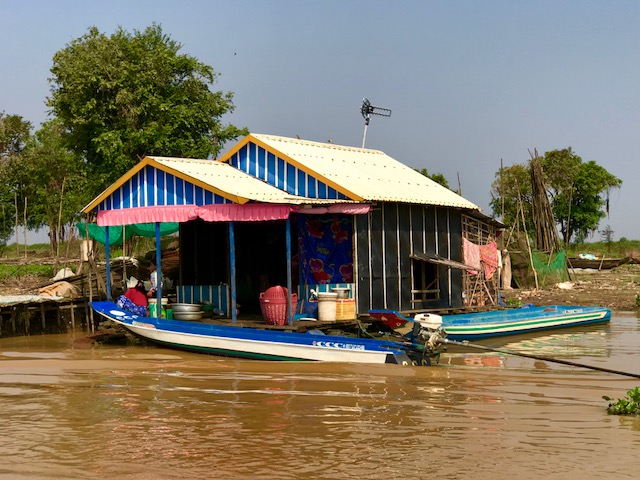
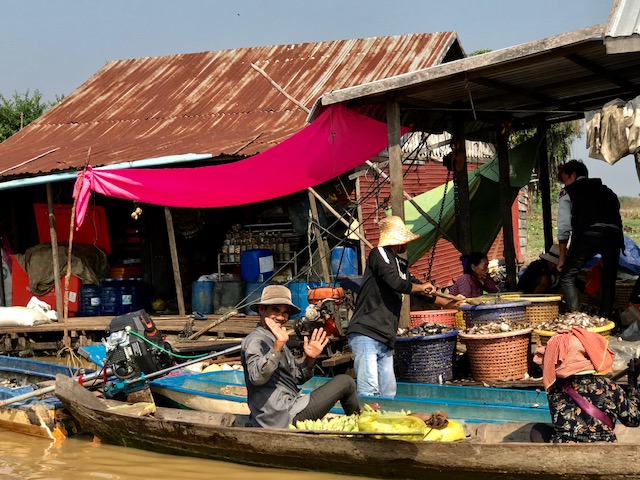
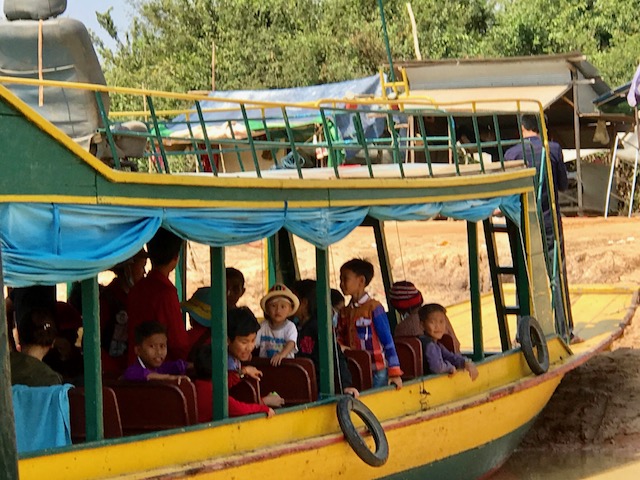
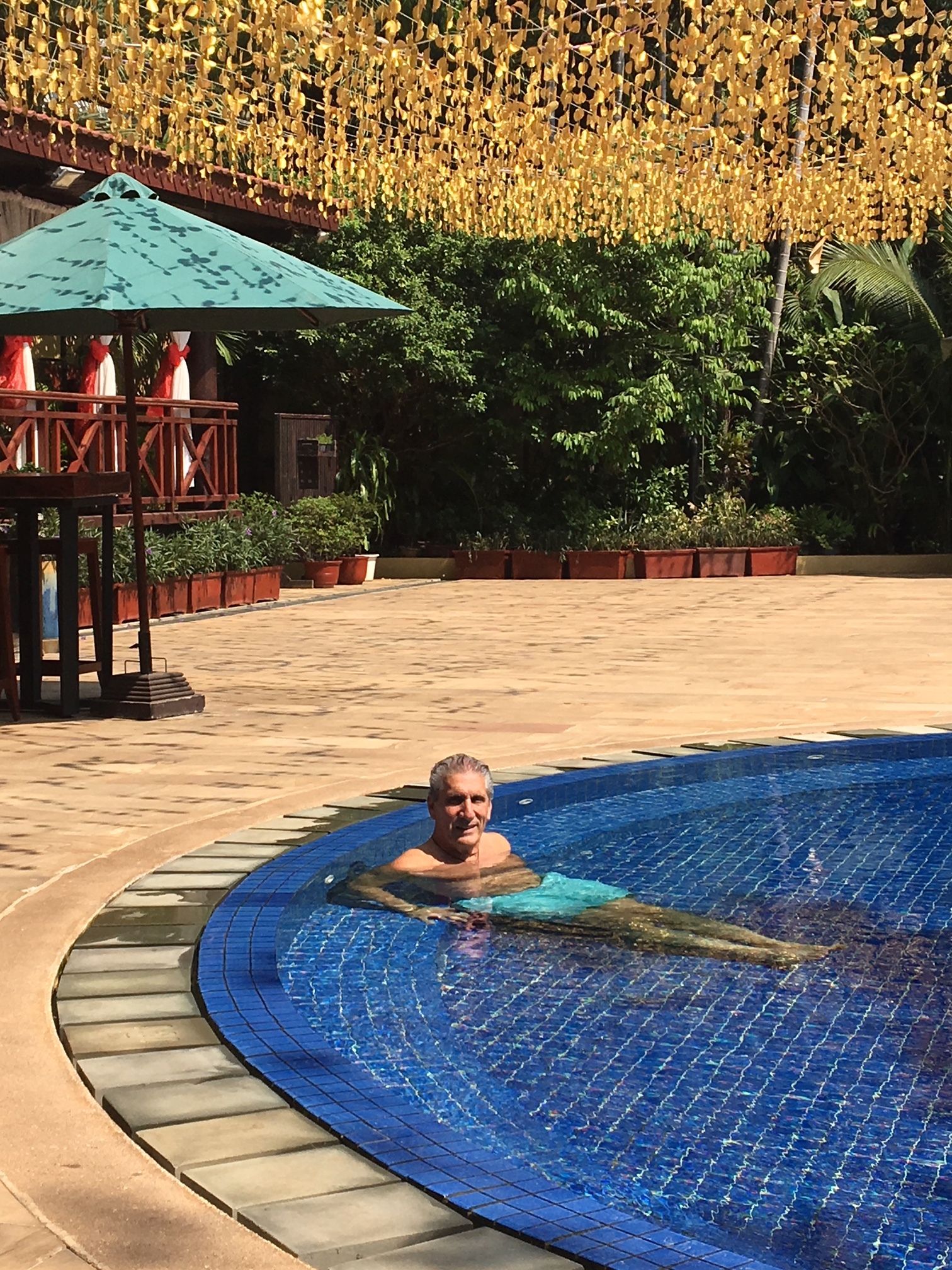
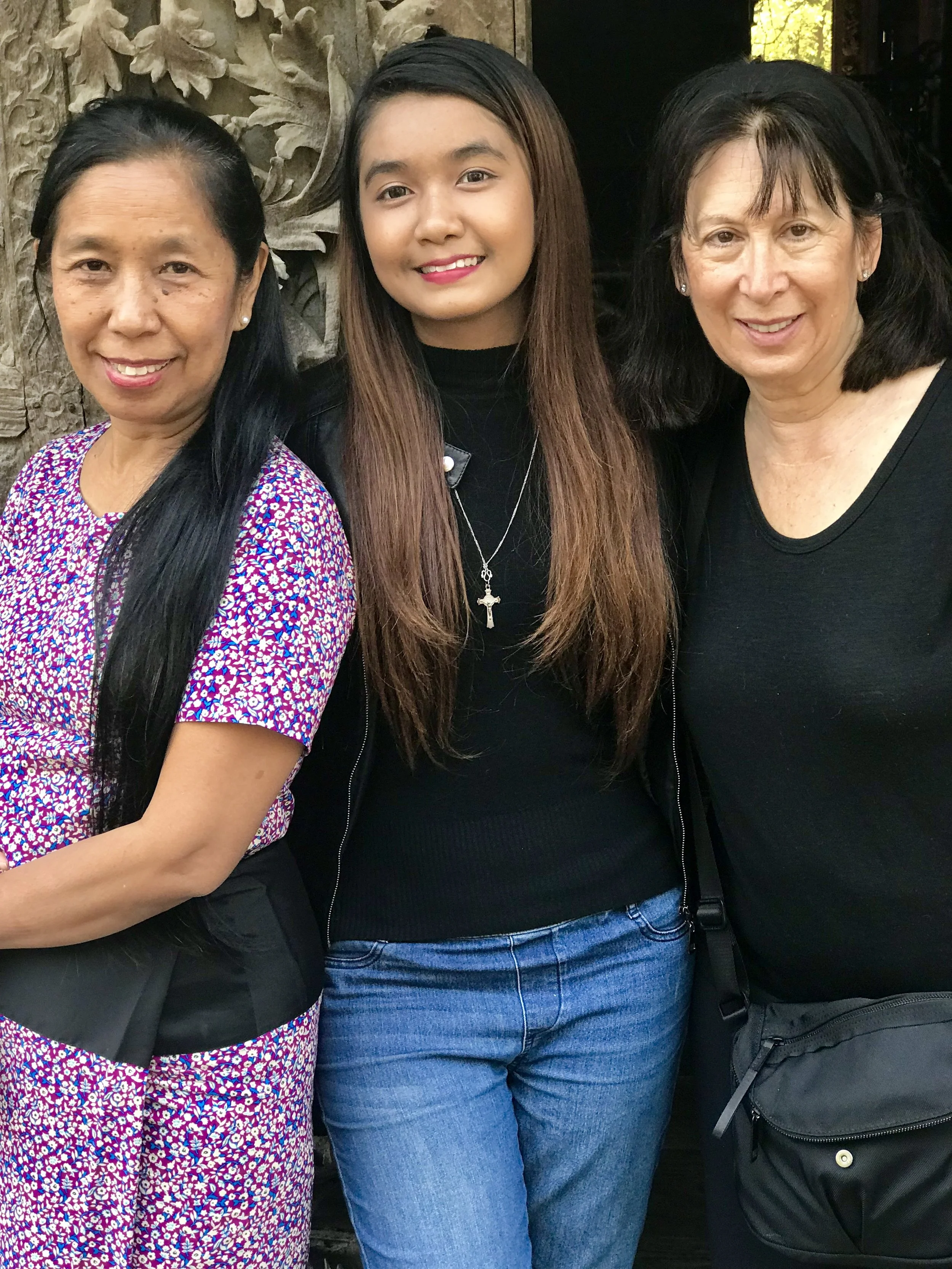
On the way to visiting nearby floating villages by boat, our bus driver stopped so we could photograph the lotus flowers which is always a site to behold. The floating villages were absolutely fascinating. There was a laundry service, a bank, a grocery store and a Catholic Church (a small minority in these neck of the woods of a mostly Buddhist population). Of course there were an infinite variety of floating homes. We made a stop to visit one belonging to a husband and wife of over 40 years. They are essentially retired though the husband, Bou, has a crocodile farm in an under water containment pen in the back of their home that he said is a lucrative past time. his wife Ny, 64 seen here in a purple and white flower print dress with her husband and Jack, our local Siem Reap guide is a midwife. She is an amazing woman. She has successfully delivered over 100 babies in the village and is well respected. She does not charge for delivering babies. She sees it as a community service. She had a little delivery kit and demonstrated how she employs it for the benefit of her patients. She learned to deliver babies from her grandmother and did some additional training at a hospital. She is very passionate about what she does. When it was time to say goodby the husband assisted us in getting back on the boat. This is another example of the Grand Circle Foundation-the philanthropic arm of Overseas Adventure Travels (OAT) providing support to a family and in the process provide travelers to experience a day in a life of people throughout the world. In this case a bathroom facility was provided for the family. After returning to the hotel we enjoyed a little down time at the hotel pool.
Meeting Spider Woman in a Cambodian Village & Eating Fried Tarantulas Just Like Angelina Jolie

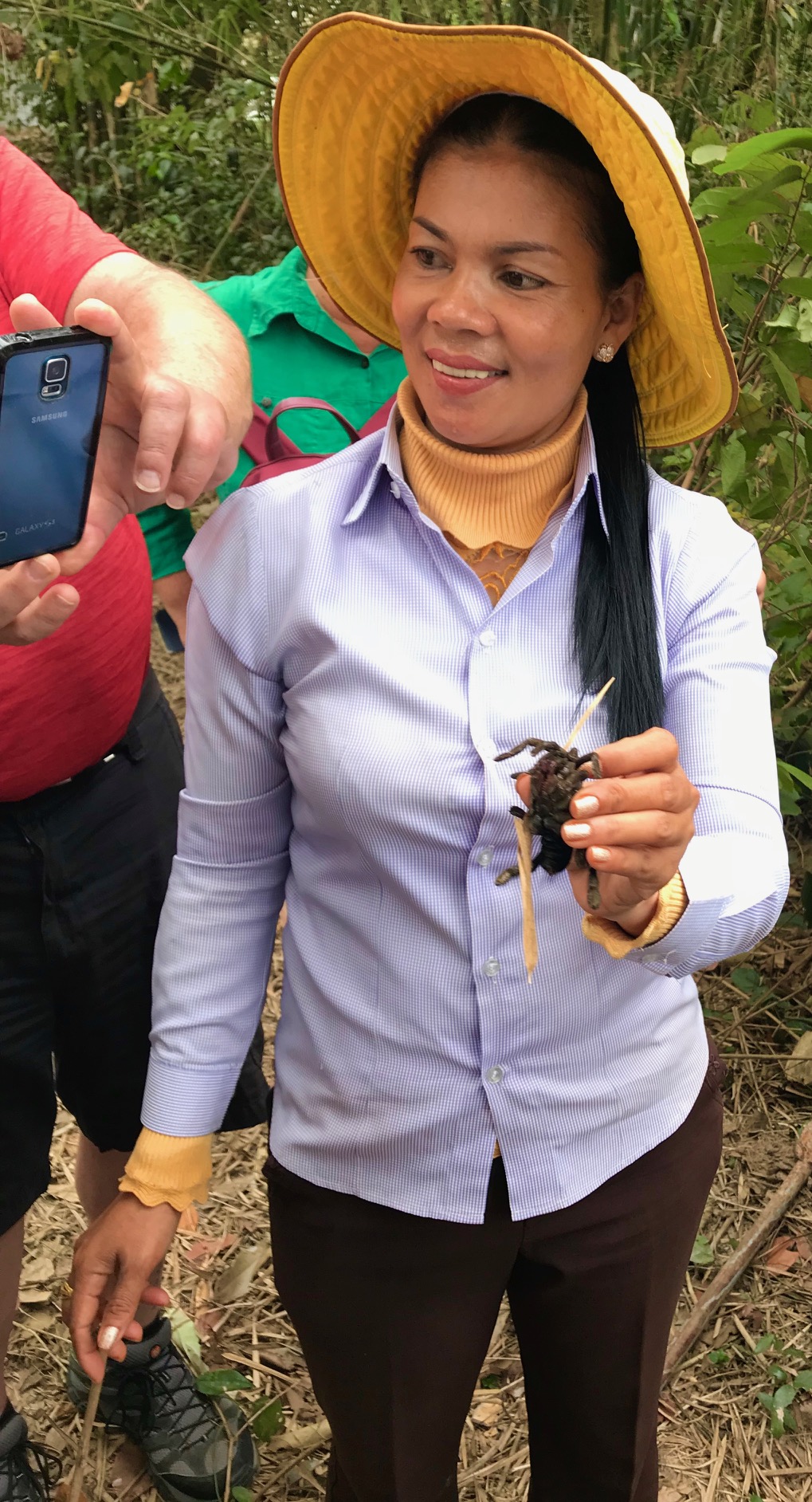
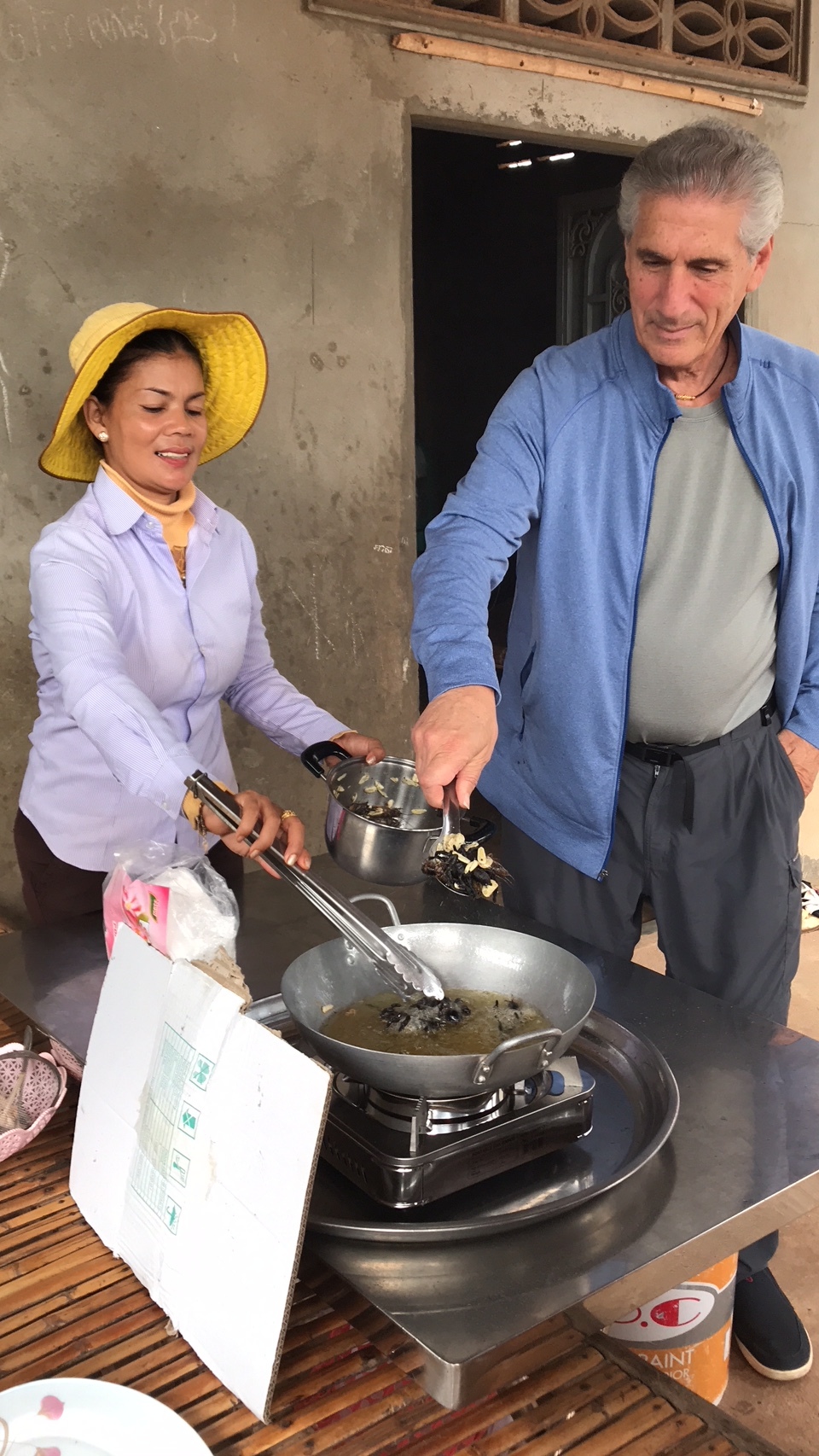
As our tour bus with Overseas Adventures Travels (OAT) made it’s way toward Siem Reap, we stopped at a small village in the Kampong Cham Province to visit a widowed mother of four who supplements her income by capturing and selling “Tarantulas.” Fried spider is a regional delicacy in this region. There is even two sculptures of tarantulas erected on the center divider in town that emphasizes this fact. 
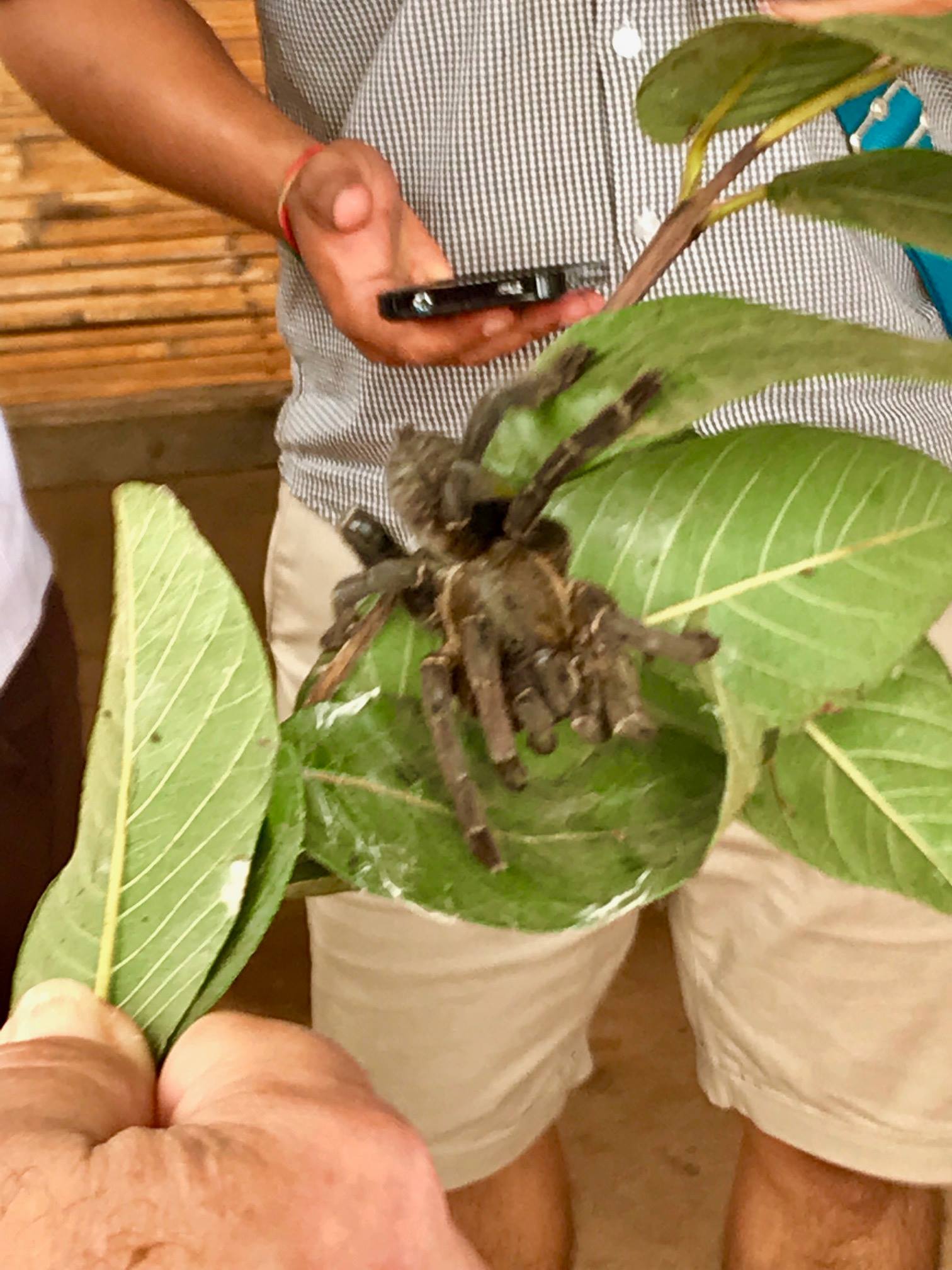
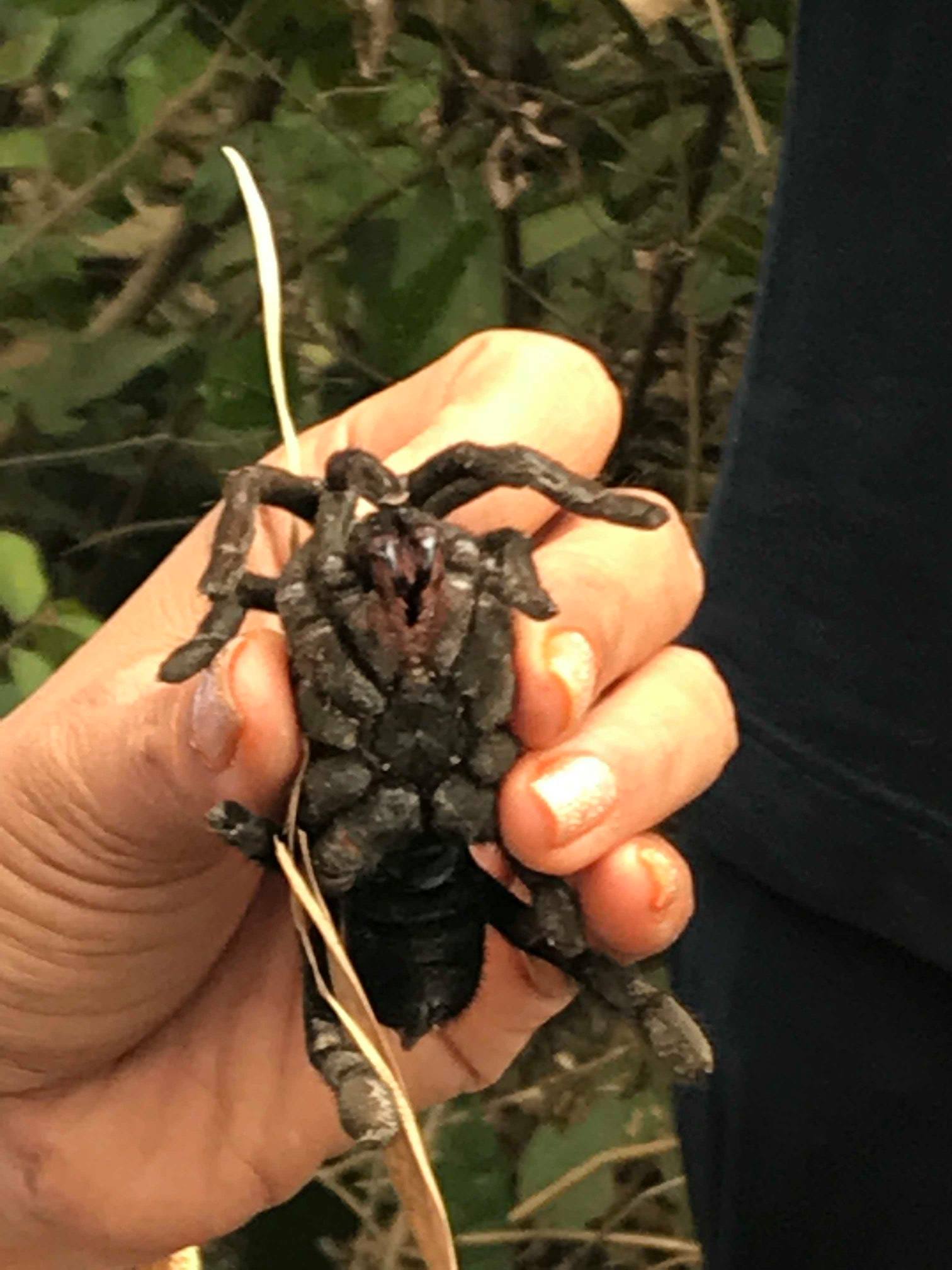
Though generally nocturnal, tarantulas can be found during the day. She showed us where the spiders are bred in holes in the ground behind her home. Once caught, she removes the venomous fangs from the furry creature, to prevent being bitten.

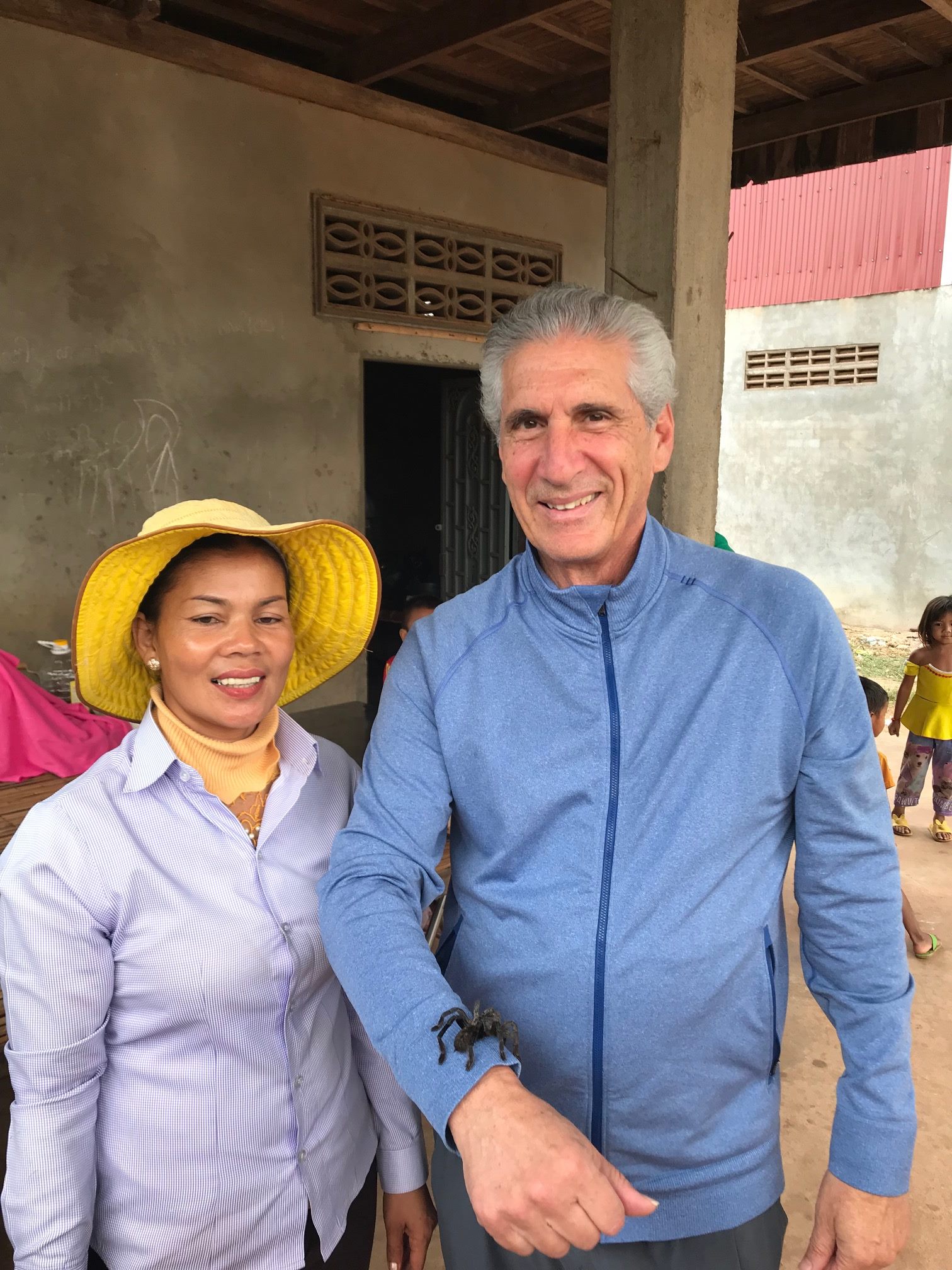
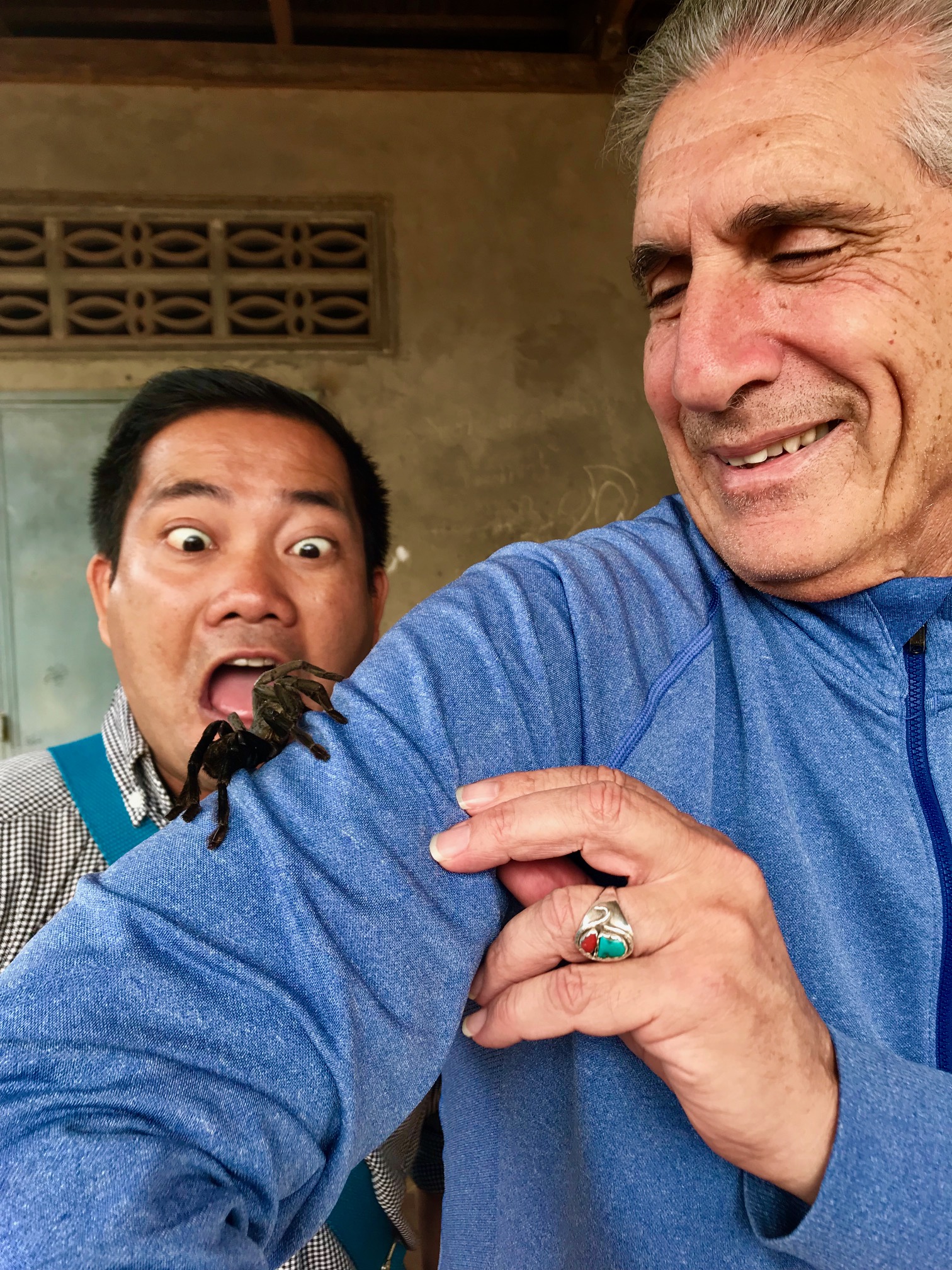
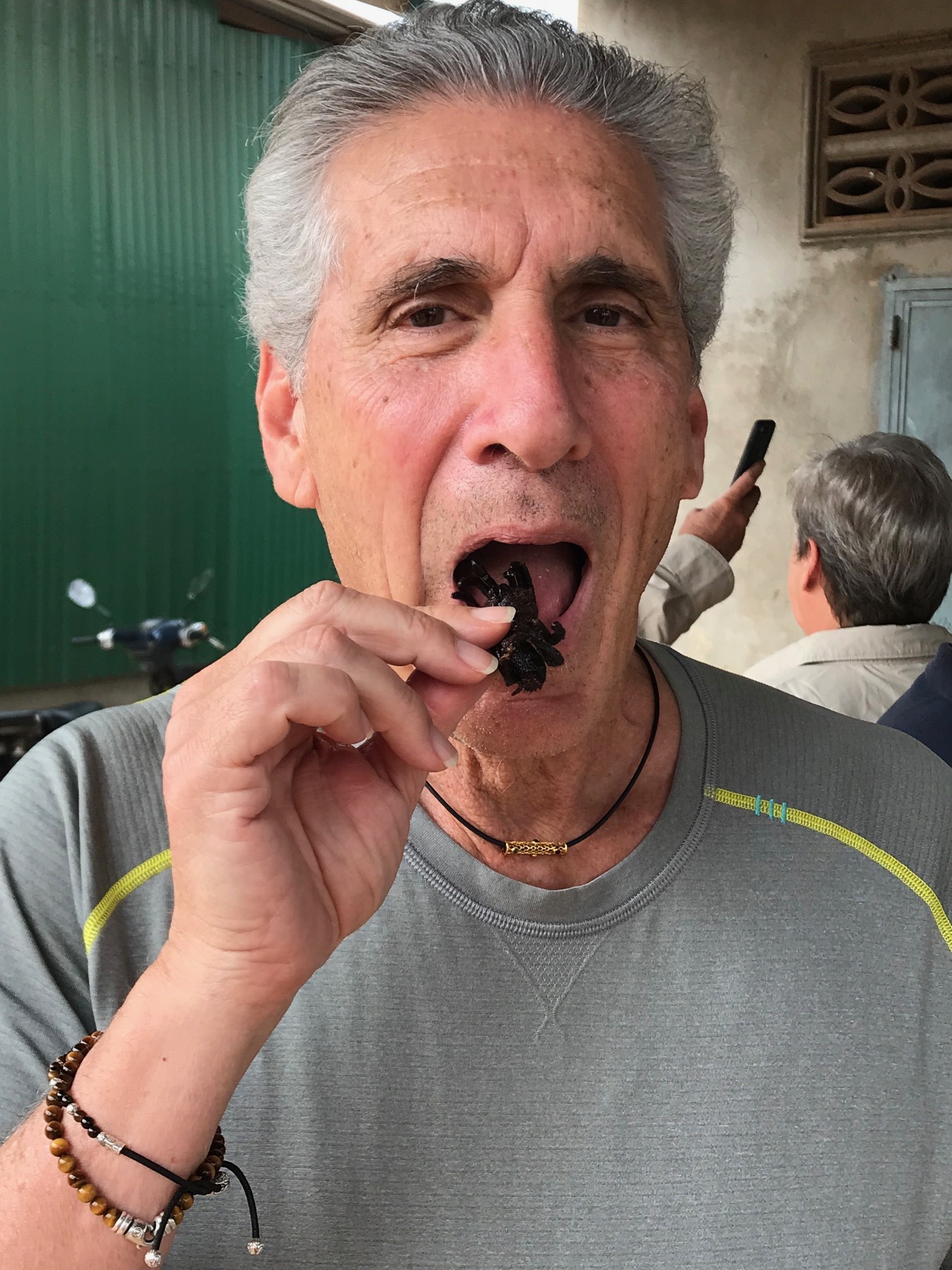
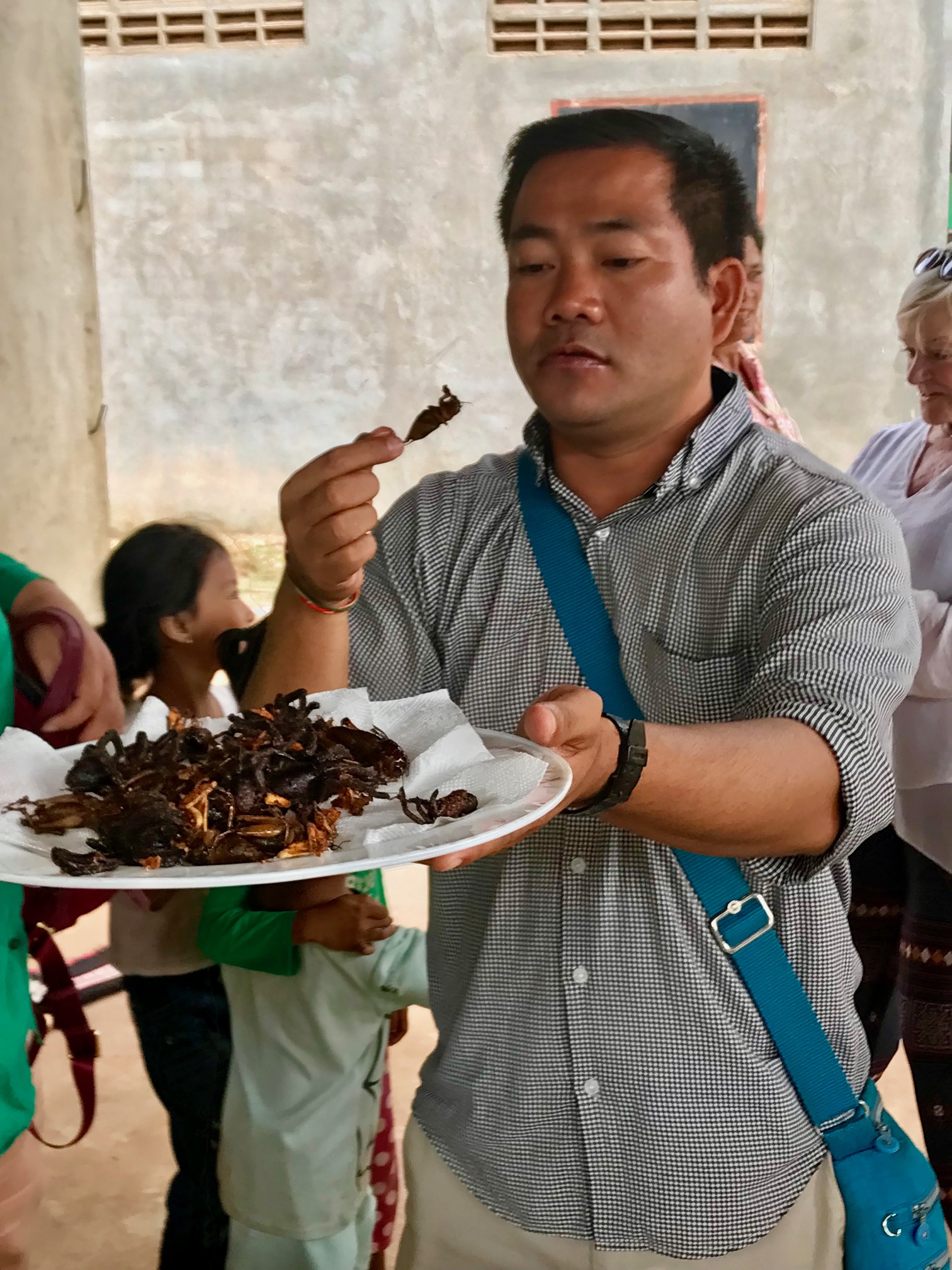
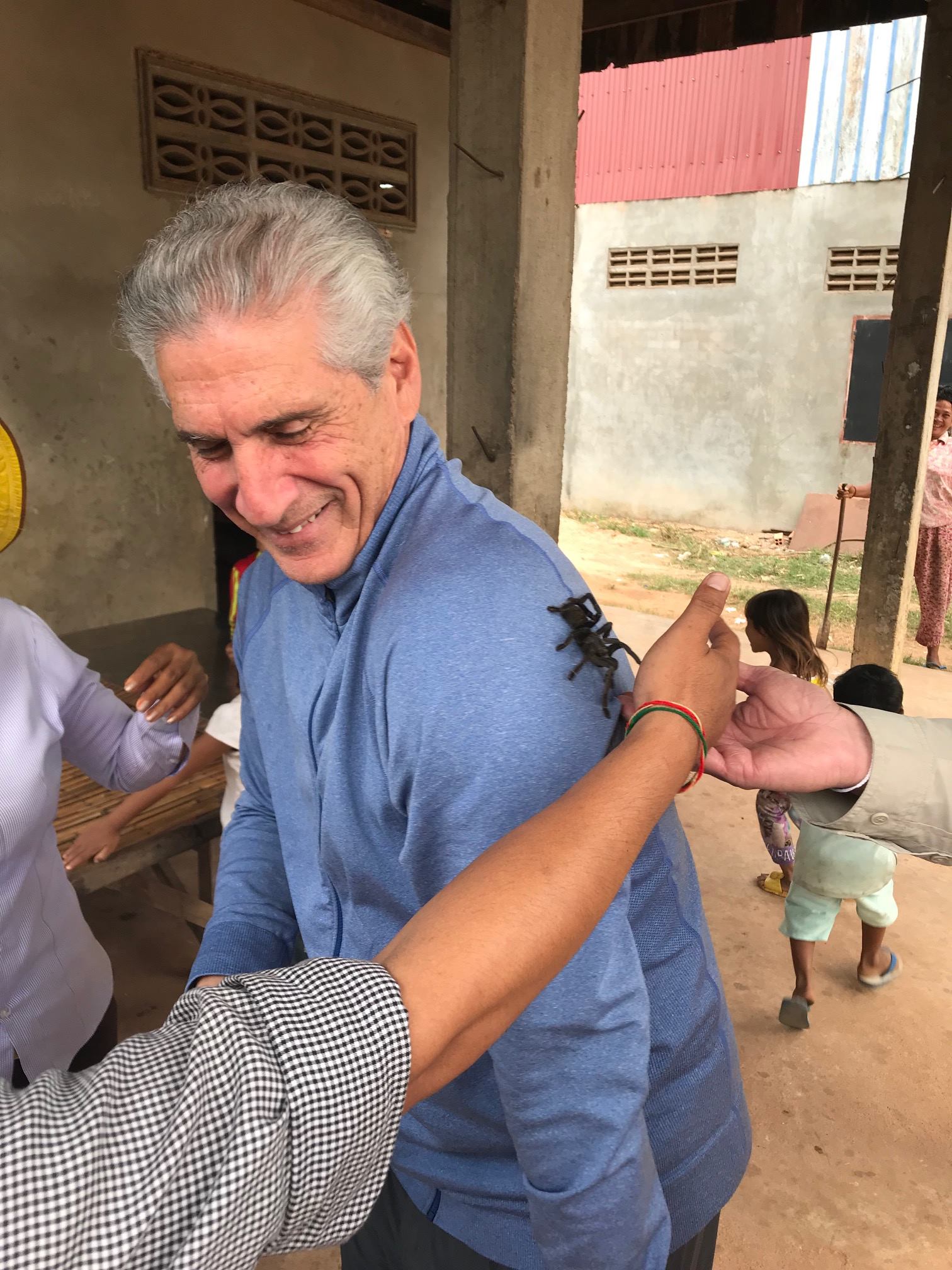
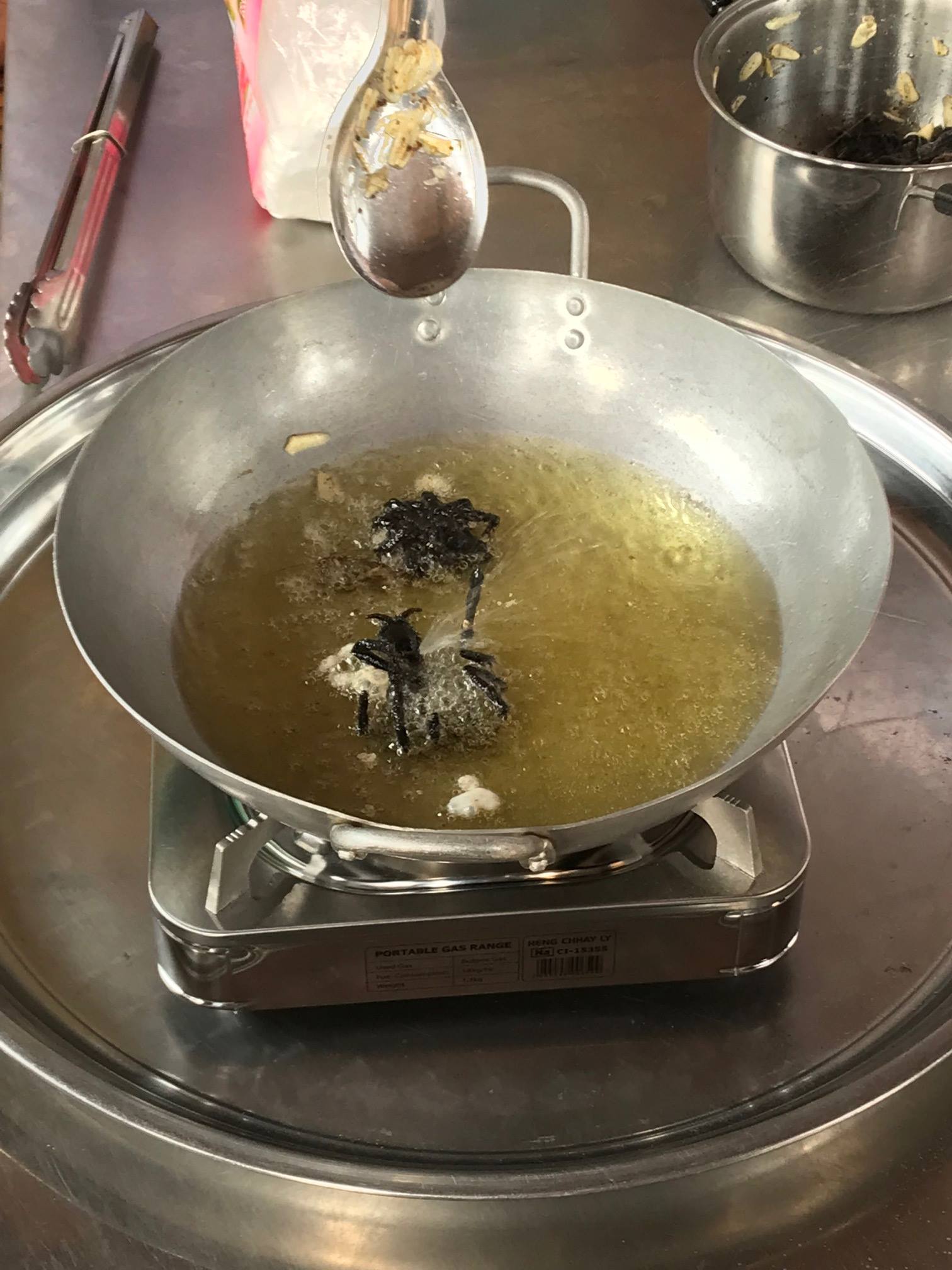
She then walked us toward the front of her house and placed the tarantulas she had caught on a branch of leaves that allowed us to hold the creatures at a distance. Having a mind of their own, they began to crawl on my hand, arms, shoulder and circled around to my back. She then marinated them in sugar, salt, crushed garlic and whiskey and demonstrated how to fry them in oil until fragrant. Some of us took turns frying one until they were completely stiff. The taste has been described as a cross between chicken and cod. It has a crispy exterior to a soft center. 

As you travel around the world, you end up trying a lot of cuisine you wouldn’t dare eat at home. However, as adventurous as I am, I never thought in a hundred years I would be eating a spider today. After all, for many of us the Tarantula represents the stuff of nightmares and horror movies. 

Cambodians have long hunted spiders for food and medicine but it wasn’t until the severe food shortages during the genocidal Khmer Rouge regime in the mid-1970s that people turned to them as a food staple. 

Tarantulas, have been rumored to be used as a traditional cure for backaches and breathing disorders. They are also a good source of protein, folic acid and zinc, making them an excellent supplement to one’s diet. They are also known to make women more beautiful as our local guide, Jack told us. He reinforced his claim by rhetorically asking, “Isn’t she beautiful?” Jack is single and is looking for a woman but said “She’s too pretty for me.”

The merchant trade in tarantulas got a big boost from celebrity chef Gordon Ramsay, who captured and cooked them in an episode of Gordon’s Great Escape in 2011.

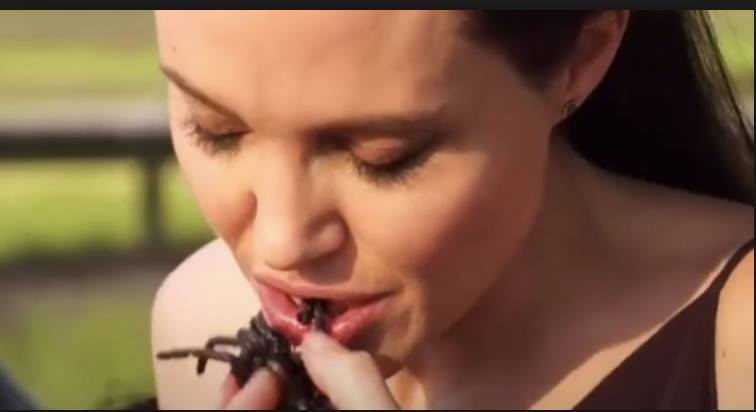
Postscript: Actress Angelina Jolie cooked and ate tarantulas with her kids (see last photo) during an interview with the BBC to promote her movie filmed in Cambodia last year called "First They Killed My Father" about the genocide of the Cambodian people by the Khmer Rouge under Pol Pot.

The Honor of Meeting The Artist Who Survived the Killing Fields of Cambodia

In 1975, when Cecile and I first moved to San Jose, CA to start my podiatry practice, the Cambodian genocide orchestrated by the Khmer Rouge (KR) regime led by Pol Pot was underway. It is estimated that between 1.5 to 3 million Cambodians were killed during the vicious four-year campaign. 

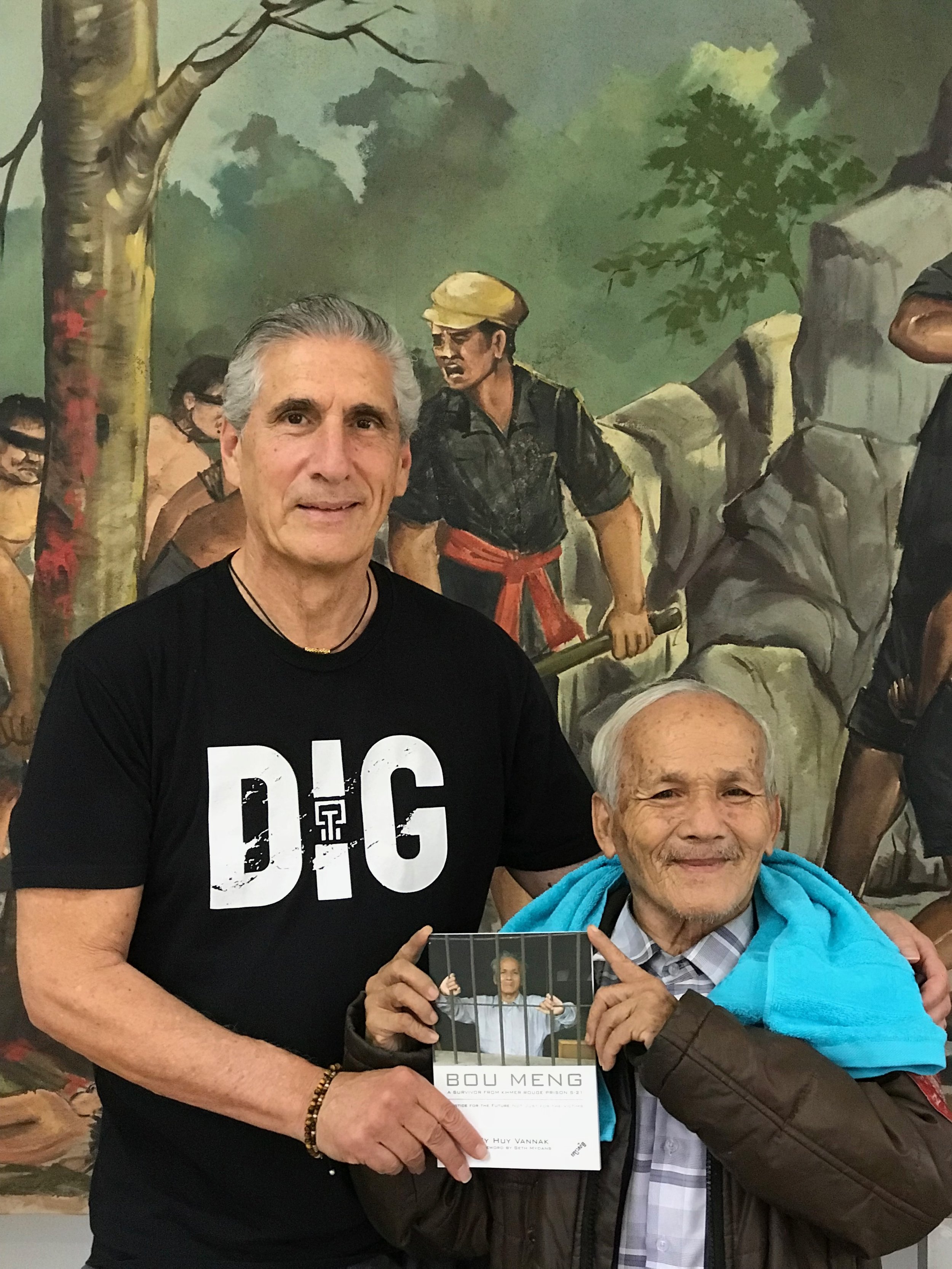
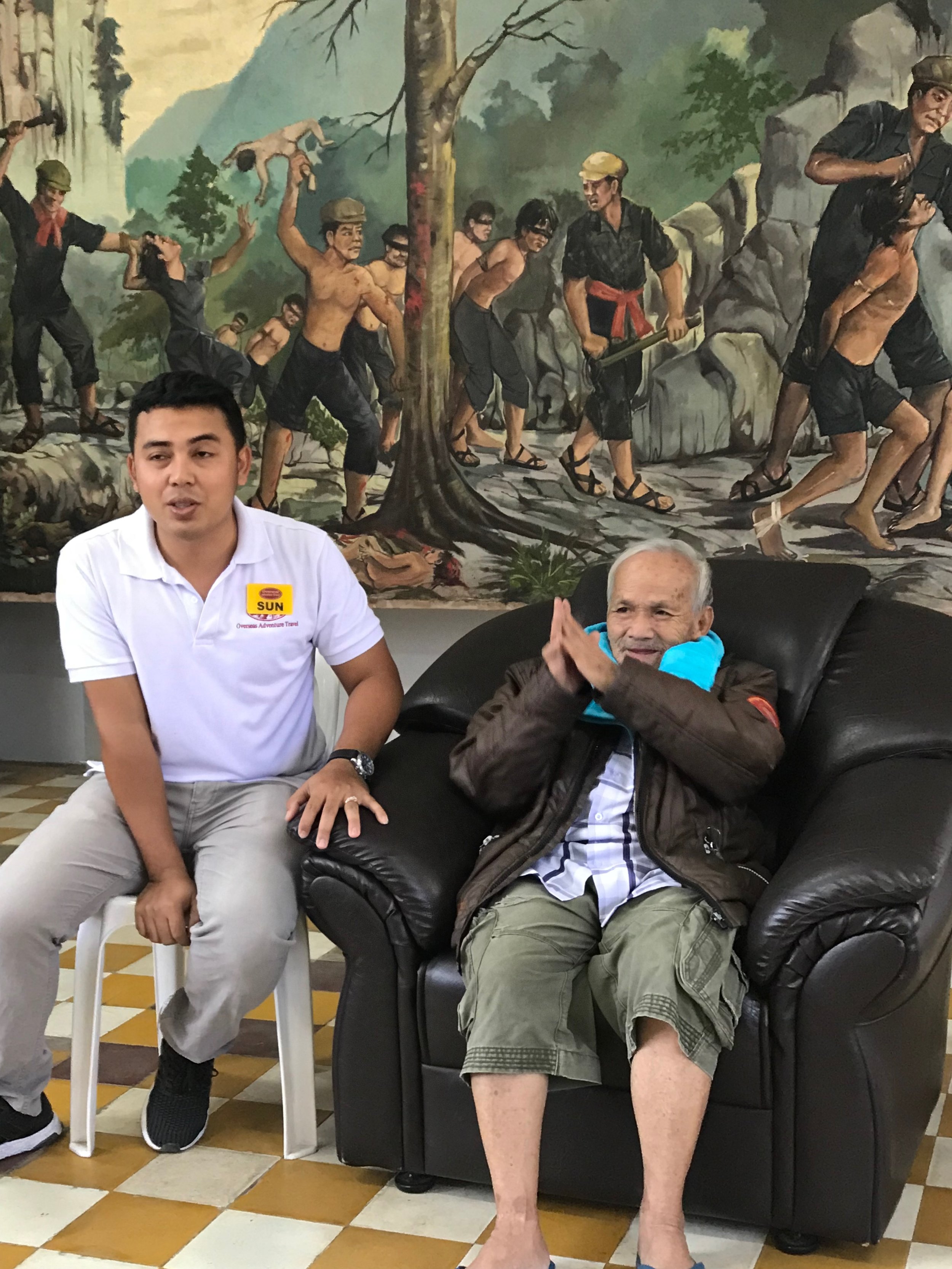
Members of my tour group including myself had the rare opportunity and honor to meet Mr. Bou Meng, one of the survivors of the notorious Tuol Sleng prison in Phnom Penh, Cambodia—the site where it all happened.

I had been to the Killing Fields and Genocide Museum about 14 years ago with my son Jason during a one month tour of Southeast Asia. I wanted him to know that there were other genocides that have taken place around the world other than the one of his Jewish heritage. No words can describe the incredible sadness one experiences when you see photos of the merciless torture of Cambodians. Amazingly, with all that Meng went through including the loss of his two children to disease during the Pol Pot years, and the loss of his wife, the 73 year old survivor is a delightful, humble and affectionate man. When he walked into the room to greet us, he took each of our hands into his then clasped his hands and bowed toward us. We each told him our name and where we were from. After the introductions we had a Q & A with our local guide, "Sun" doing the translation.

Bou Meng’s said he owes his life to his ability of being a artist. He was first asked to paint pictures of machine parts for a training program for the Khmer Rouge soldiers. Later, he was asked to paint portraits of Pol Pot. If he failed, he would have been executed. Due to his skill and Pol Pot being happy with how he was portrayed he was rewarded with larger portions of food to eat.

“Every night I looked at the moon,” Bou Meng said. “I heard people crying and sighing around the building. I heard people crying out, ‘Mother, help me! Mother help Me!,” he repeated. They were being loaded into trucks and sent to a killing field.” Every night he thought his time would come, but when midnight passed, he realized he would live another day. “ It was during the 2009 war crimes tribunal that Meng learned his wife, Ma Yeoun (Prisoner 331) was arrested, tortured and killed on August 16, 1977.

The ghost of those who died says Meng, call out to him every night pleading to seek justice on their behalf.

Monks Tutor Our Group in Meditation at the Temple of 10,000 Buddhas & Visiting Other Magnificent Sites

"The goal of meditation is not to get rid of thoughts or emotions…it is to become more aware of them and learn how to move through them without getting stuck.”
—Dr. P. Goldin

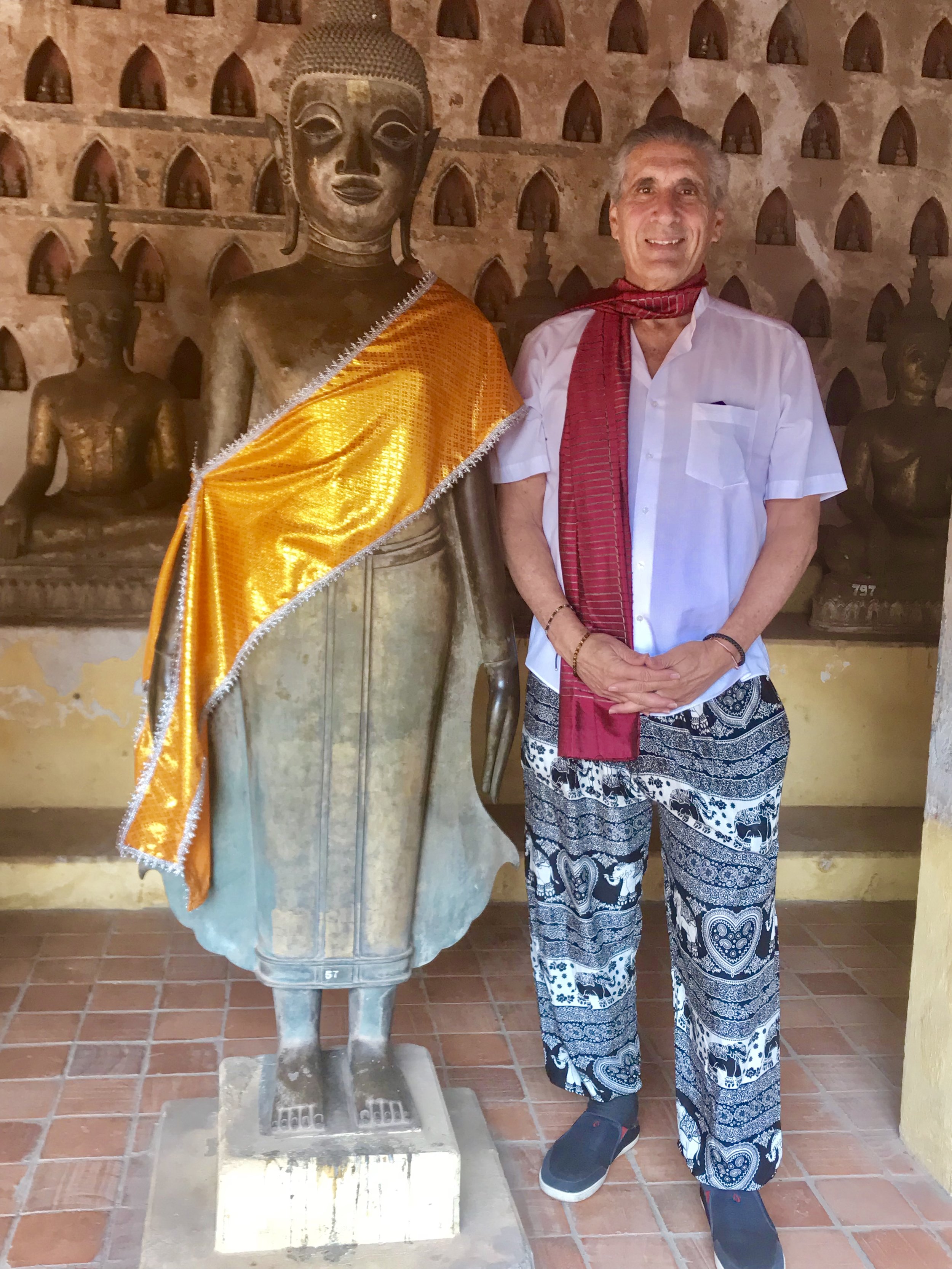
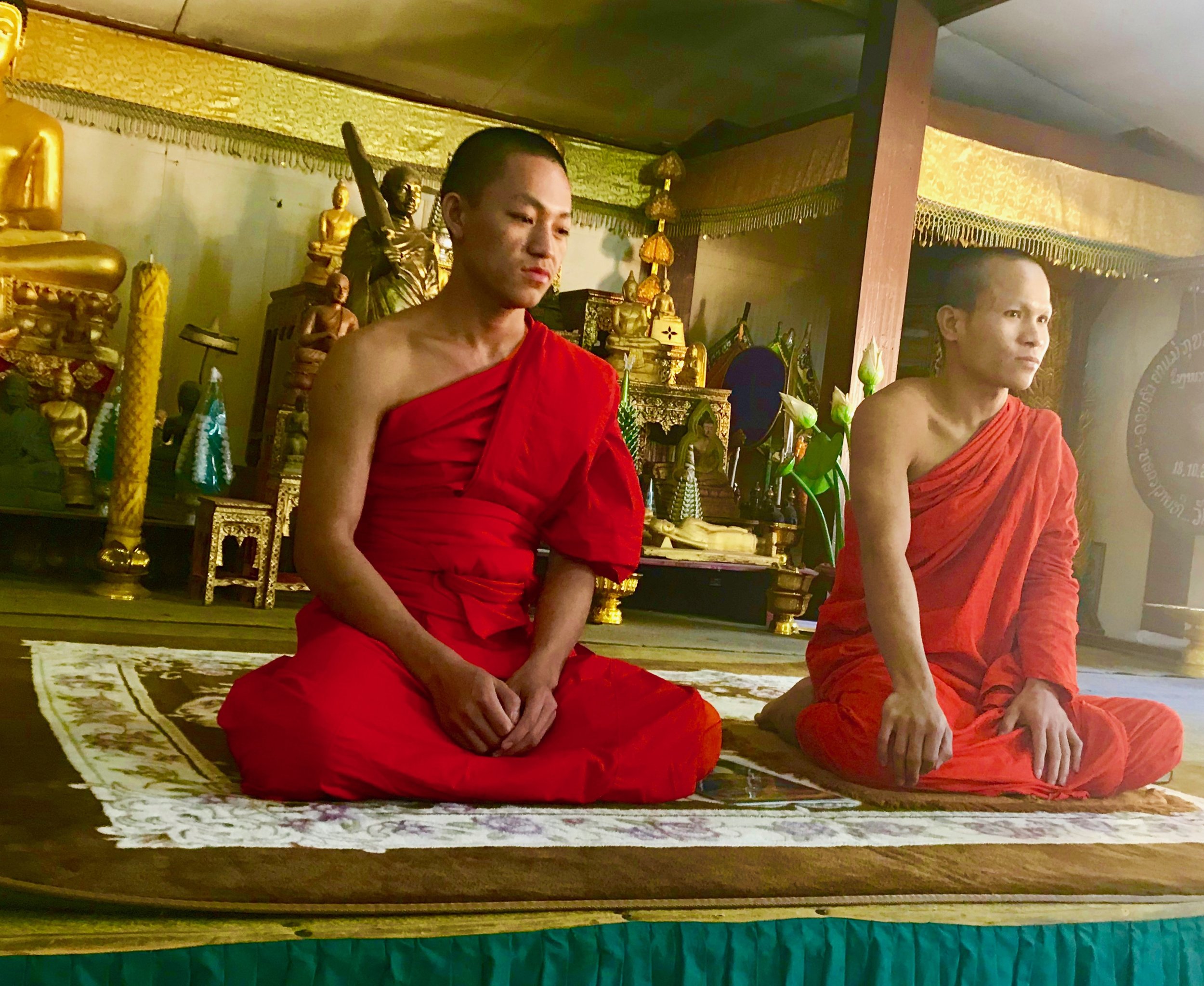
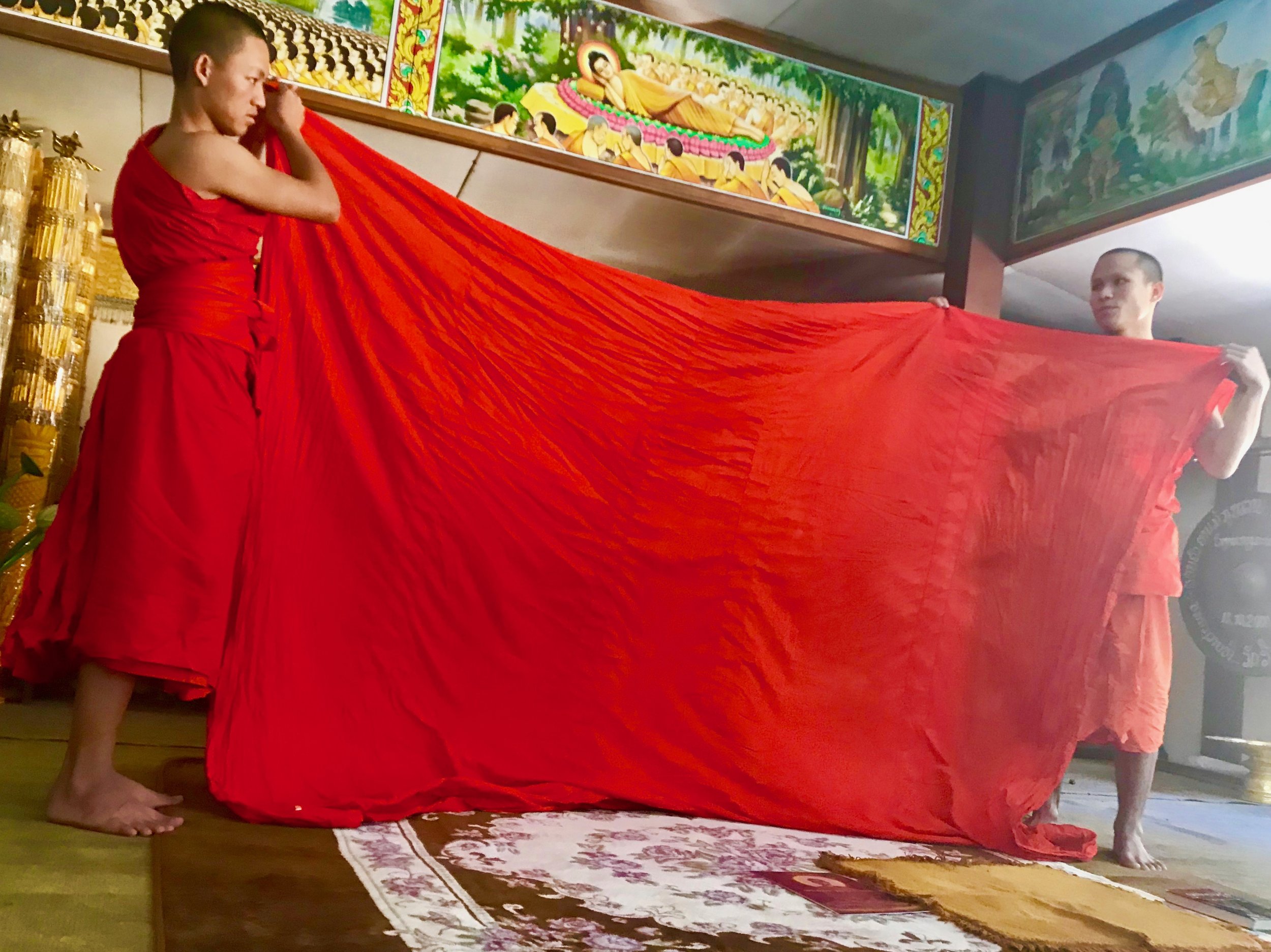
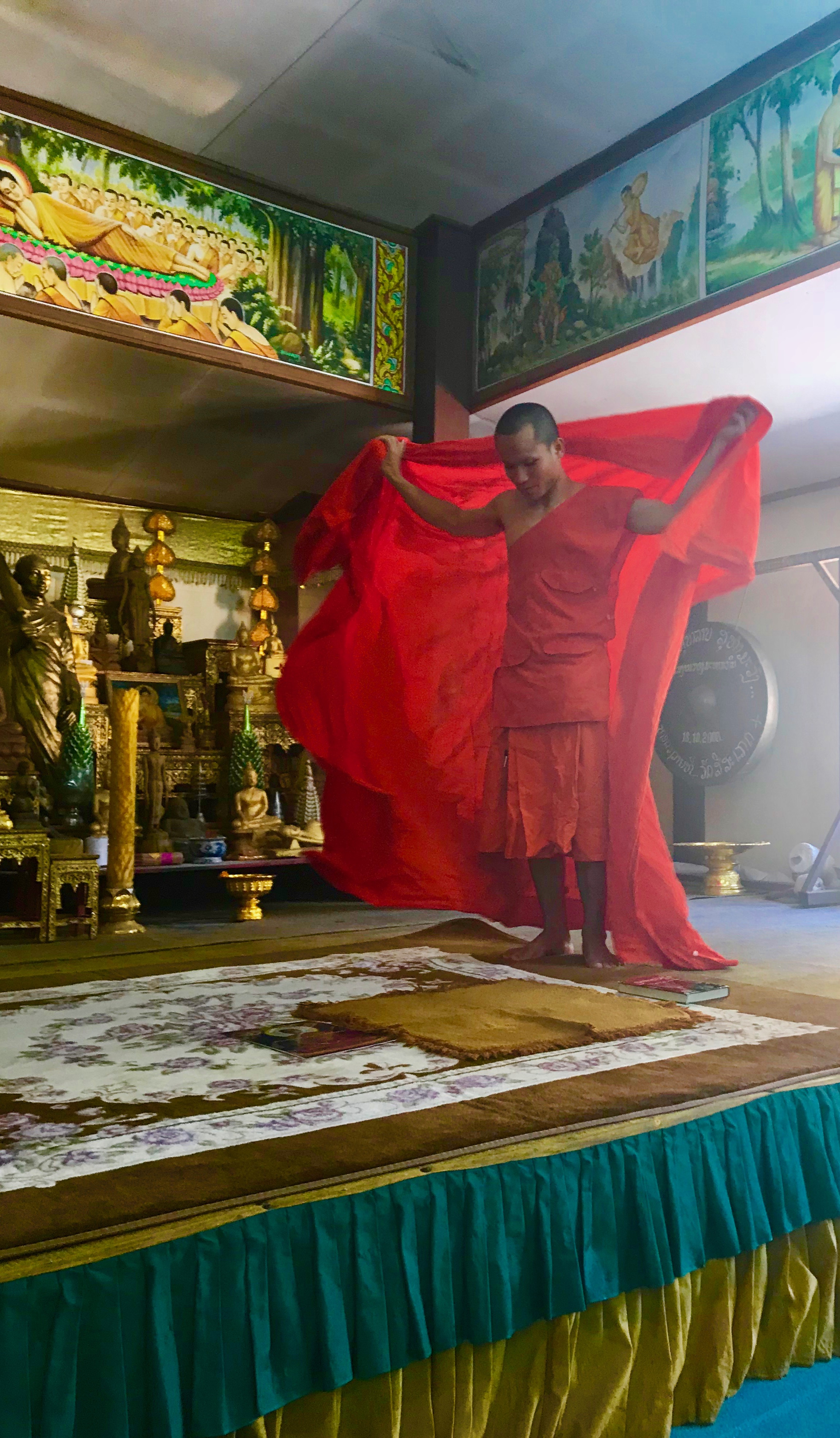
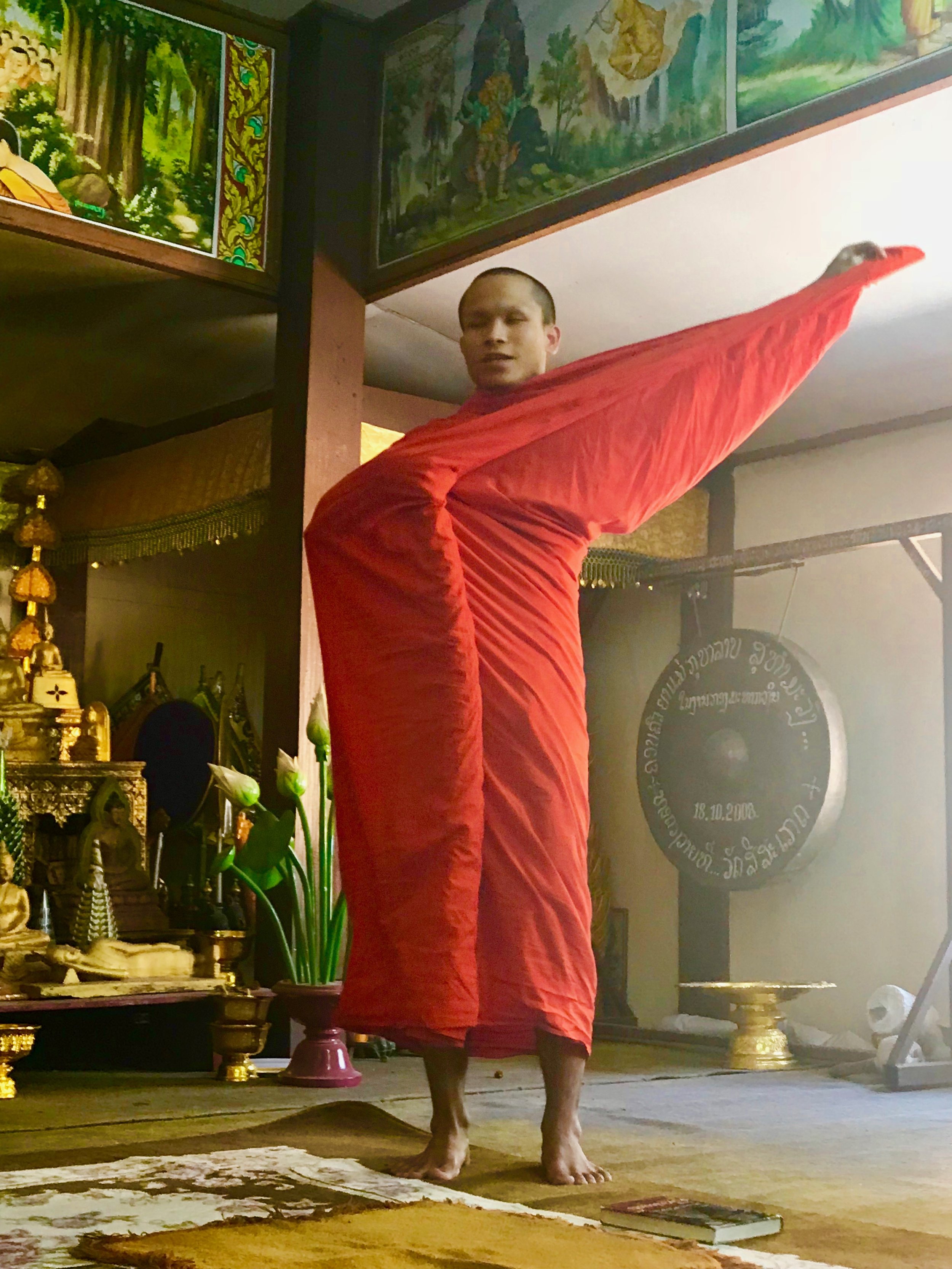
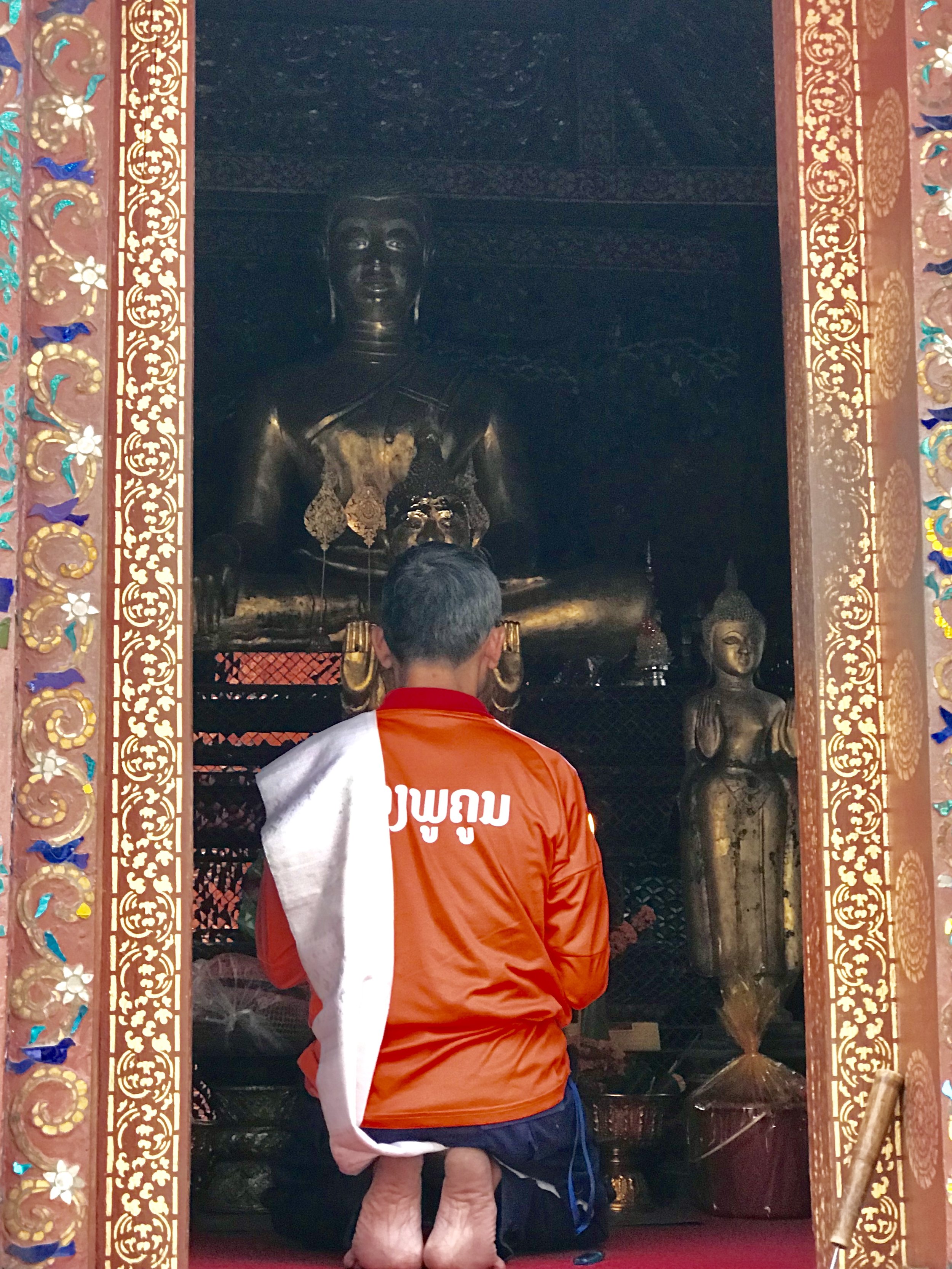
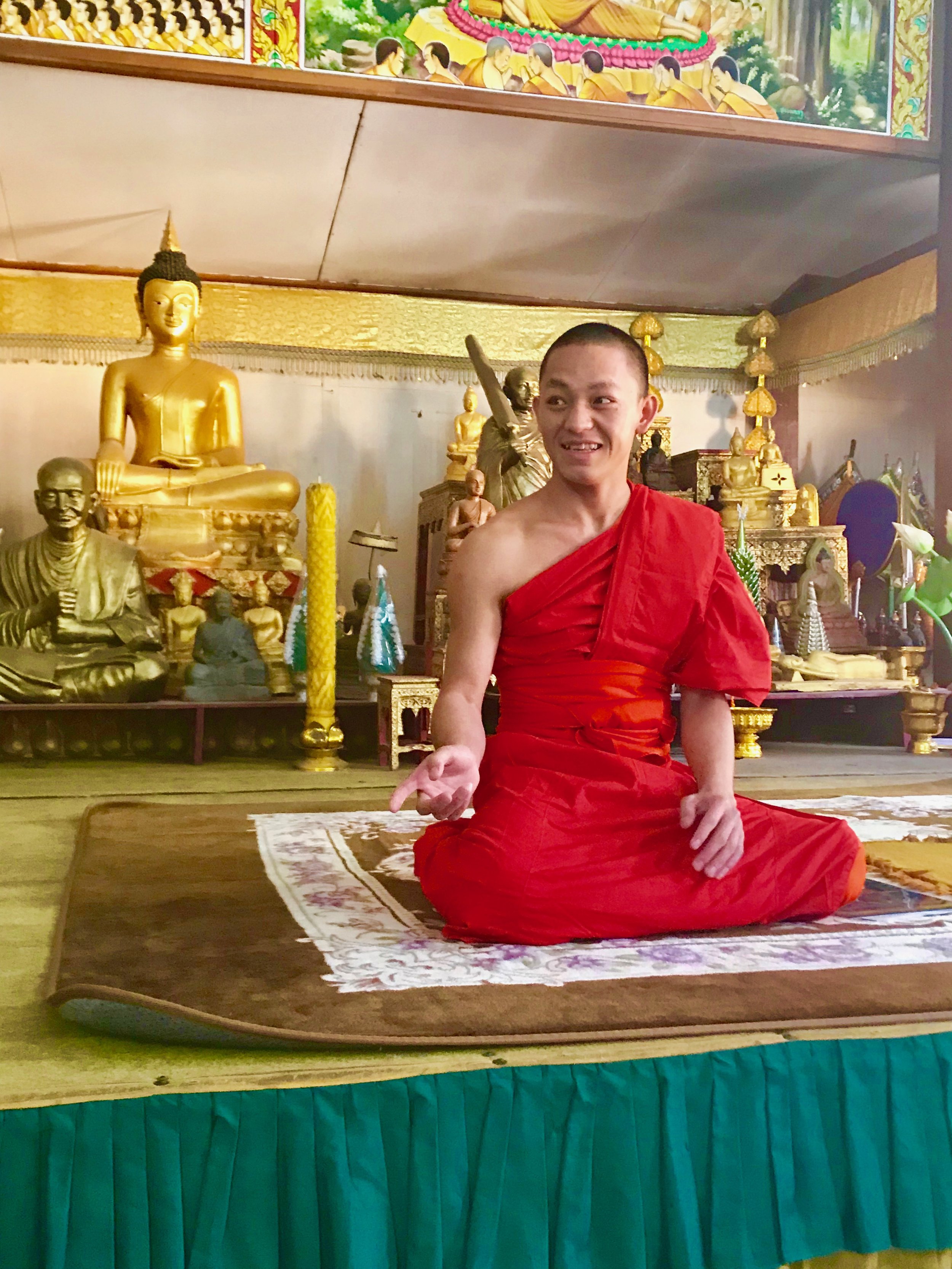
Cecile and I are currently in Vientiane, the capital city of Laos. It is a place of grandeur and laid back at the same time. Our first stop is Wat Sri Saket. There is a joke that Lin, our practicing Buddhist guide tells us. OAT which is short for Overseas Adventure Travels also means: OH, ANOTHER TEMPLE. But she will be the first to tell you that Wat Sri Saket is not just another temple by any means. It is a nineteenth century Buddhist monastery built in 1827 that houses over 10,000 Buddha Images and appears in its original form. Approximately 7000 of these Buddhas are contained in niches within the cloistered walls. The right hand gesture of the larger Principal golden Buddha image in the main hall is touching the ground, “Calling the Earth to Witness,” the “Buddha’s Awakening." After all, the Buddha means the “Awakened One.” It is here where we had the opportunity to ask questions of the novice and senior monk about their daily, routine, witness how they fold and unfold their robes and have them tutor the group in a ten minute meditation exercise. Phet (pronounced Pet) our English-speaking Lao guide, who was an ordained monk for 8 years translated for us. We sat with our spine erect either on chairs or on a mat like I am doing here in the photo. The monk had us concentrate on the moment to moment movement of our breath and the rising and falling of our abdomen while witnessing any thoughts or sensations that arise as simply background noise and nothing to get attached to. The premise is that all mind states, uncomfortable emotions and bodily sensations, come and go and it is our constant identification with them that makes one feel agitated, unsettled or subject to feeling dissatisfied or discontented. It is that constant ruminating about the past or the future that robs us of the present moment.

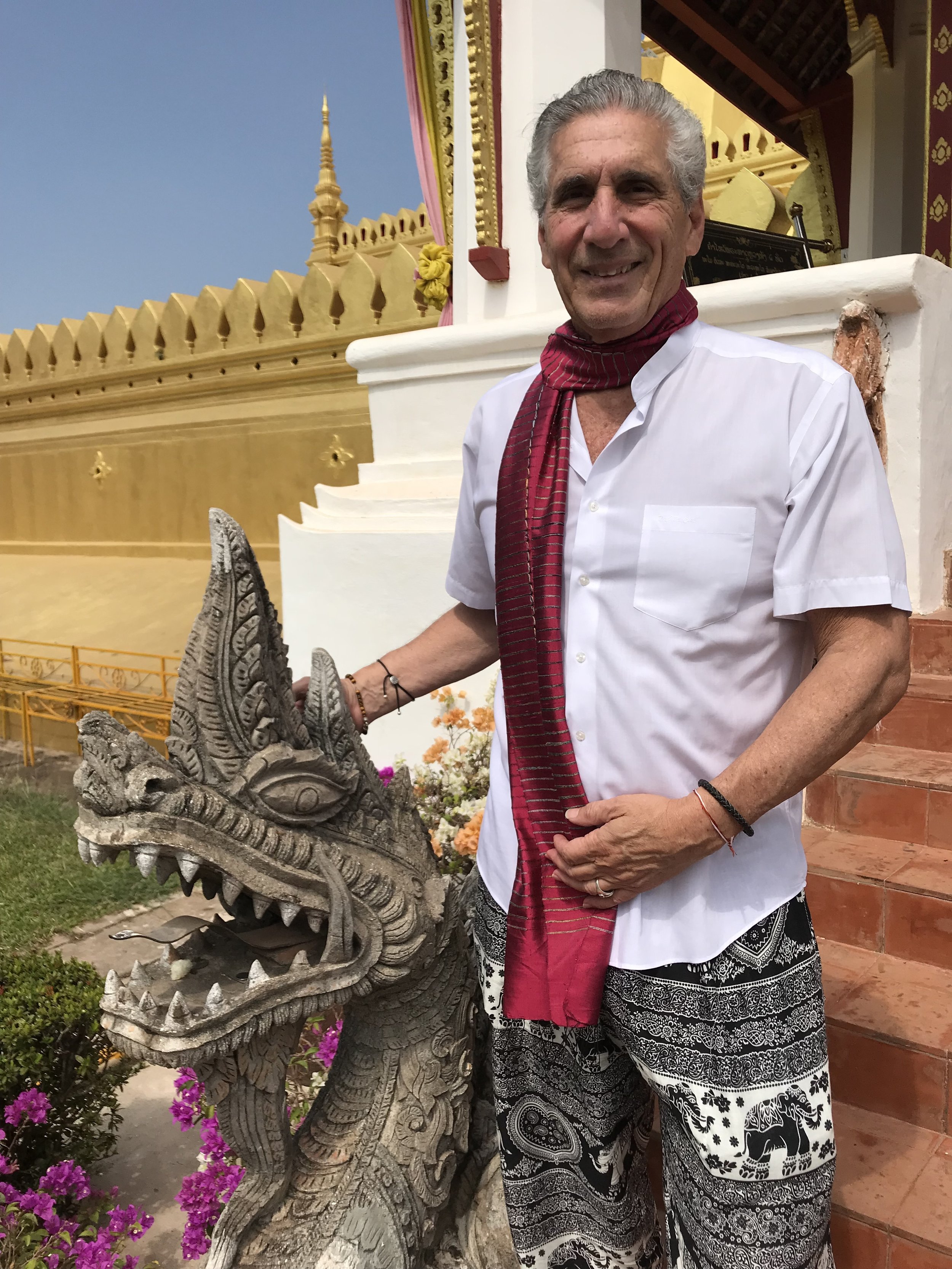
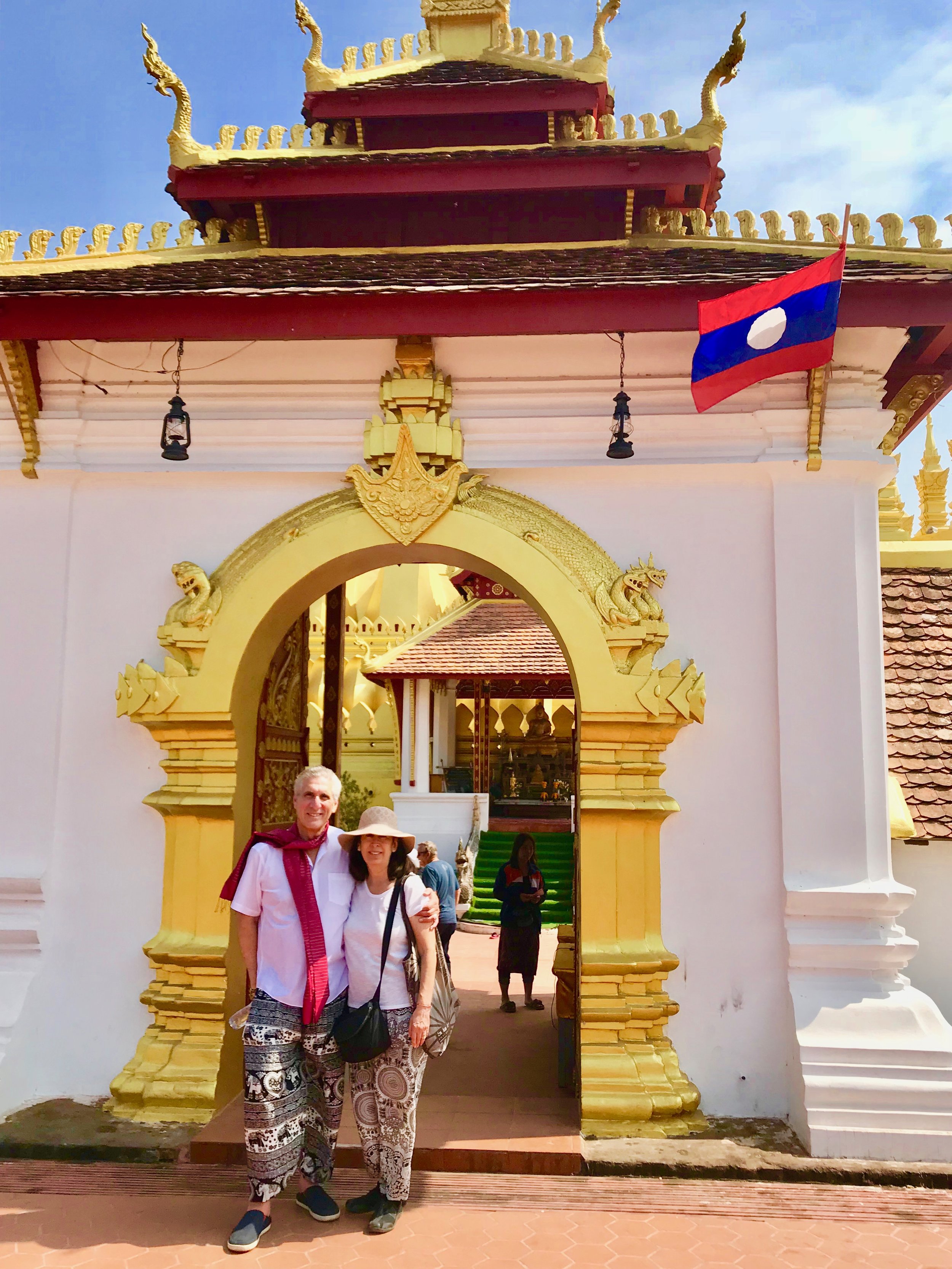
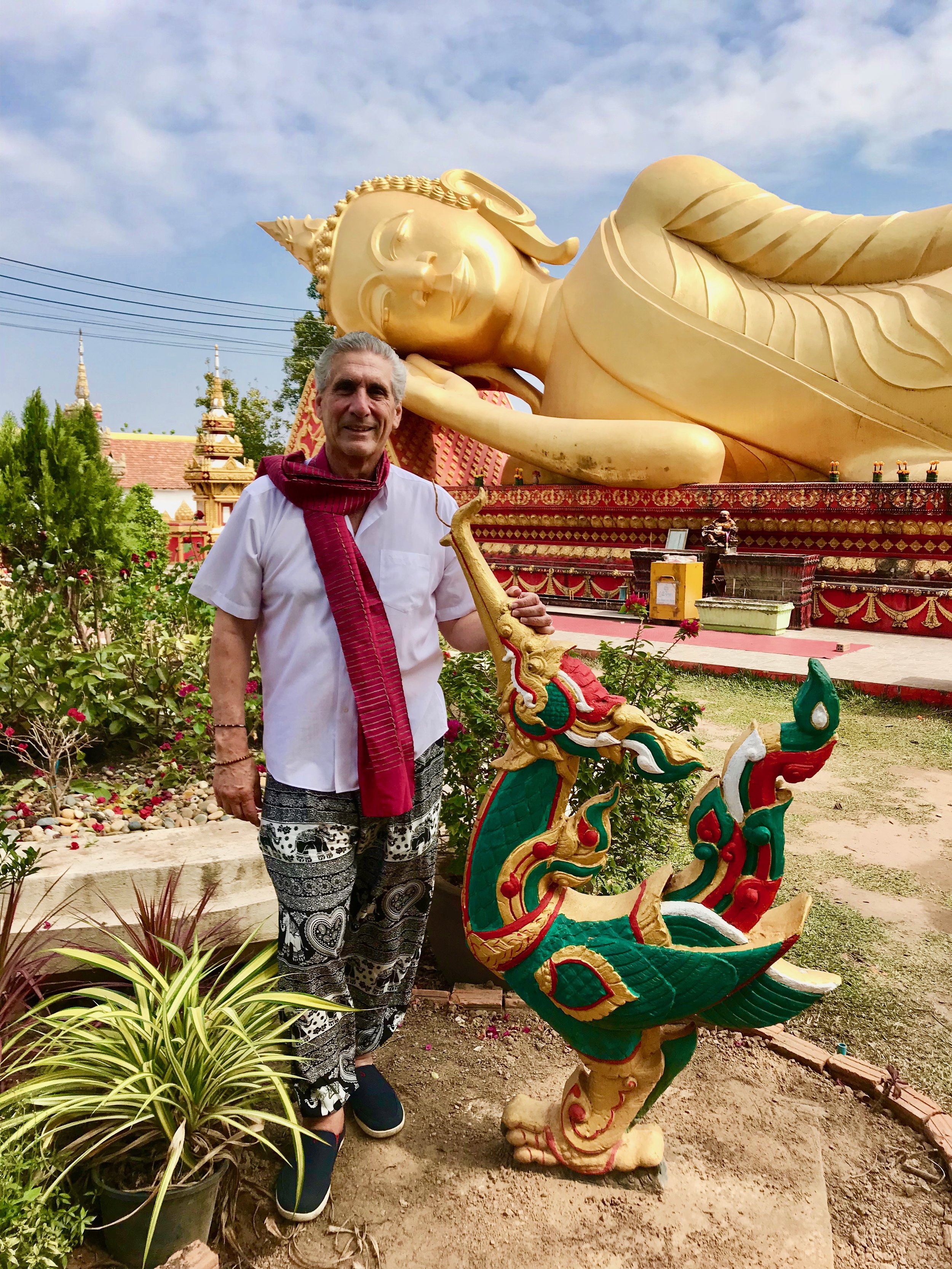
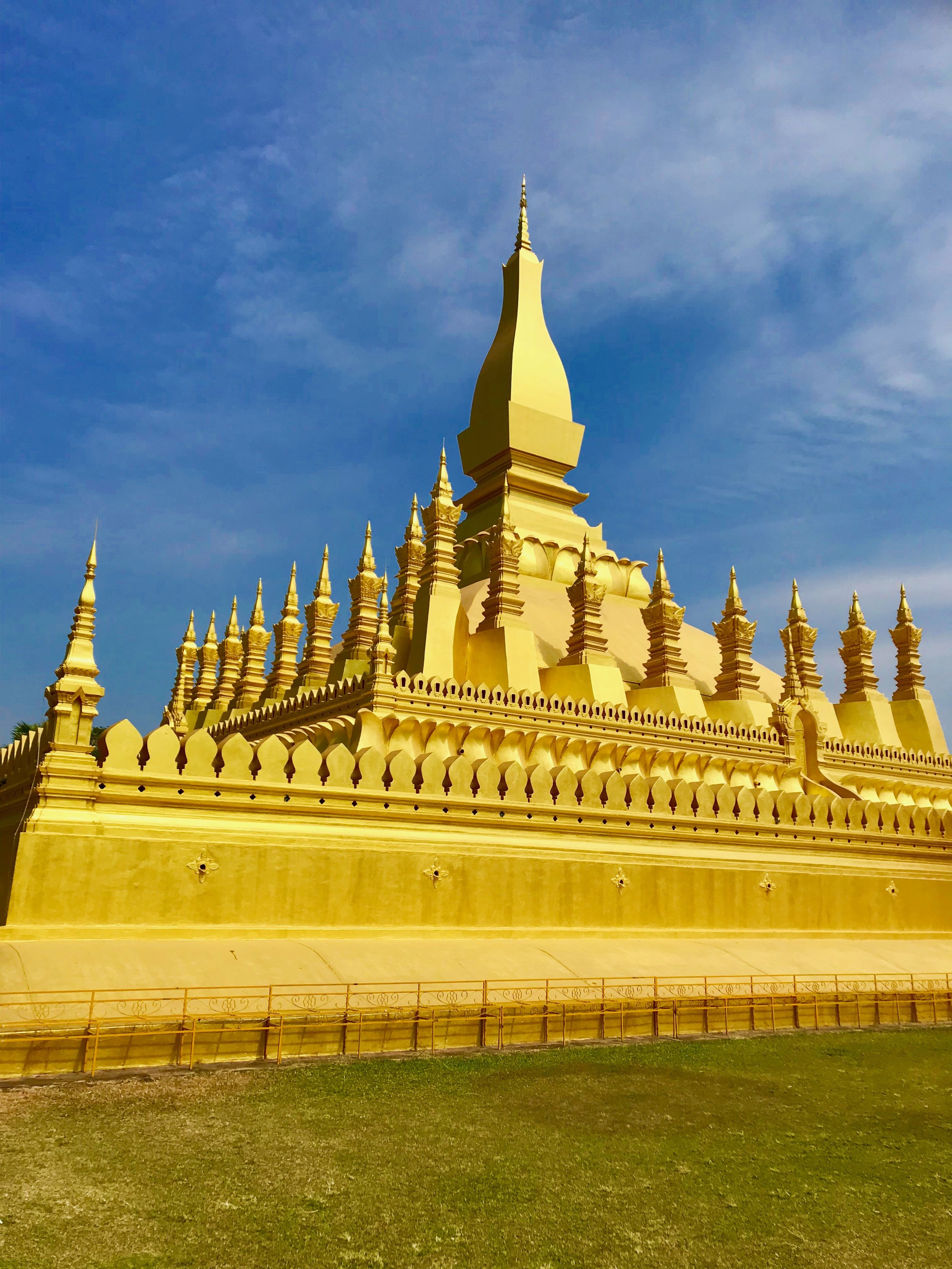
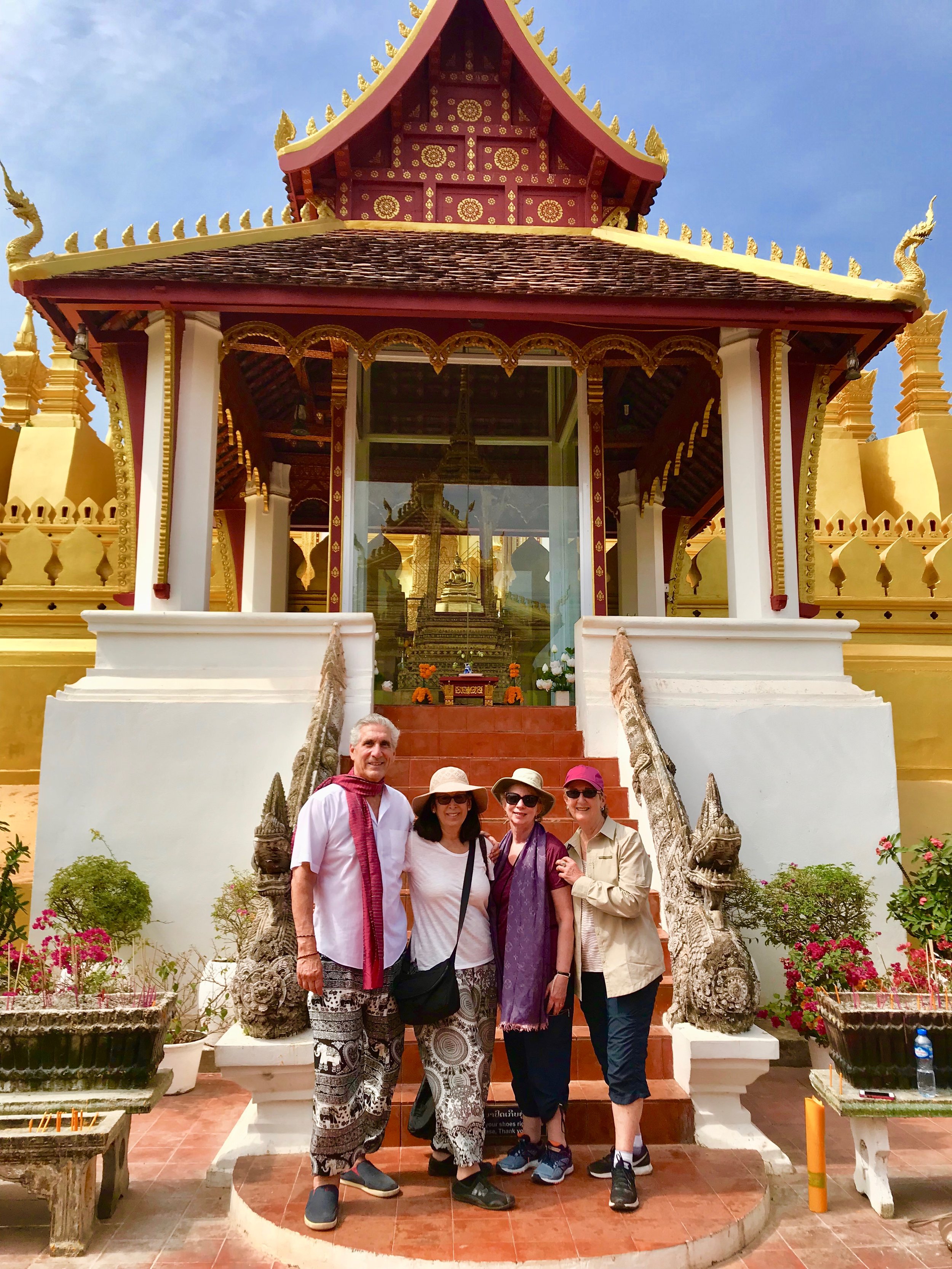
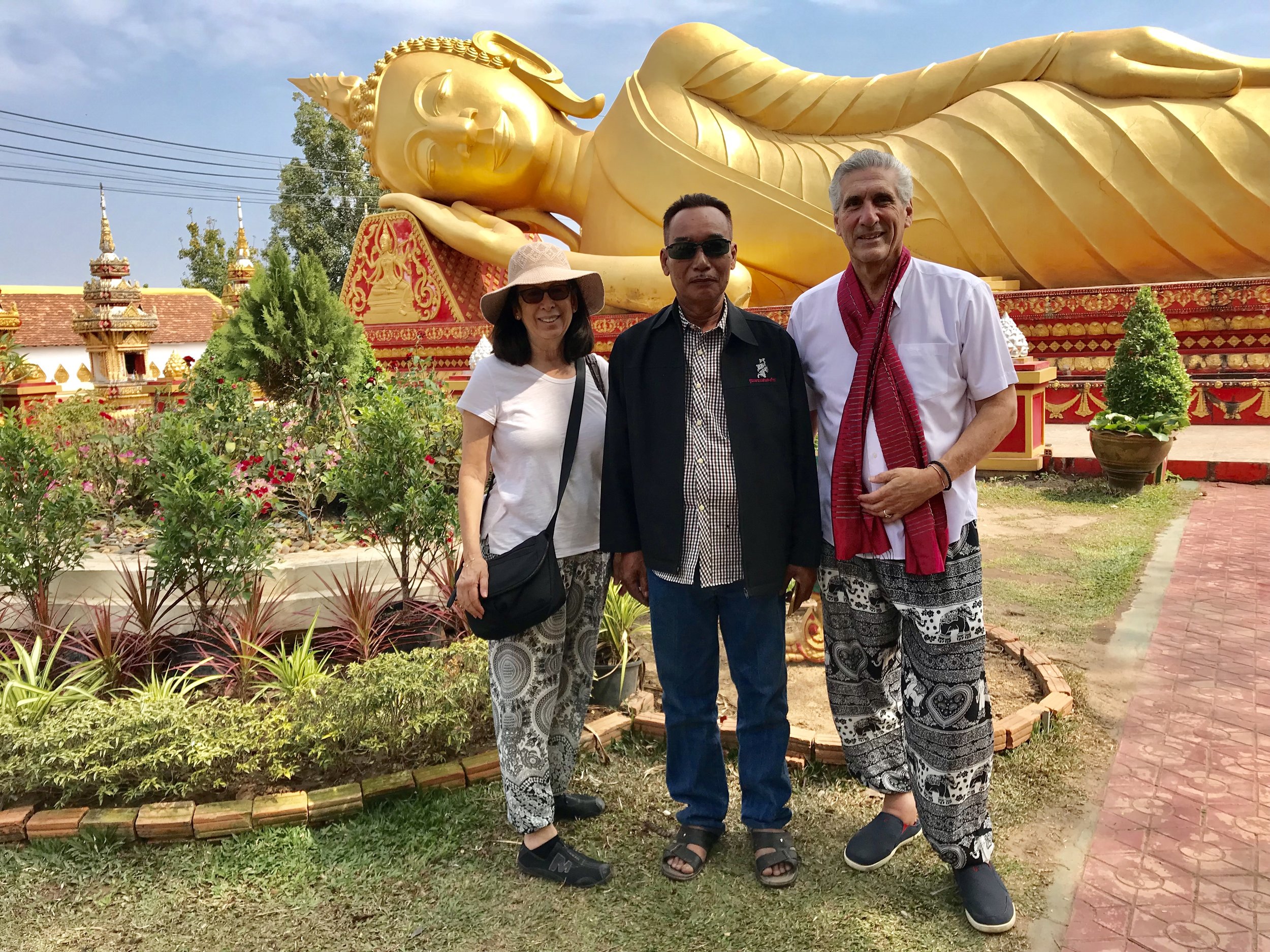
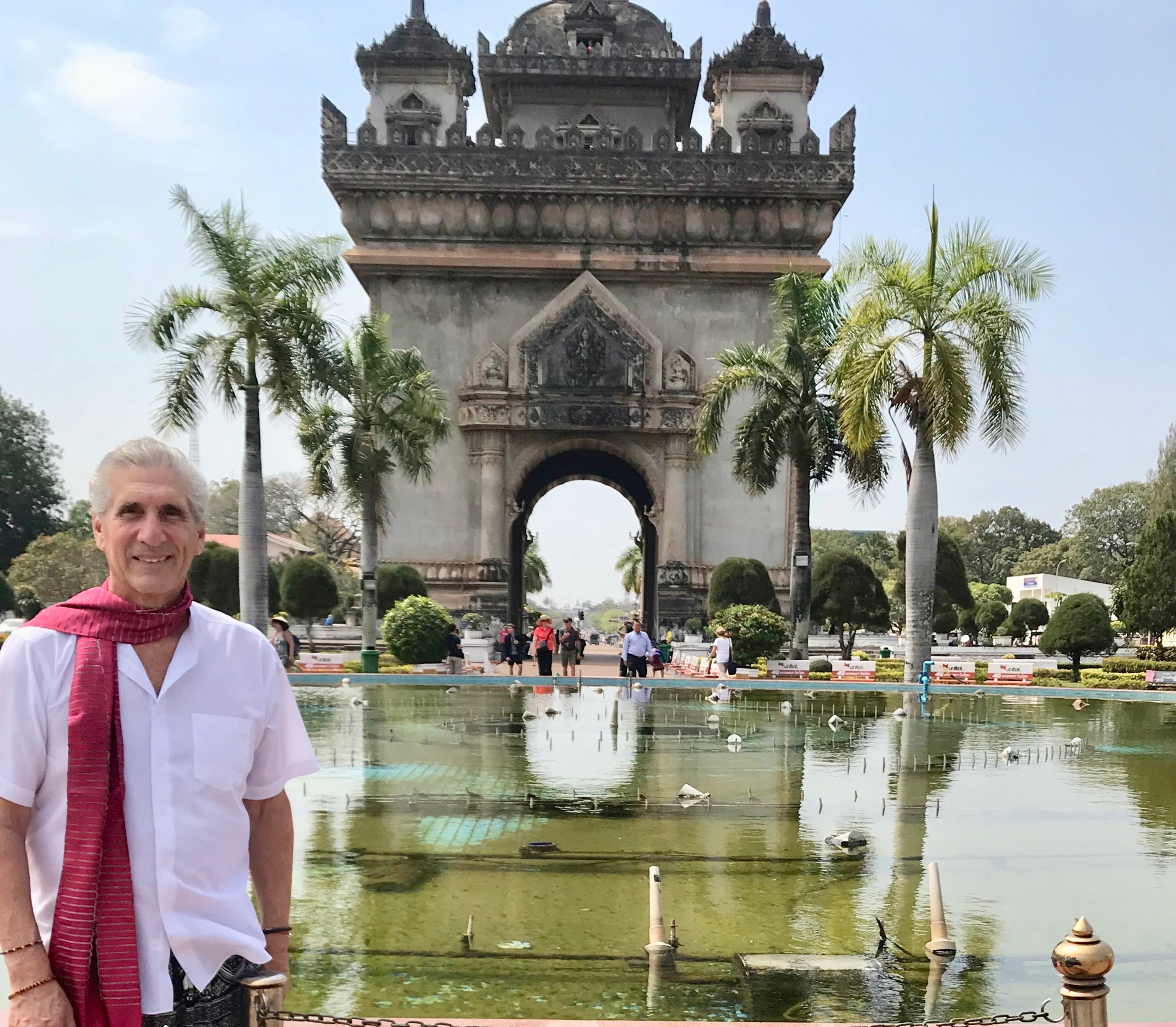
After our visit ended with the monks our bus driver took us to Wat That Luang (The Great Stupa), Laos’s most important monument. The three-layered gilded stupa is a magnificent site to behold at every vantage point, especially on a sunny day when the suns rays make it glisten. Gold is more than just a color to behold, it is a symbol defining the very best of Vientiane. We then went to the Patuxai or the “Victory Gate,” which resembles the “Arc de Triomphe” in Paris. Built between 1957 and 1968, it is a war memorial to remember those who lost their lives during the struggle to gain independence from France. It is a popular site to take temporary refuge from the afternoon sun and mingle with locals. The last photo is of Cecile and I with a Lao man who wanted very much to take a photo with us.

Playing a Shaman's Flute While Dancing & Shooting a Crossbow in a Laos Village During a Cultural Exchange

"Travel is fatal to prejudice, bigotry and narrow-mindedness."—Mark Twain

During a visit to a small Laos village, Cecile and I and our small tour group from Overseas Adventures Travels (OAT) got to experience “A Day in a Life of the Lao People”. We were greeted by the mayor, vice mayor (who is also the shaman) and their wives. The backdrop of the introductions left most of us puzzled. We kept hearing rapid fire gunshots and didn't know whether to duck or run for cover. We found out later that there was a military training camp nearby.

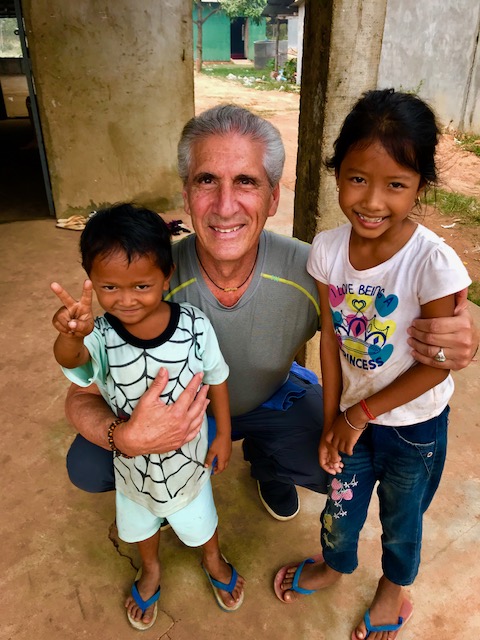
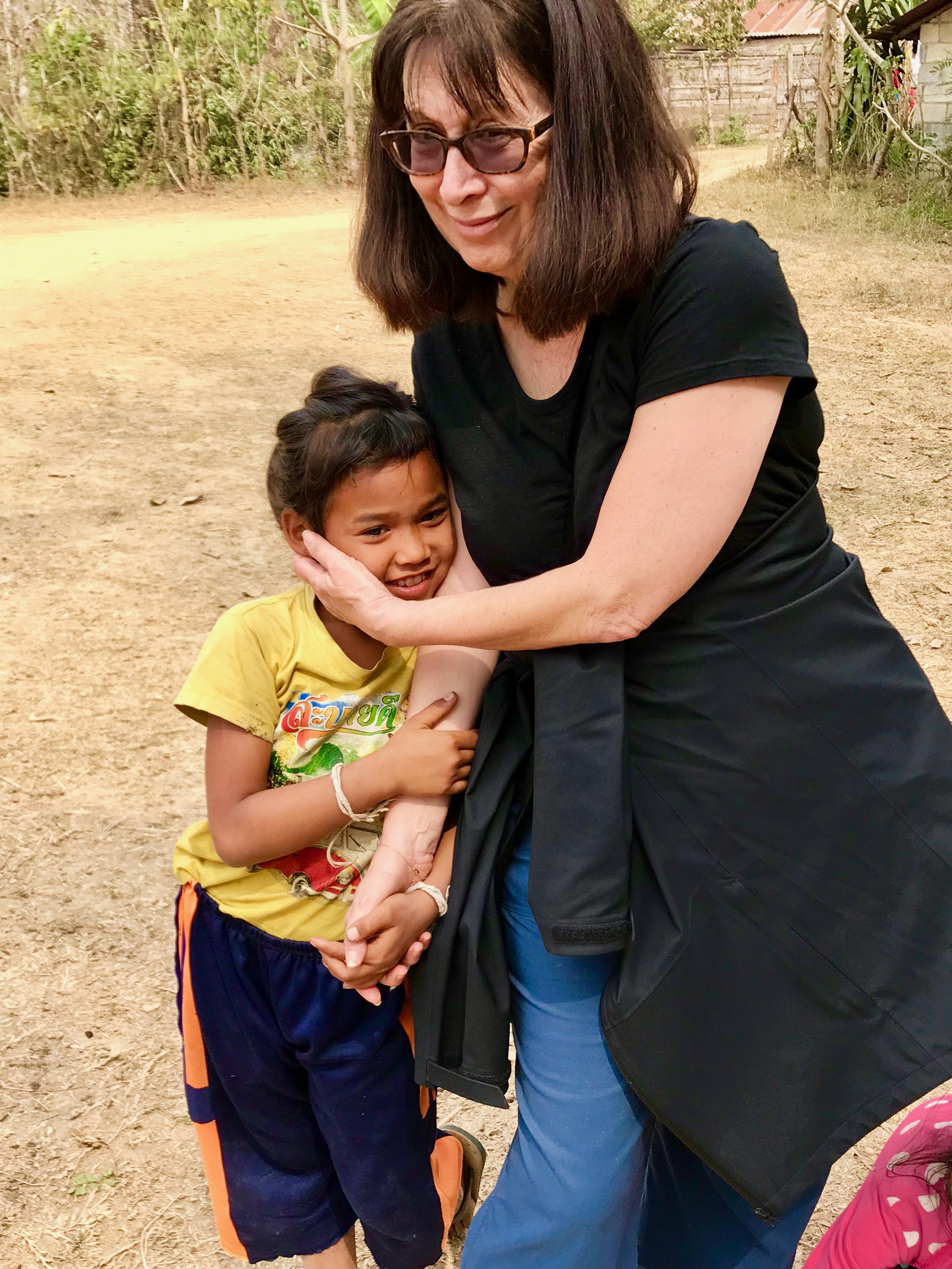
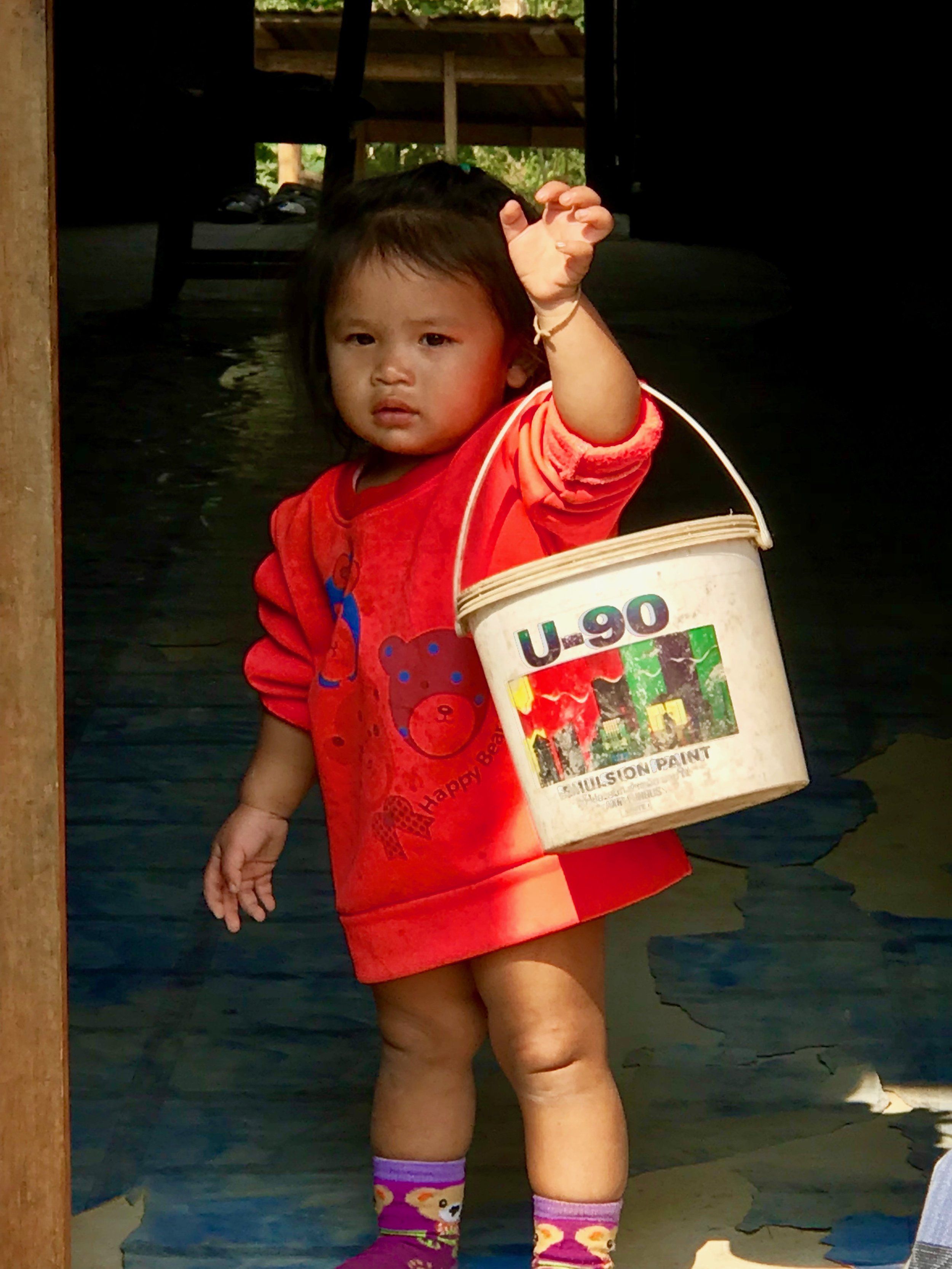
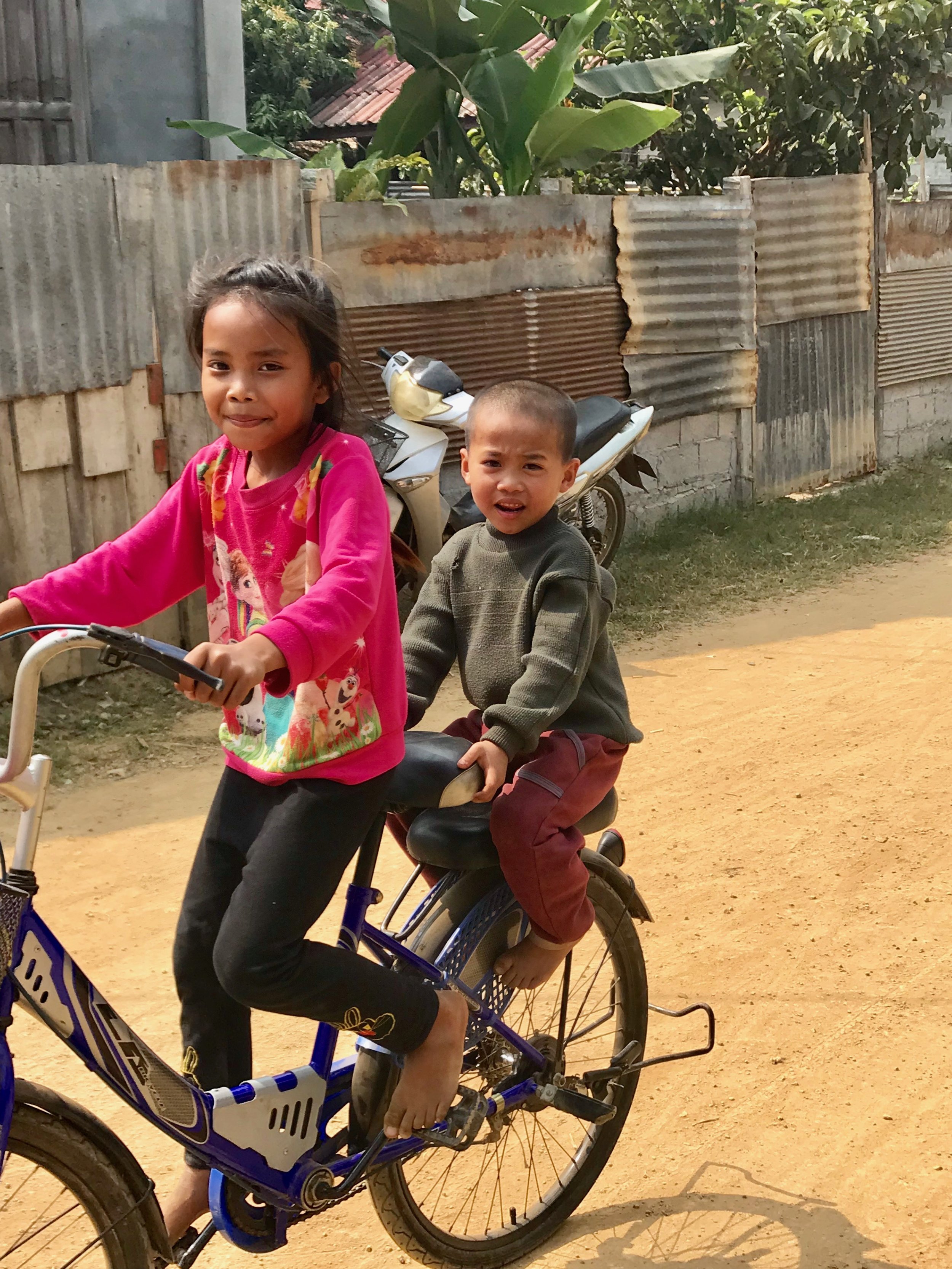
We were given a tour of the village community hall, housing, a small shack of a school and weaving wheels local women use to make scarves and other products. It is a very poor village but they give thanks to the Grand Circle Foundation (the charitable arm of OAT) for assisting them with helping to put in a water tank, and donating two weaving wheels. The school children were excited, cheerful and inquisitive about their visitors. They were also very affectionate. We saw a senior teacher lead a class, we sang American songs like, “Old McDonald’s Had a Farm…and did the "Hokey Pokey" to name a few—after the class was over. Having had been an elementary school teacher, Cecile was very touched by the experience, especially by the young girl who took her hand and showered her with affection.

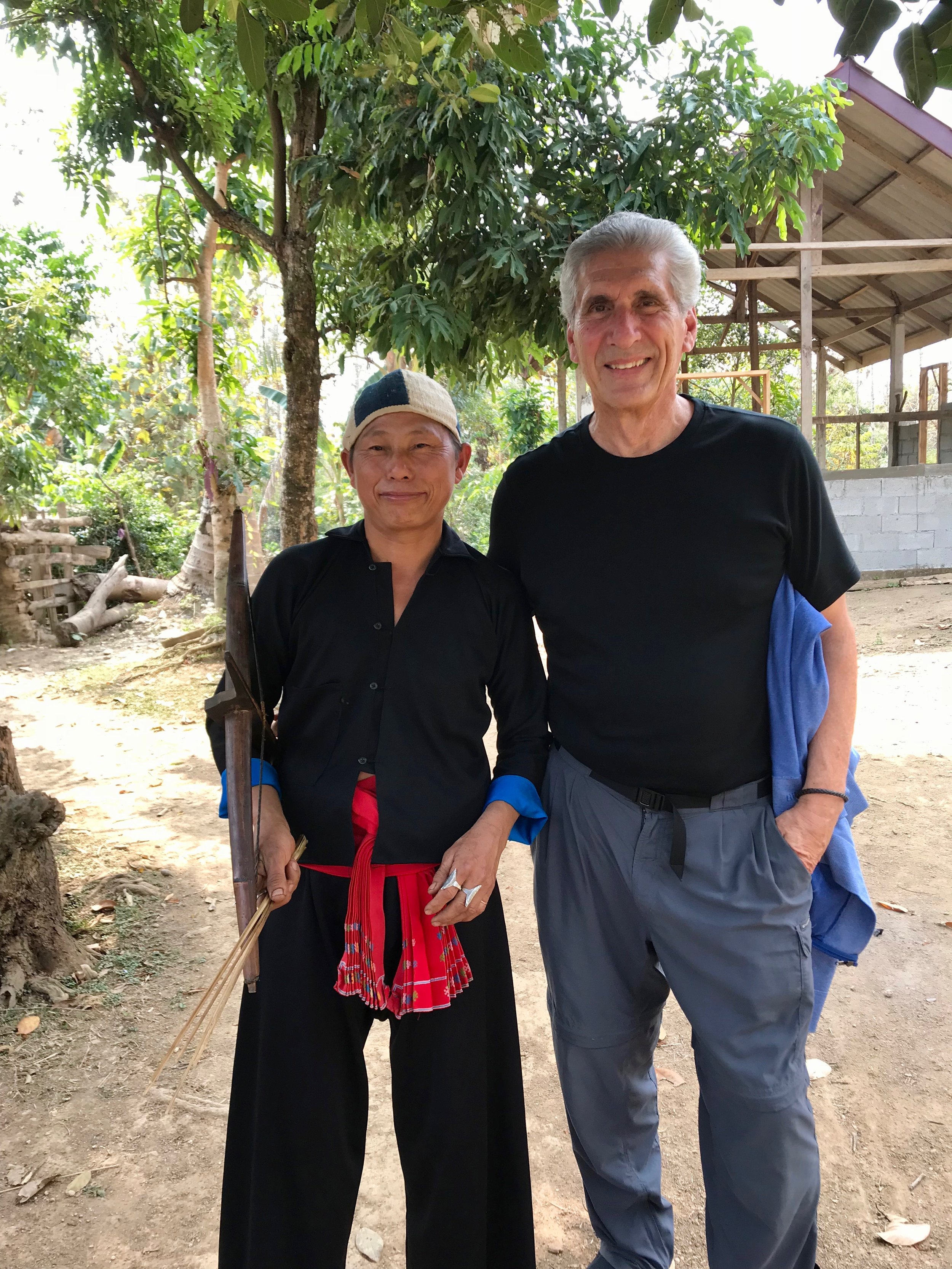
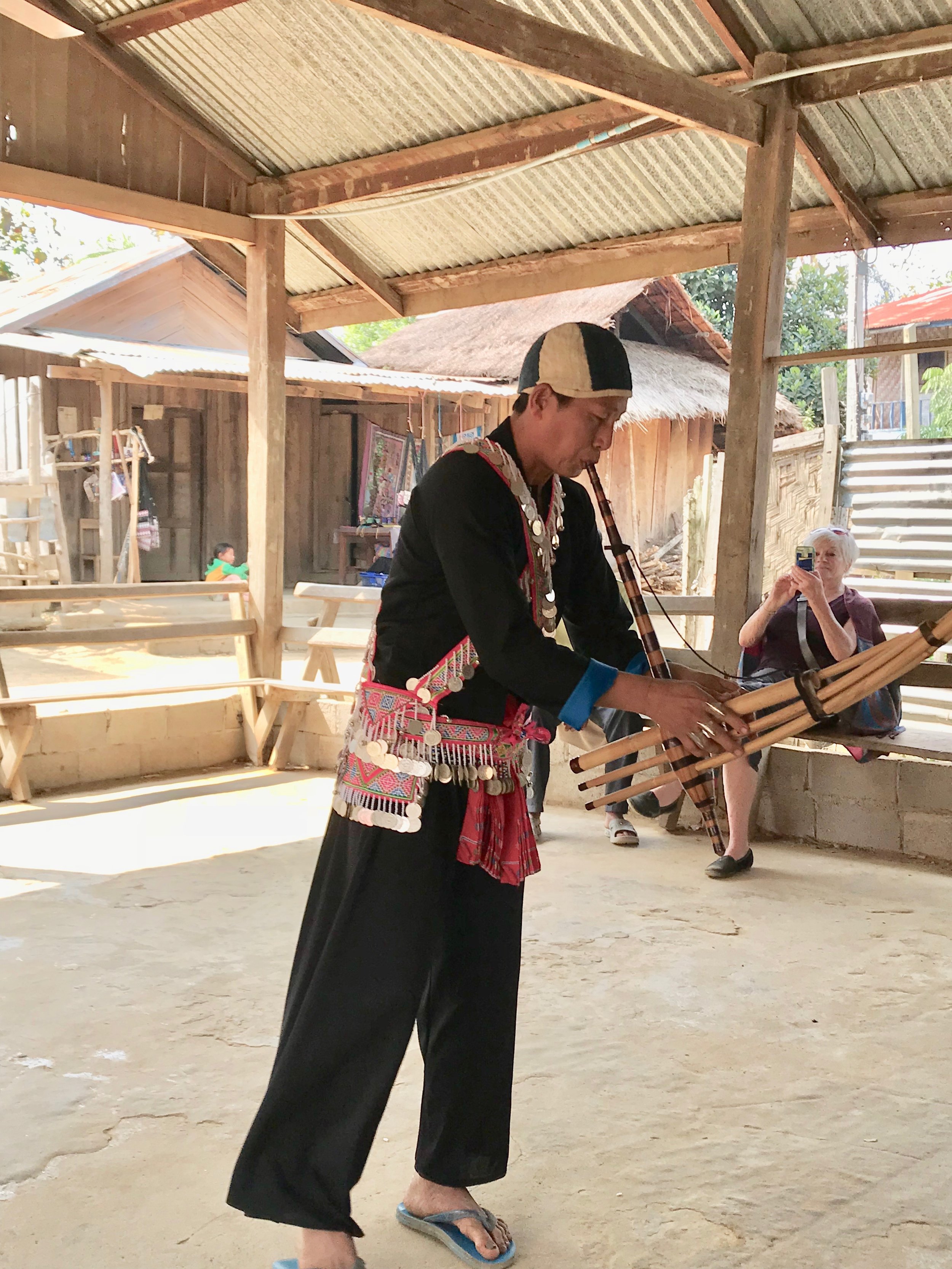
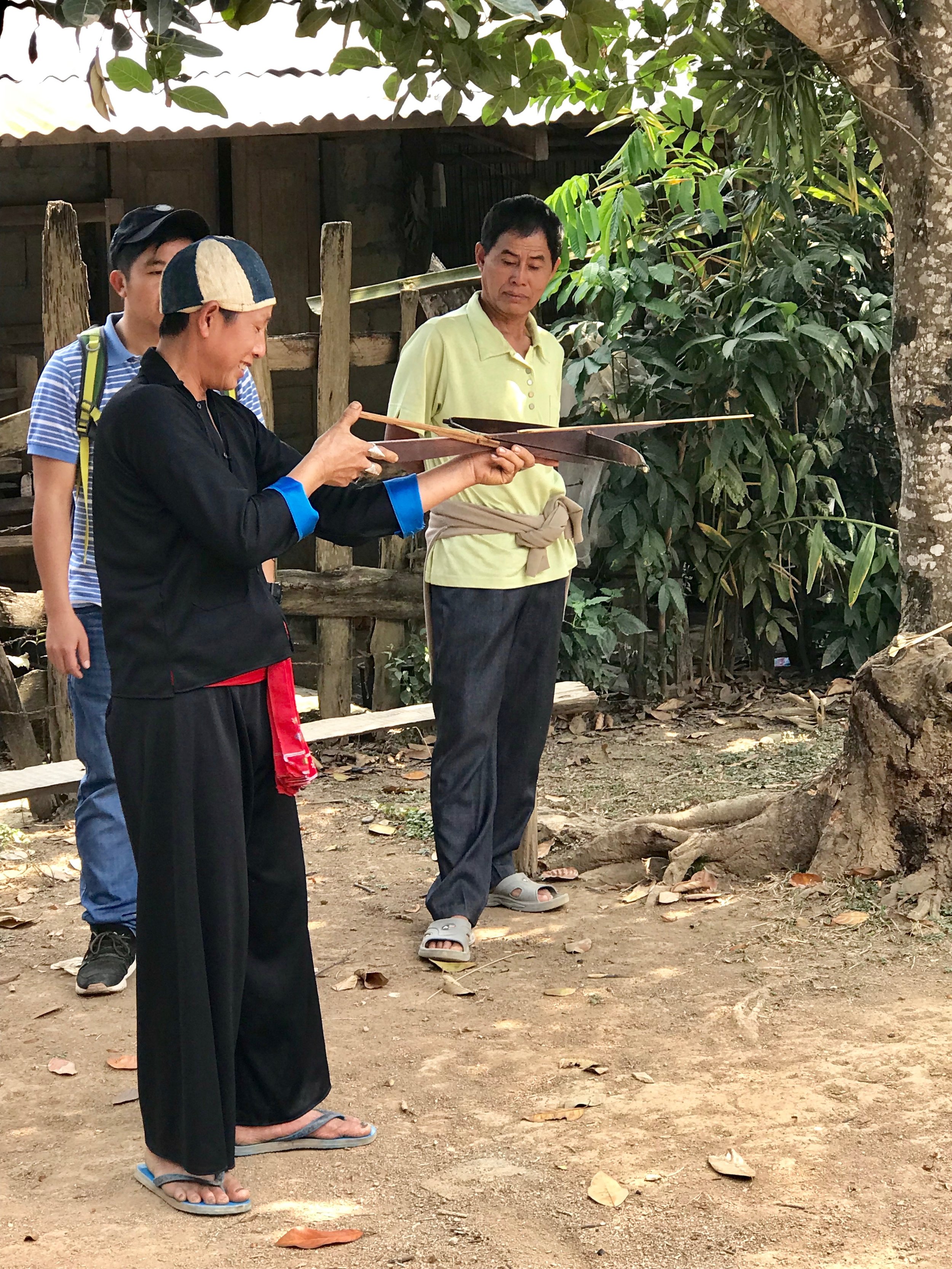
Norseng, the vice-mayor who also doubles as a shaman for the village put on a show for us by dressing up in his native dress and played a flute called a “Khvang” while dancing like a whimsical pied-piper. He, is from the Mon people, one of the earliest settlers to reside in Southeast Asia that resides on the border of Thailand and Burma. He called for volunteers and I was one of them as seen here in the video clip. Norseng also demonstrated how to shoot a crossbow. I was more timid about shooting the crossbow than dancing while making an attempt to play the flute since several of the volunteer’s arrow hit near the center of the target. But, I gave it the “old Yankee try” and to my surprise, rather than hit center mass, I hit what would be considered a forehead shot. 

When asked Siya how he became mayor? He told us he was chosen as a candidate for mayor by the Communist Party and won the election by the majority vote of the villagers. He was embarrassed to say how much he made. It was meager. Then again, there are municipalities in the states where city officials essentially are volunteer positions. 

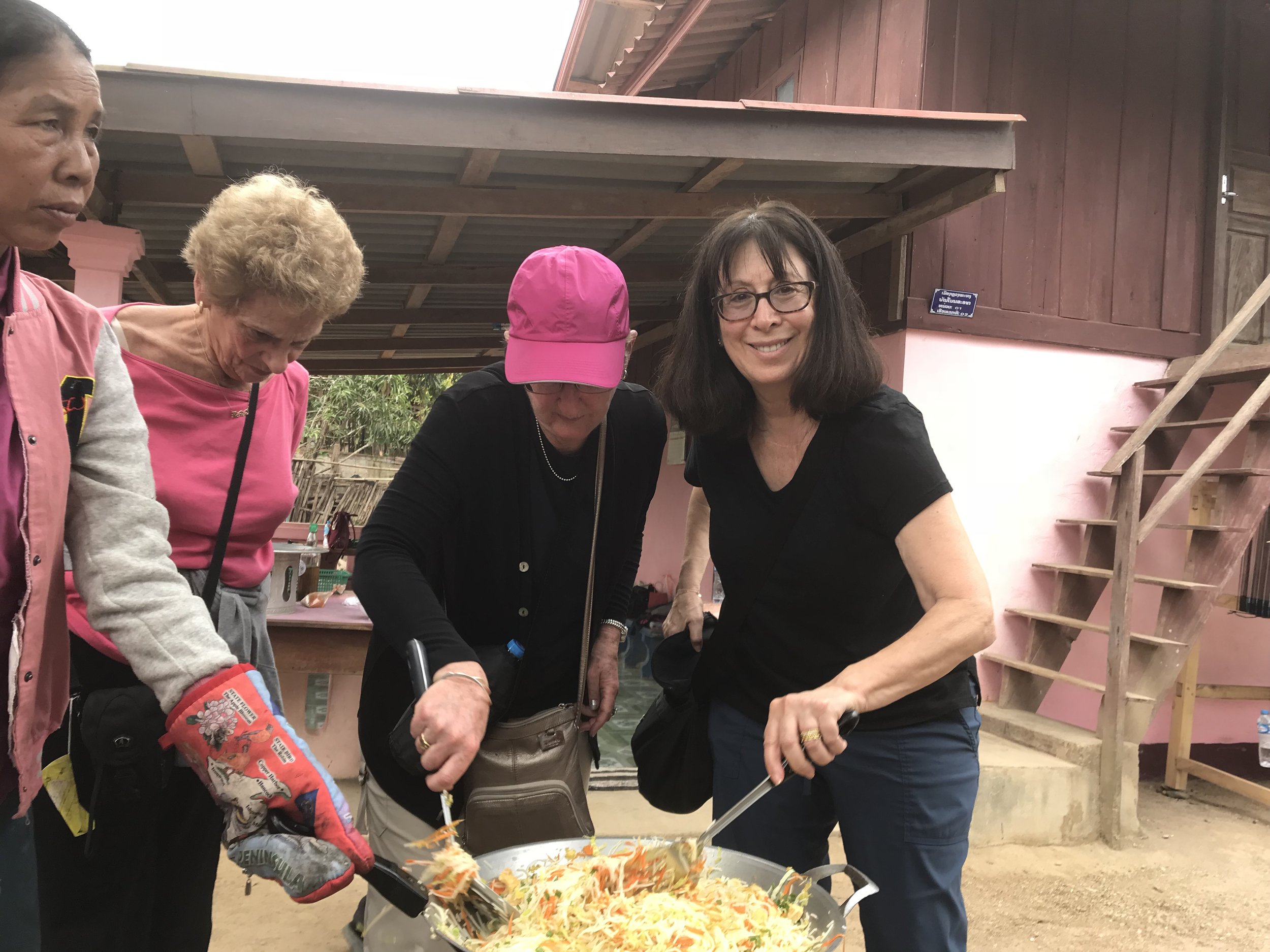
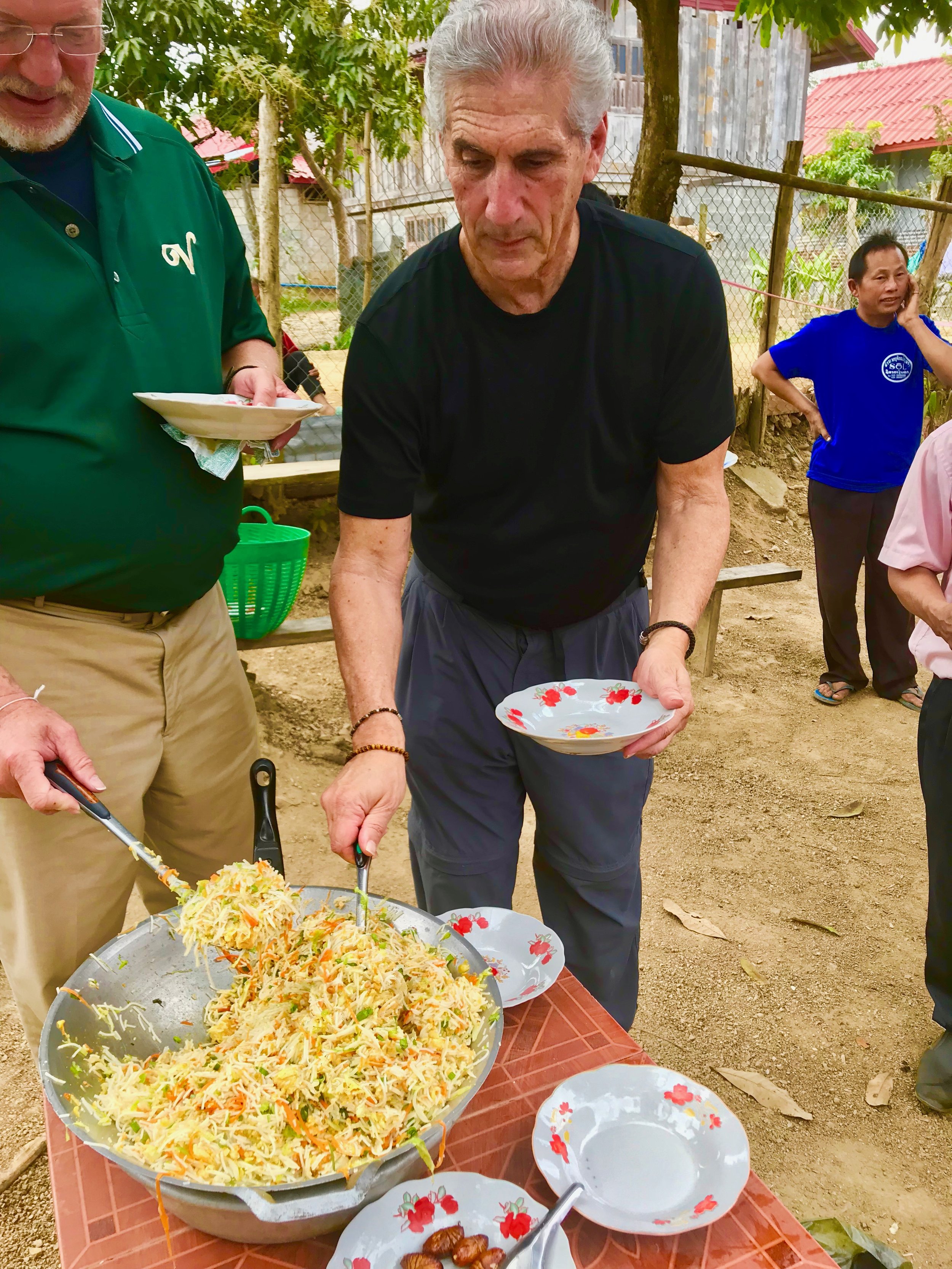
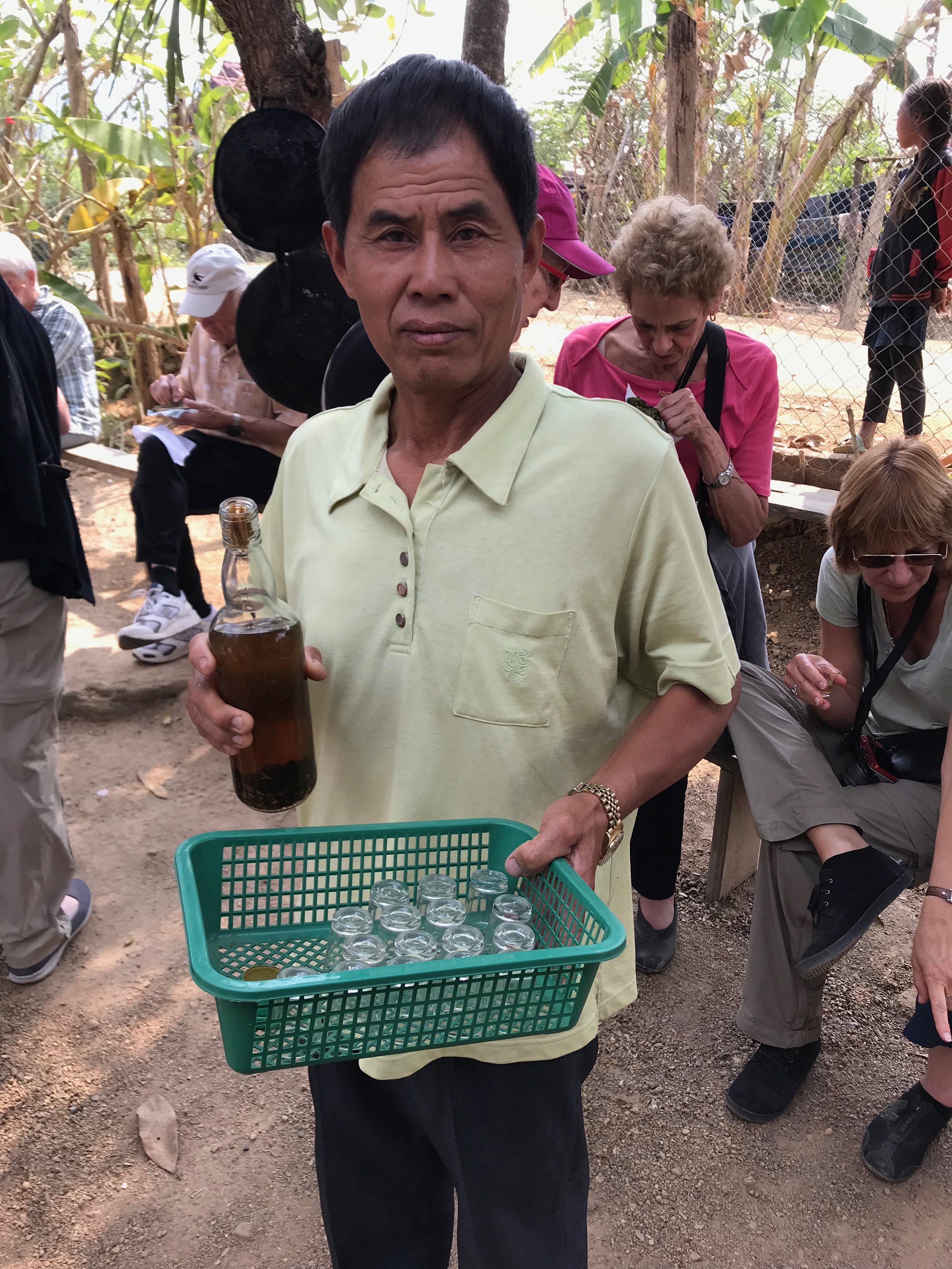
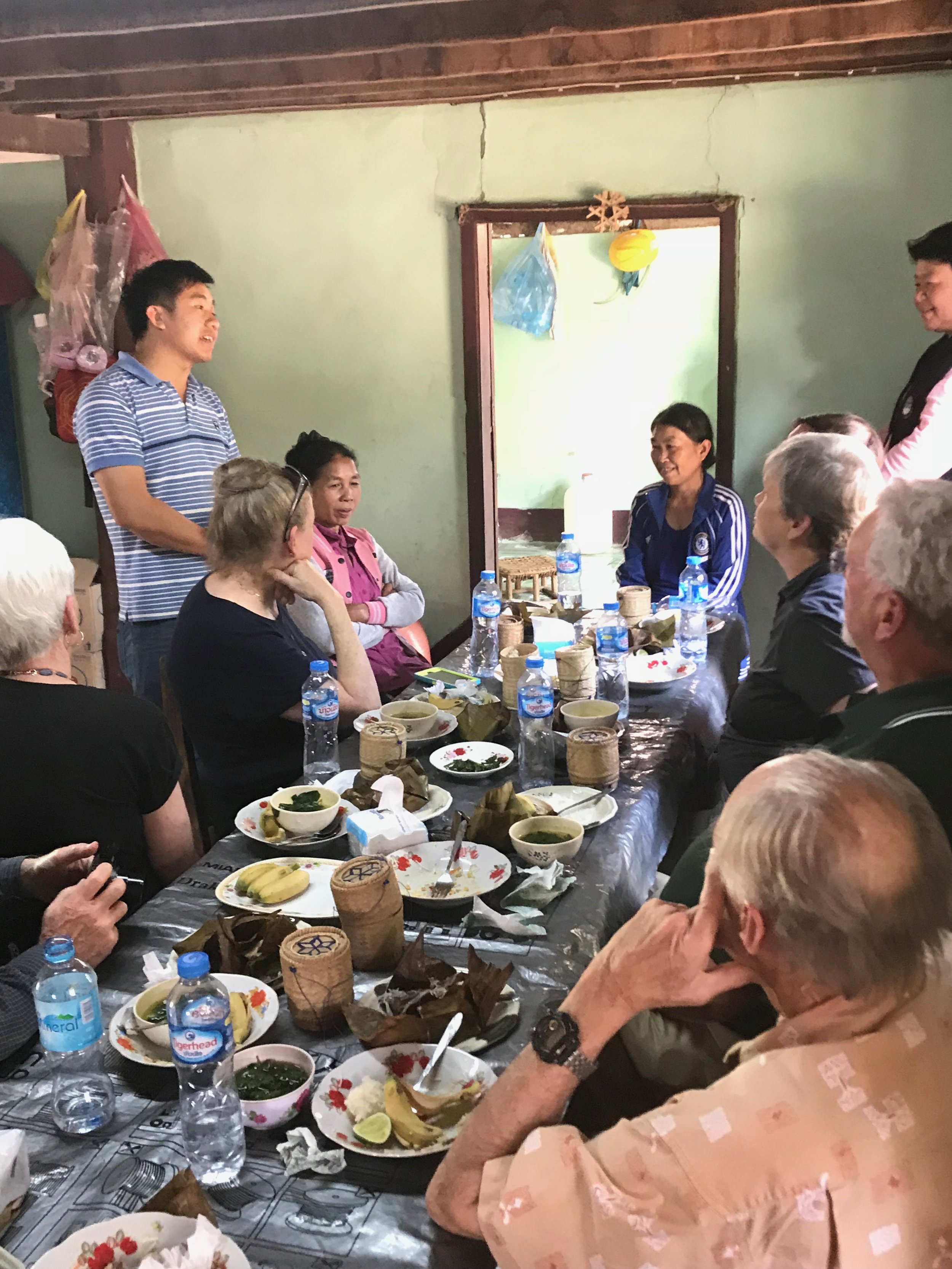
We then assisted our hosts in preparing a very fine Lao meal with some of the ingredients we bought earlier in the day at the street market. The mayor served us shots of whiskey that is made here in Laos and we all shared a meal on his dining room table. The back and side walls were walled with framed certificates of merit by the communist party for his service to the village. When his wife was asked what she liked about her husband being mayor, she responded with "all the people I get to meet."

When we said our goodbyes, Norseng, came on the bus to give us a blessing and thank us for our visit and support and hoped that someday we will visit again. It was a very humbling experience overall and any reservations that the villagers had about hosting us believing they could never satisfy our standards were set aside as we all came together as one.

To view the short audio-video clip of Dennis playing the Shaman's flute while dancing in the village in Laos click on the link below:
https://www.facebook.com/dennis.augustine.18/videos/vb.519921667/10156036910086668/?type=2&theater&notif_t=video_processed&notif_id=1518366868066252

Our Early Morning Alms Giving to the Laotian Monks: A Time Honored Tradition of Mystery & Meditative Calm

"Accepting the miracle of the moment, this breath, this day, this life..."—Terry Patten

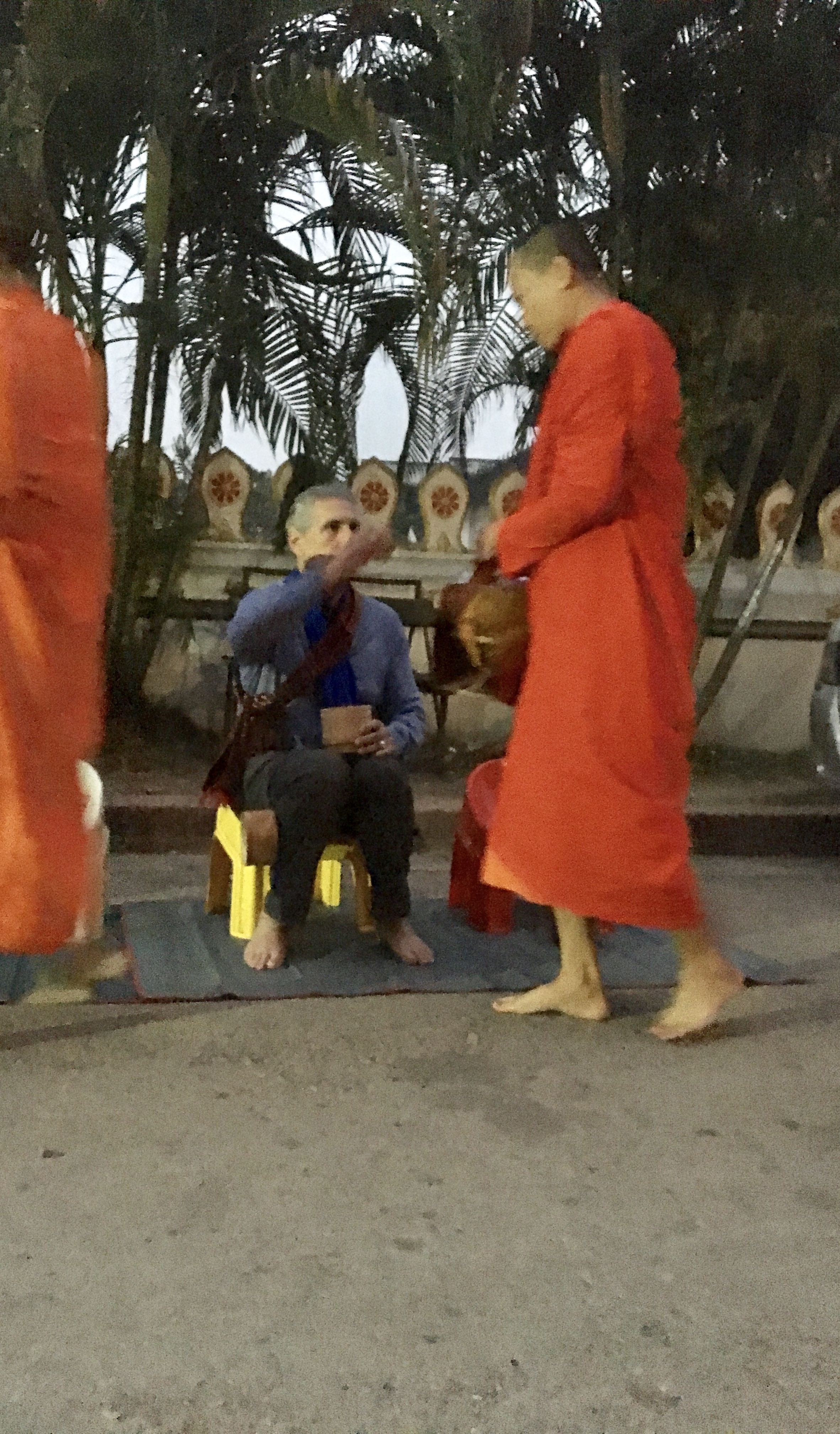
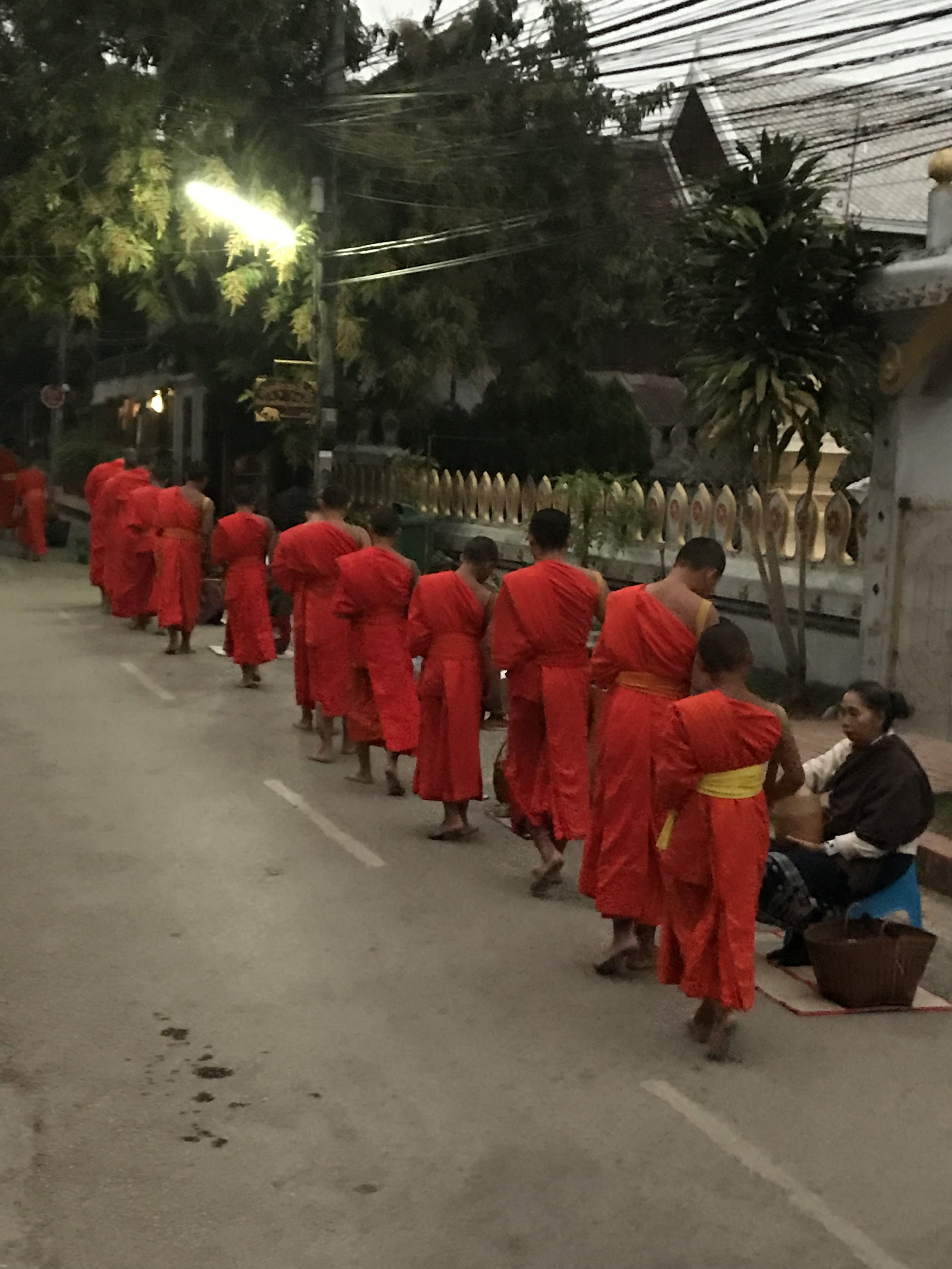
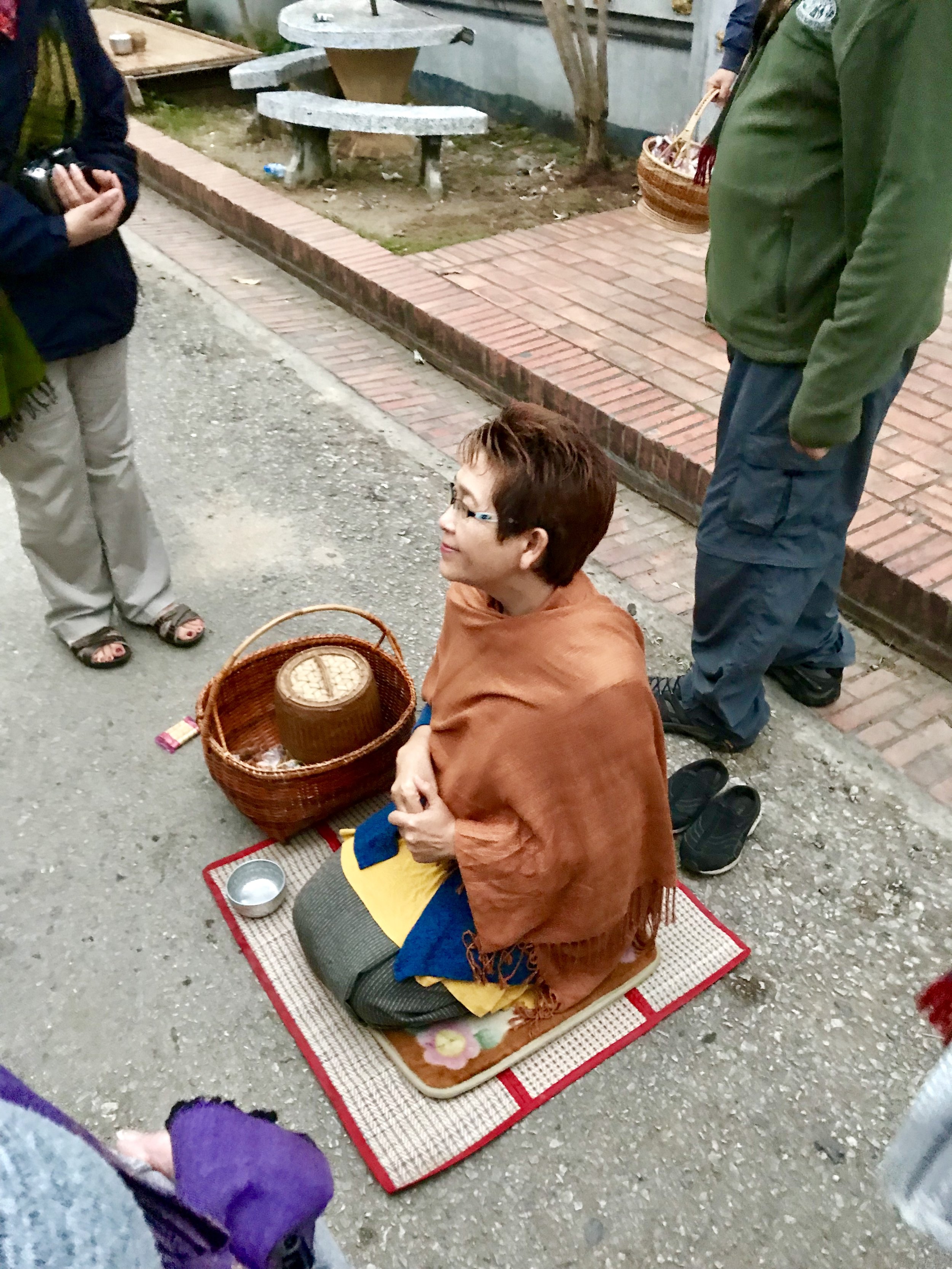
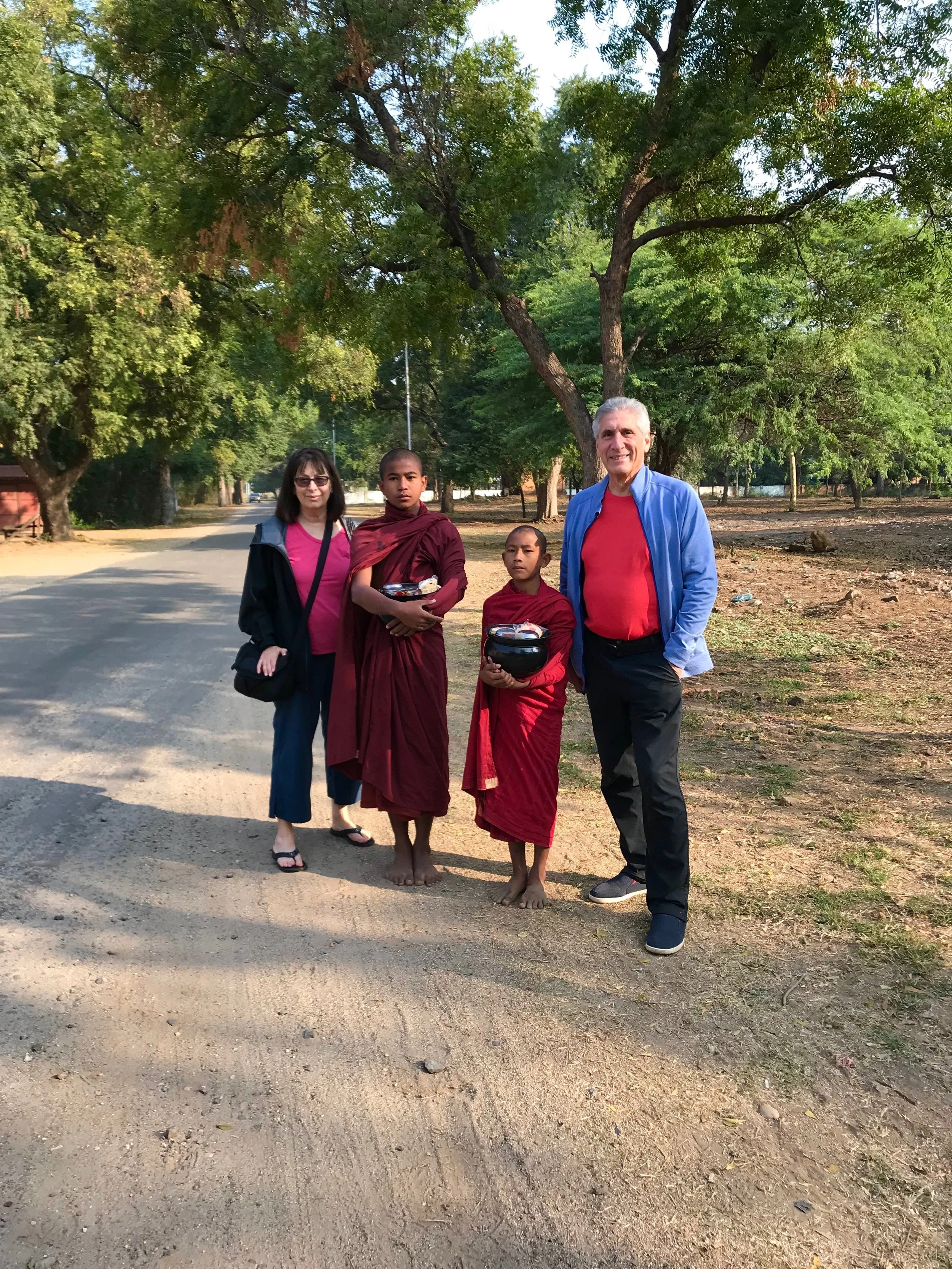
Just before the sun rose in Luang Prabang (Laos), we passed locals waiting for the procession of around 200 monks that were getting ready to make their alms rounds for the day called “tak bat.” It is a time-honored tradition that dates back to the 14th century that is done silently. We ourselves positioned ourselves, along the roadside near a local monastery in town waiting in anticipation for their arrival. It was a rare opportunity to experience this ancient Lao tradition. We each had a small covered weaved basket of sticky rice. As a sea of monks in their orange robes passed us one by one (oldest first) in a meditative state I dropped a small portion in their bowls which are attached to a strap hanging from their shoulders. 
Once we were finished giving out the rice, we were permitted to take photographs from a distance without a flash so as not to disturb the monk’s meditative peace. It is a uniquely, spiritual experience. The daily ritual is a collaborative effort between the monks and the laypeople. It is not charity the way the West interprets it. Rather it is a symbolic connection between the monk who requires daily physical sustenance and the layperson who gets to practice generosity and loving-kindness to a monastic who provides spiritual sustenance to the community.

I had been a recipient of offerings (sticky rice and mango) by locals during my monastery stays in Burma as a gesture of gratitude to us Westerners for coming thousands of miles away to study meditation and Buddhist, mindfulness teachings. However, this was only the second time I made an offering of rice to a monk. The first time was when my son Jason and I travelled to Southeast Asia more than 16 years ago. During the Alms offering we were invited to quietly recite a loving-kindness chant to ourselves for the benefit of "all beings everywhere" ending with "may peace, love, kindness and compassion be revealed in the world and in ourselves.

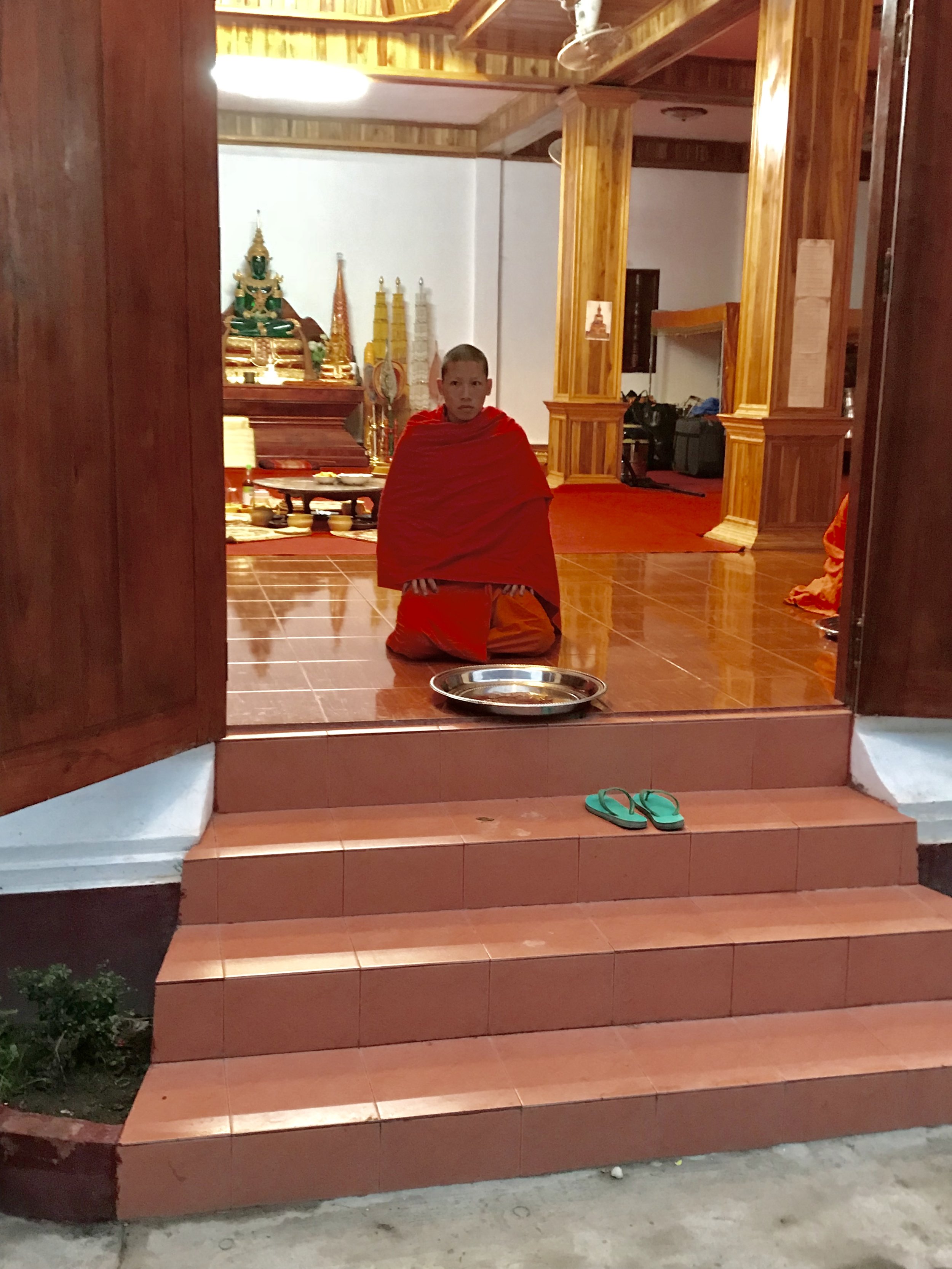
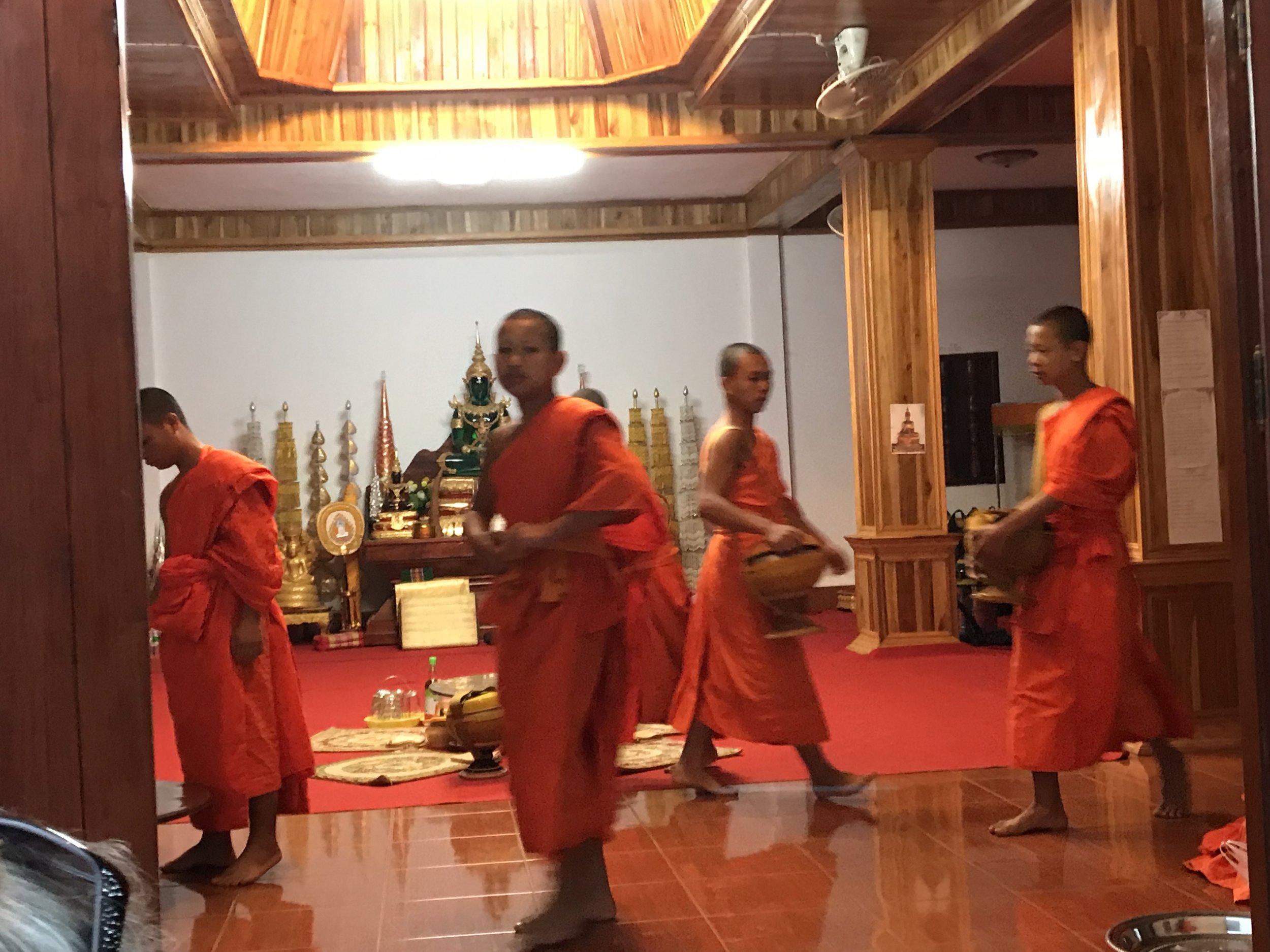
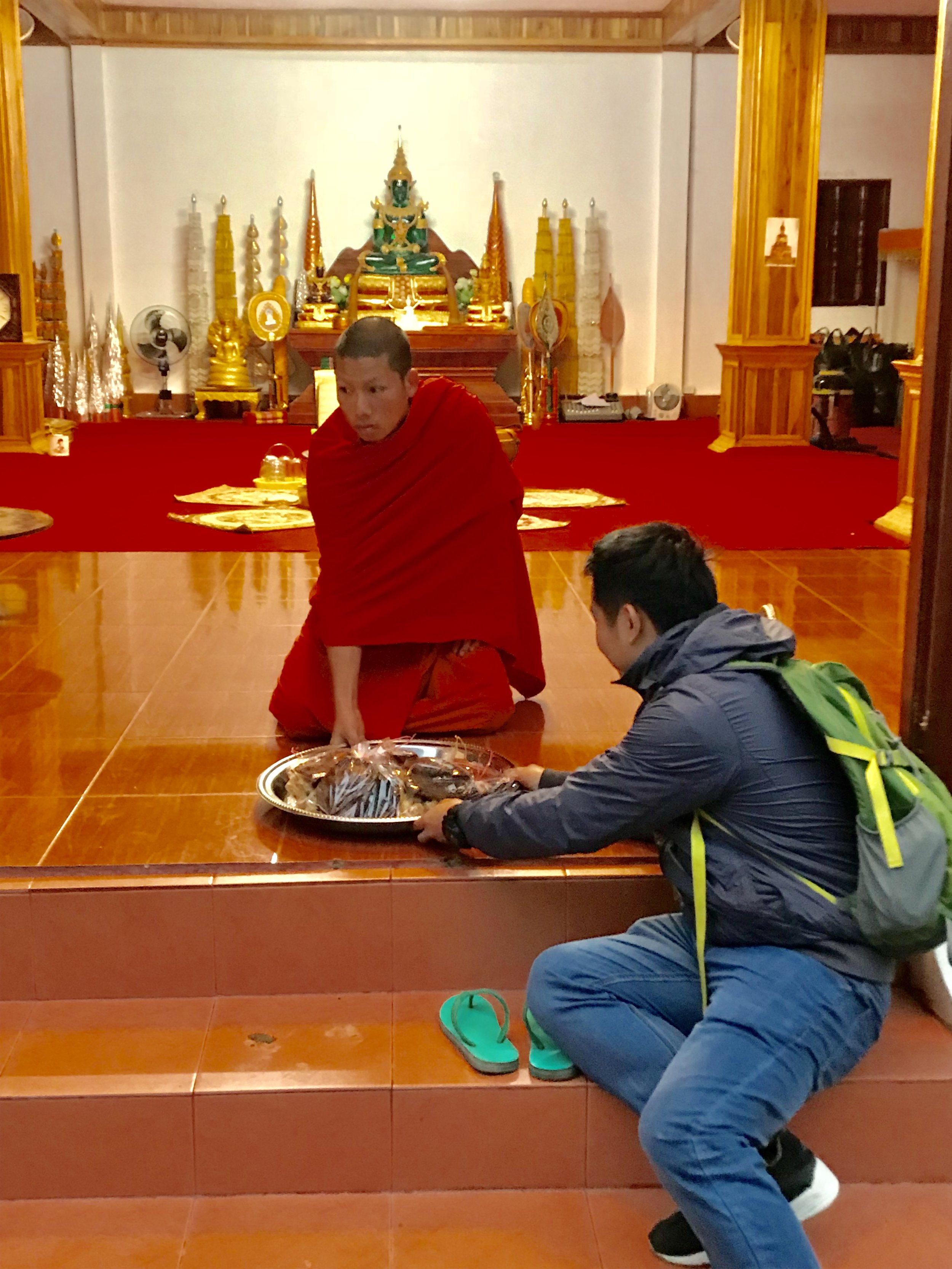
After alms rounds, the monks returned to the monastery and one of them was designated to take a seated cross legged position in front of the entryway with a platter to receive other food goods that we offered to the monks as a group after which he did a closing chant.

Visiting the Richly Decorated Temple of the Golden City in Luang Prabang in Laos

“Be like the lotus: trust in the light; grow through the dirt; believe in new beginnings.”

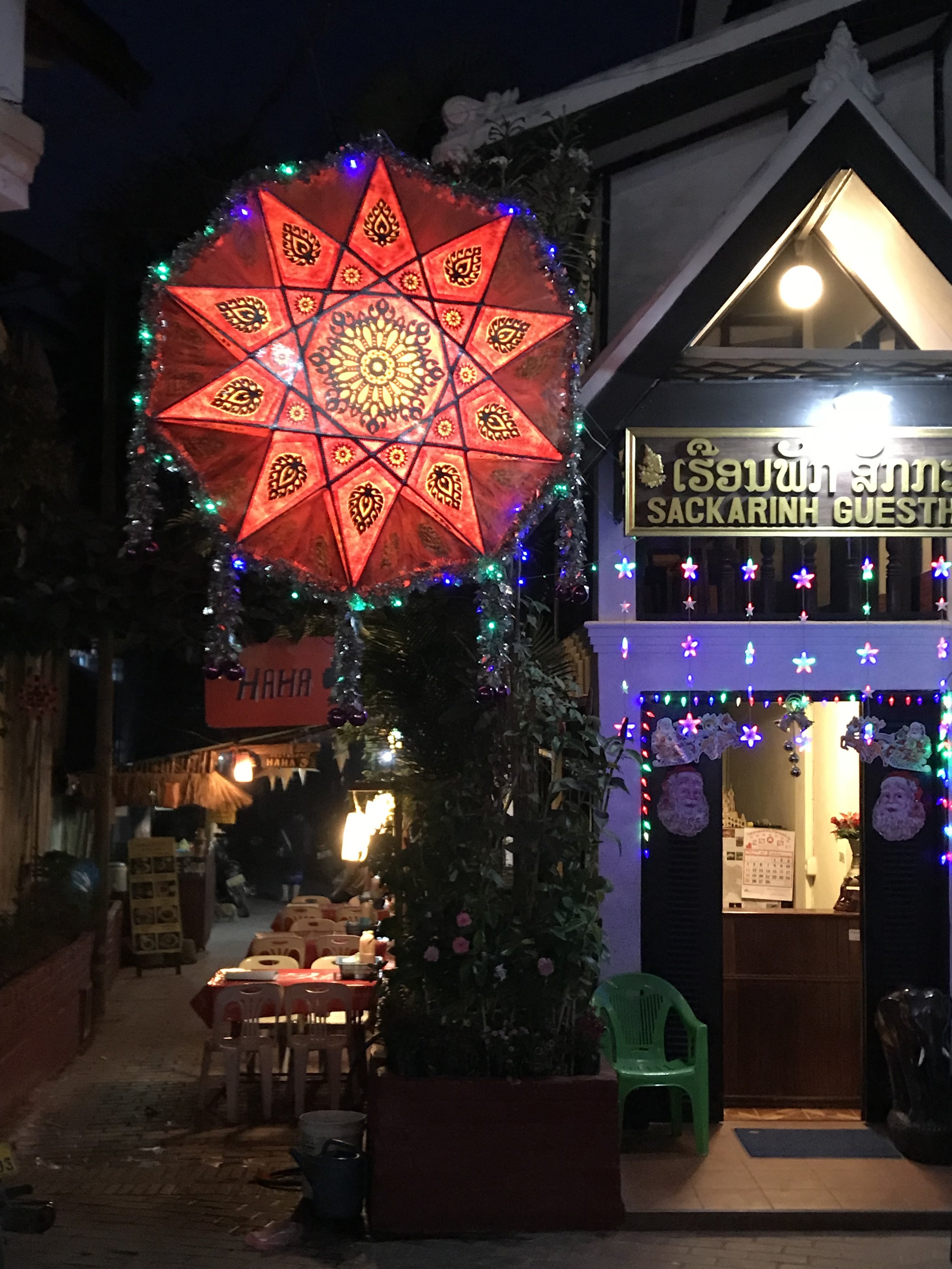
Cecile and I arrived in Laos with our group from Overseas Adventures Travels (OAT) this morning and checked into the Le Palais Juliana Hotel, a boutique hotel in Luang Prabang. It is situated on the peninsula formed by the Mekong and Nam Khan River, and has earned the distinction of being a UNESCO WORLD HERITAGE SITE.
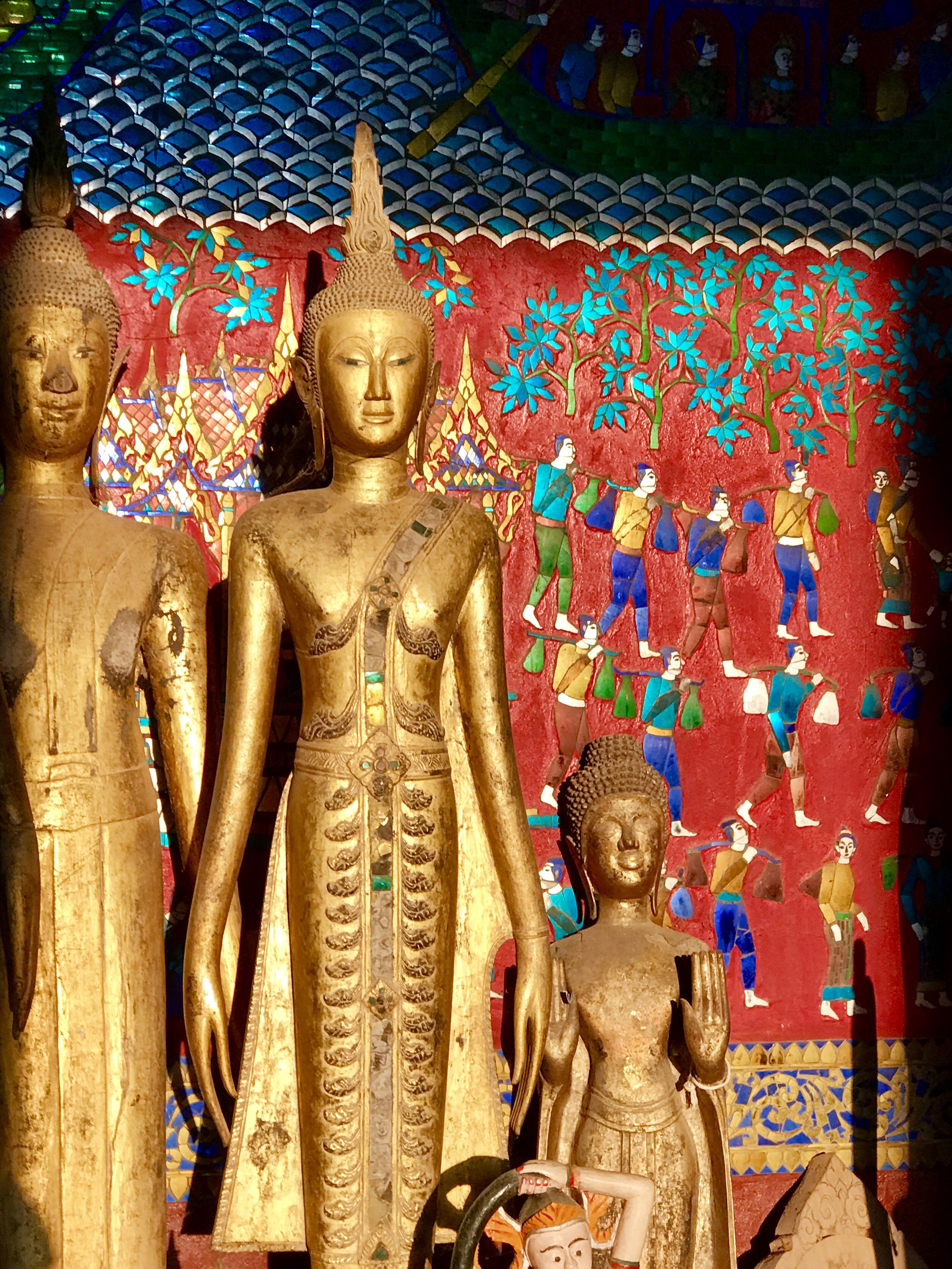
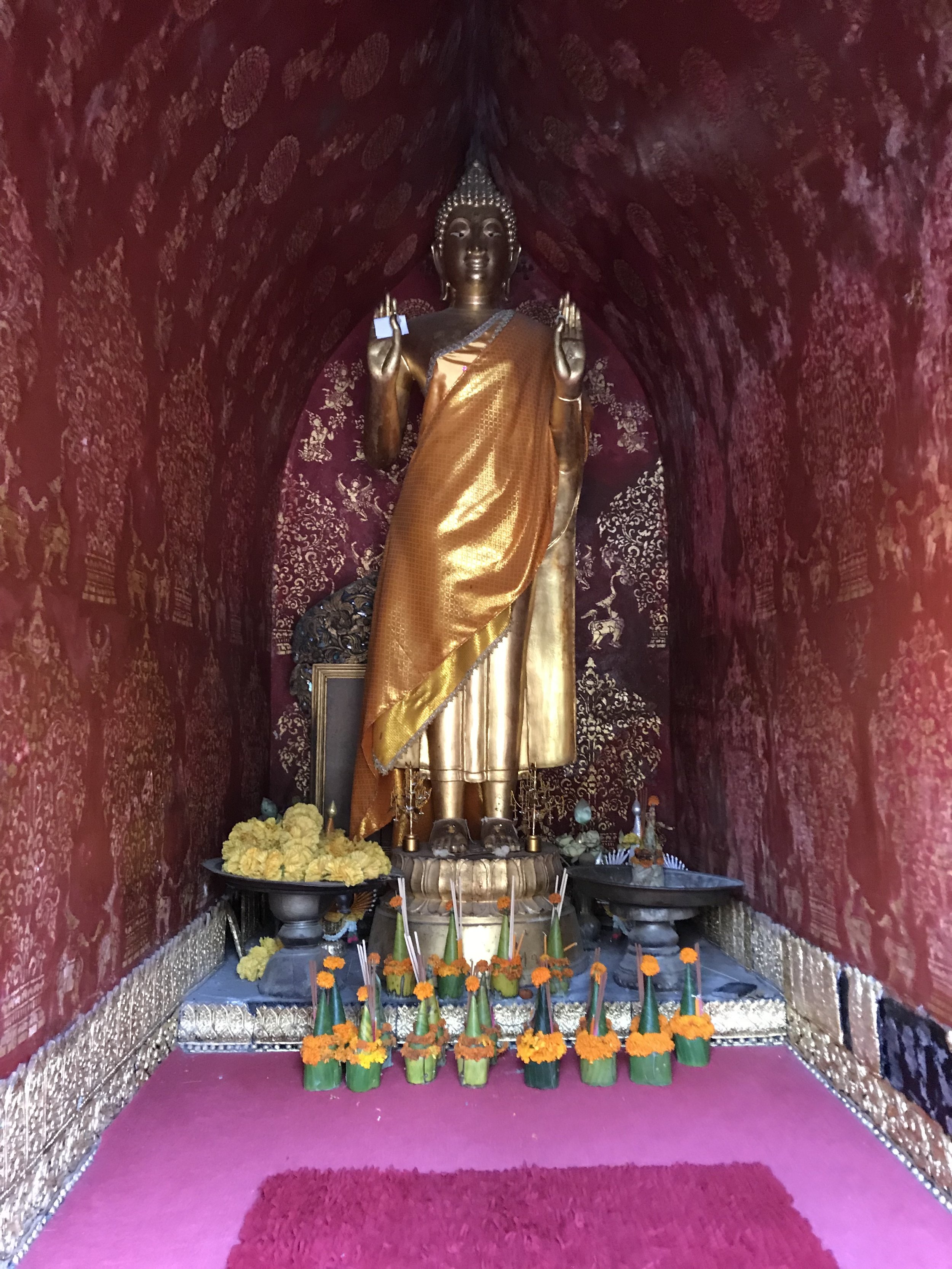
In the late afternoon we visited Wat Xieng Thong, otherwise known as the “Temple of the Golden City, which is one of the most important Lao monasteries. The richly decorated temple combines the spirit of religion, royalty and traditional art. It was built 1159-1560 and was a royal temple until 1975. The Lao kings were crowned here. There are carved gilded wooden doors that depict the Buddha’s life. The walls of one section contain a glass mosaic that depicts the tree of life and the wheels on the ceiling symbolize the Buddhist recognition of the law and circle of reincarnation. In total there are over twenty structures on the grounds including shrines, pavilions and residences in addition to gardens, ornamental shrubs and trees and lotus capped stone pillars. The lotus is considered to be a sacred flower in various thousand years old eastern traditions and is a metaphor for personal transformation. The lotus grows in muddy water, and it signifies that each one of us can rise above the murky waters to achieve the clarity of enlightenment.

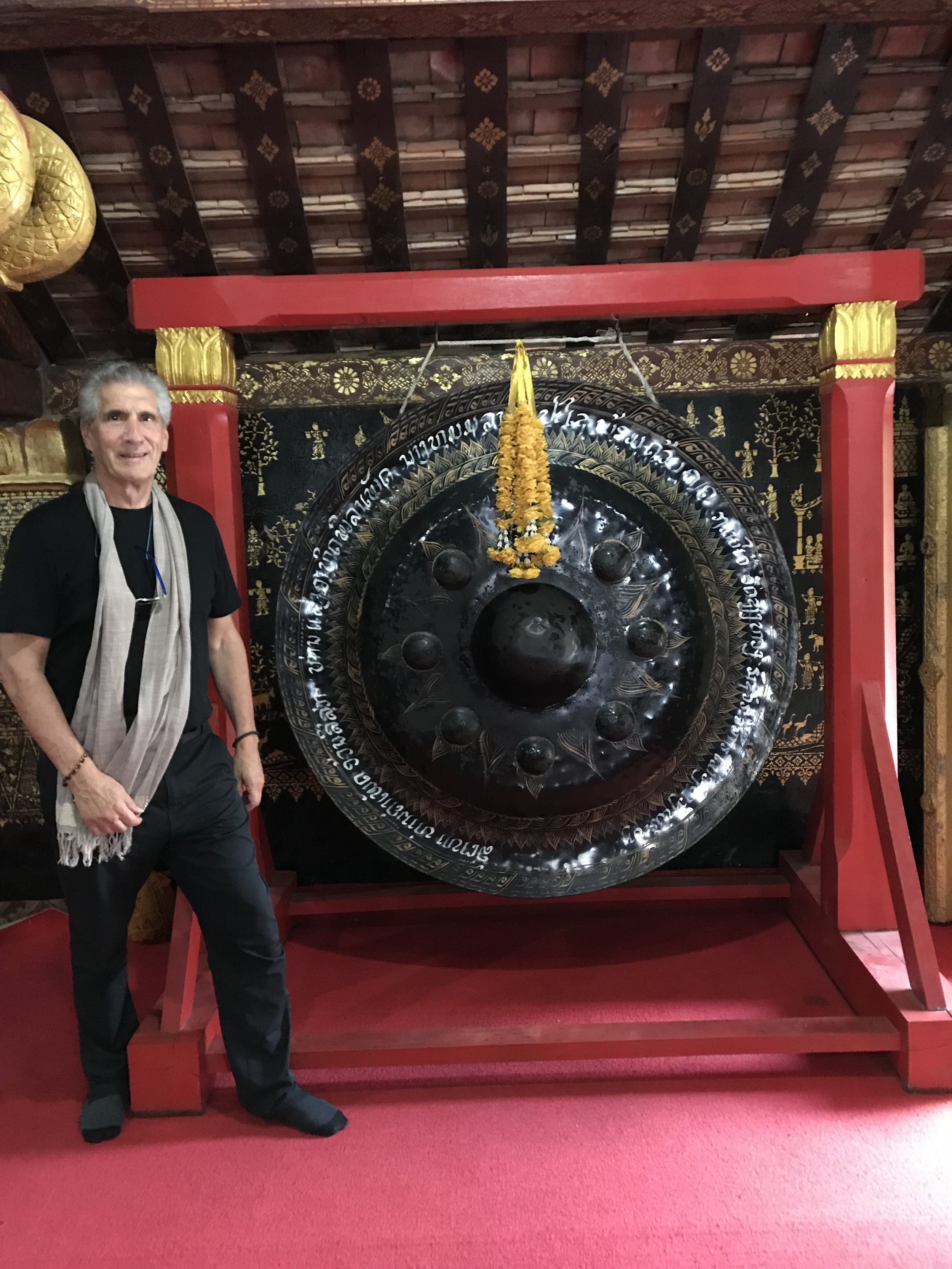
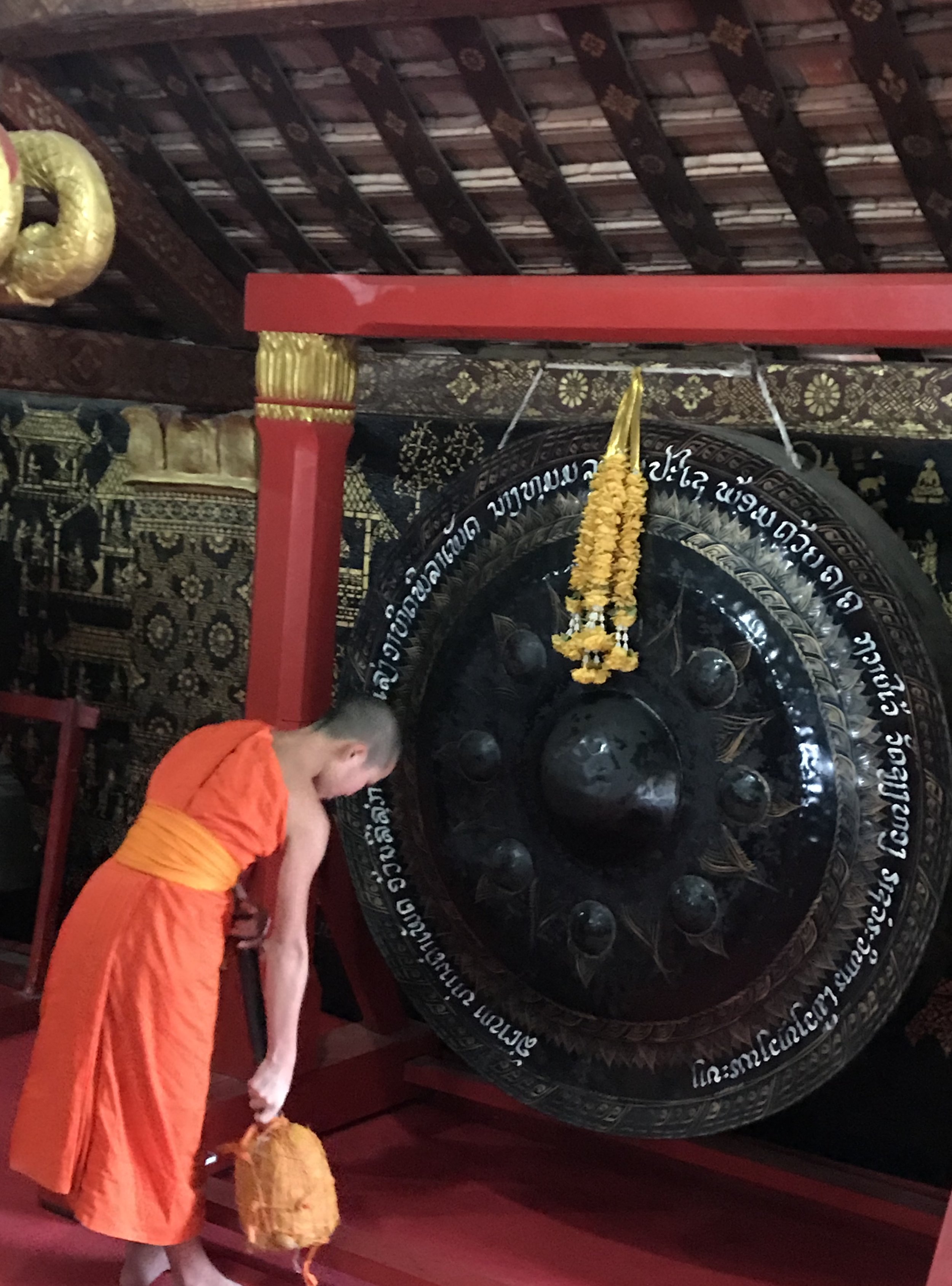
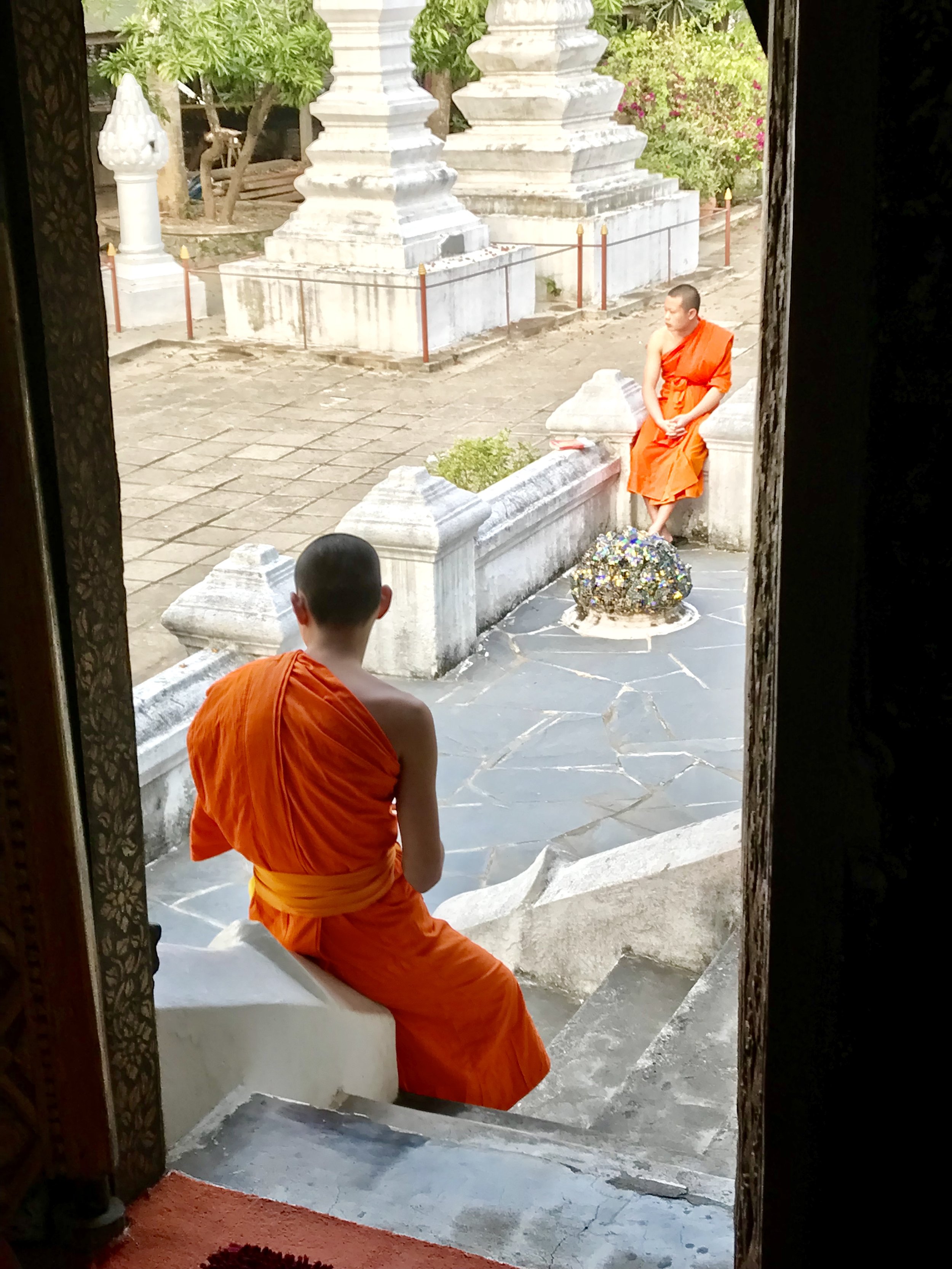
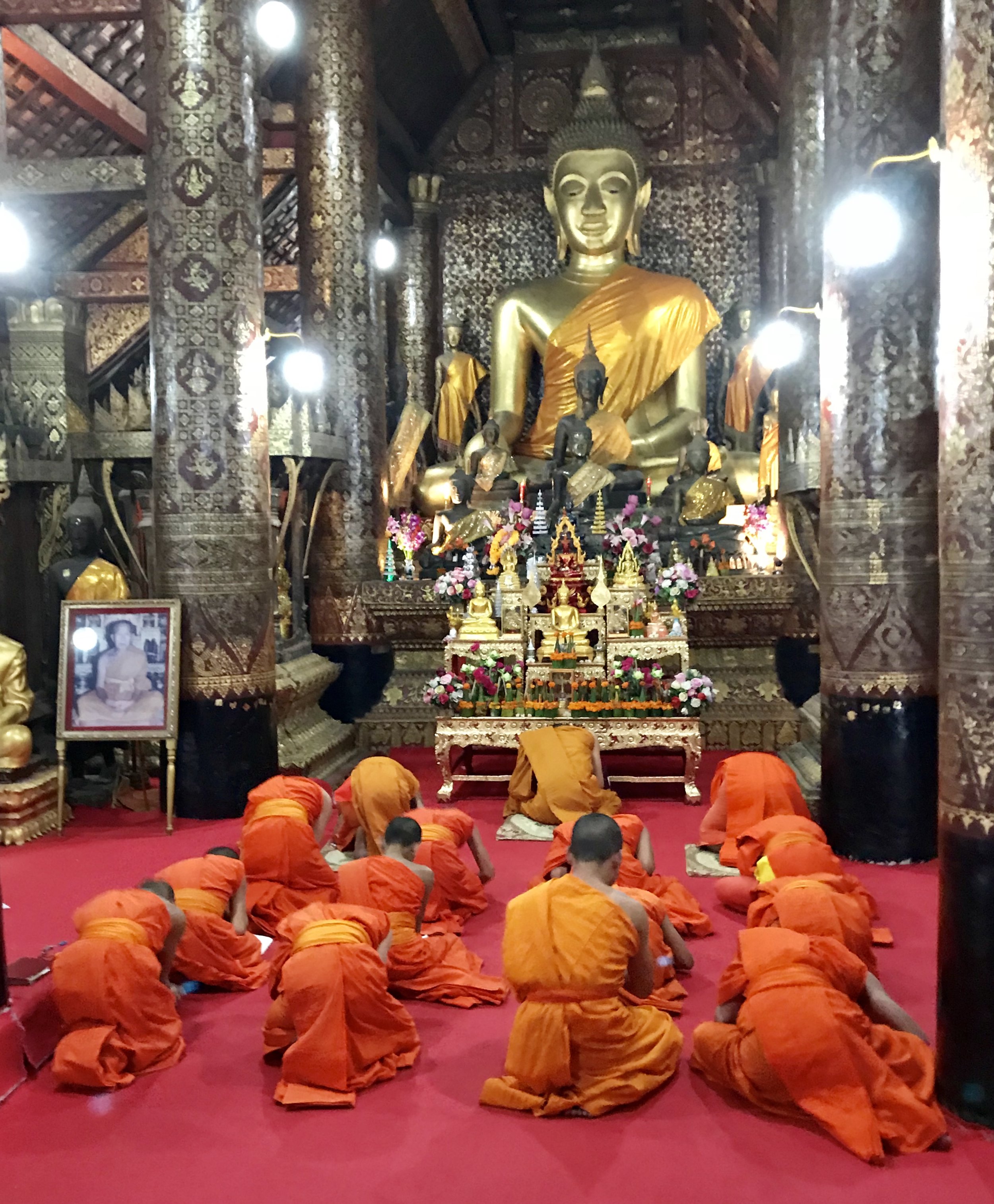
I captured two monks outside a side entrance waiting to be called to prayers, one monk hitting the large circular gong to announce time for prayers and chanting. The rest of the monks in these photos were taken in the sim (main congregation hall), after they had gathered together. Traditionally, a monk bows (prostrates) three times before and after a ritual like this. It represents the three precious gems of the Buddhism: The Buddha, The Dharma (teachings) and the Sangha (community of monks). In non-monastic mindfulness meditation centers throughout the world a "sangha," would could also apply to lay practitioners who come together as group to meditate and chant during meditation retreats. 

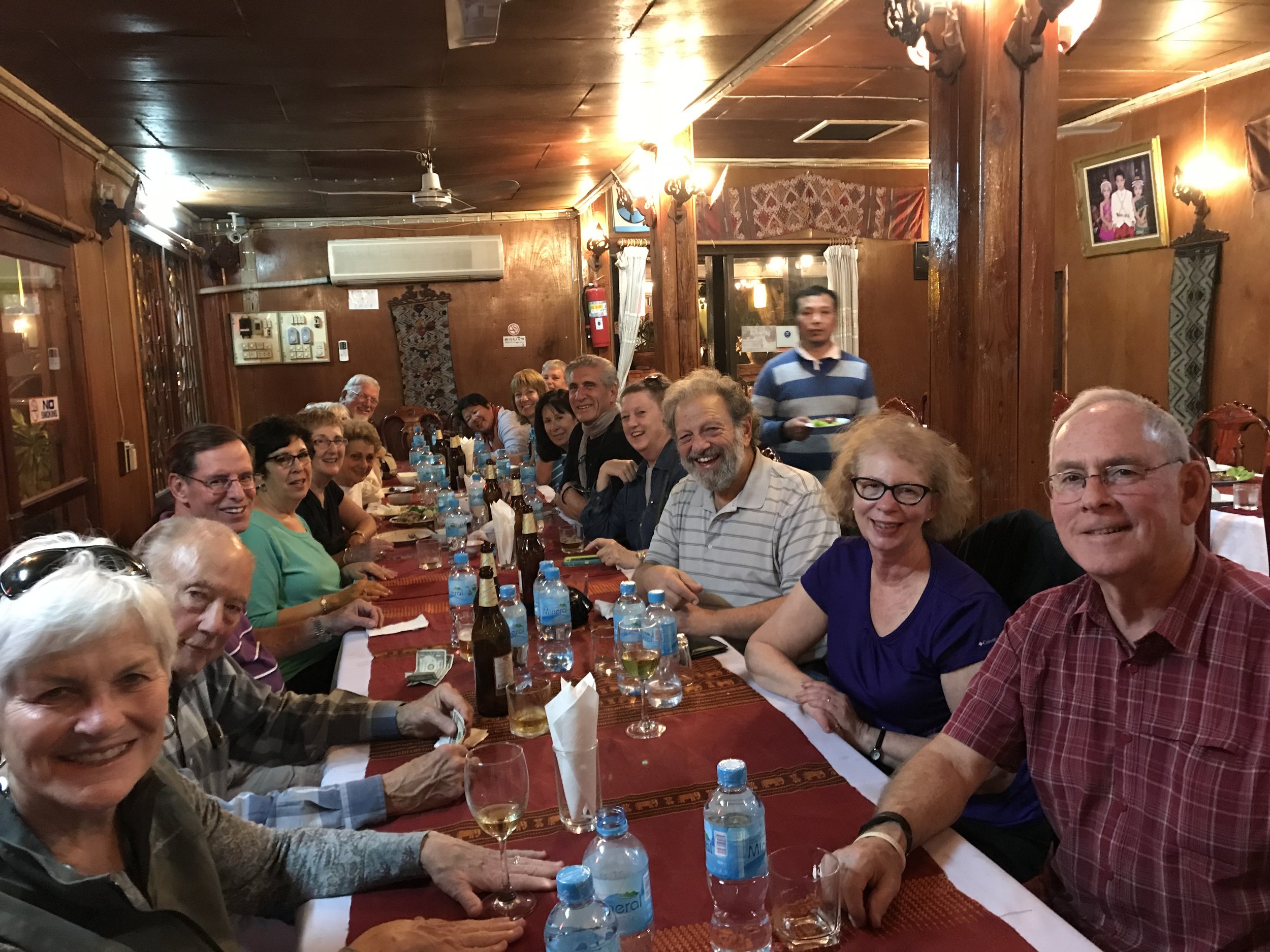
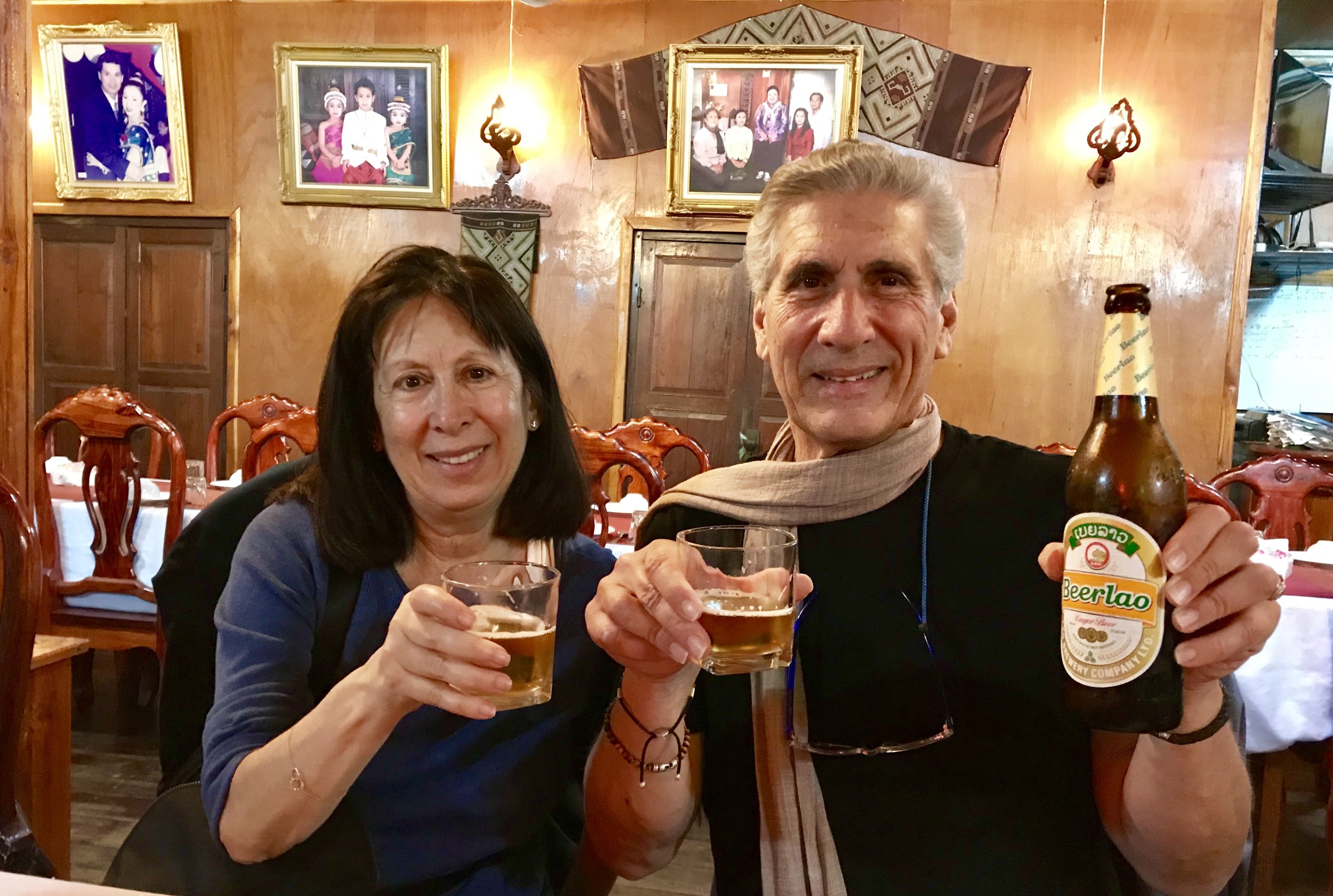
Afterwards, we went to stroll the colorful night markets and ended the evening with an amazing traditional Laos dinner and some of us enjoyed a Laos beer with the group.

Touring the Grand Palace to Stepping into a Kick Boxing Ring in the Slums of Bangkok

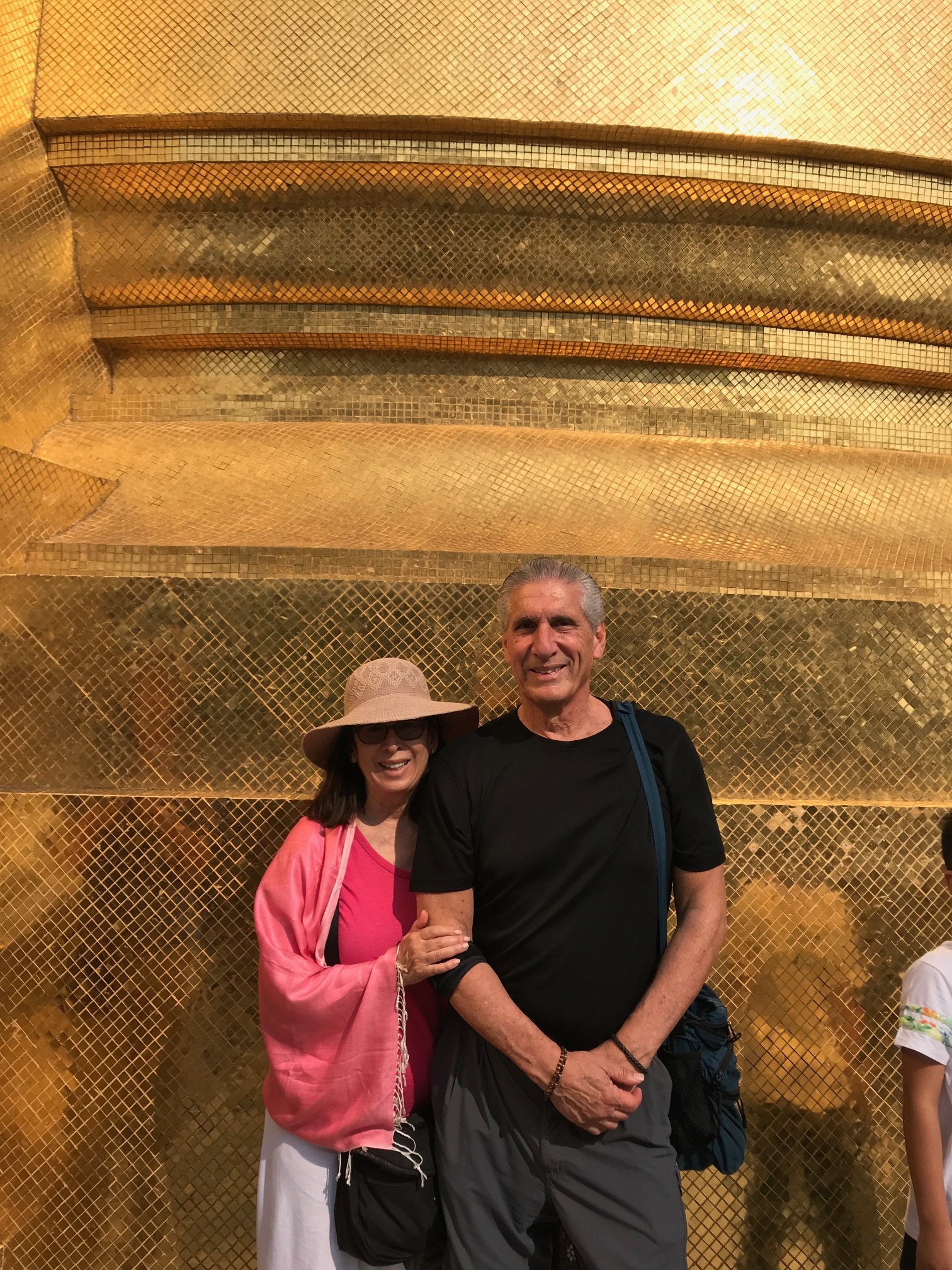
The Grand Palace, that Cecile and I had seen before is Bangkok’s most famous landmark and is spectacular in every sense of the word. It was also not surprising to learn it is considered the spiritual heart of the Thai Kingdom. Built in 1782 it has been the home of the King, The Royal court and the administrative seat of Government. It continues to draw a record number of people from all over the world to see it’s amazing architecture, intricate detail and absolutely stunning craftsmanship. It simply takes your breath away. 

After a colorful canal boat ride, a Pad Thai cooking demonstration and lunch by a lovely Thai woman, her husband and family at their home that sits on the edge of the Bangkok canal; we had optional events to participate in. 

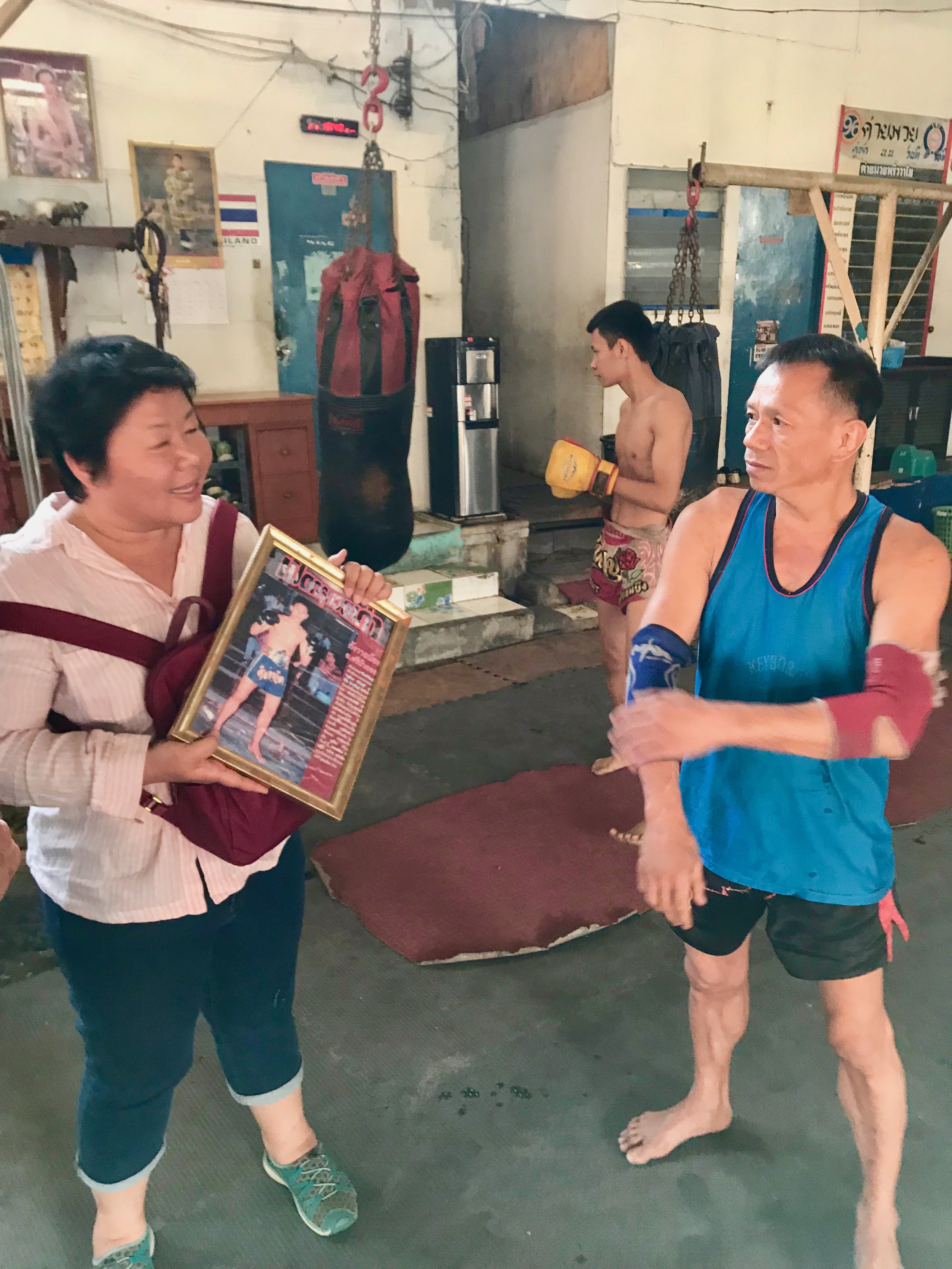
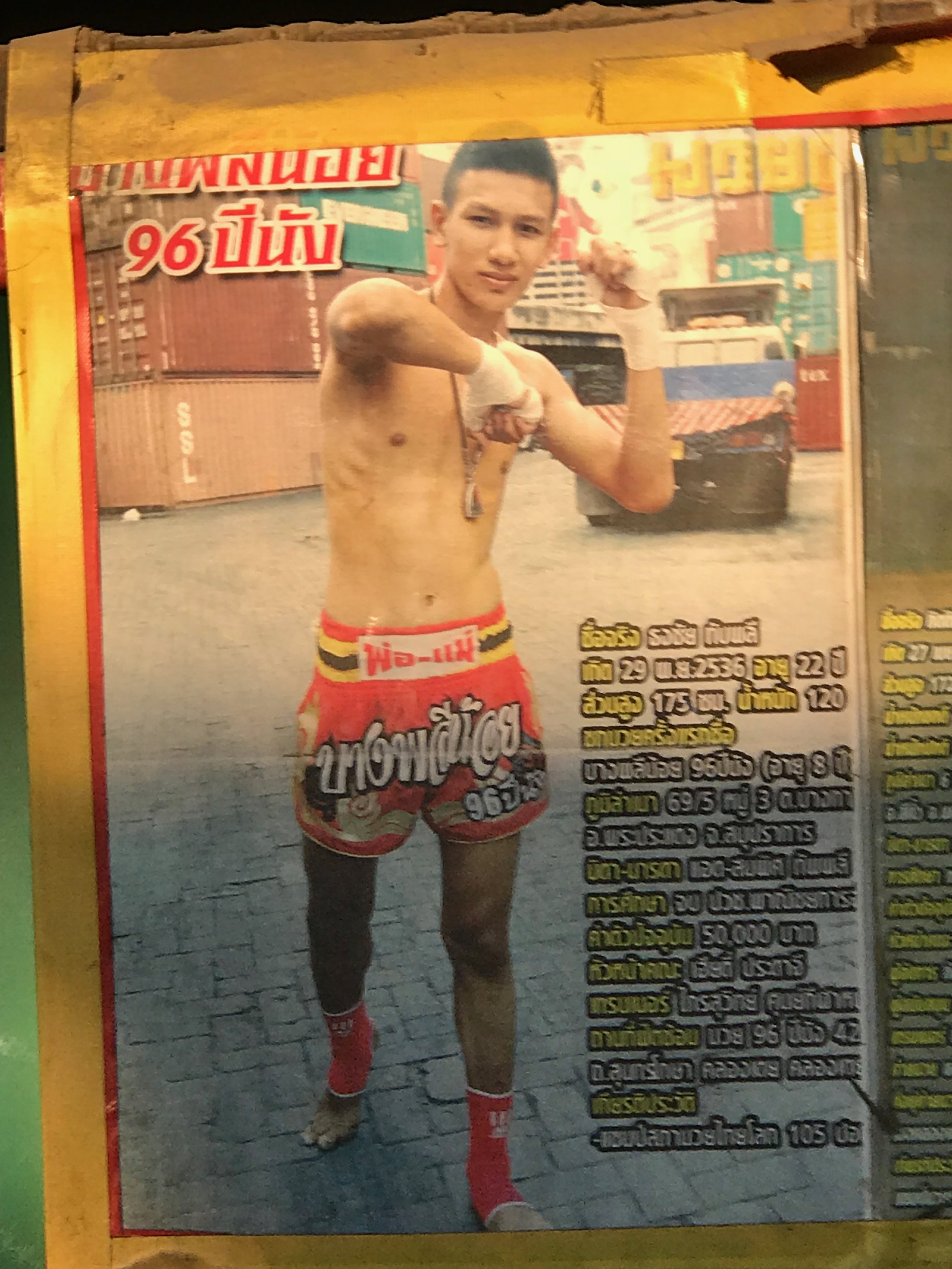
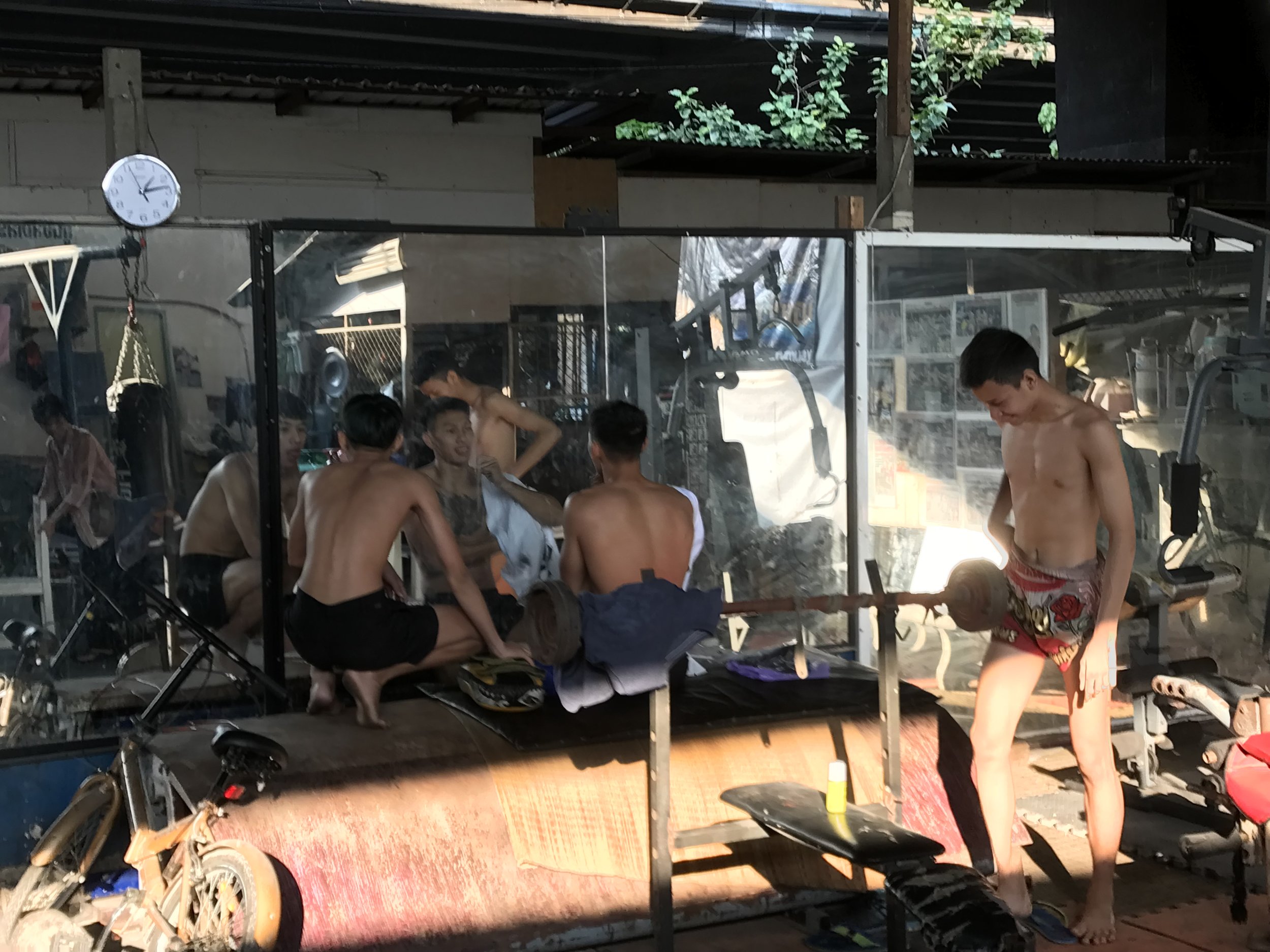
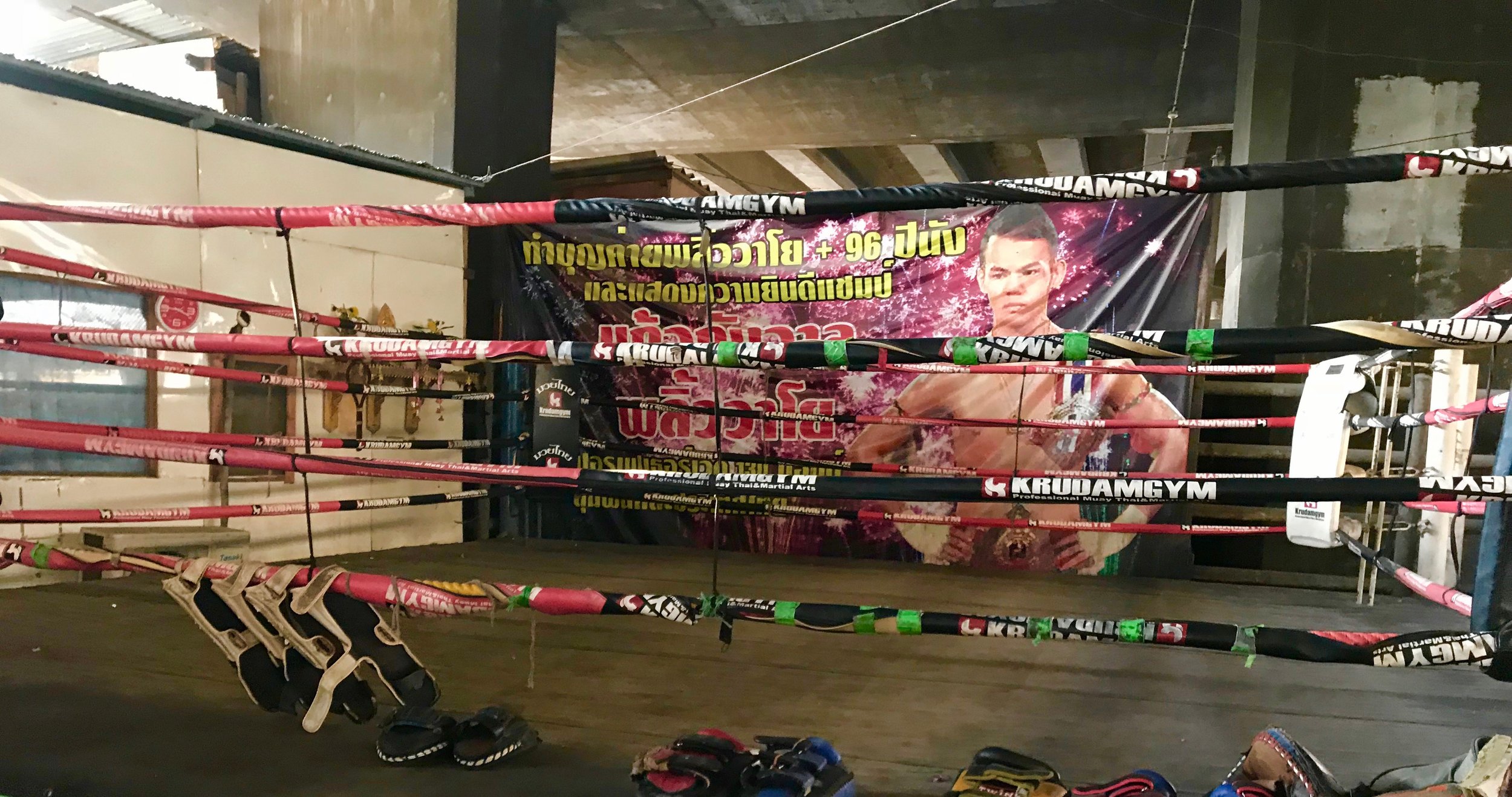
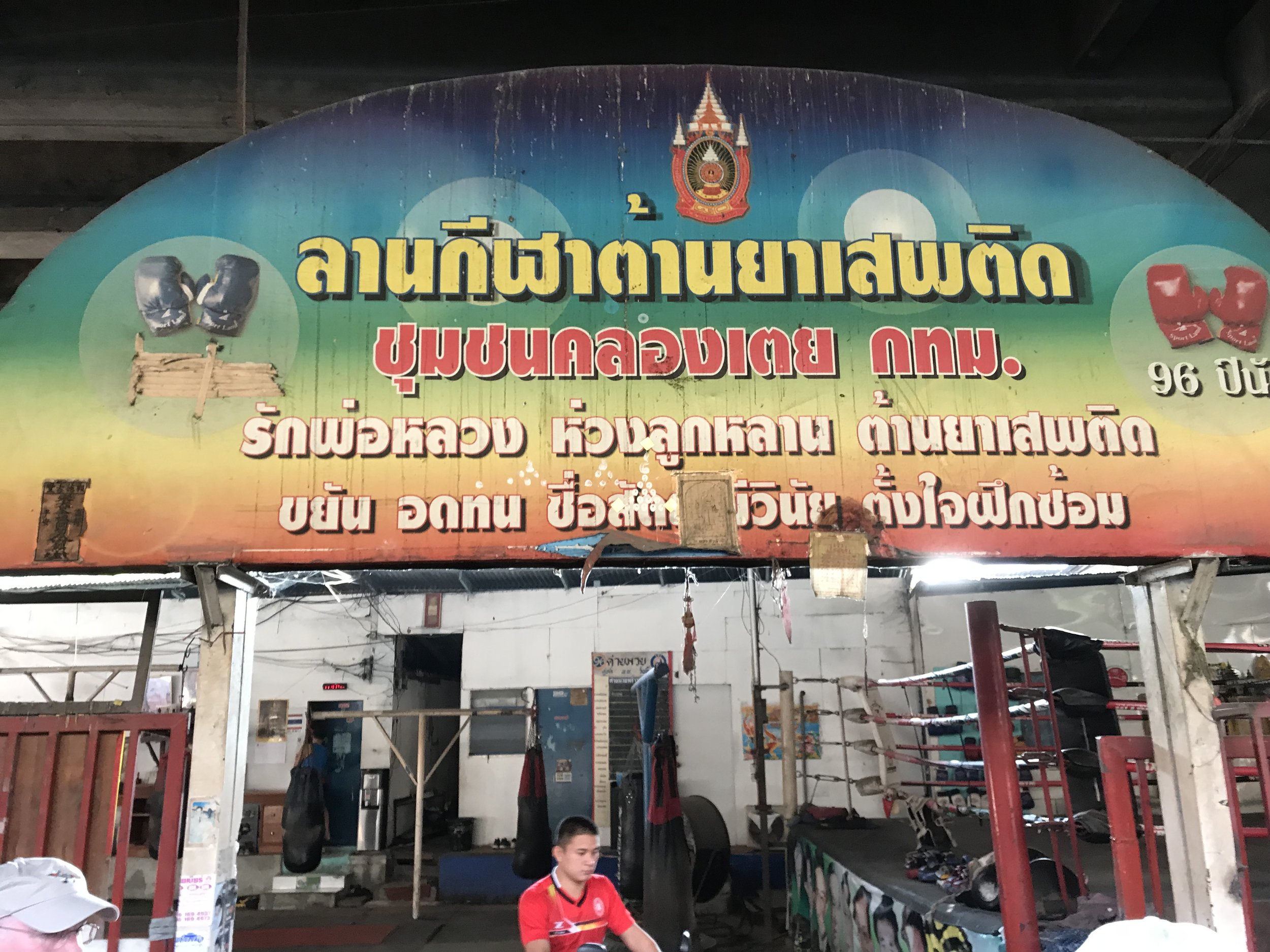
One of the options I chose was to visit a kick boxing training camp called 96 Penang Gym located within the infamous “Klong Toey” slums. The attraction for me was to see all aspects of Thai life and to witness what a dedicated Thai boxing coach was doing to keep young kids off the streets. 

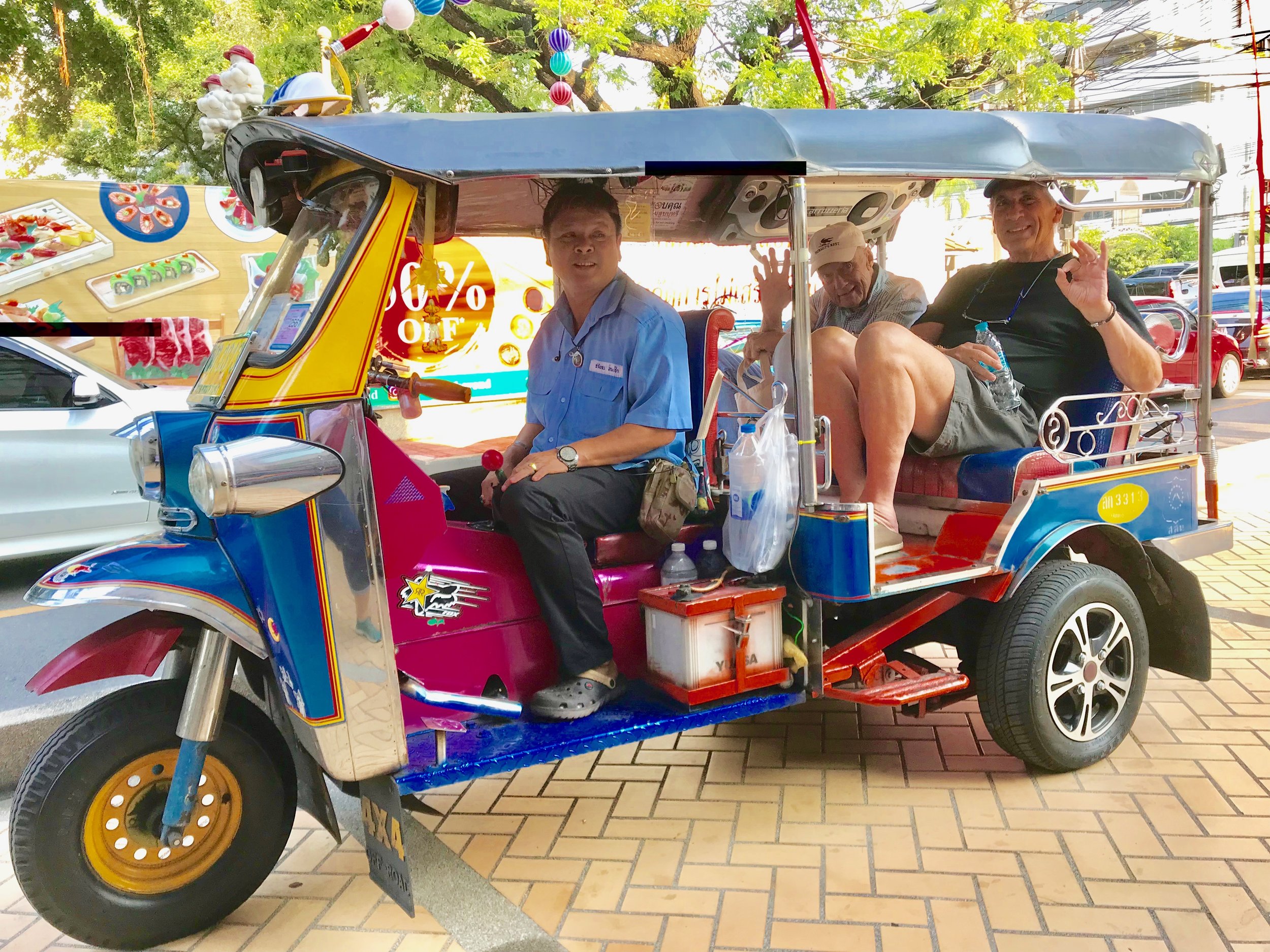
When myself, and three other guests (Cecile stayed behind) arrived at the gym by Tuk-Tuk, our guide Lin introduced us to the coach who calls himself “Mr Thai.” During a Q & A, the 50 year old veteran of the sport told us about the basics and said he began training at the age of 10. He fought professionally from the ages of 20 to 30 before retiring. Two of his students were currently training for an event the next day. He then demonstrated with a student from each weight class how he trains them.

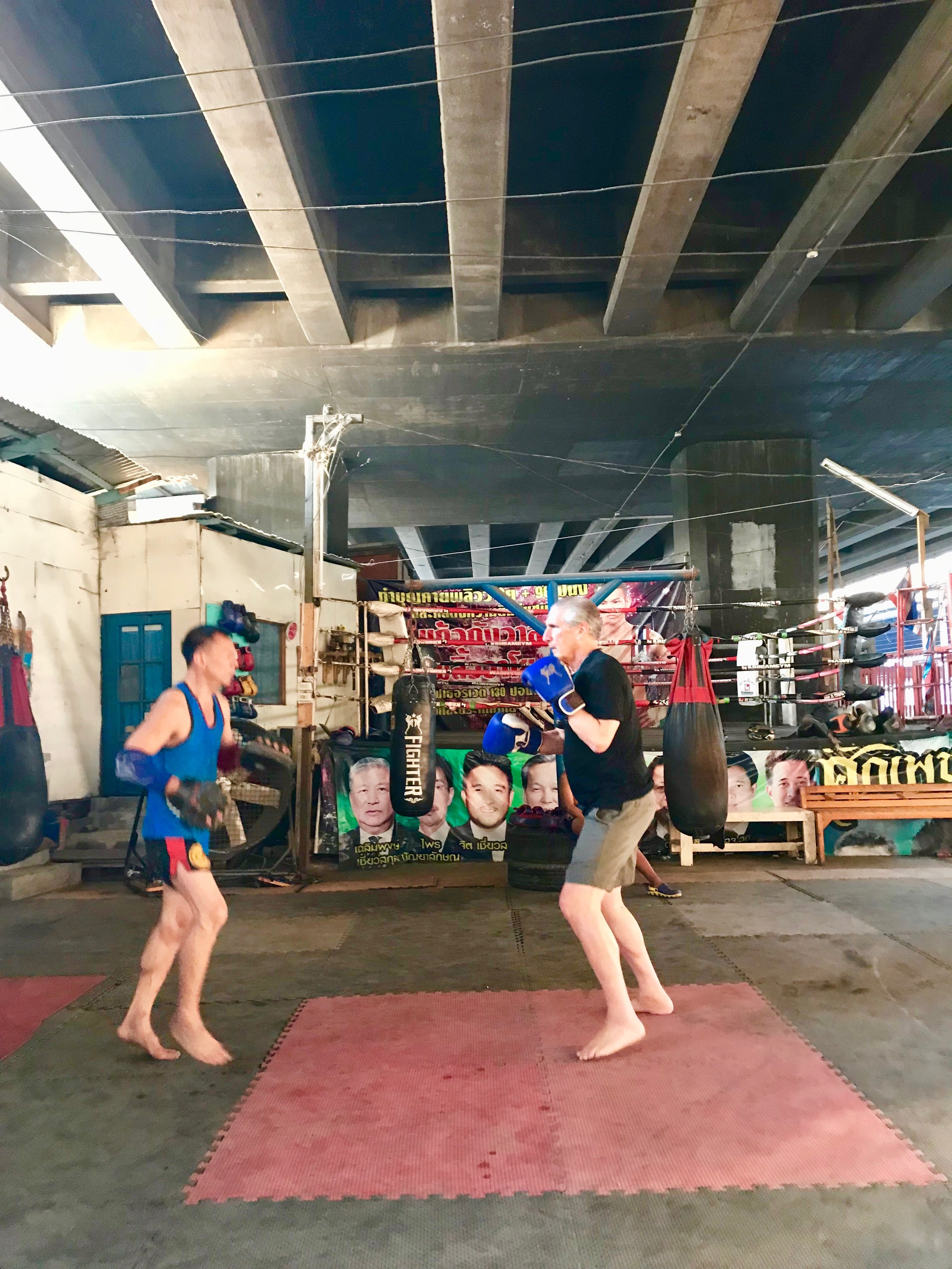
At the invitation of Mr Thai, an award winning coach and a former champion in the Thai boxing world, I stepped into the ring to spar with him. After I left the gym, all I could think of was if I only had a few more lessons “I could have been a contender.” 😎😎😎

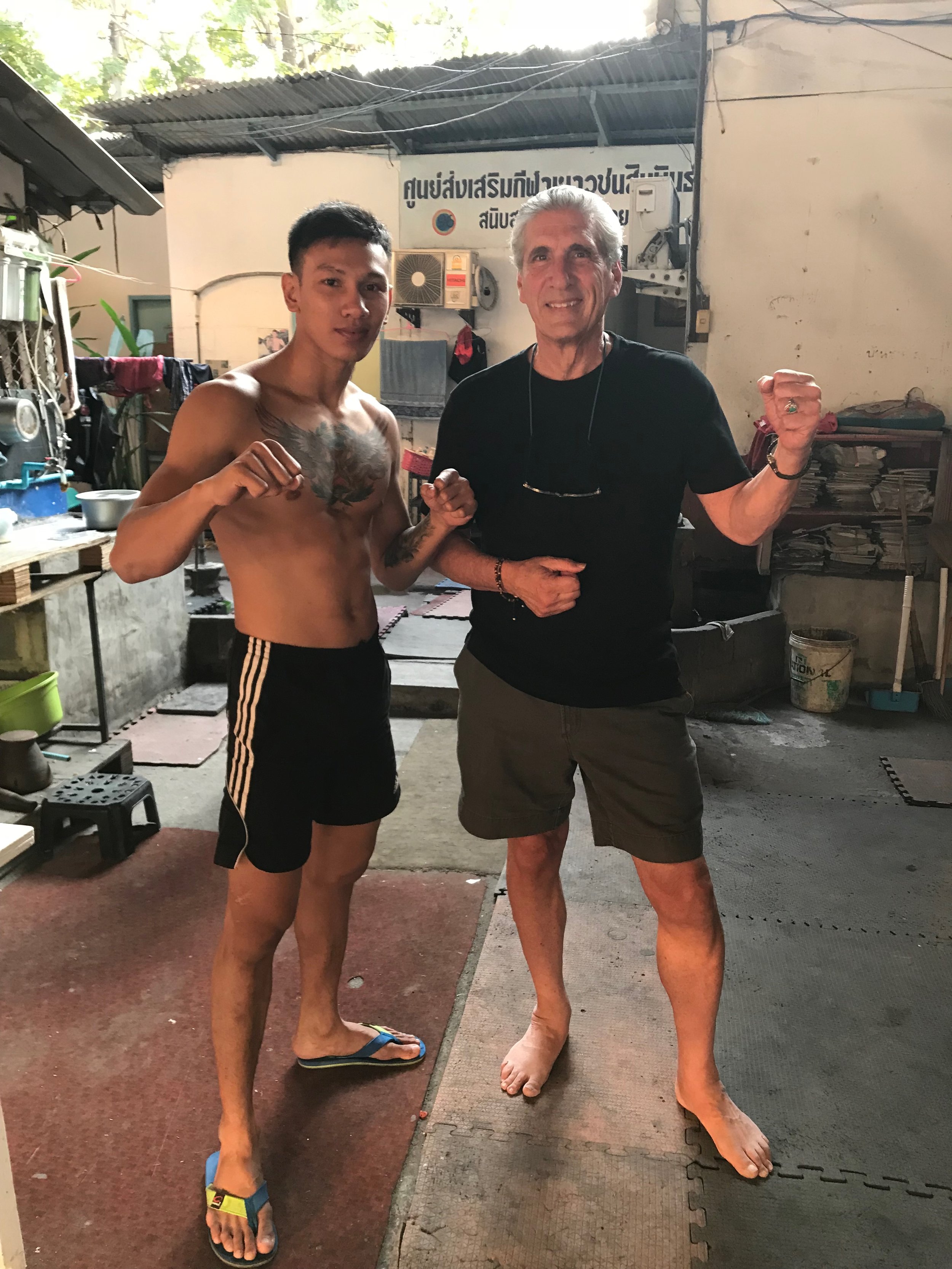
Postscript: The charming young man I am posing with named Bangpleenol is in fact a contender and has won a 50,000 Baht purse ($2,000) and will soon be fighting for over a $3000 purse. Also cover story photo of him.

Note: To view a video clip of me sparring with the coach check out this Facebook link:

https://www.facebook.com/dennis.august…/…/10156023075076668…

enjoyyourlifenow.net

Visiting the Incredible Ruins of Ayutthaya & the Elephant Taxi Controversy

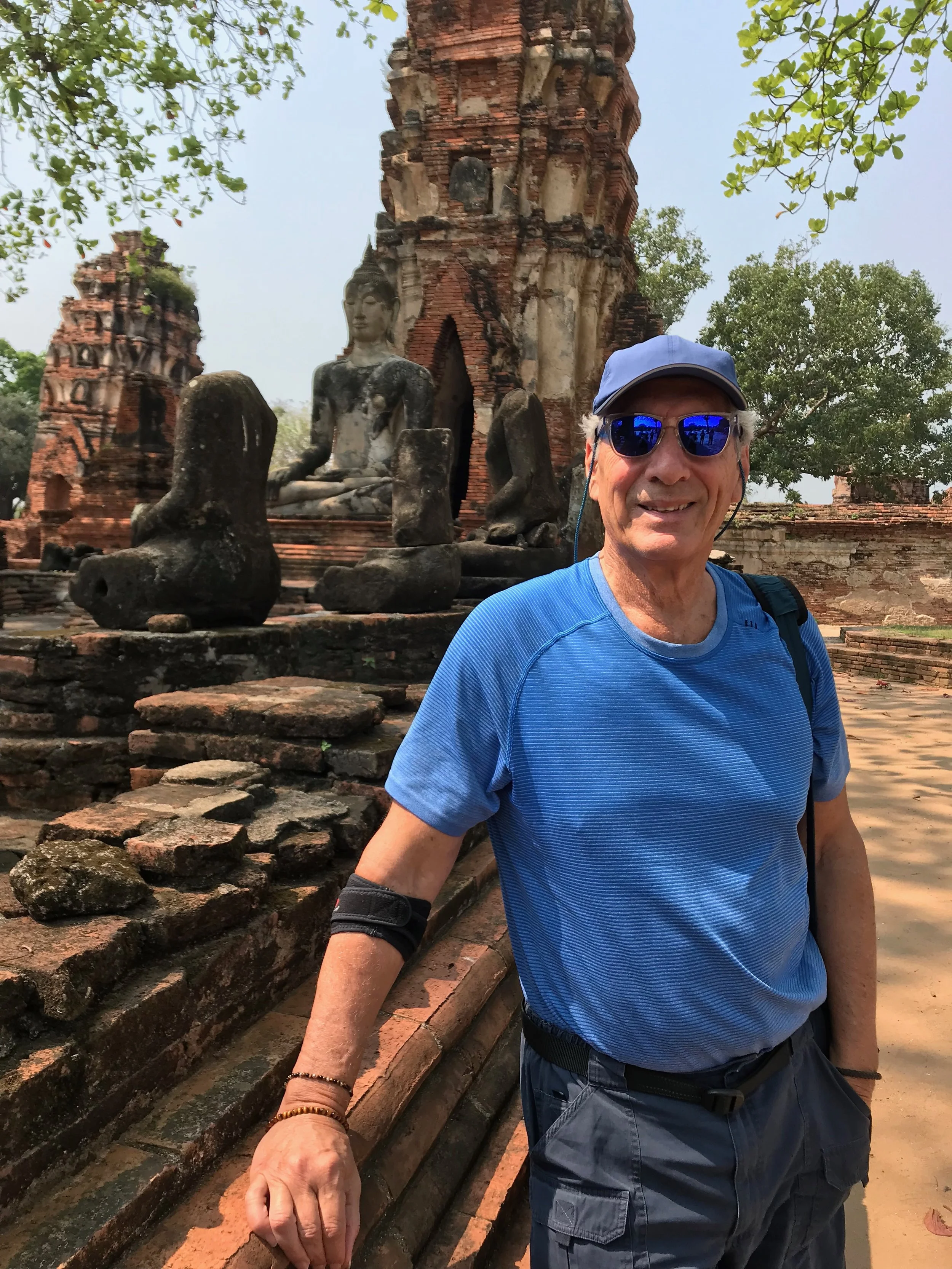
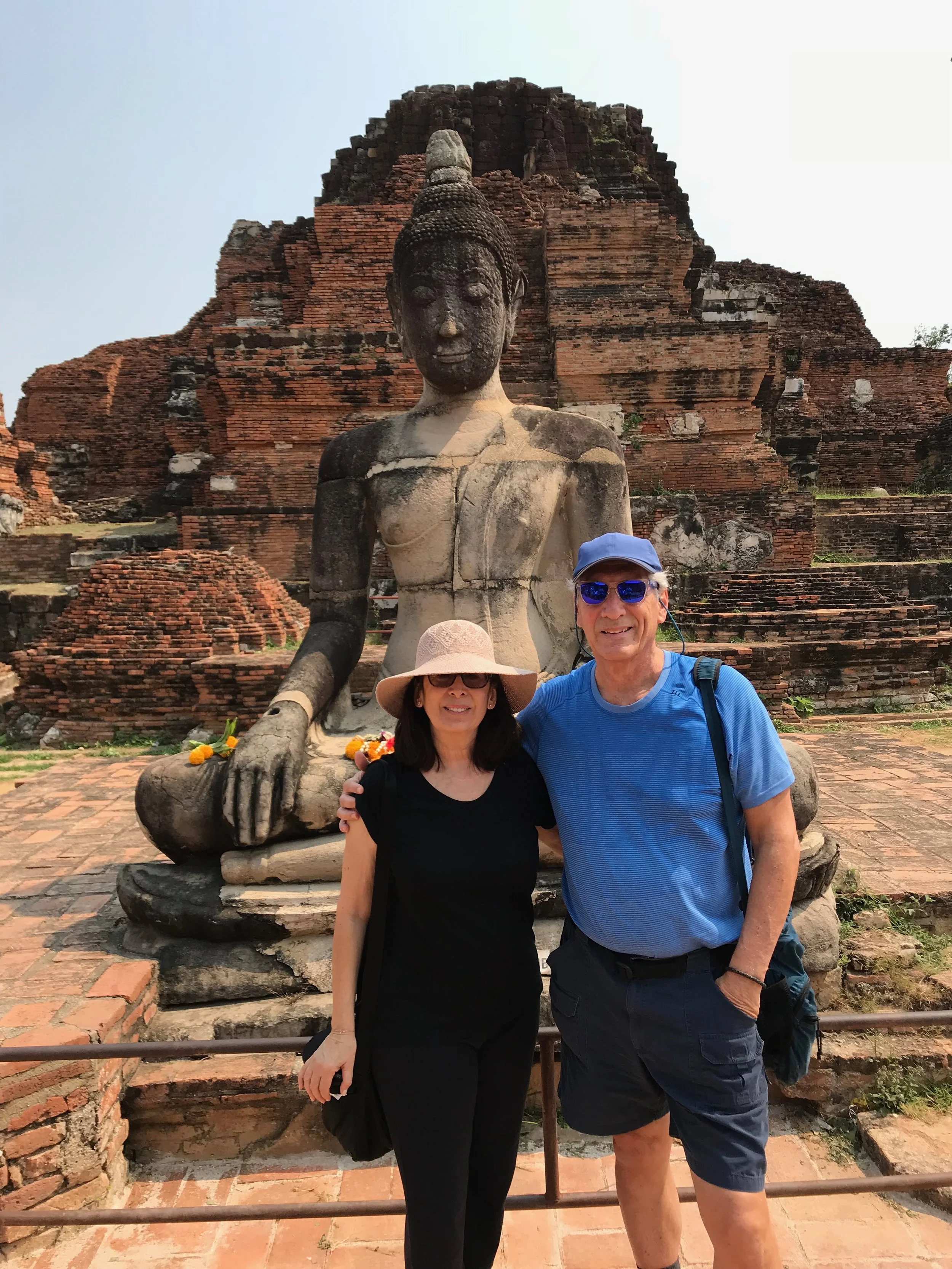
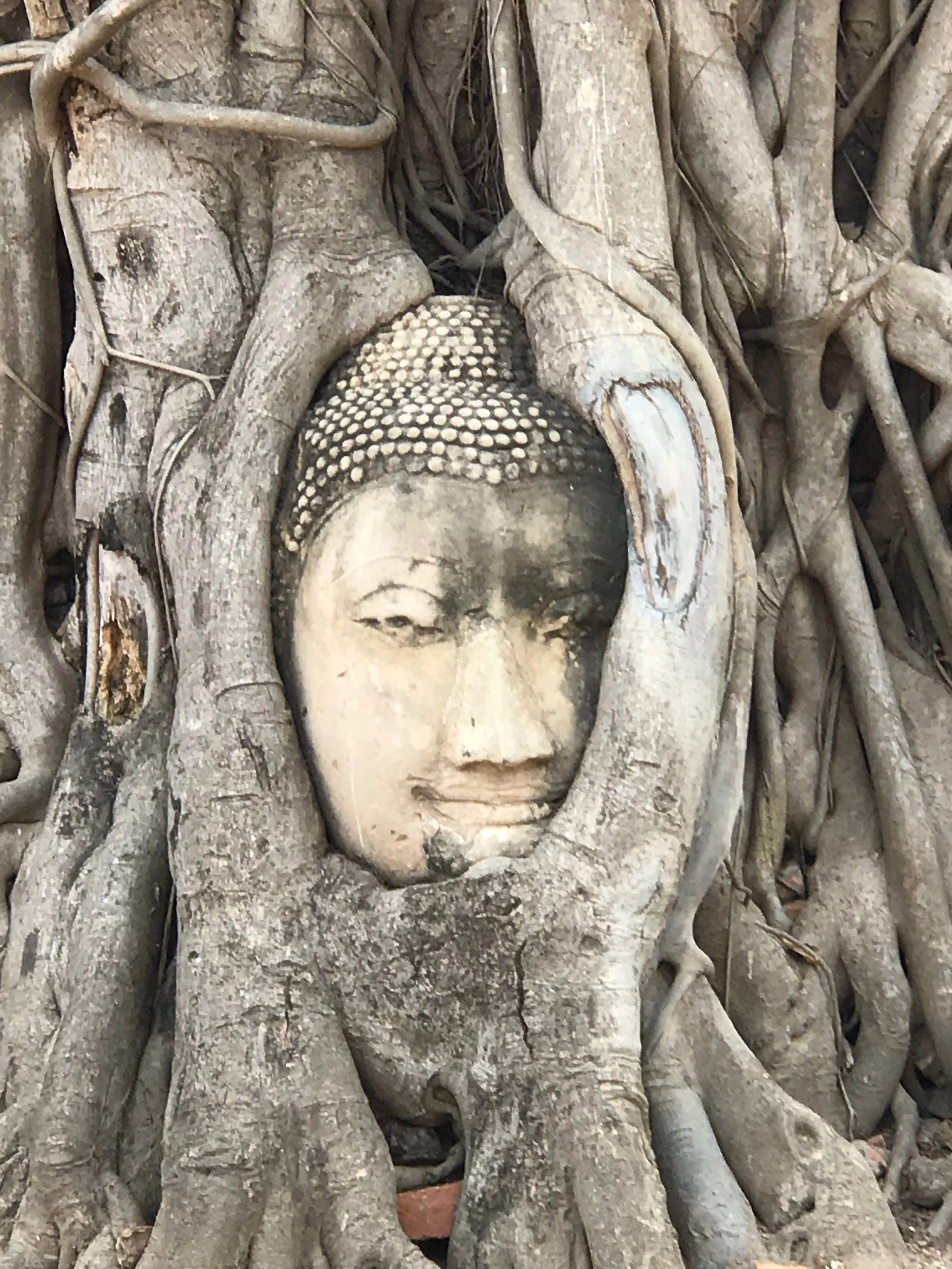
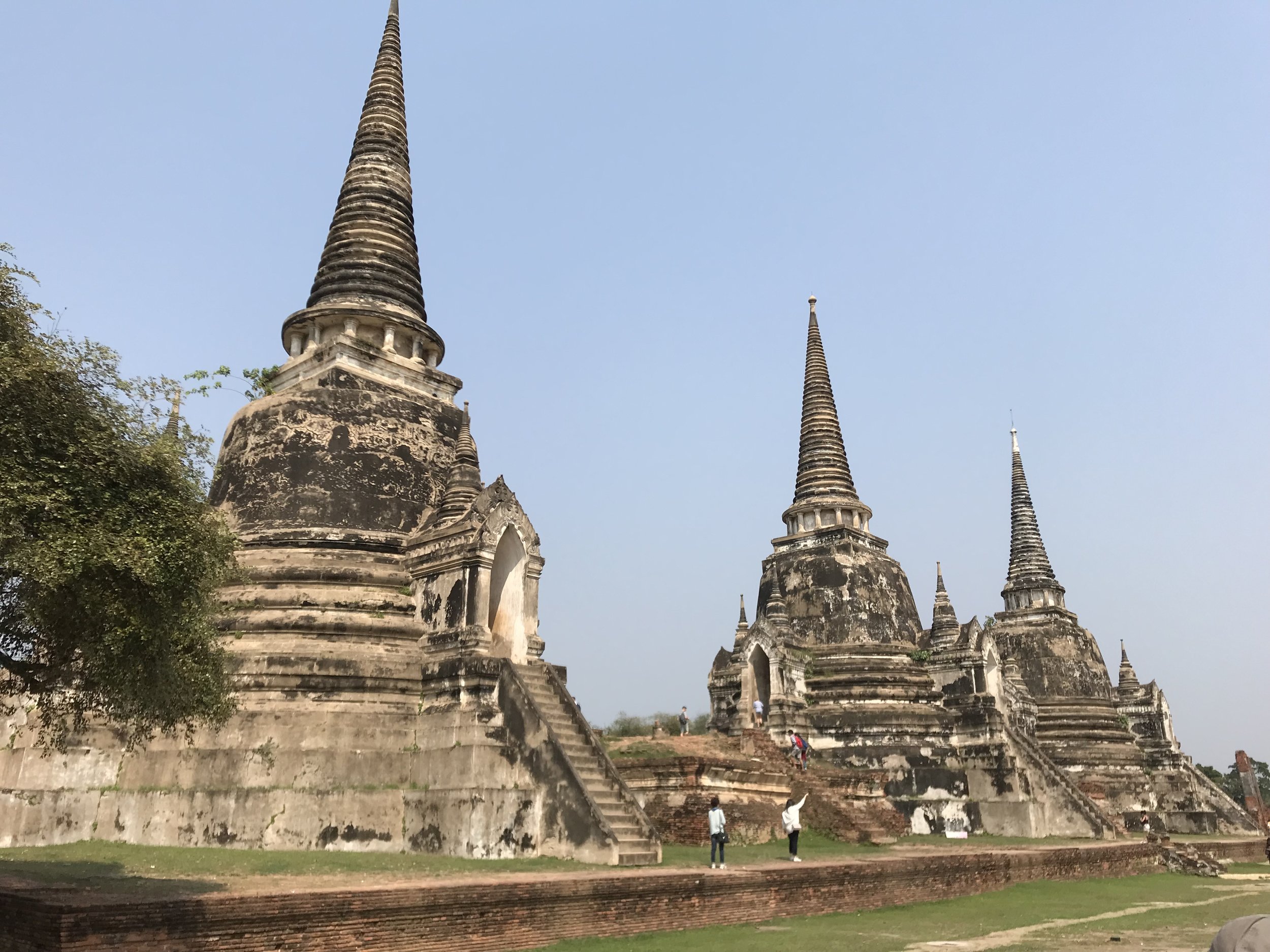
Cecile and I hooked up with a group tour of 16 people with Overseas Adventures (OAT) in Bangkok. Our ever joyful and passionate tour guide Lin, is from Chiang Mai. We are currently staying at the Evergreen Laurel Hotel. This morning after breakfast we travelled north of Bangkok, past fields of rice and coconut palms to the ruins of the ancient city of Ayutthaya. It was a kingdom of enormous wealth that existed from 1350-1767. The name means “undefeatable,” in Sanskrit. That all changed when the Burmese army reduced it to rubble and made off with more than 170 kilos of gold. Only a few temples survived the attack and the rest are remnants of its former glory that are preserved at Ayutthaya Historical Park, that has been designated a Unesco World Heritage site. Ironically, even in its brokenness it has an ephemeral beauty and peace about it. We saw the stone head of a Buddha ensconced firmly in the roots of a Bodhi tree and Buddha statues that were cut in half as modern day looters searched for more gold artifacts that is believed to be still hidden within statues. In the area there were elephant taxis which is a controversial subject these days as animal rights groups claim in order to make it possible for people to ride elephants they have to be trained and the taming process is not the same as with a wild horse, it is much more brutal and needs to be done when the elephants are very young. 
After getting back to the hotel we rested up, enjoyed dinner outdoors at a local Thai Restaurant near the hotel.

Running of the Bulls in the Ancient City of Bagan & the Riverboat Sunset Cruise

“We travel not to escape life but for life not to escape us.” —Anon

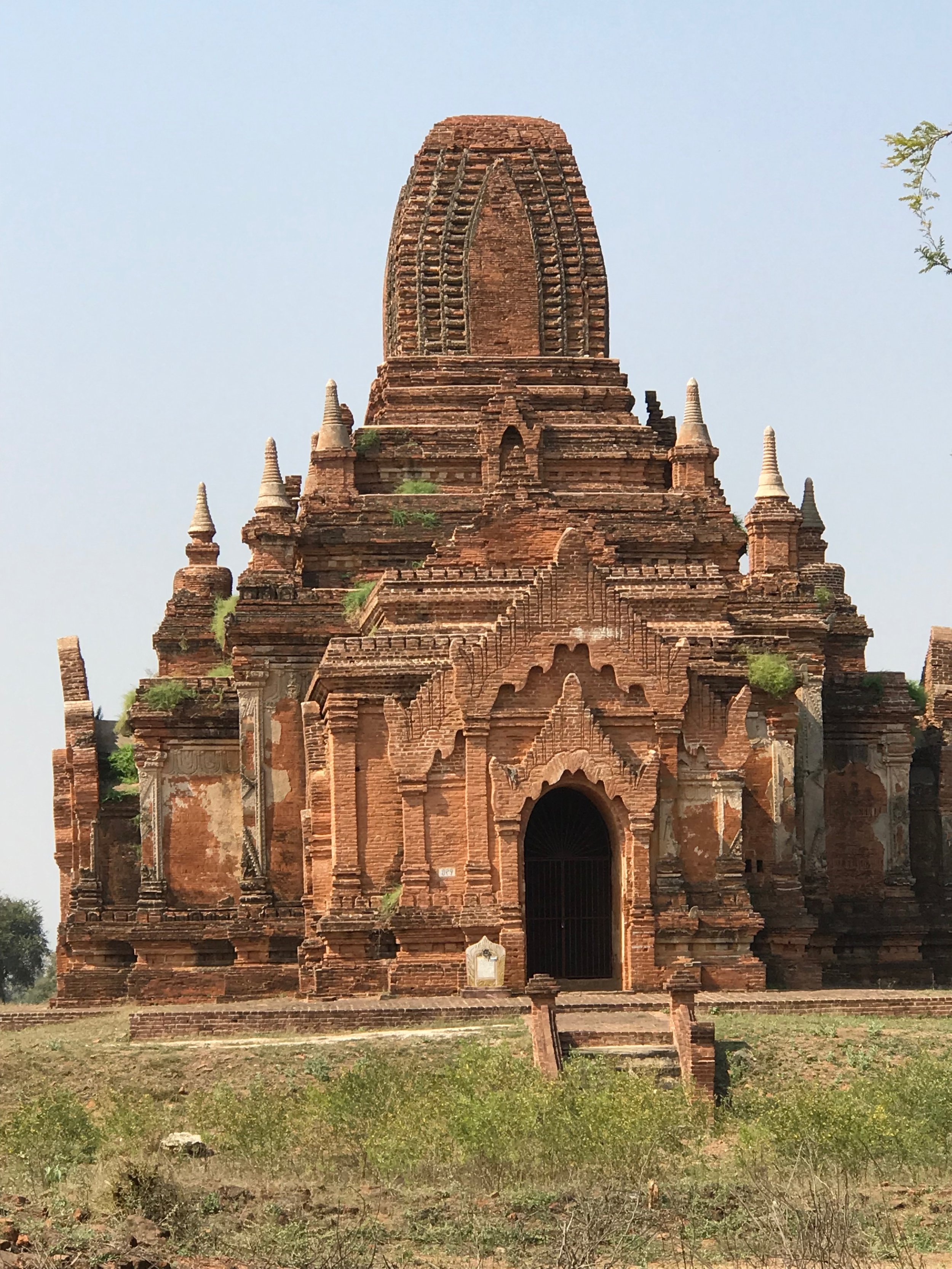
Cecile and I hired a driver named Min Min to take us to the ancient city of Bagan that was the capital of the prosperous Bagan empire from the 9th to the 13th century and controlled most of present day Burma. After the four hours drive, we checked into a deluxe old world room at the Bagan Thande Hotel on banks of the Irrawaddy River. Bagan has the highest concentrations of Buddhist temples, pagodas, stupas than anywhere in the world. We focused on visiting the most well-known antiquities.

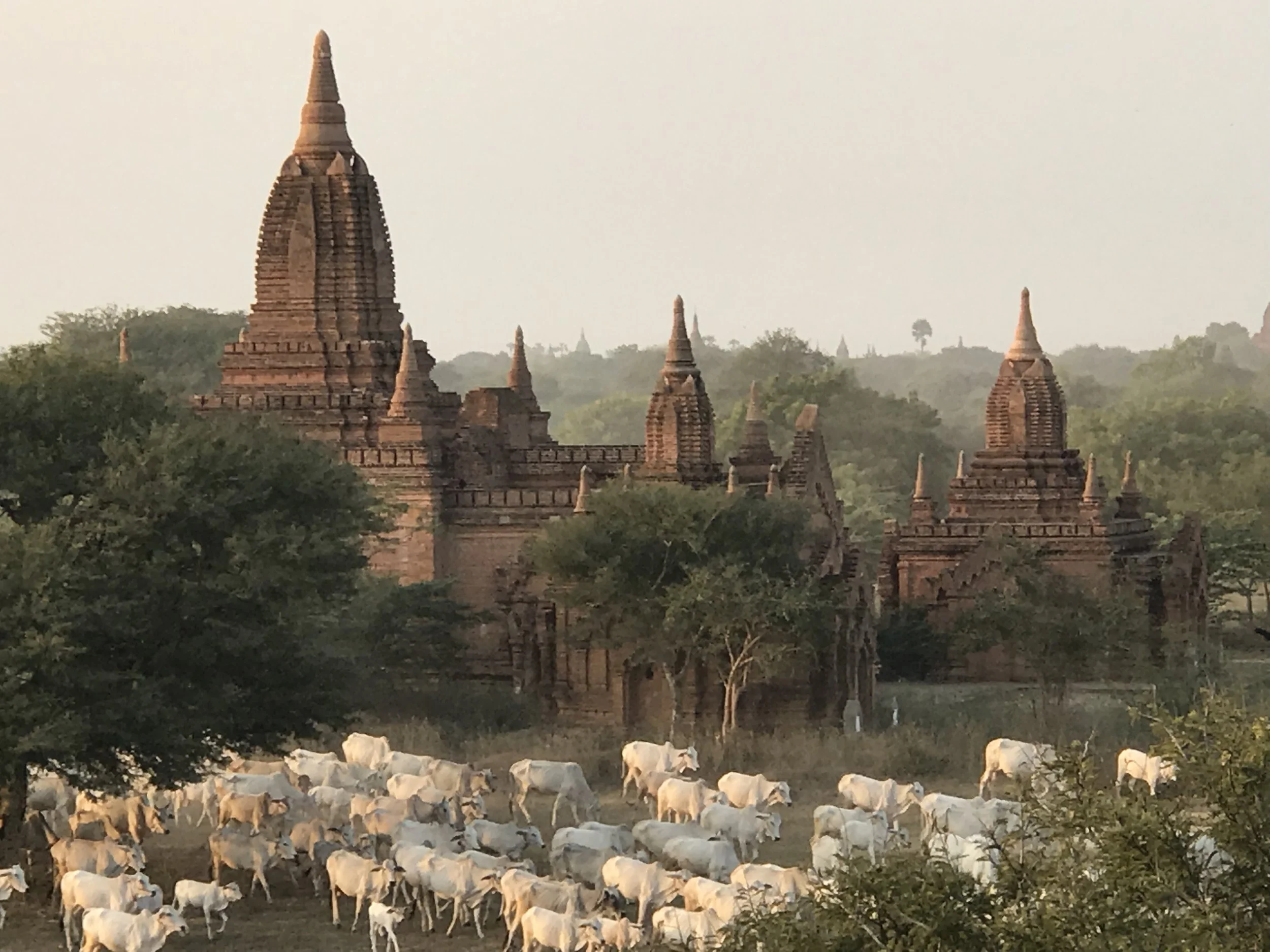
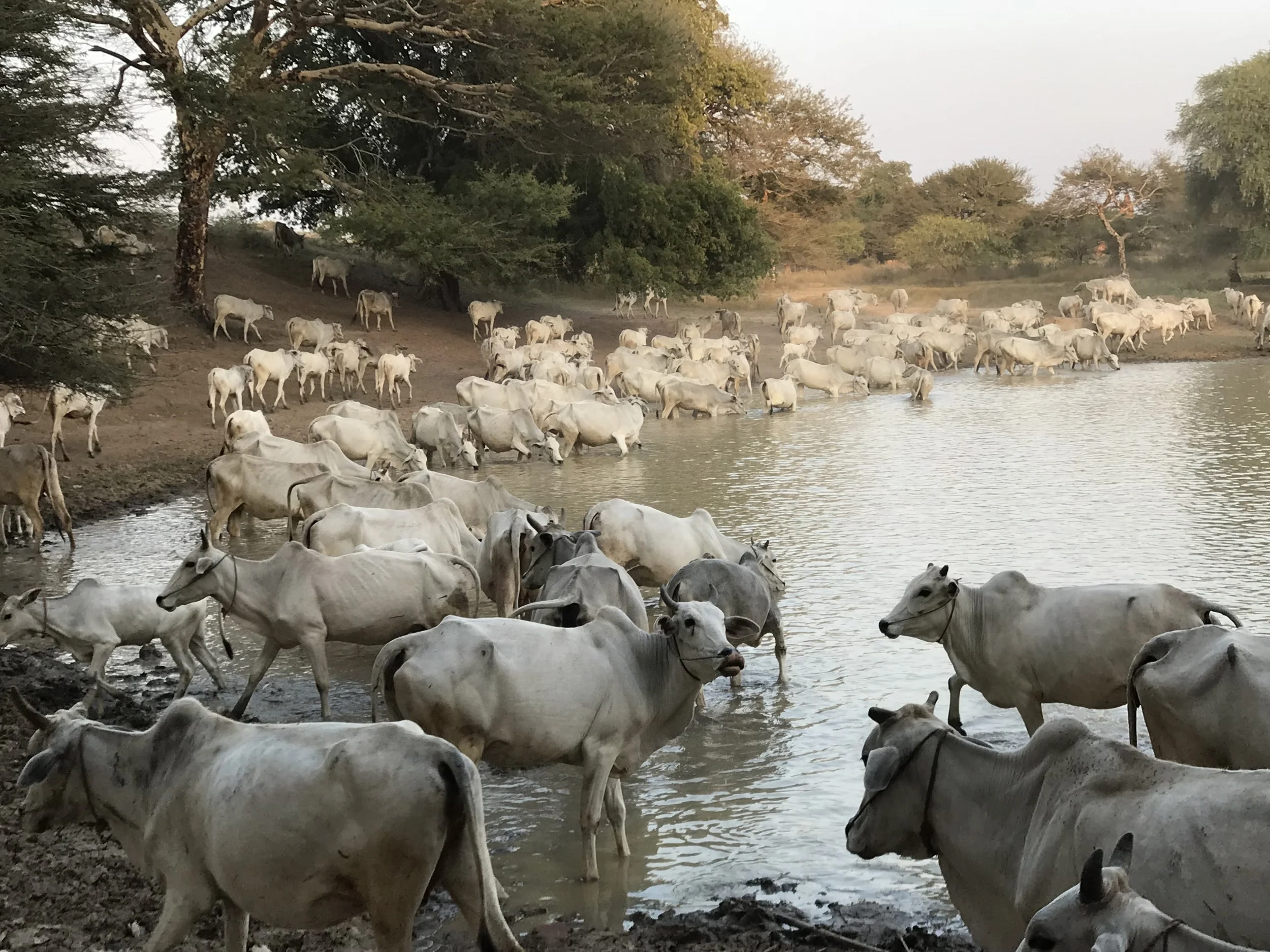
At the end of our first day when most visitors had their fill of visiting the ancient ruins, their tour guides recommend that they take in the sunset off observation hill. A French woman next to me agreed that it was not so much the sunset but the running of the steer that took center stage. It had the feel of the “Running of the Bulls” in Pamplona, Spain I had heard so much about, only in this case the handlers of the cattle were ushering the wild, yet obedient animals to the river for refreshment.

Burmese cattle herd in Burma isn’t as much a vehicle for producing beef as it is to drive the vital non-mechanized agricultural industry for farmers to lighten their load. What differentiates Burmese cattle from some other types is that they have horns, floppy ears and a distinctive hump on its upper back located between the head and neck.

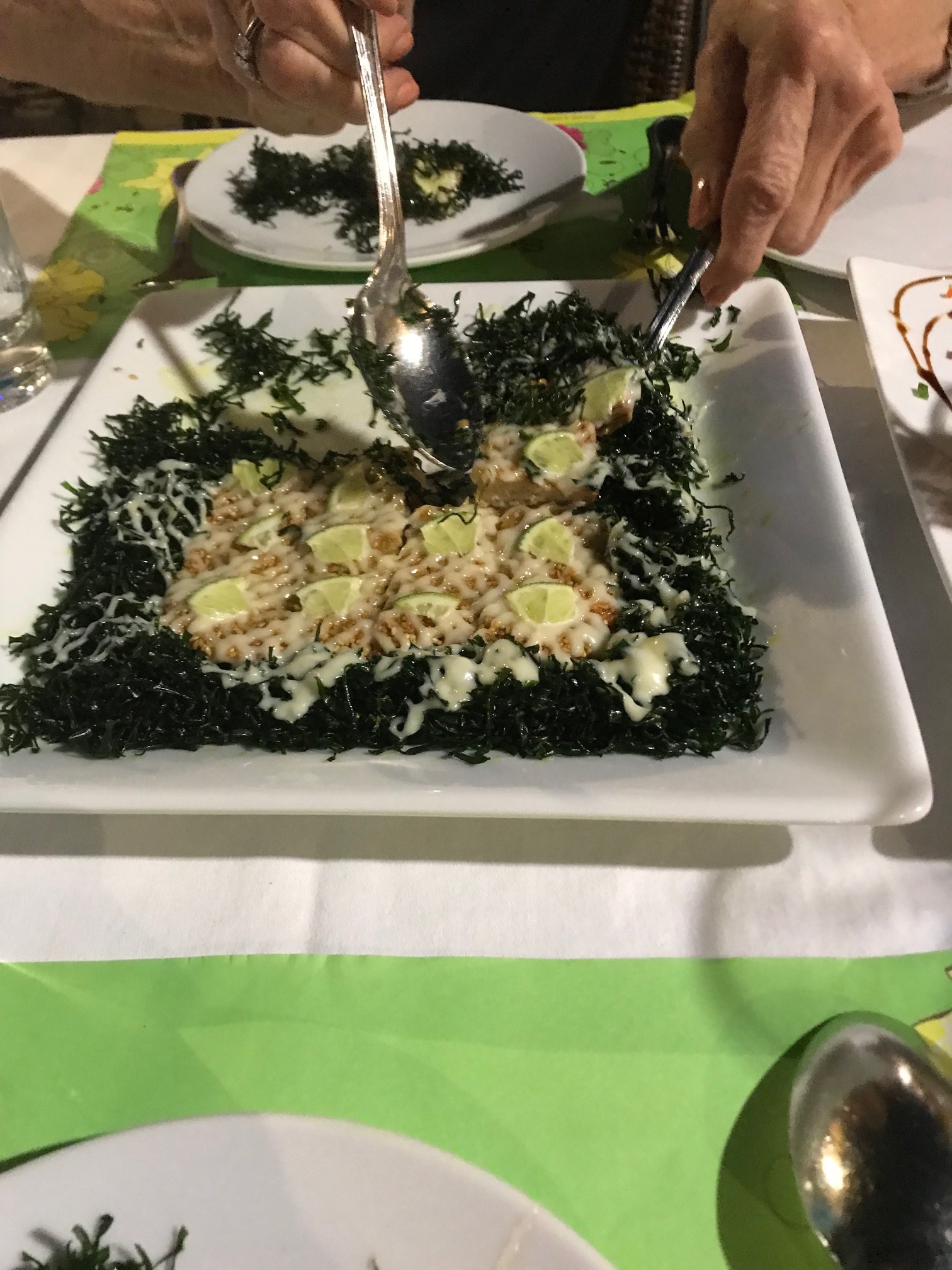
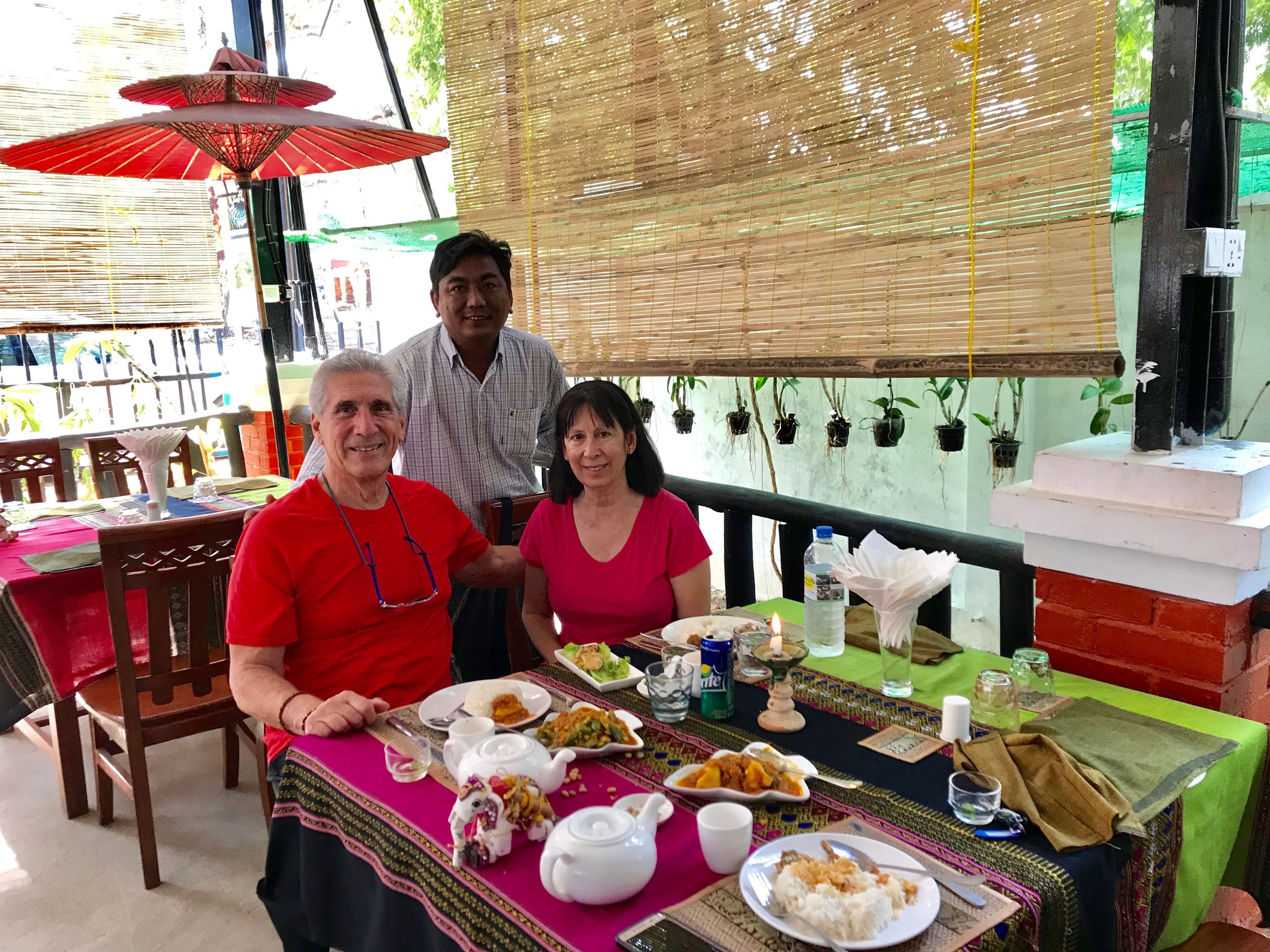
On the second day at 8:30 AM, we took in several more grand pagodas, etc., after which we agreed to have lunch with Min Min at the Mimosa Restaurant he had highly recommended as being clean, reasonable and a fun place to eat. He was right on all counts. We started out with fresh Ginger Tea, a common cold remedy his mother used to make when he was a kid and one that is easy on the digestive tract. The waiters brought out a heart shaped pile of rice to add our curry dishes to, either with chicken or vegetarian options. Min Min chose the mutton option, common in this part of the world. The owner of the restaurant brought two complimentary dishes including crispy spinach (much like crispy Kale that is so popular in California) and fresh fruit.

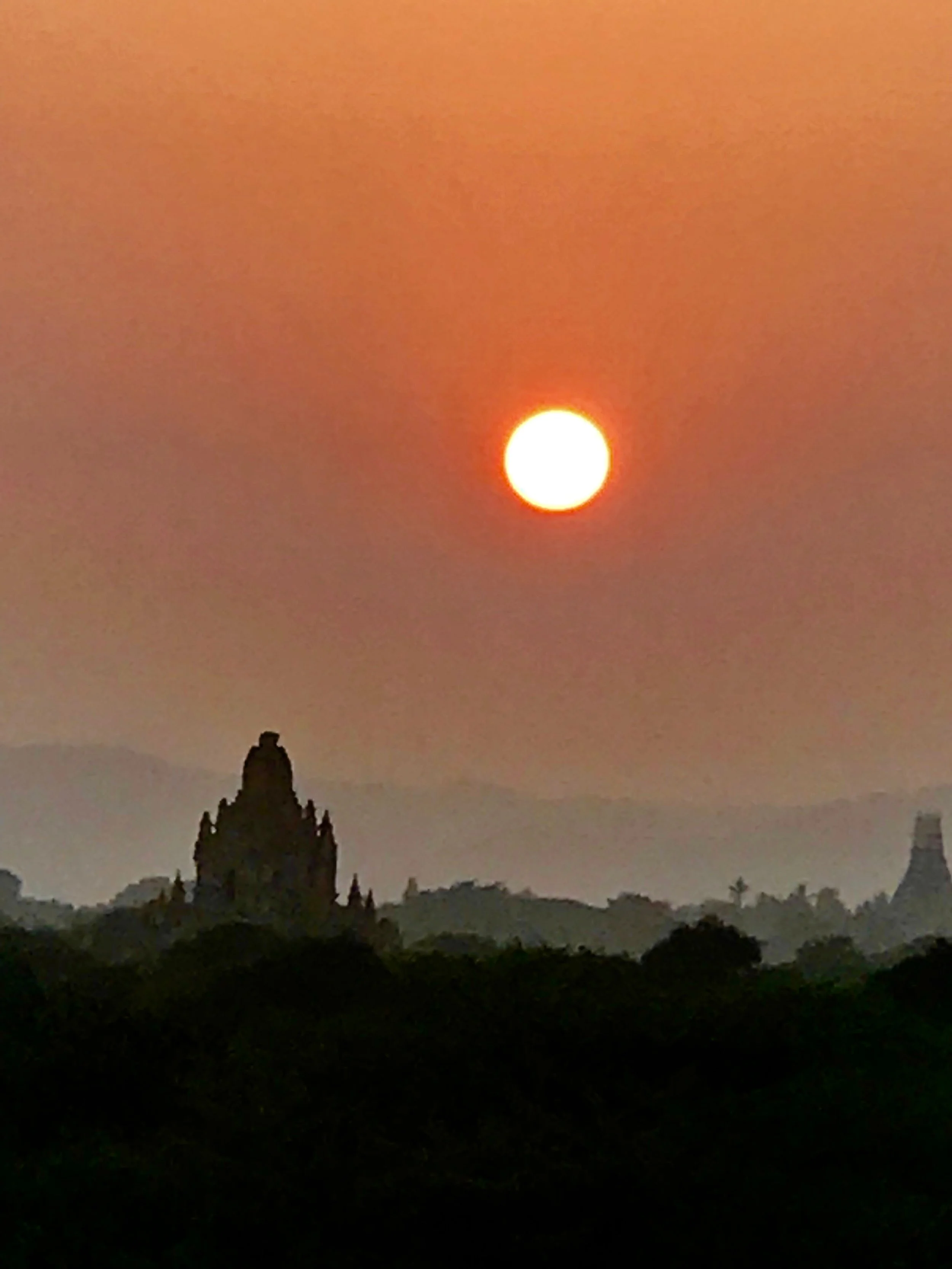
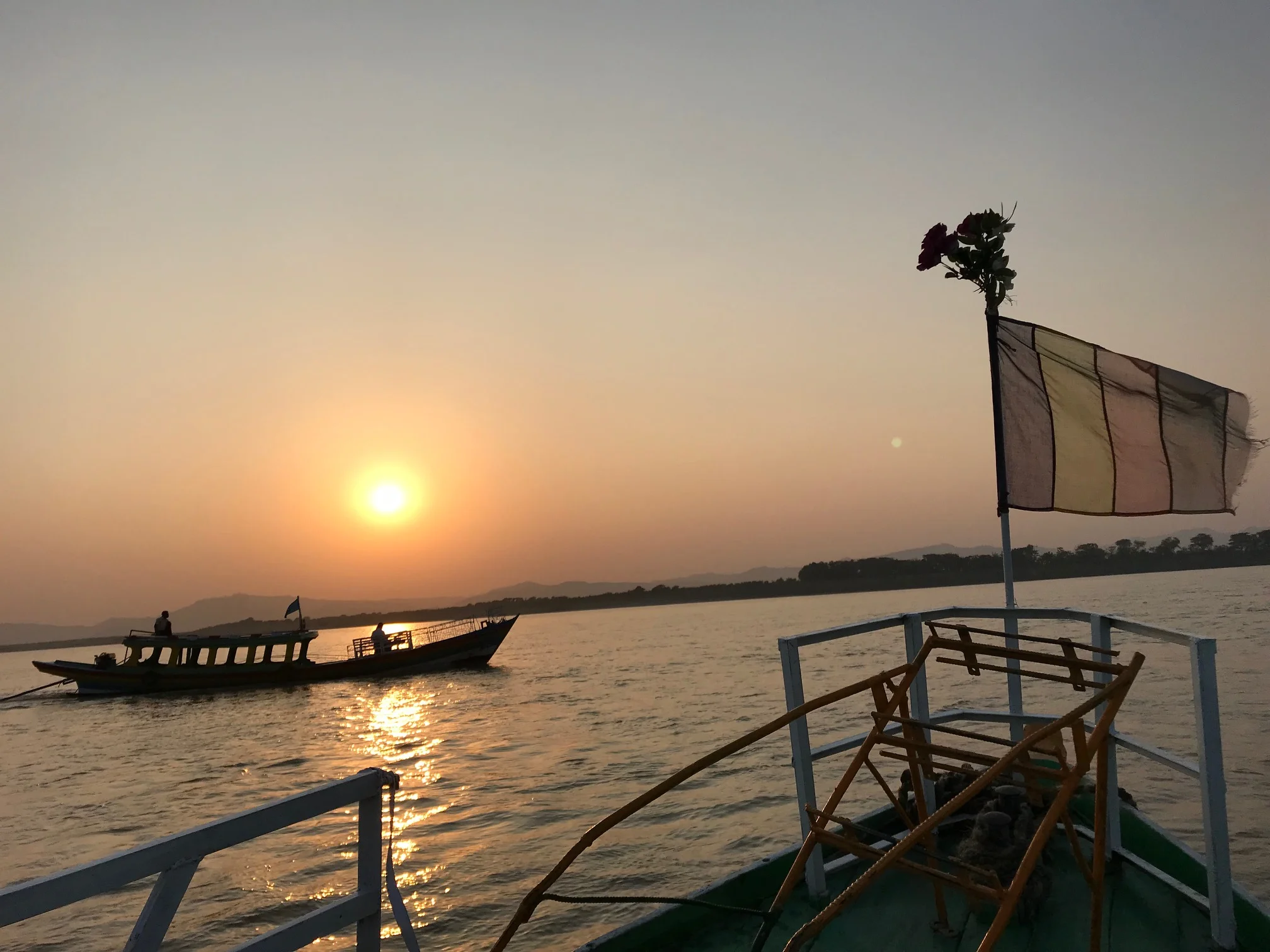
After lunch Cecile and I took a nap and Min Min arranged for us to take a sunset riverboat cruise on a large motor boat. The sun went down at 6 PM and we made our way back to shore where Min Min stood waiting to take us back to our hotel.

A Visit with my Meditation Teacher in Upper Burma and The Reclining Buddha on Mandalay Hill

"My hut lies in the middle of a dense forest; Every year the green ivy grows longer. No news of the affairs of men, Only the occasional song of a woodcutter. The sun shines and I mend my robe; When the moon comes out I read...poems.
I have nothing to report, my friends. If you want to find the meaning [of life], stop chasing after so many things."
—Zen Master Ryokan

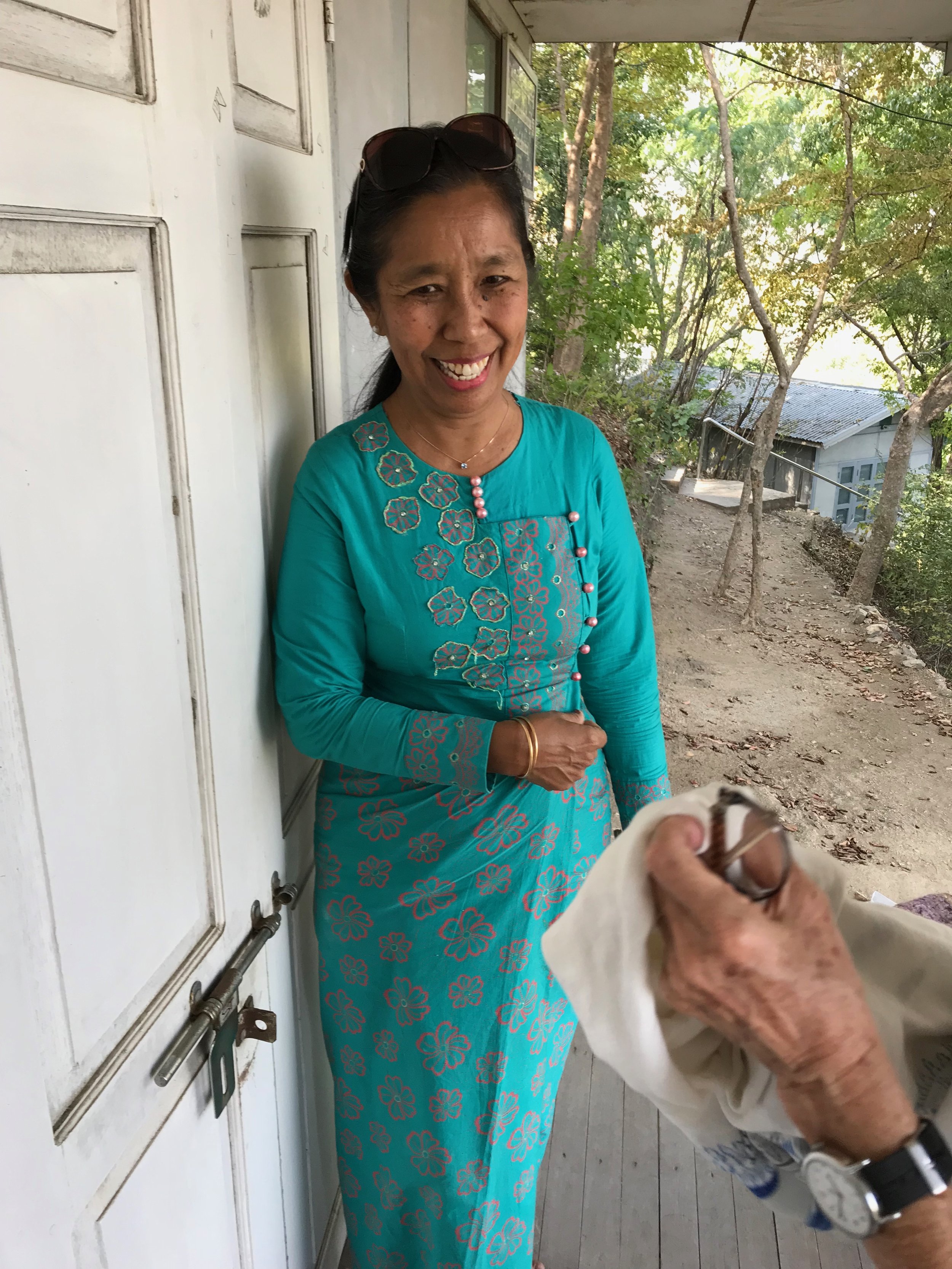
Our friend Maybelle drove us to Kyaswa Monastery, an hour from Mandalay to visit with my esteemed meditation teacher, Michele McDonald who was just about to complete leading a three week meditation retreat. She was kind enough to create a half hour window for us to meet, which wasn’t easy, as I contacted the retreat manager last minute. I hadn’t seen Michele for eight years, yet she remembered me. Over the years Cecile and I have supported the local nunneries and school affiliated with the monastery. This year was no different. One of the highlights of doing a meditation retreat at the monastery is the opportunity after the retreat to give out uniforms to the kids in their classrooms and having the young nuns sing loving kindness chants just before the last sit of the evening. 

With over 30 years as an insight meditation teacher, Michelle was the first woman to teach a formal silent meditation retreat along side senior monastic figures at Kyaswa. I was fortunate to have her as one of my main lay teachers several times in Myanmar (Burma) and the US. I found her down to earth style of teaching to be accessible, incisive, compassionate and illuminating. She definitely assisted me to find entry points into stillness and find peace no matter what challenges came my way both in the meditation hall and in everyday life. The last time I sat a retreat with her was around 2010. 

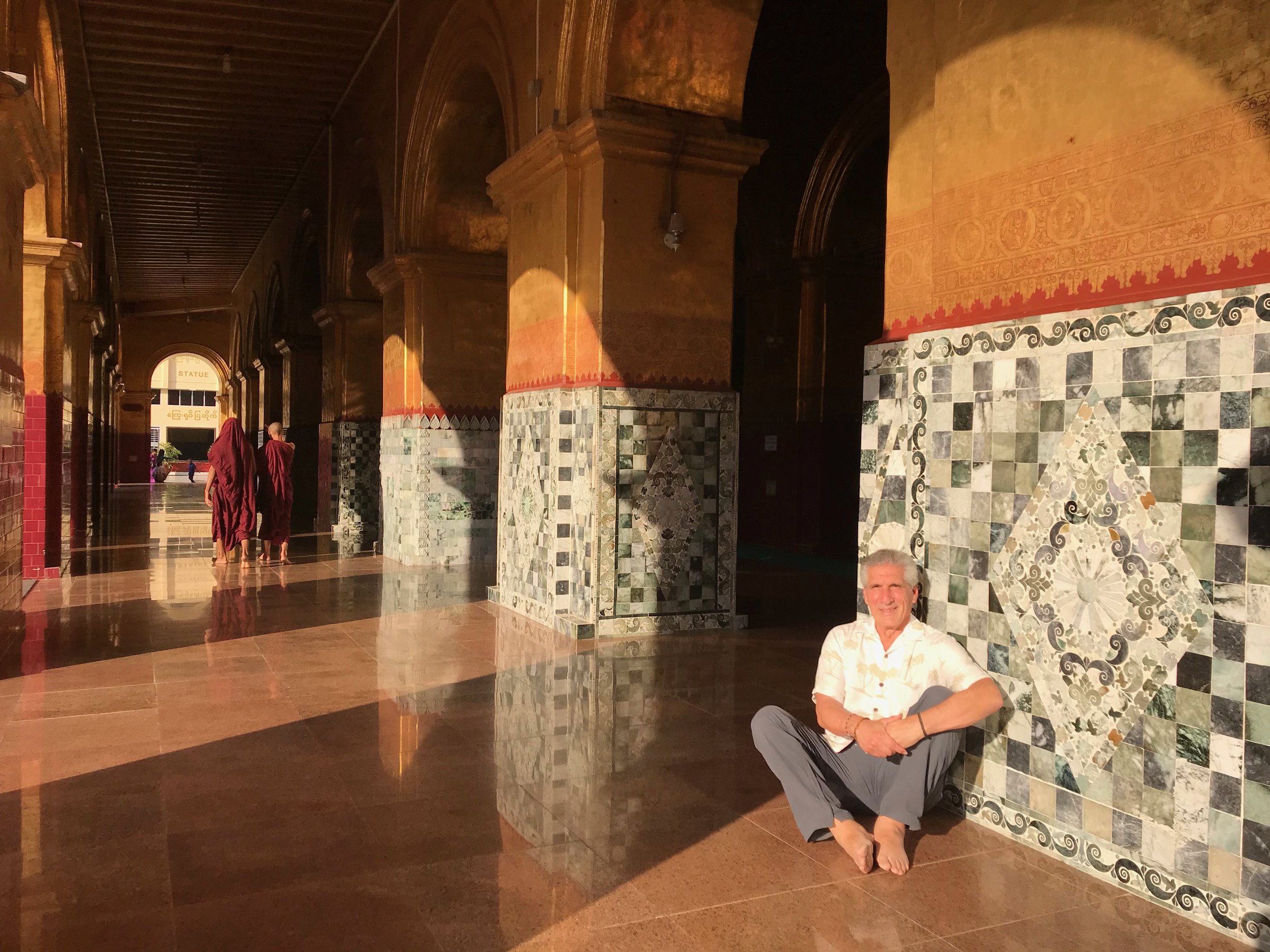
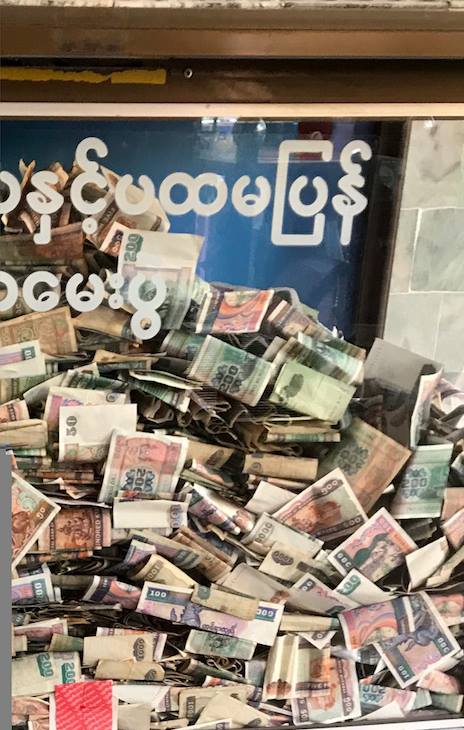
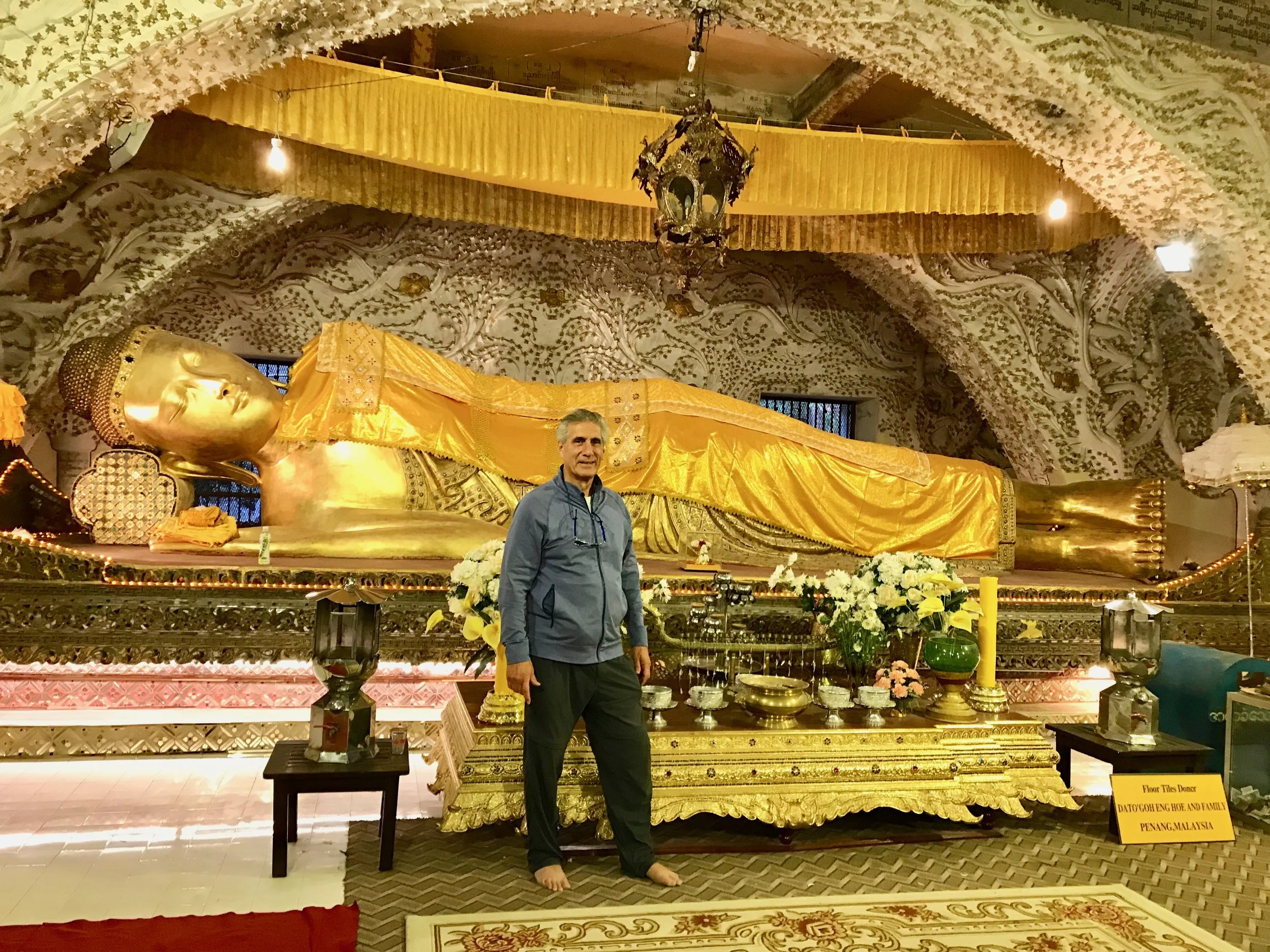
In the early evening Maybelle took me to see the gilded majestic looking reclining Buddha, housed in an old museum type building on the lower part of Mandalay Hill not to far from our hotel. It appeared to be closed. The door was locked and the lights were out. That didn’t stop Maybelle as she is as persistent as she is kind, and she managed to find the custodian of building who is a young monk who also lives there. The pleasant monastic is pretty handy. Apparently, all the donations visitors place in the glass container are used to maintain the statues and the pedestals they sit on. This is the Burma I know, based on the wisdom of kindness and generosity. 

Speaking of generosity, I have learned a lot from Maybelle. In a country that is 90% Buddhist, she makes it a regular practice to help people that are hungry, disabled, elderly at any given opportunity, no matter what their religious preference. She is also a part of a sisterhood who make small seed loans to women for small opportunities.

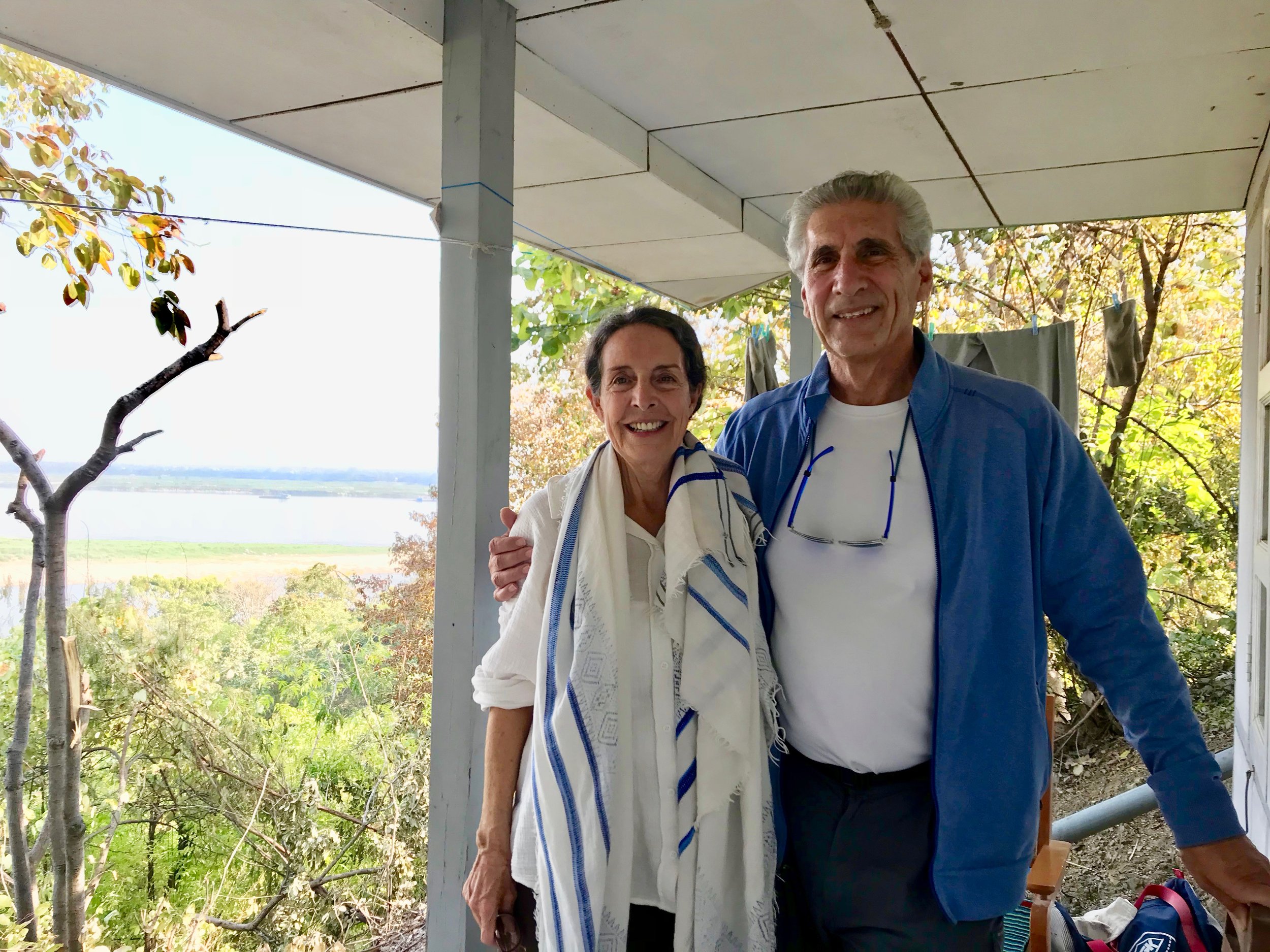
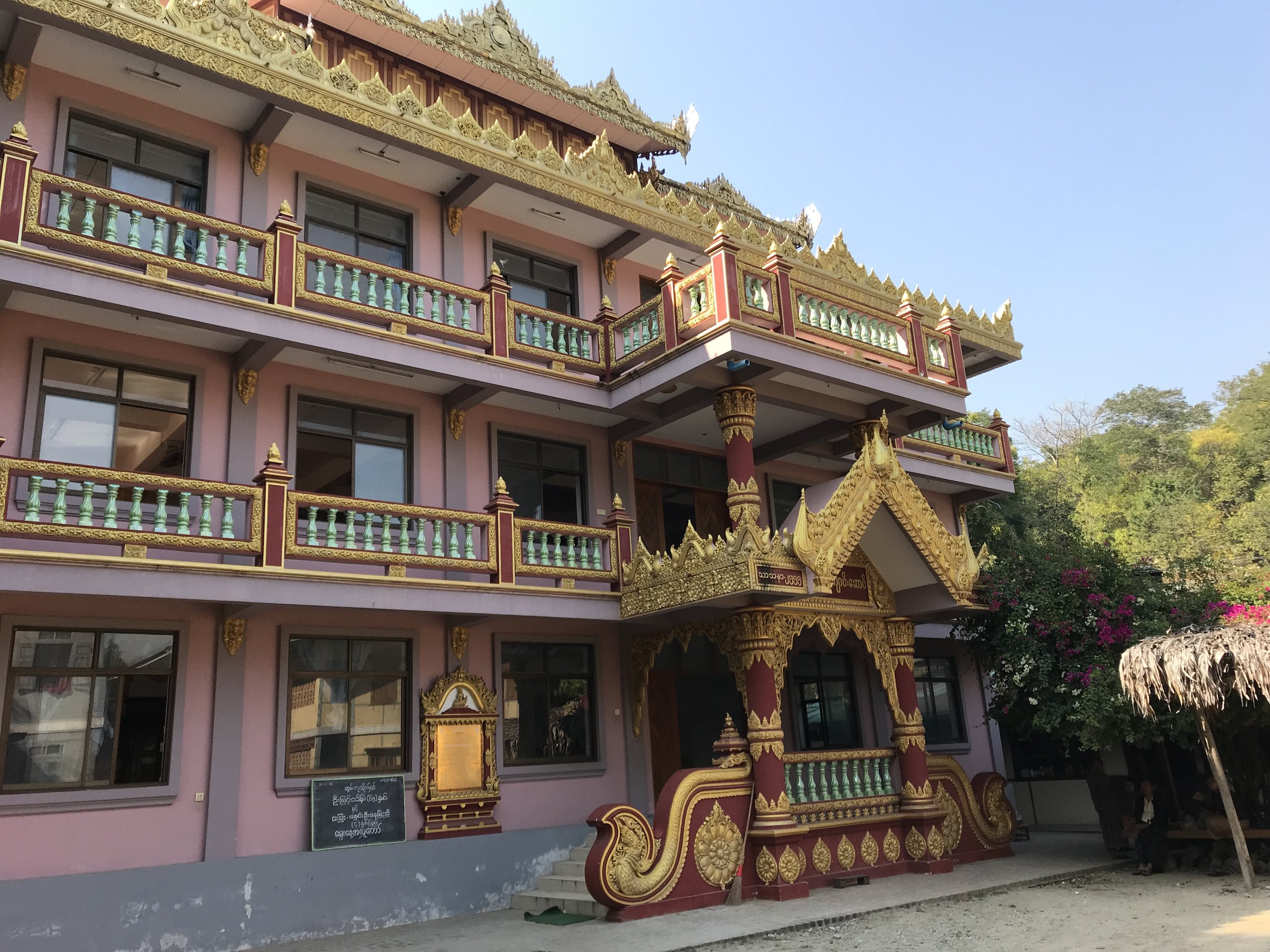
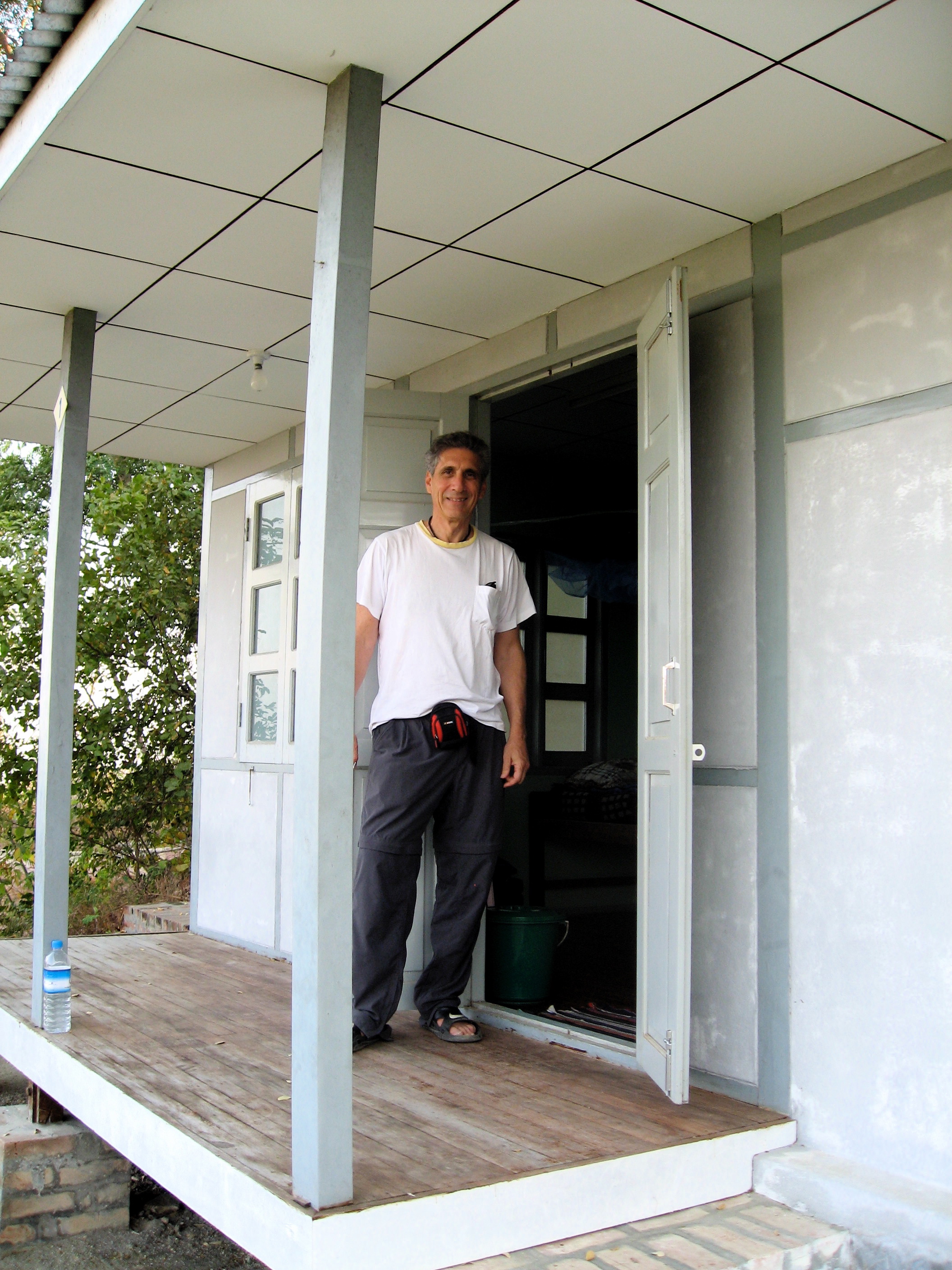
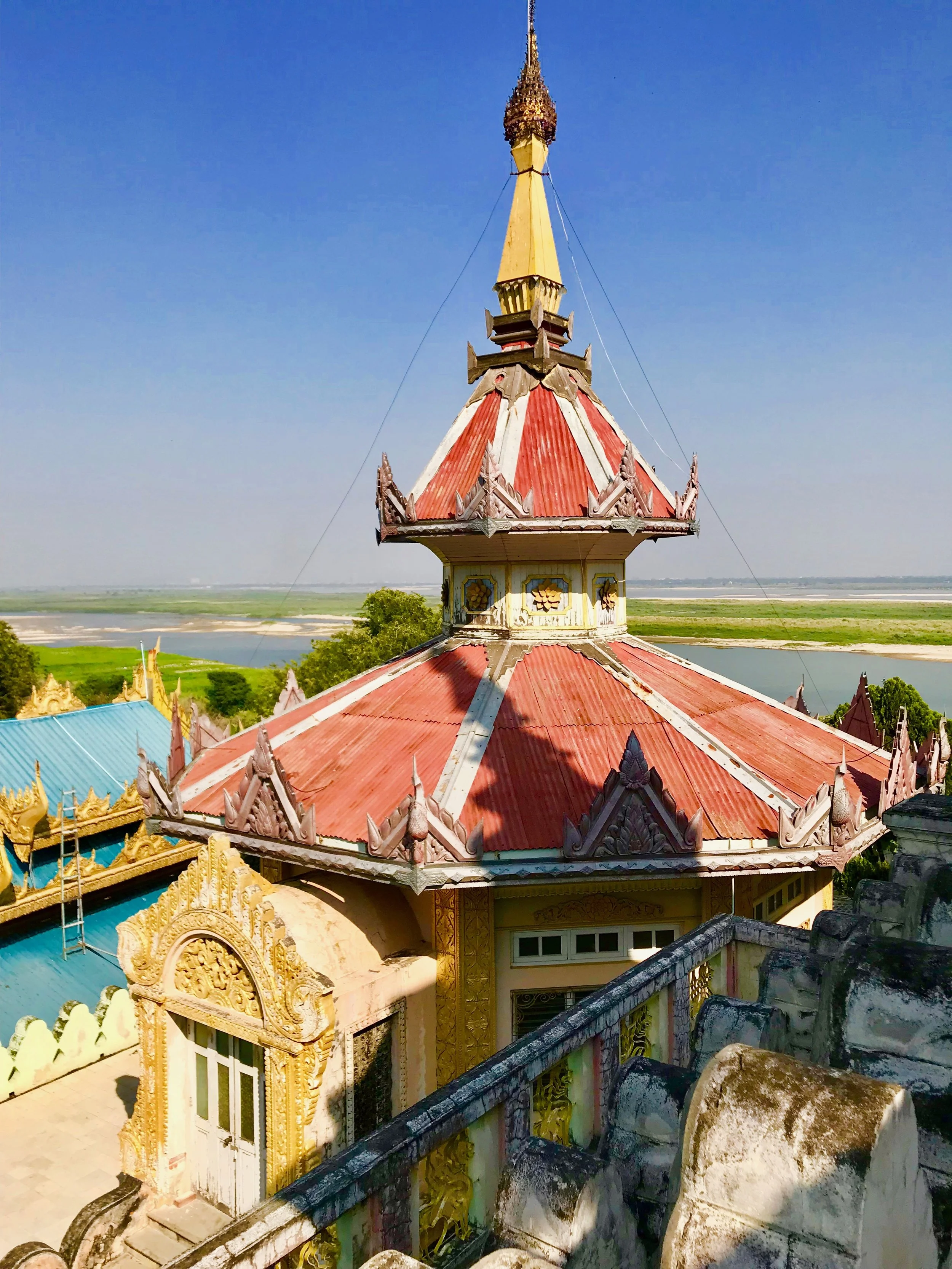
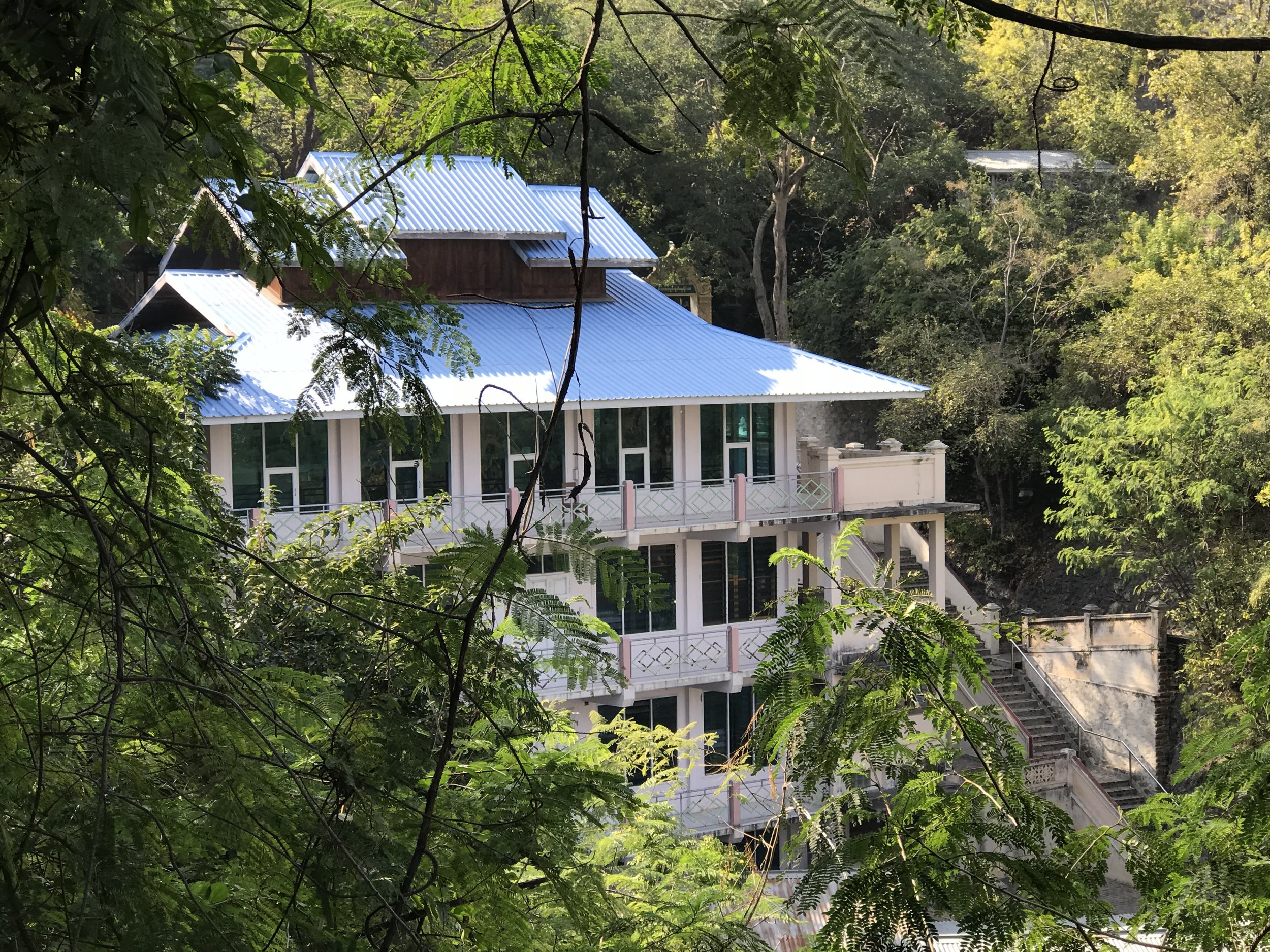
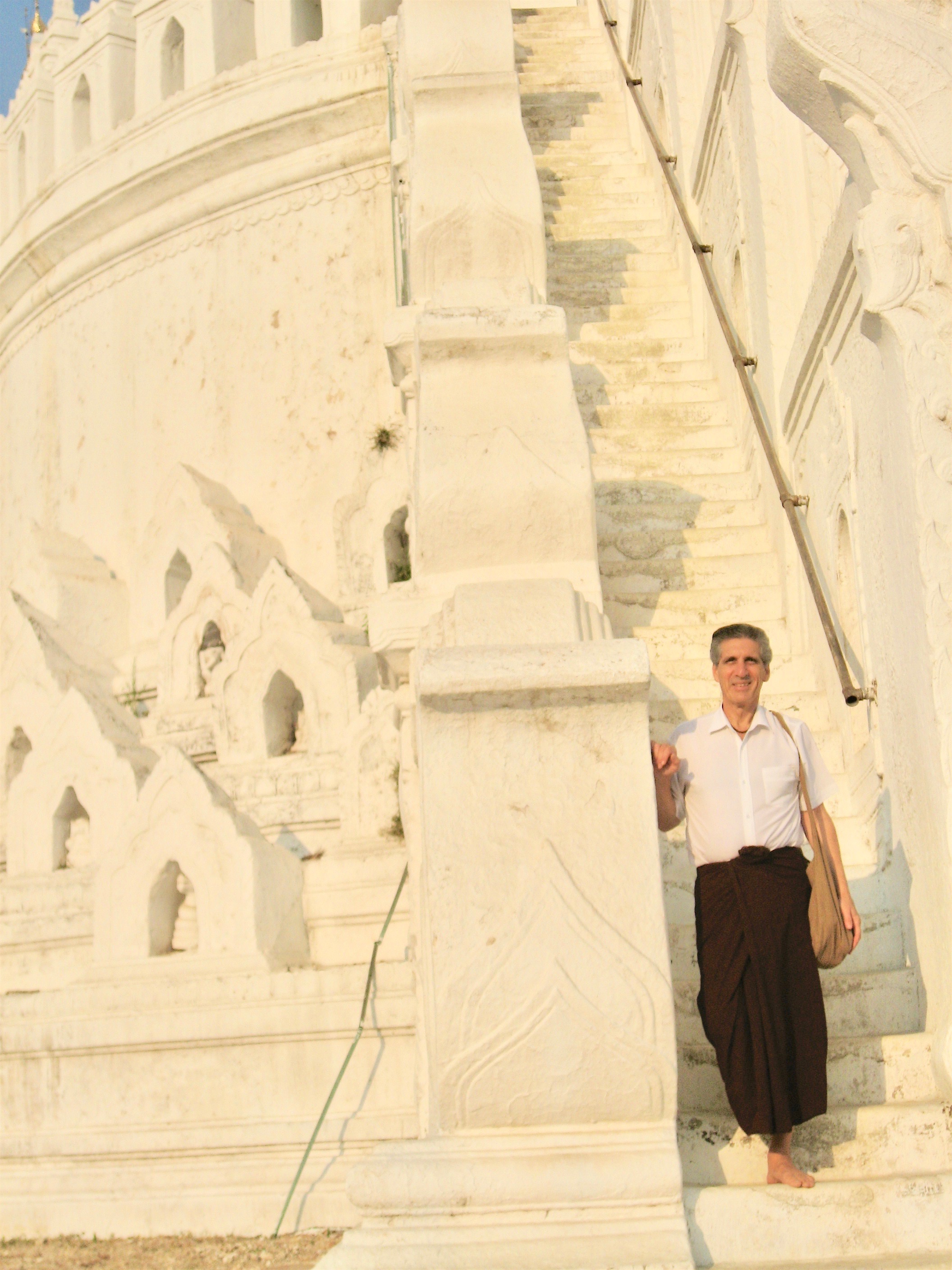
Photos: With the exception of the reclining Buddha, all photos were taken at the monastery on this trip and in 2010. The wrap around dress is called a longyi and along with a white shirt is required clothing for men at these monastery retreats. The four story building with the stone steps to the right is the meditation hall. The hut I was assigned has a bed, closet, desk and bathroom. I was quite happy there.


Young Burmese Nuns in Pink and the Revered Golden Mahamuni Pagoda

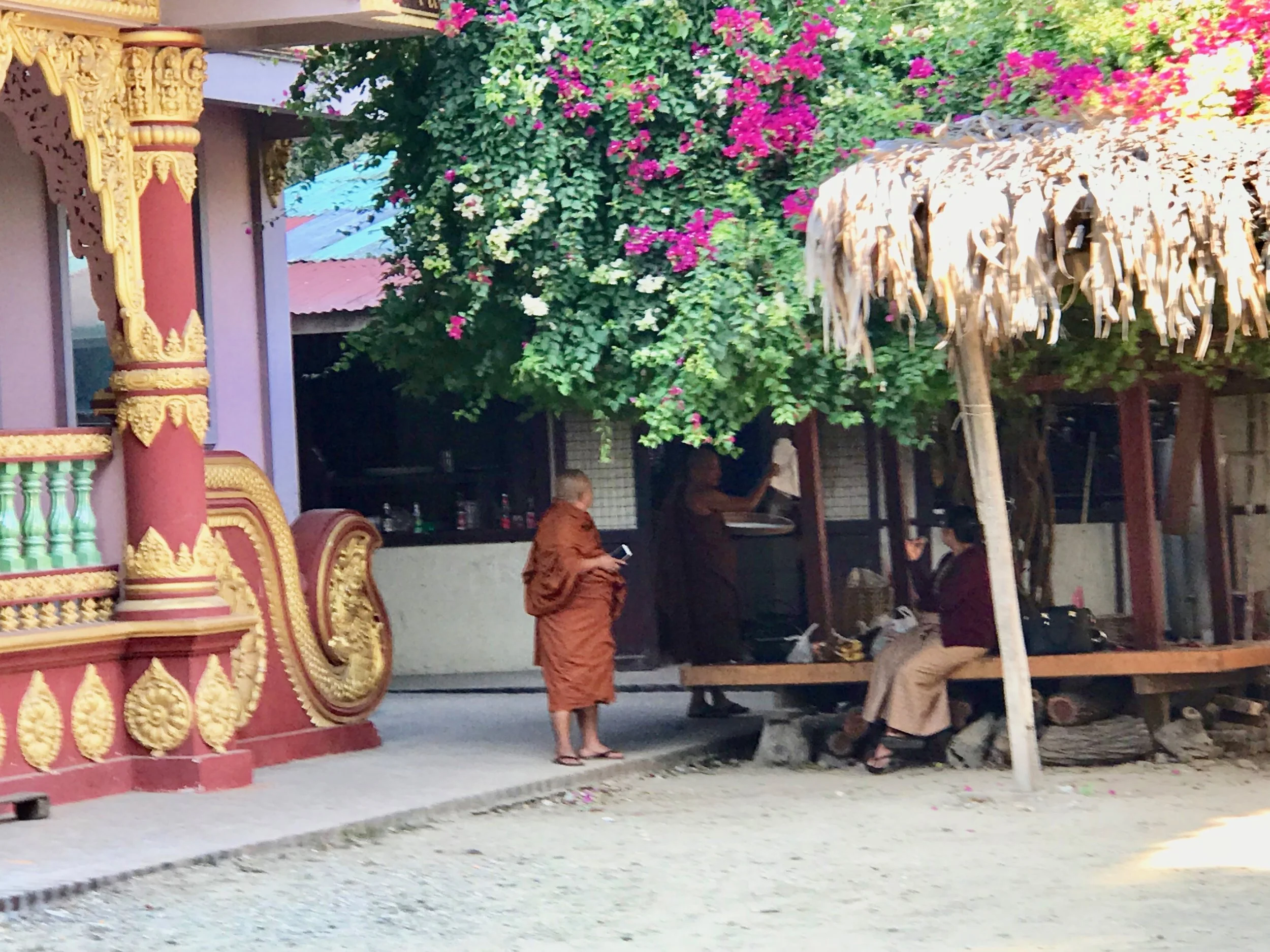
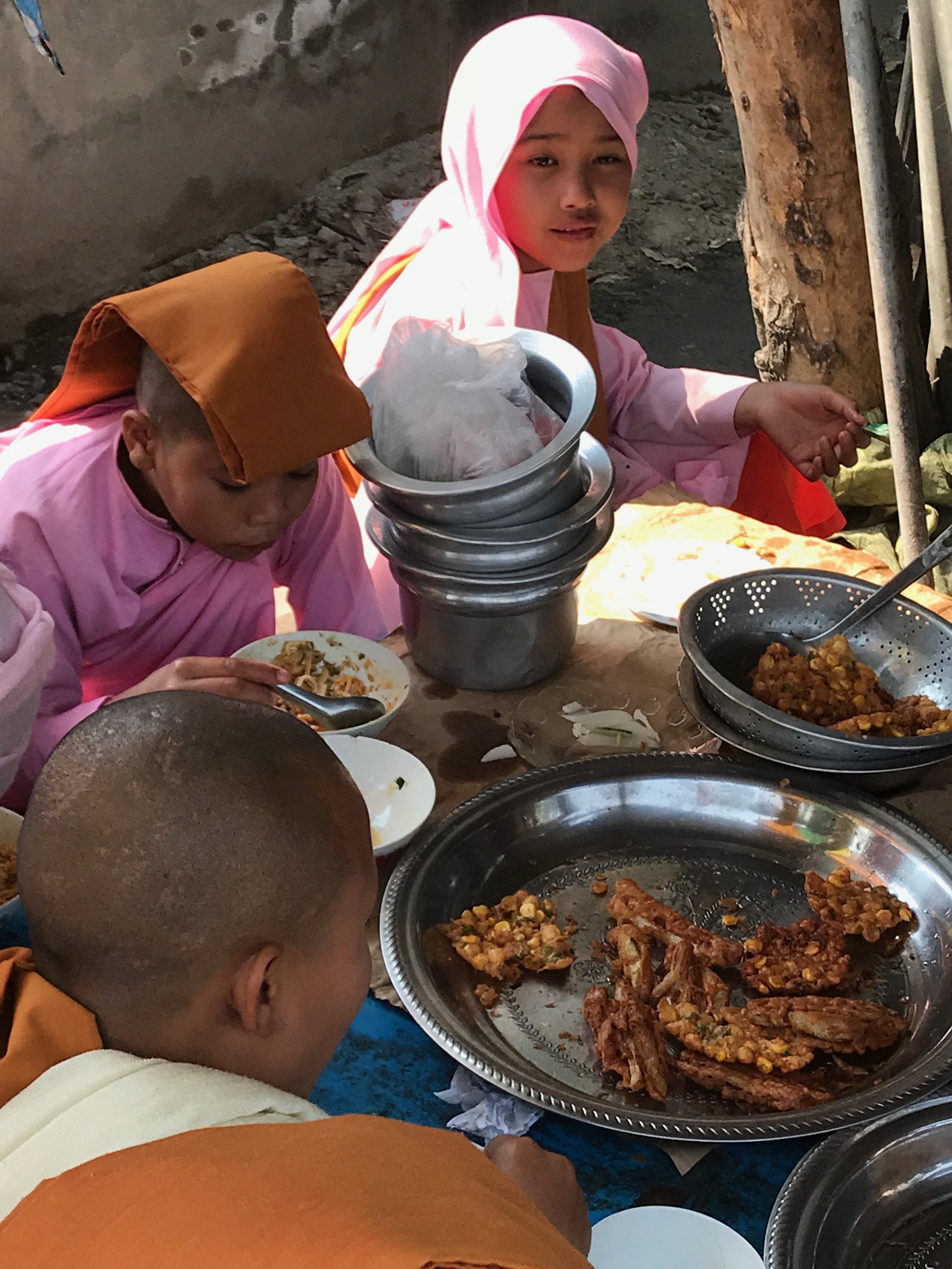
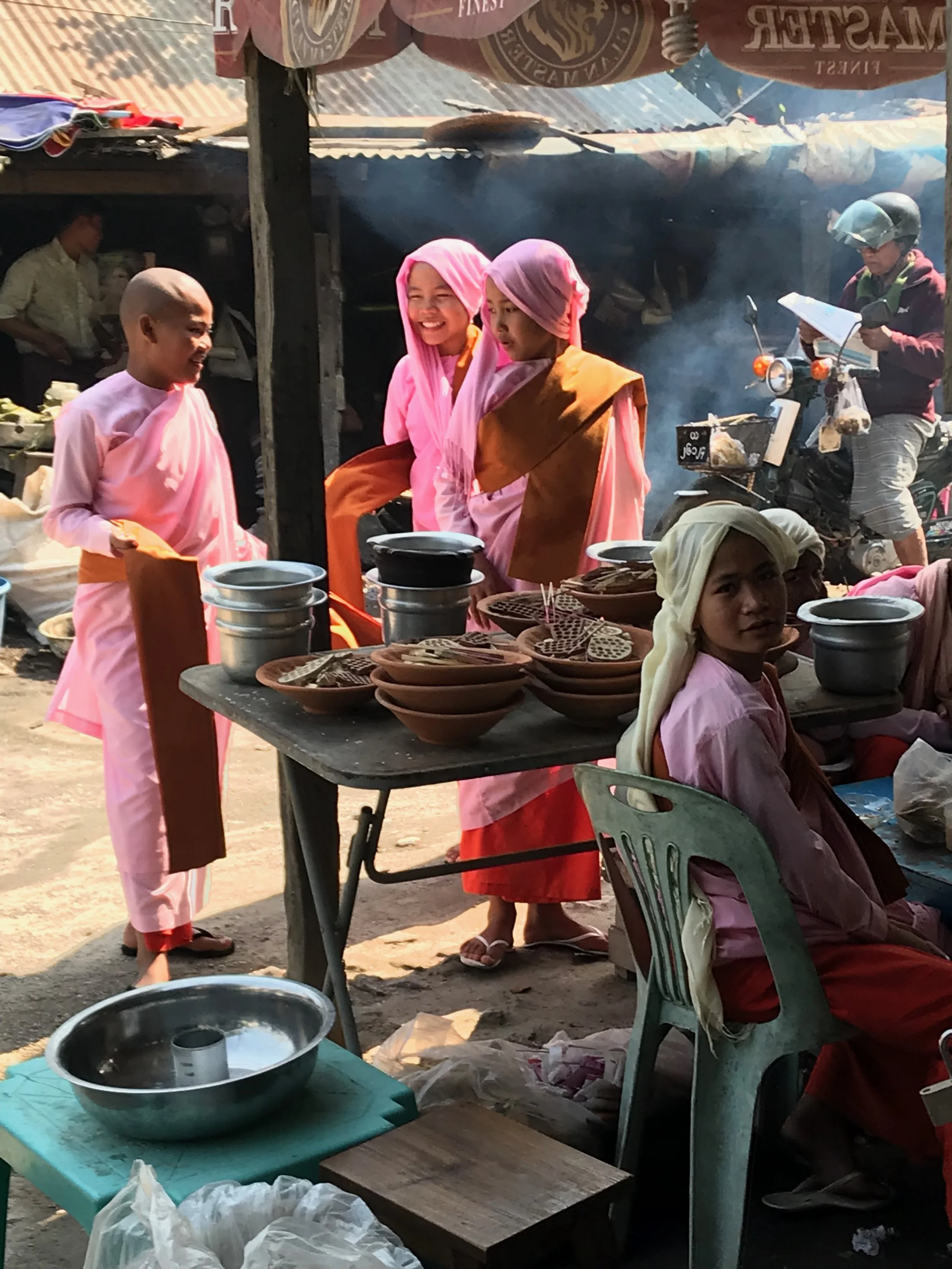
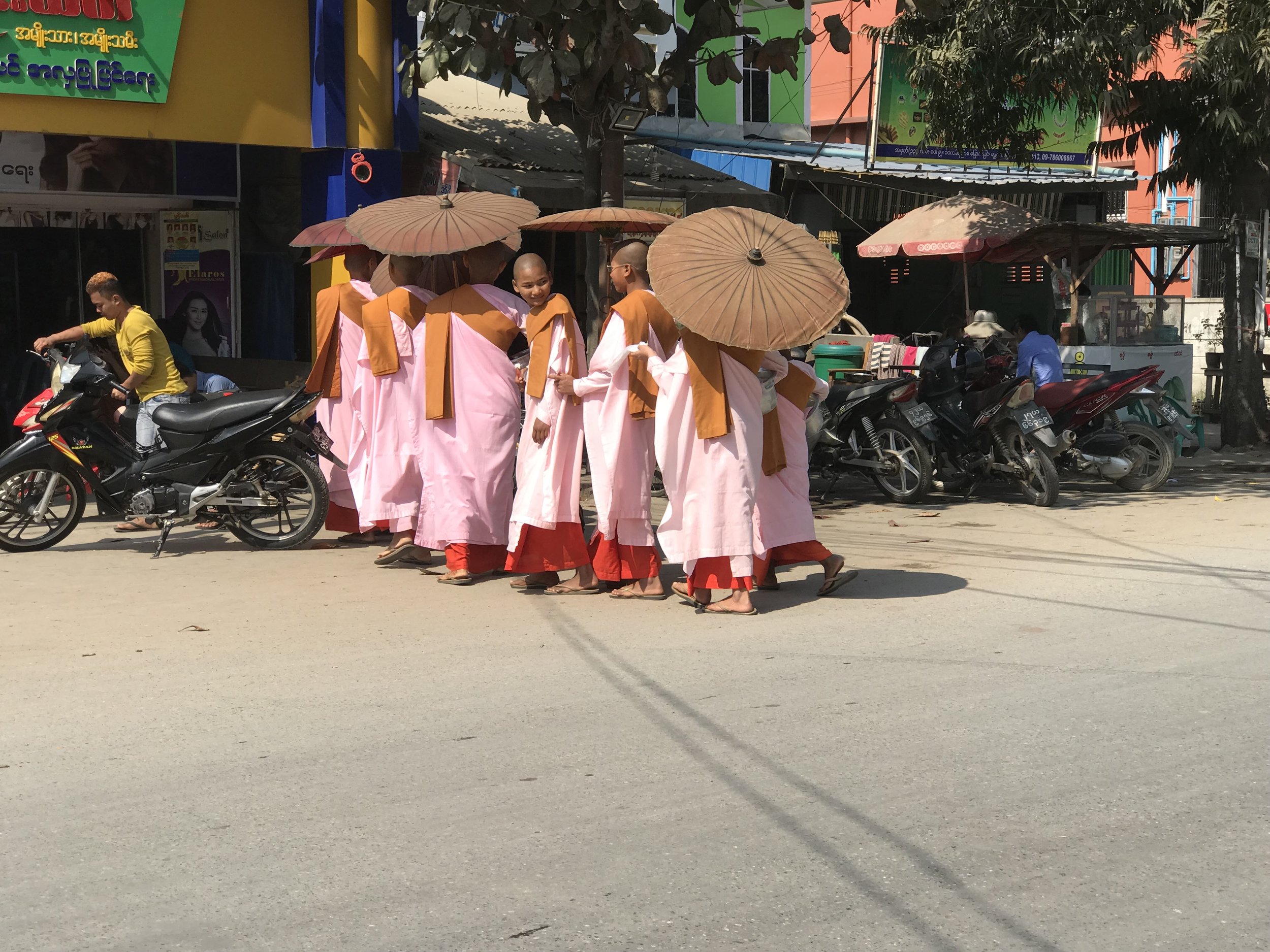
The Pali word for Buddhist nuns who wear a baby pink robe is Bhikkhuni. Child nuns are seen almost everywhere in Burma, making alms rounds with older nuns twice a week.

Many come from poor families or are orphans. Hence, they stay in the nunnery for many years and are supported with education and food. They walk with so much grace and confidence. Once younger novices become adults they can decide if whether they wish to remain in the order. That said, the term “order,” is controversial as the ordination process to become ordained is thought to confer no more status than a pious laywoman who must abide by taking additional vows. Unfortunately, patriarchy still exists here.

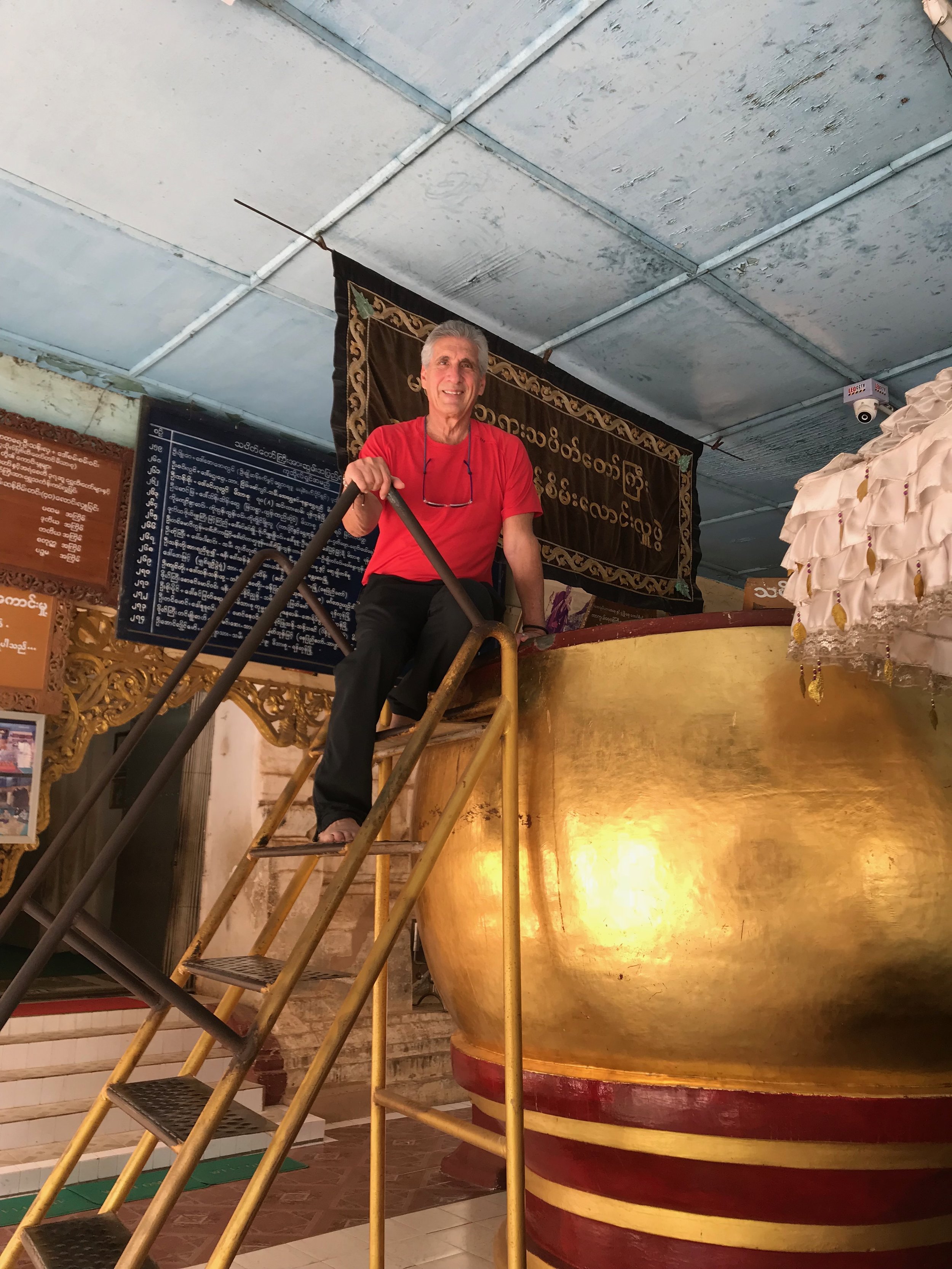
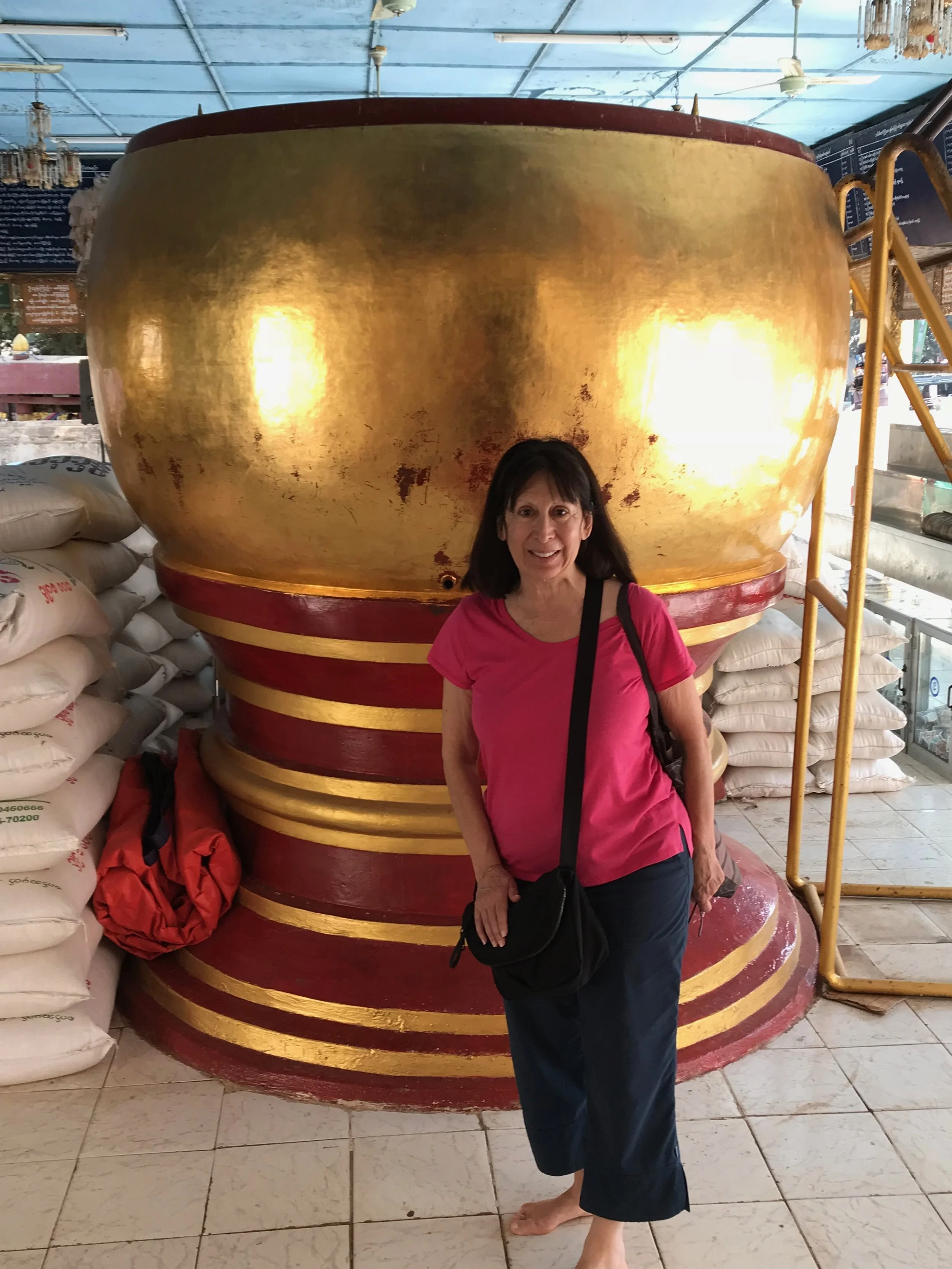
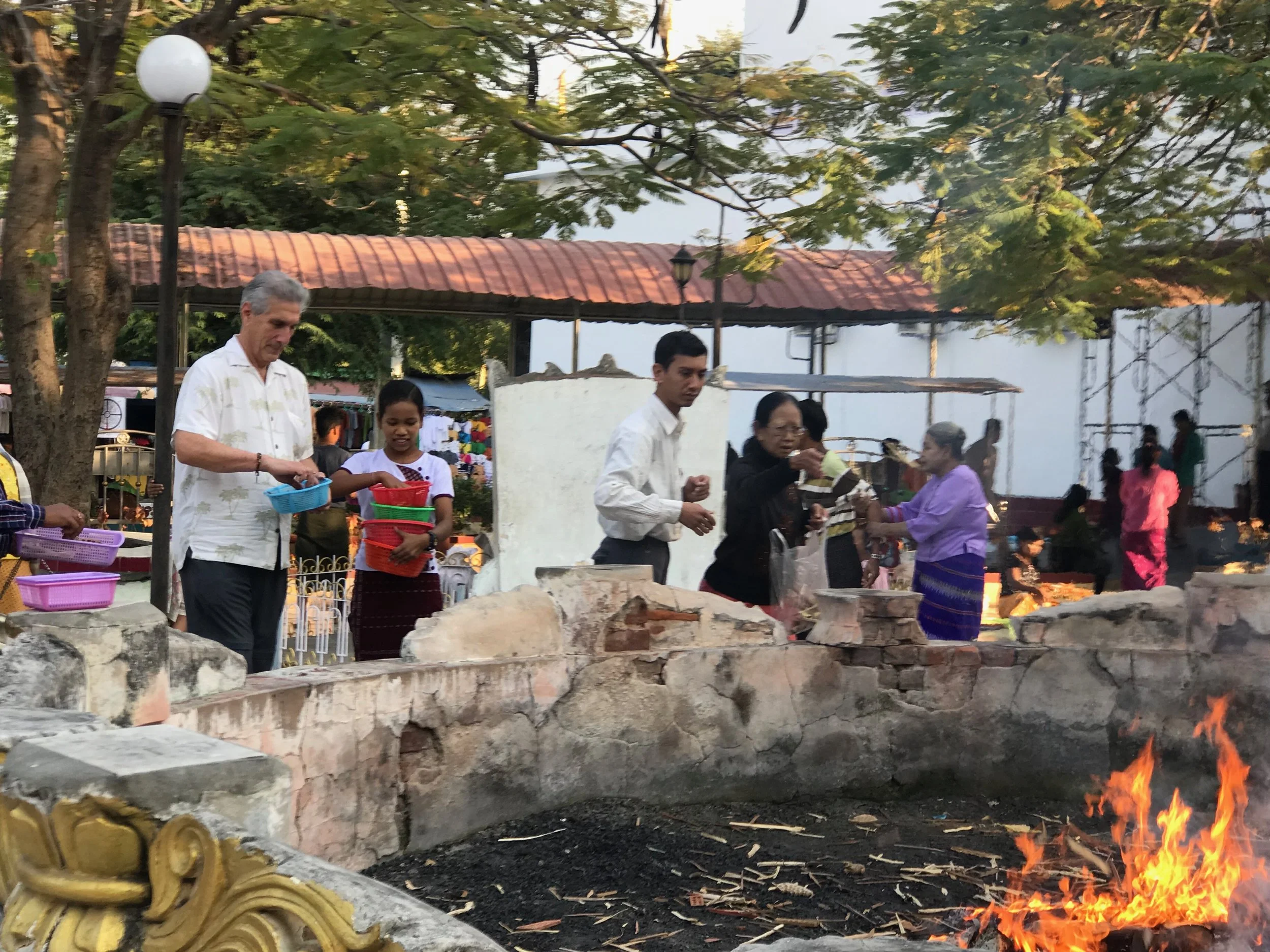
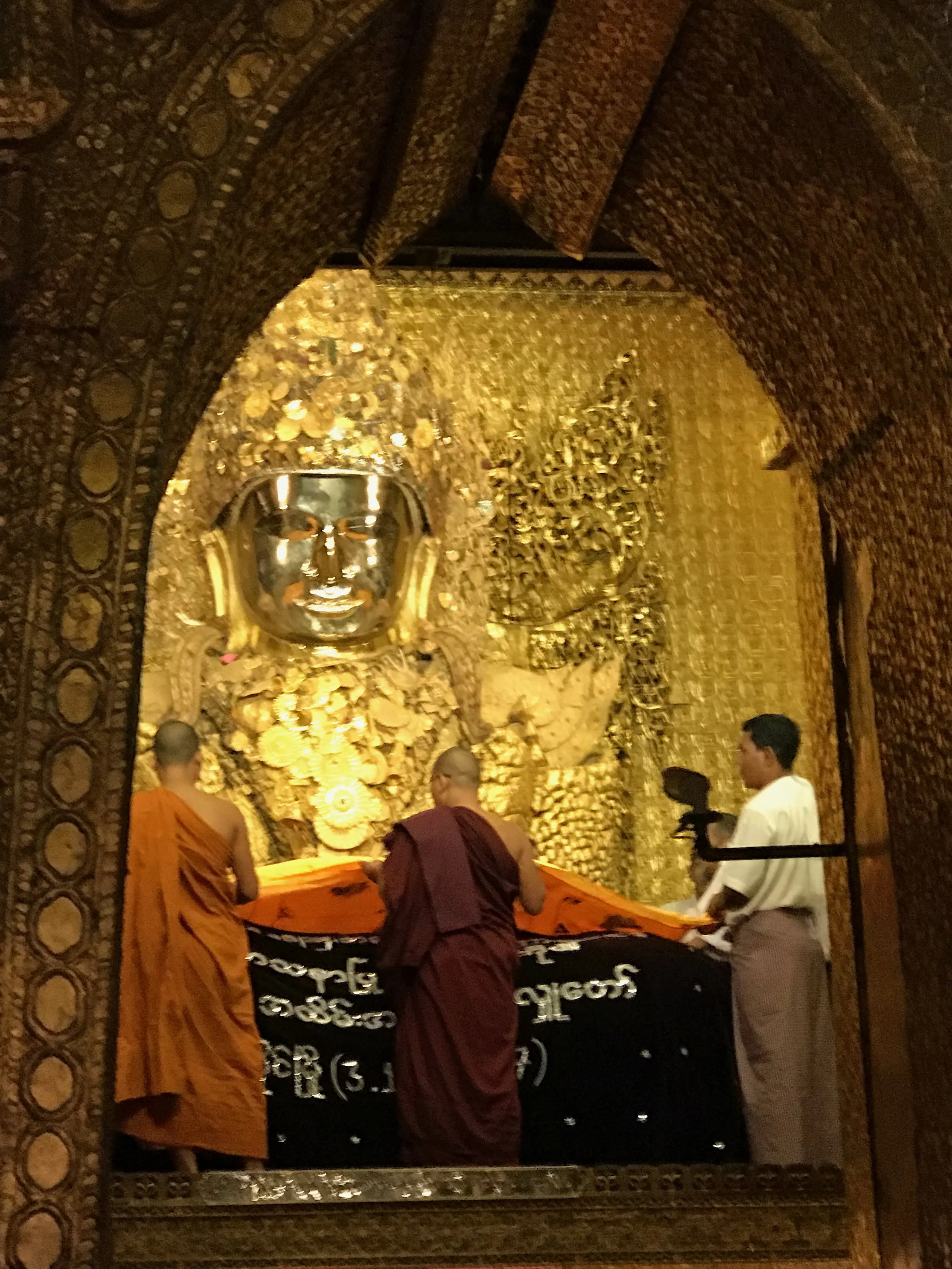
The Mahamuni Pagoda that houses the Mahamudi Buddha statue as seen here is one of the most revered Buddhist pilgrimage sites in Burma. It was built in 1785. The crown is set with precious stones including diamonds and rubies. Each morning at 4 AM the Buddha image is washed and witnessed by devout Buddhists. Maybelle took me to the pagoda at around 3:30 PM and I got to apply 5 thin patches of gold leaf to the image as I have done several times in years past. Preparations were under way for the full moon celebration on the lunar calendar. Tons of food items are donated to benefit the poor and disabled including sticky rice. It’s also a real treat for the monastery dogs which warms the heart. The young, sweet Burmese girl at my side assisted me in tossing wood offerings into the fire pit.

Crossing the Teakwood U Bein Bridge on the Outskirts of Mandalay To Witness the "Mother of All Sunsets"

“The World is a book and those who do not travel it read only a page.”—St. Augustine

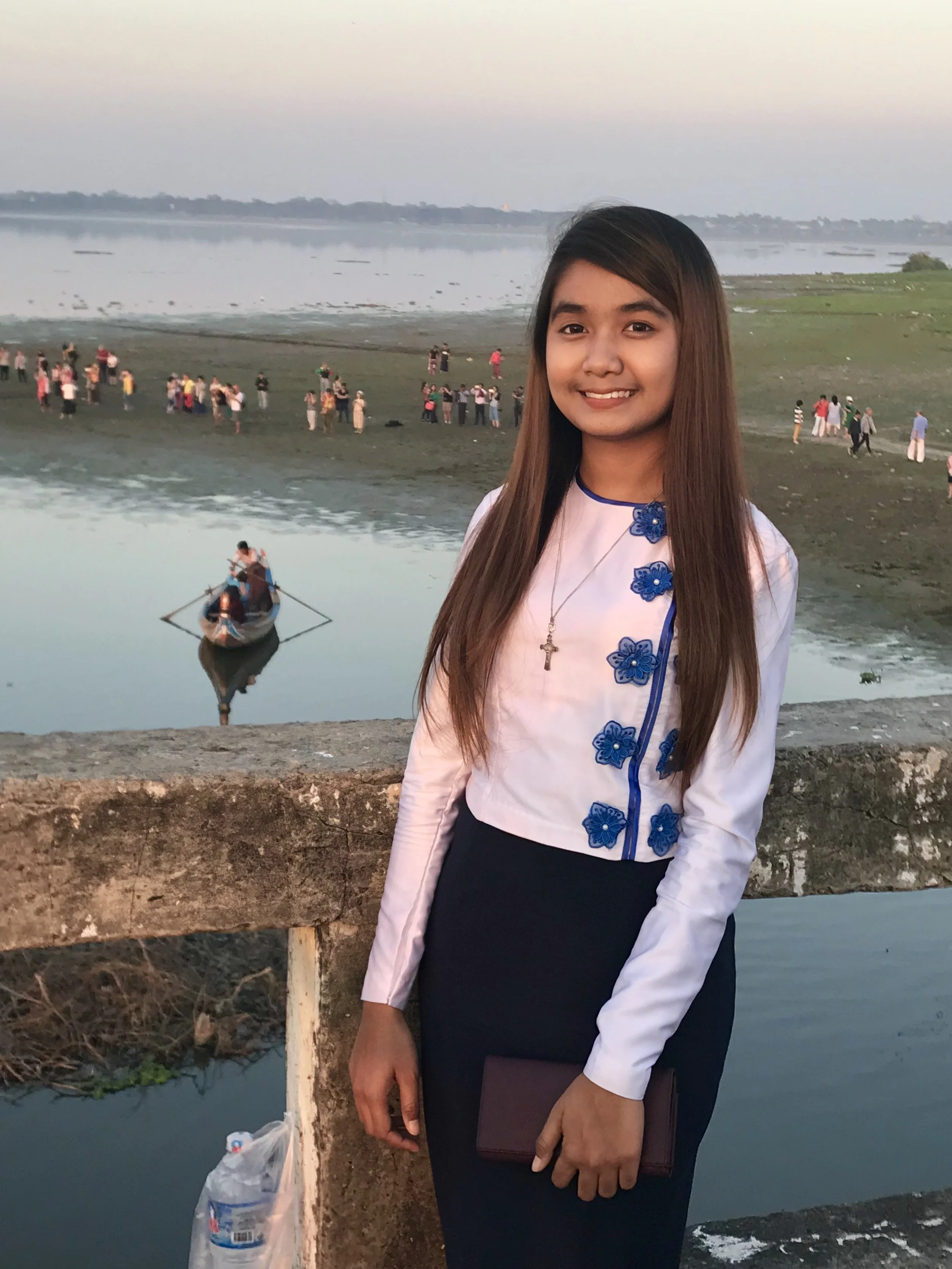
After visiting more monasteries containing bigger than life statues of the Buddha and other legendary deities, I crossed the historic U Bein Bridge with Maybelle’s daughter, Michelle MhuMadii who I have haven’t seen in eight years. She has grown into a respectful, pretty and delightful young lady. 

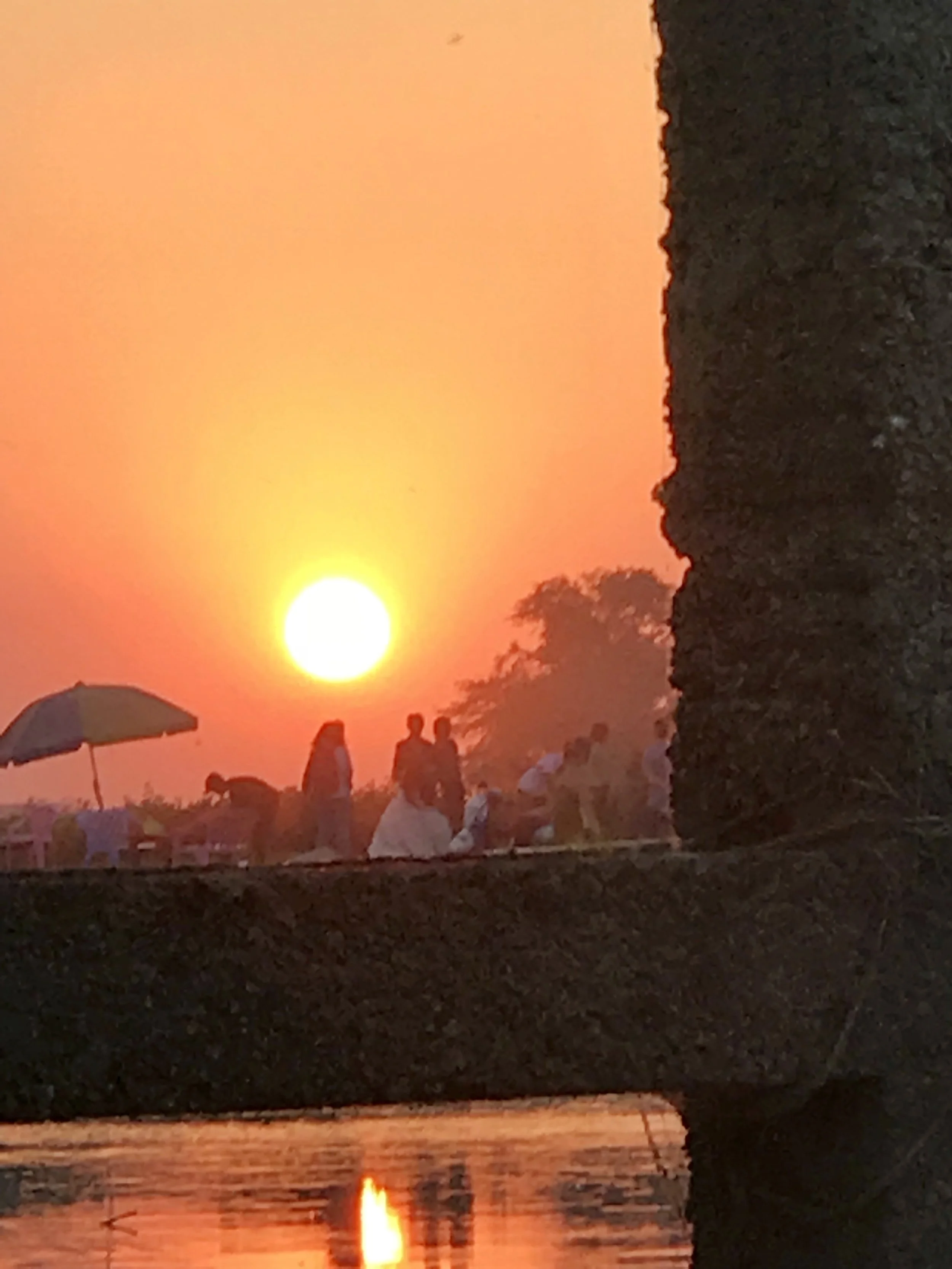
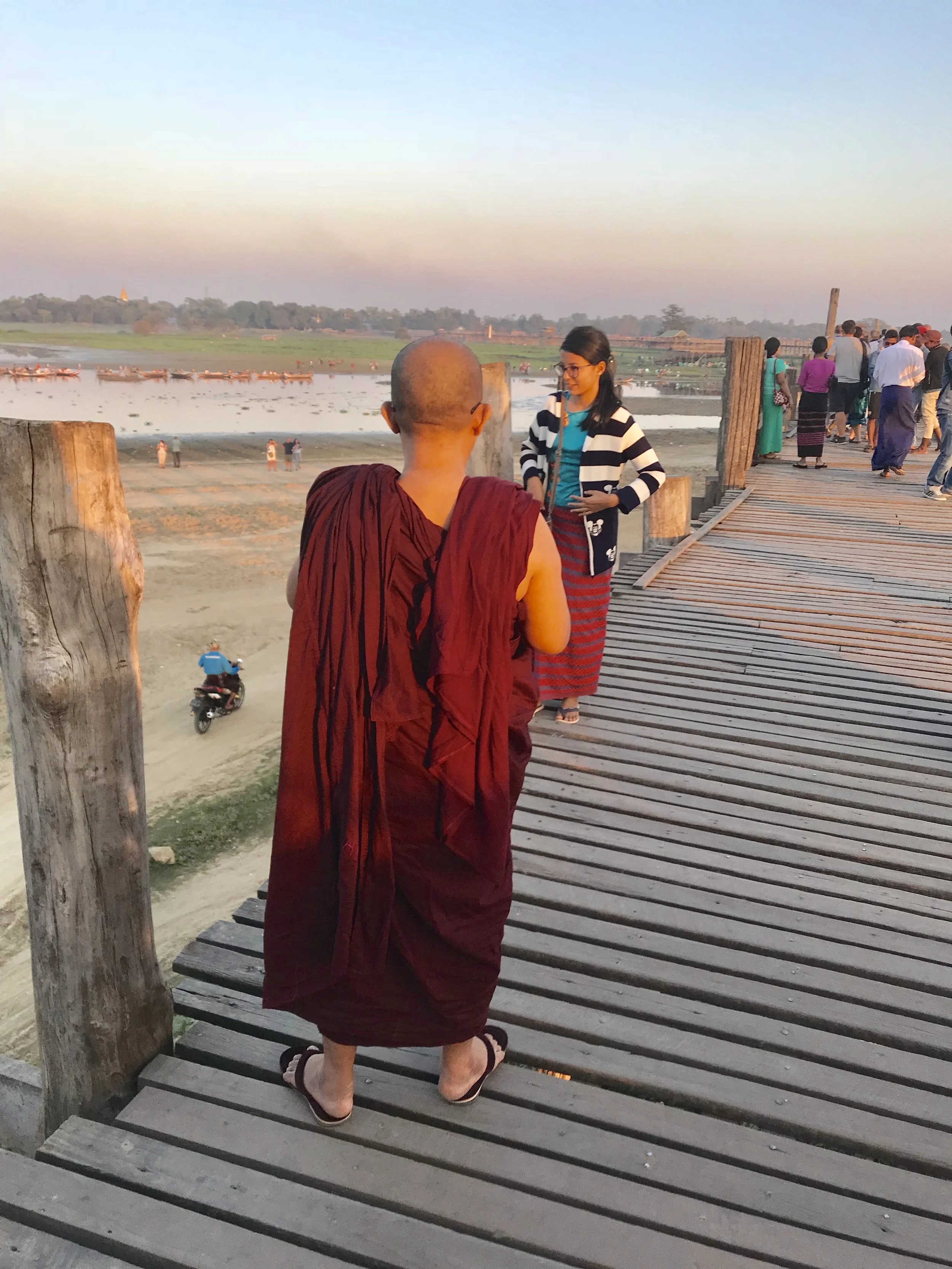
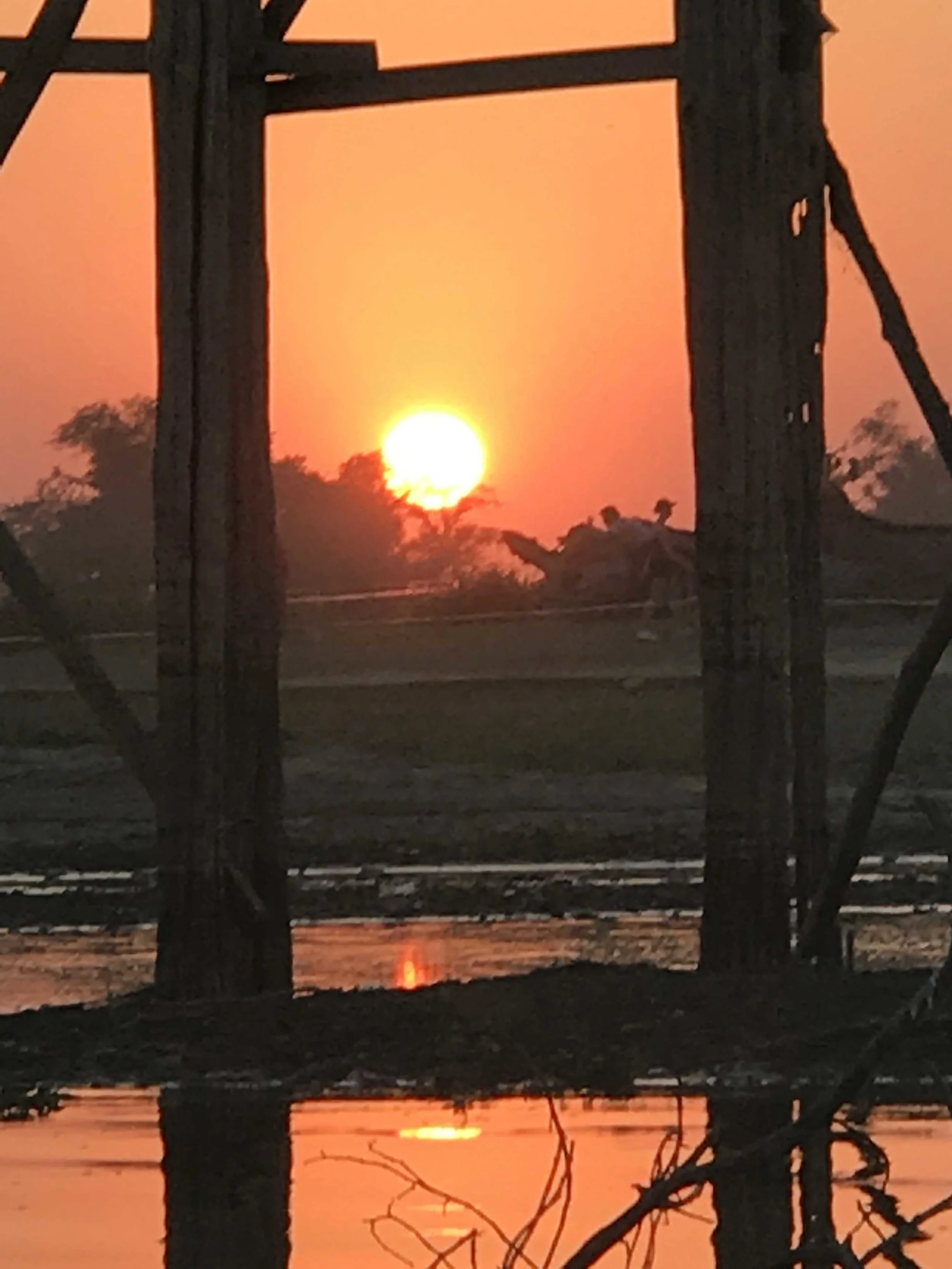
The U Bein bridge was built over 150 year ago and is believed to be the largest teakwood bridge in the world. It stretches out to 1.2 kilometers across the Taungthaman Lake in the ancient capital of Amarapura on the outskirts of Mandalay. It is one of Myanmar’s favorite adventures for fun-loving tourists from around the world. U Bein Bridge was named after a mayor who had it built. It is supported by over 1000 teakwood poles is an Important part of everyday life in the community. It makes it possible for villagers to get their kids to school, fisherman to catch their fish and for locals to reach religious sites and food markets. Like many people present, we were there to experience the magnificent golden yellow sunset together. When we got to the end of the bridge, I hired out a boat so Michelle and I could obtain a better vantage point to see the sun gradually melt below the horizon. Afterwards our oarsman took us to shore with a colorful flotilla of boats where we met Maybelle for the drive back to the hotel. 

What’s interesting about bridges is they symbolize hope. If you can just get over that bridge, you just may find yourself in a better place. Some bridges are harder to cross than others. If you are afraid of heights they can be scary. If feeling the bridge shakes beneath your feet—as it did mine—makes you unsettled, then crossing can pose a challenge. If a bridge is narrow and has no guard rails like U Bein, it can make you pause. On the other hand, the prospect of better things to come on the distant shore gives one hope. In this case the reward was the sunset for all those who were present. As actor, director and producer Woody Allen said: “The secret of success is showing up.”

Postscript: There are so many monastery dogs that sadly look malnourished. I took a photo of these two cute puppies that appeared to be from the same litter cuddling one another. There is also a photo of a group of young monks who appear to be making a getaway with a cart, but in fact they are really doing their chores—sweeping the monastery grounds—which is a meditation in and of itself.

Touring the Ancient Golden Palace Monastery and Another Pagoda

"Travel isn't always pretty. It isn't always comfortable. Sometimes it hurts, it even breaks your heart. But that's okay. The journey changes you; it should change you...It leaves marks on your memory, on your consciousness, on your heart...You take something with you. Hopefully you leave something good behind." —Anthony Bourdain

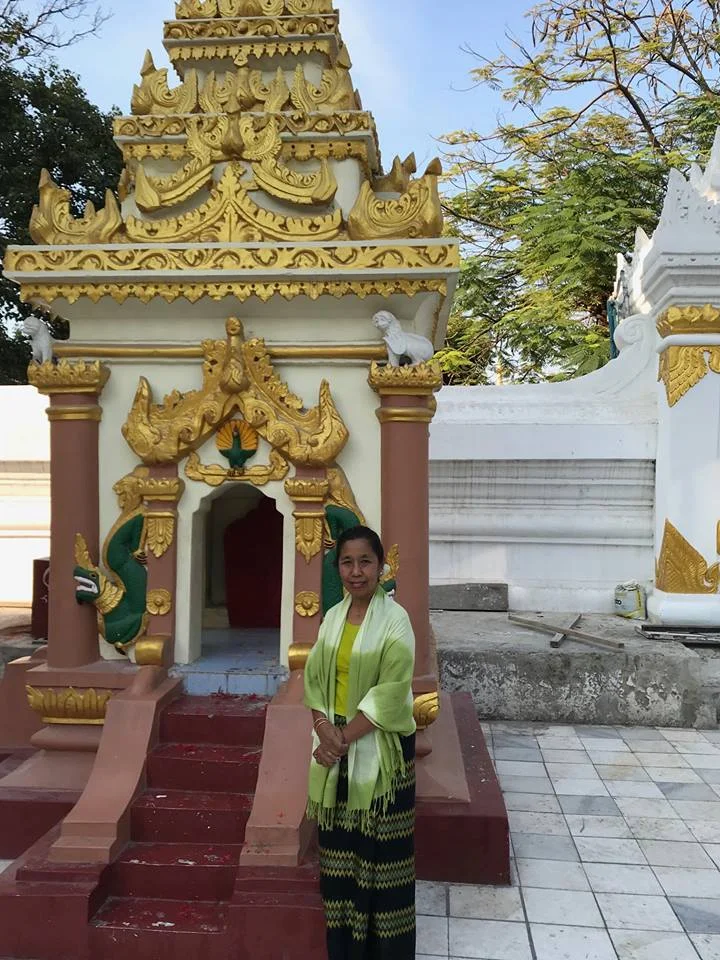
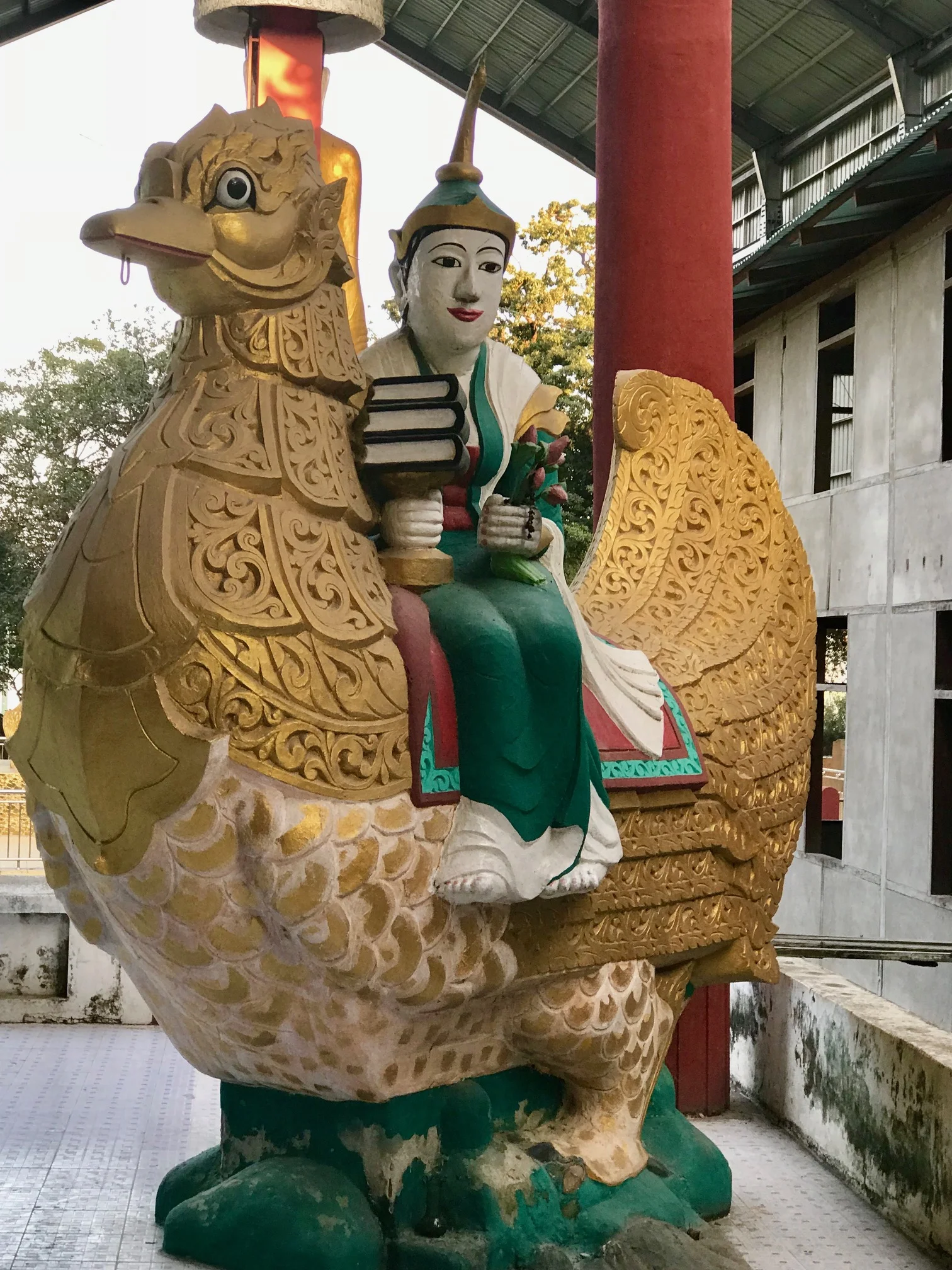
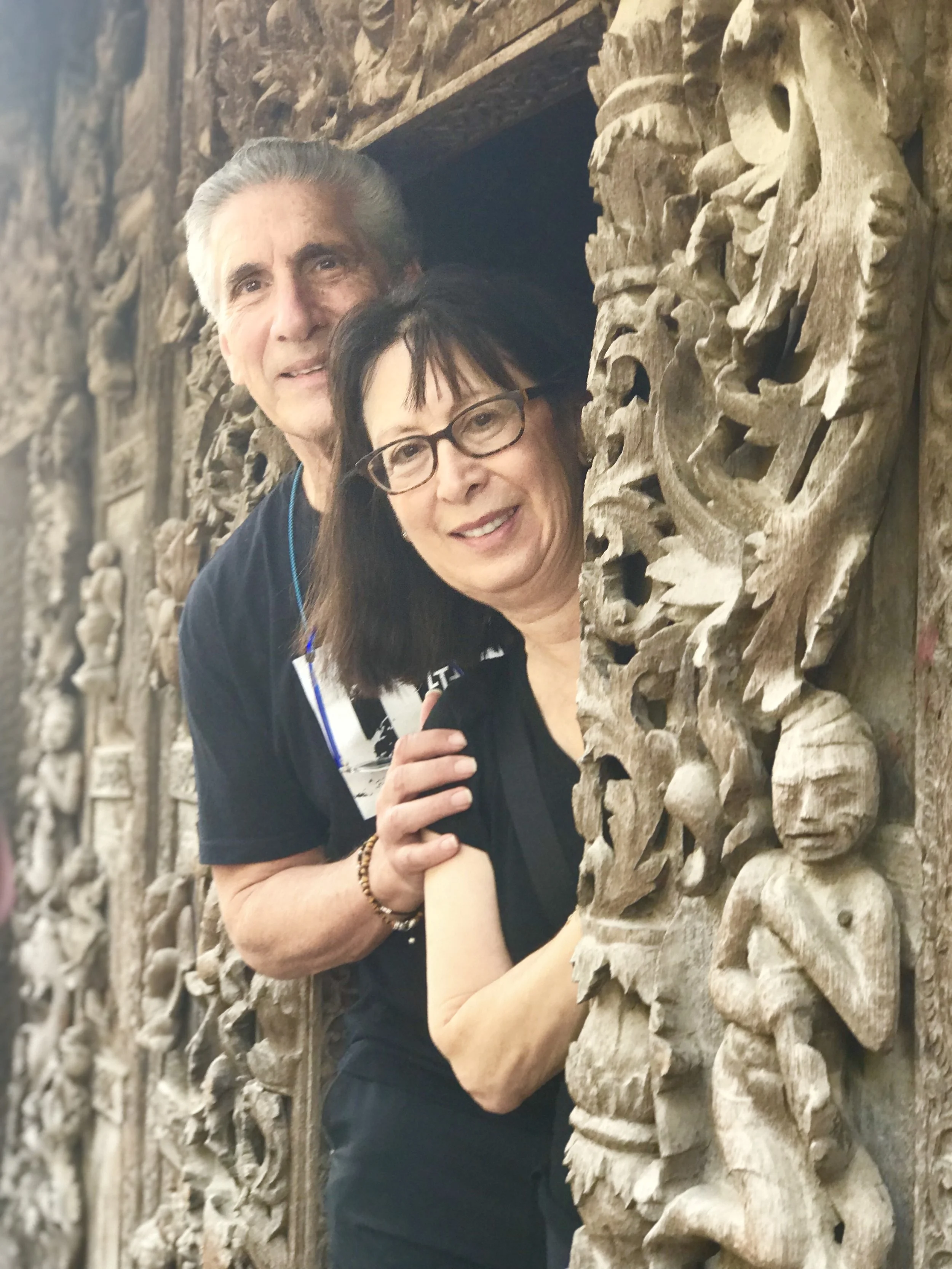
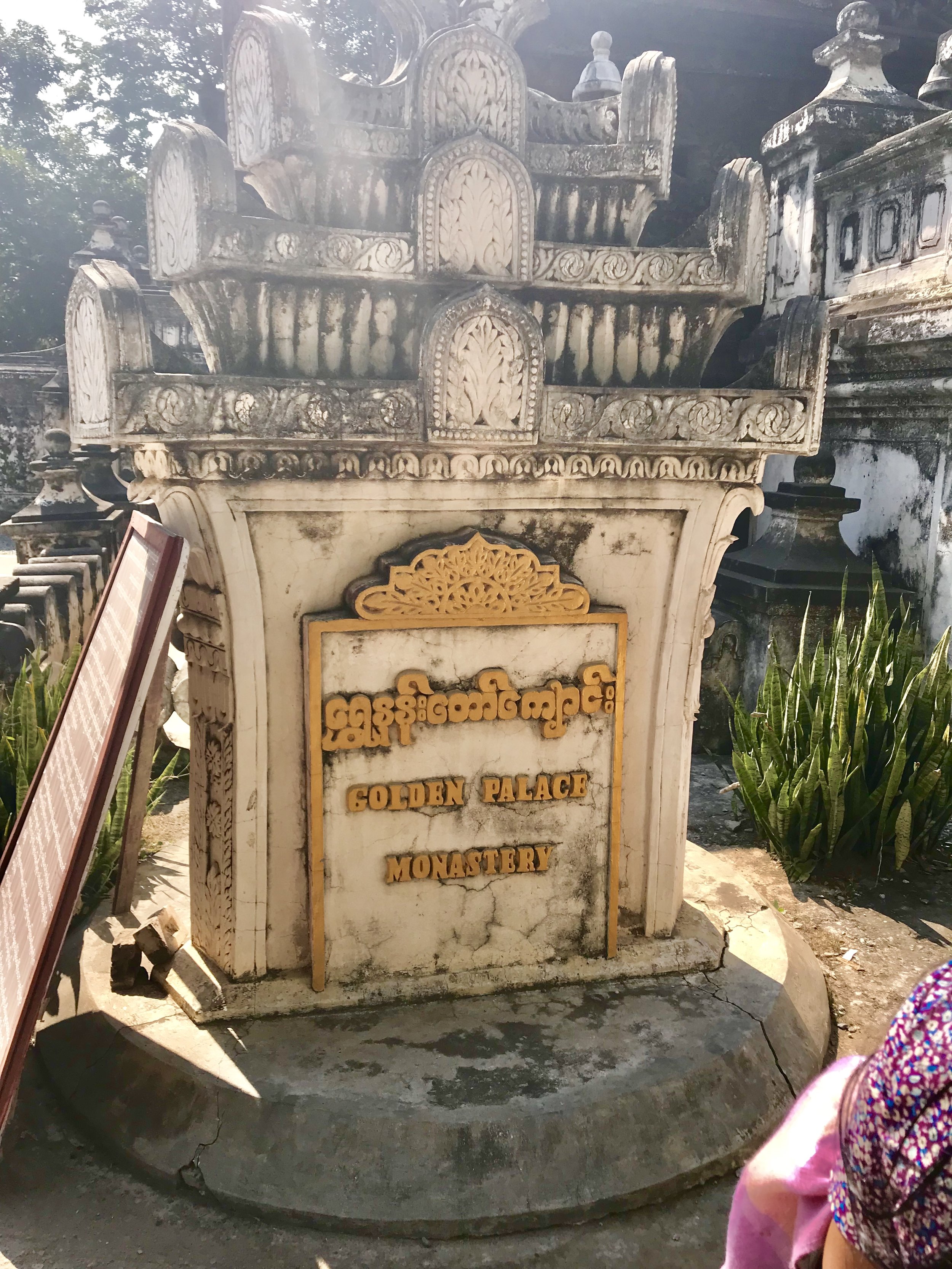
Our Dear friend Maybelle and daughter Michelle, residents of Mandalay took us to see The Golden Palace Monastery. It is heavily gilded and adorned with mythical animals, dancing figures and floral designs carved in gold relief and was once the beloved King Mindon's Royal Apartment. After his death, his son dismantled it and built a monastery in 1883 and dedicated it to the Buddhist Order. It was the only Palace Building to survive the destruction of WW ll in 1945.
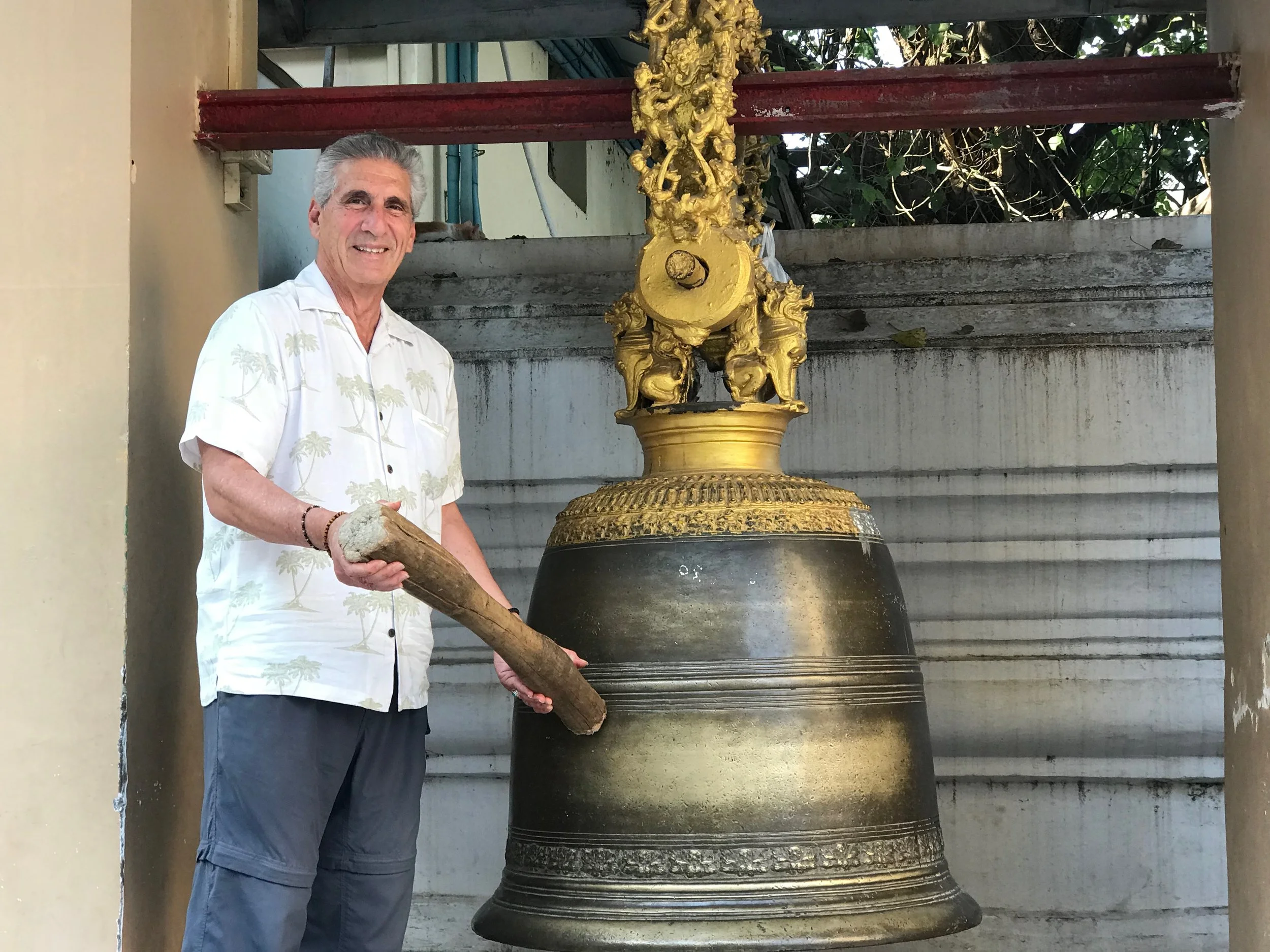
This is a hotspot to visit for locals as well as overseas tourists as seen here. Michelle is ringing the monastery bell.
In the backdrop the monks are doing devotional chanting 24 hours straight for 7 days. From our room it serenades us to sleep, and I experience a deep sense of nostalgia from my meditation retreats at a monastery outside Mandalay back in the day.

Good Morning Mandalay! Touring Gilded Pagodas & Visiting with an English Speaking Monk Whose Name means Knowledge & Bliss

"Being rich in pagodas and monasteries, Mandalay is considered the heart-land of Myanmar..."

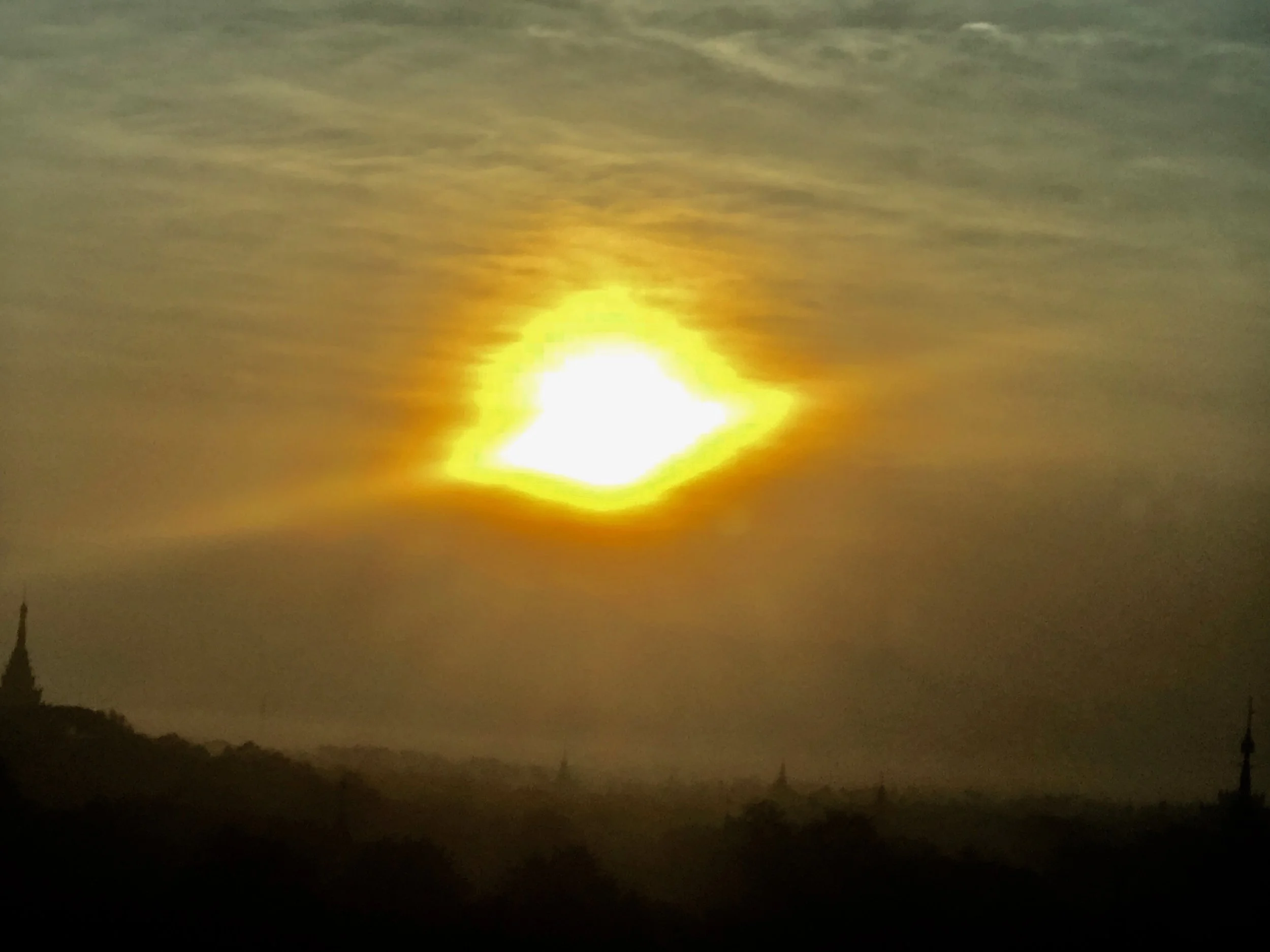
Cecile and I awoke to this beautiful sunrise and the sound of peaceful chanting of the monks from our room at the Mandalay Hill Hotel. Our dear friend Maybelle picked us up at the airport and was the one who recommended the Mandalay Hotel. Upon our arrival she arranged with hotel management to get us a street side view to the hillside view room facing the hillside and the top of the famous Mandalay Hill.
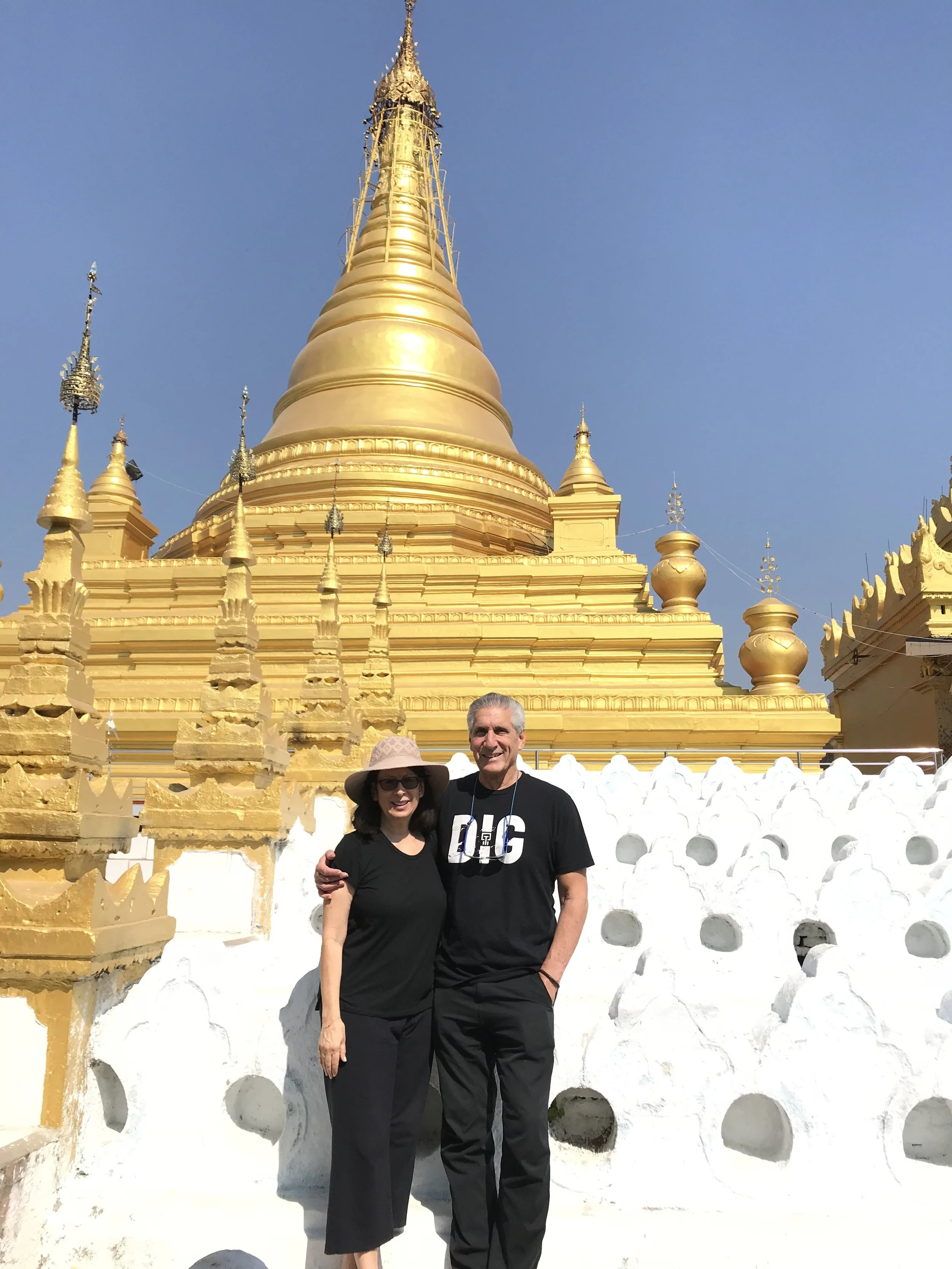
Cecile and I recalled our visits to the local pagodas the night before like the Kuthodaw Pagoda seen here, known as the world’s biggest book as it comprises a spectacular golden pagoda that contains white alabaster shrines that house 729 inscribed marble slabs, each simulating the page of book of Buddhist teachings.
The “Pagoda” also called the “Royal merit pagoda,” was built by King Mindon Min shortly after the founding of Mandalay in 1857. It was meant as a legacy for
future generations. We were accompanied by our friend Maybelle and her lovely daughter Michelle, who I have had the privilege of knowing for 8 years during my many visits to Mandalay to study meditation. 
Maybelle introduced us to an English young monk in burgundy robes named Vidya Ananda. When he realized I knew that it meant “Knowledge and Bliss,” he beamed a smile. Ananda was actually the name of the Buddha’s first disciple. We spoke about his life as a Buddhist monk and his joy of meeting and getting to practice his English with visitors from abroad.

The Journey Begins: Images Along the Way from San Francisco to Southeast Asia

“The beautiful Journey of today can only begin when we learn to let go of yesterday.” —Dr. Steve Maraboli

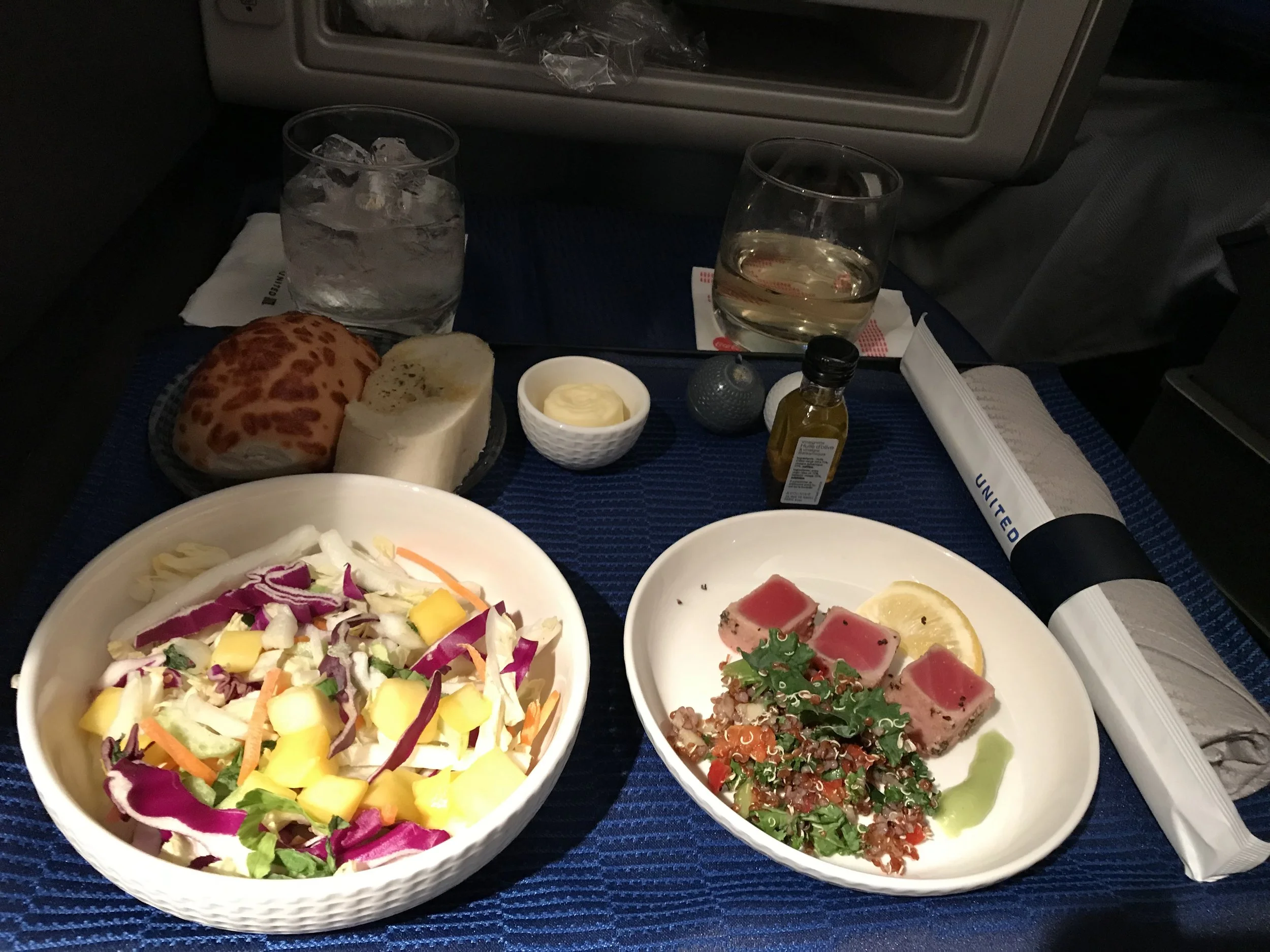
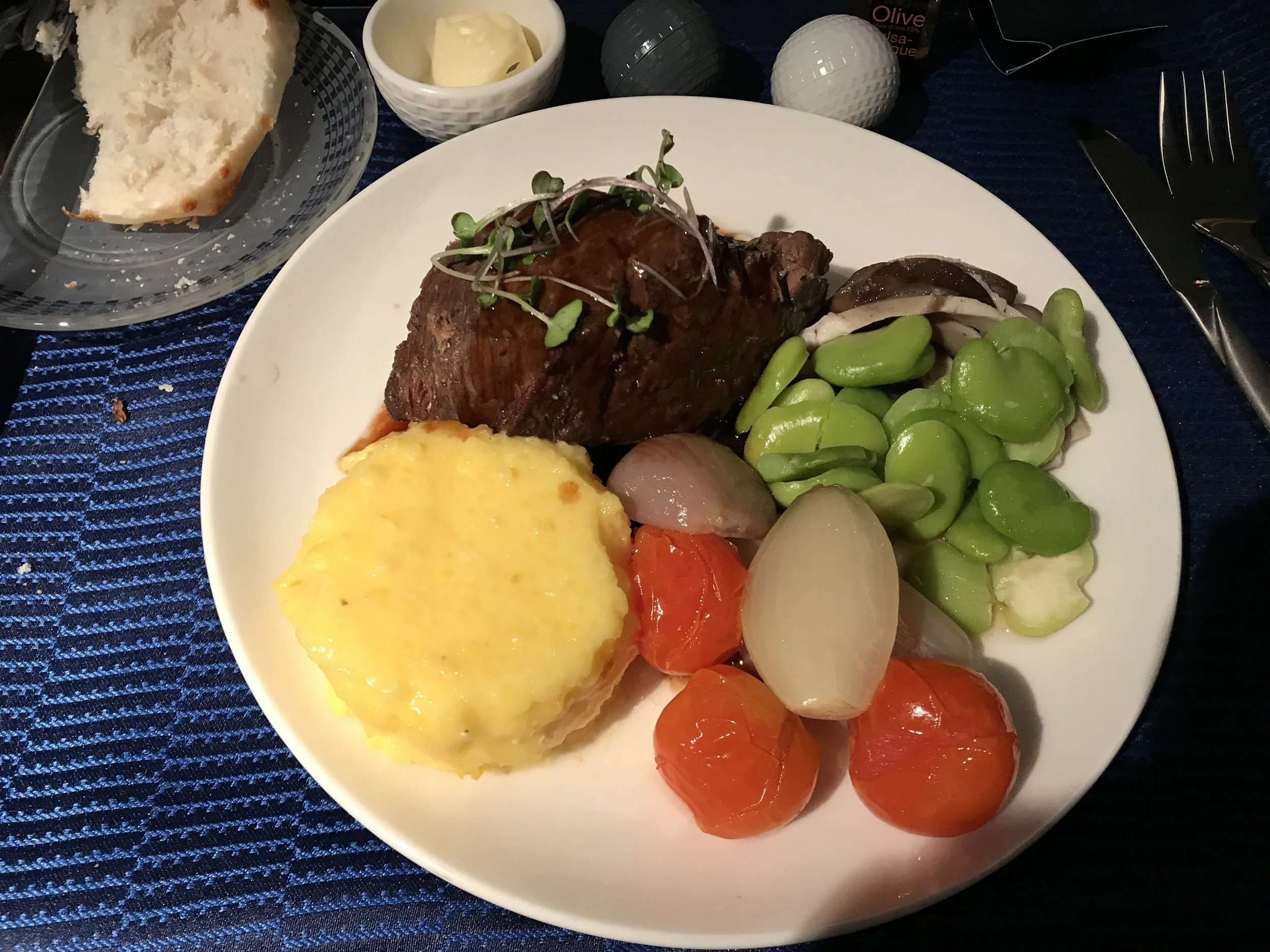
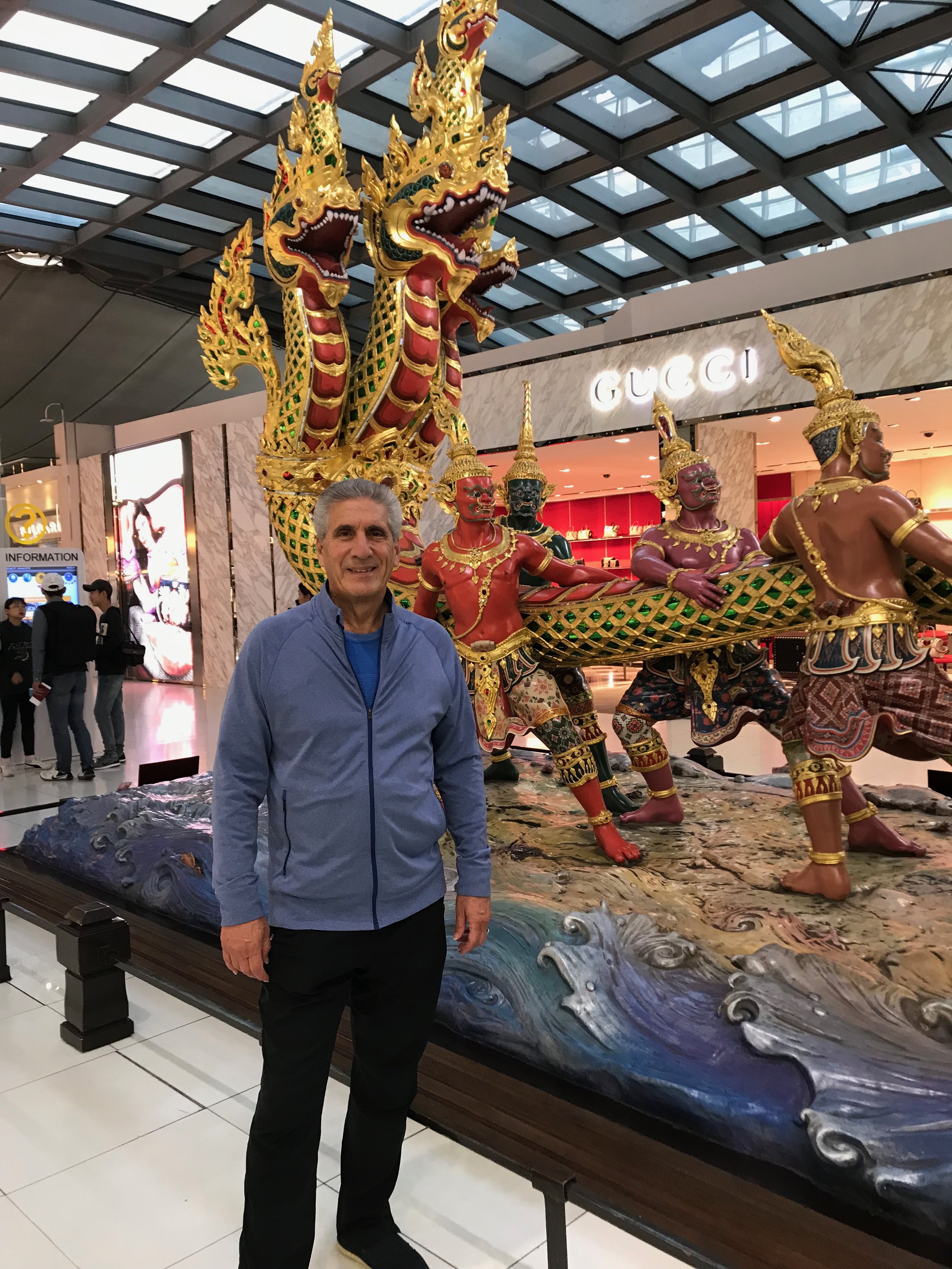
It was a long haul from to SF to Bangkok with a stopover in Narita Airport in Tokyo, 23 hours in fact including the four hour layover. To me any journey, trip or pilgrimage always begins the moment I step on the plane. You never know who you will meet and what you will experience as you enter the realm of Holiday Consciousness.
We lucked out getting an upgrade to Biz class. Betty, the flight attendant for United Airlines took good care of us.
It turns out she is a student of meditation in the Tibetan tradition. Her husband is a German Translator for the Dalai Lama. She is a Brit who lives with her husband in Switzerland, and does acupuncture on the side. We connected in a meaningful way and had many opportunities to talk. The food was incredibly good as was the wine and dessert. I loved the colors of the kimonos of two Japanese women sharing their tradition with travelers waiting for their next connection, like the Sikh with his precious little boy looking so joyful in a form of dress different than his own.

When we arrived in Bangkok at passed midnight, Cecile and I stayed over night at the Miracle Hotel and Spa at the airport. We are now awaiting a flight to Myanmar (Burma).
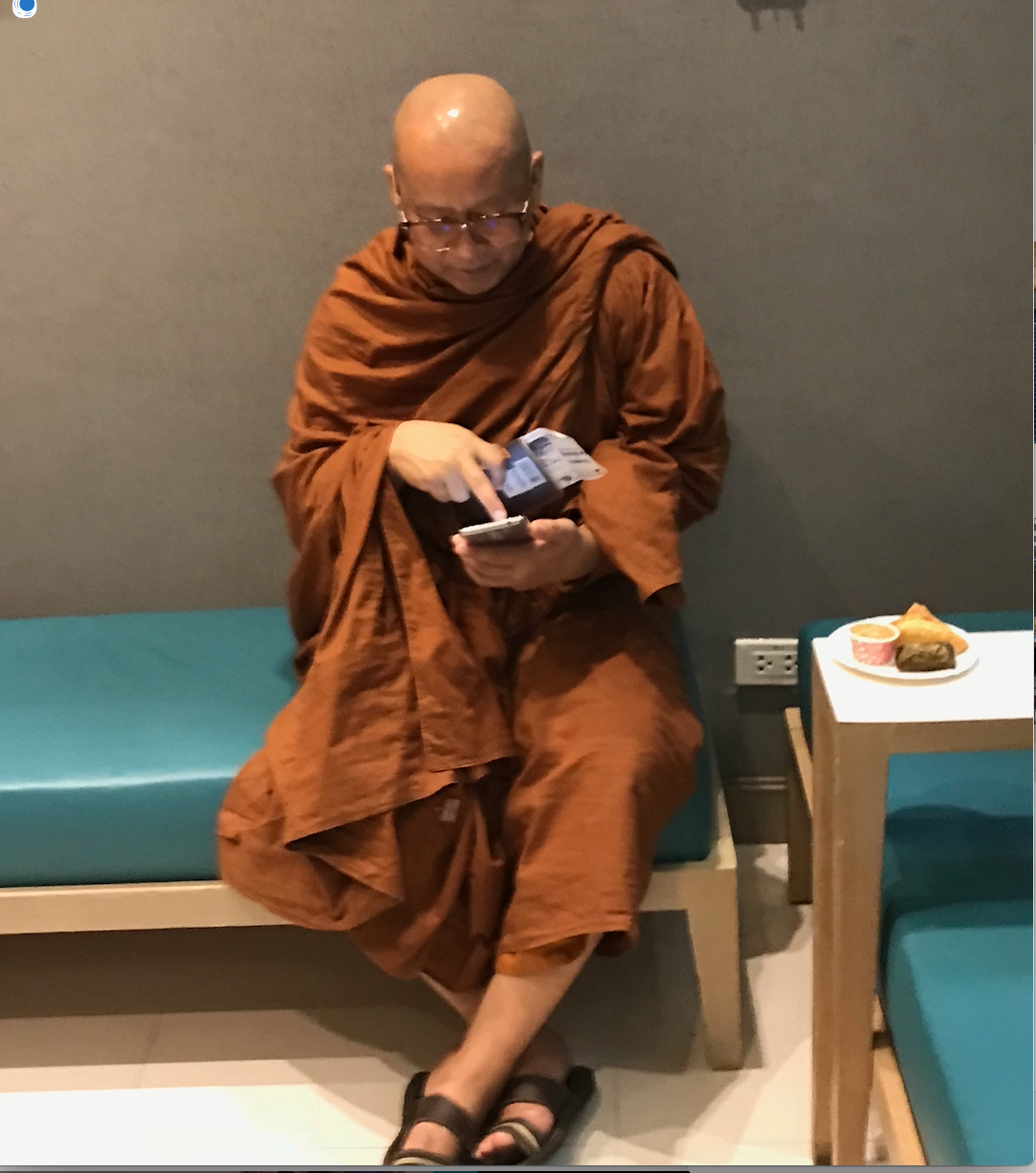
While I was writing this post on my laptop, I noticed a monk seated to my left side. Some young Thai men brought him food. They bowed as a gesture of respect. I have witnessed traditional alms giving many times, and even participated in some. But this was the first time I have seen an offering of food at the airport. When the young men walked away, the monk then got on his mobile device as I got off mine. I smiled to myself. Even monks have adapted to the digital age in recent years.

Reconnecting with an Old Friend Who Certifies that Satellites are Safe to Launch & Shares a mutual Interest in Mind-Body Medicine

Retrouvailles is a French word meaning the happiness of meeting again after a long time.

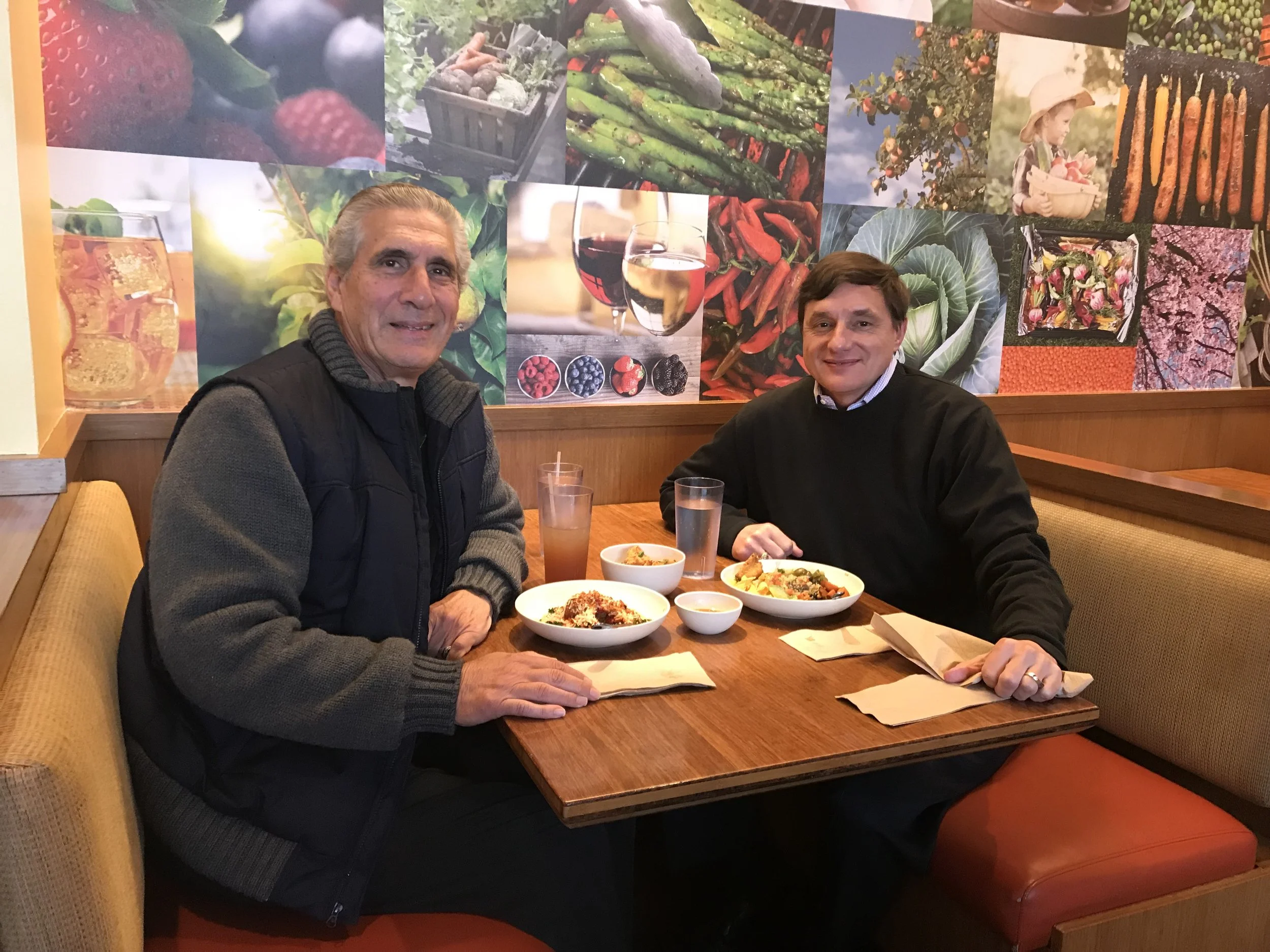
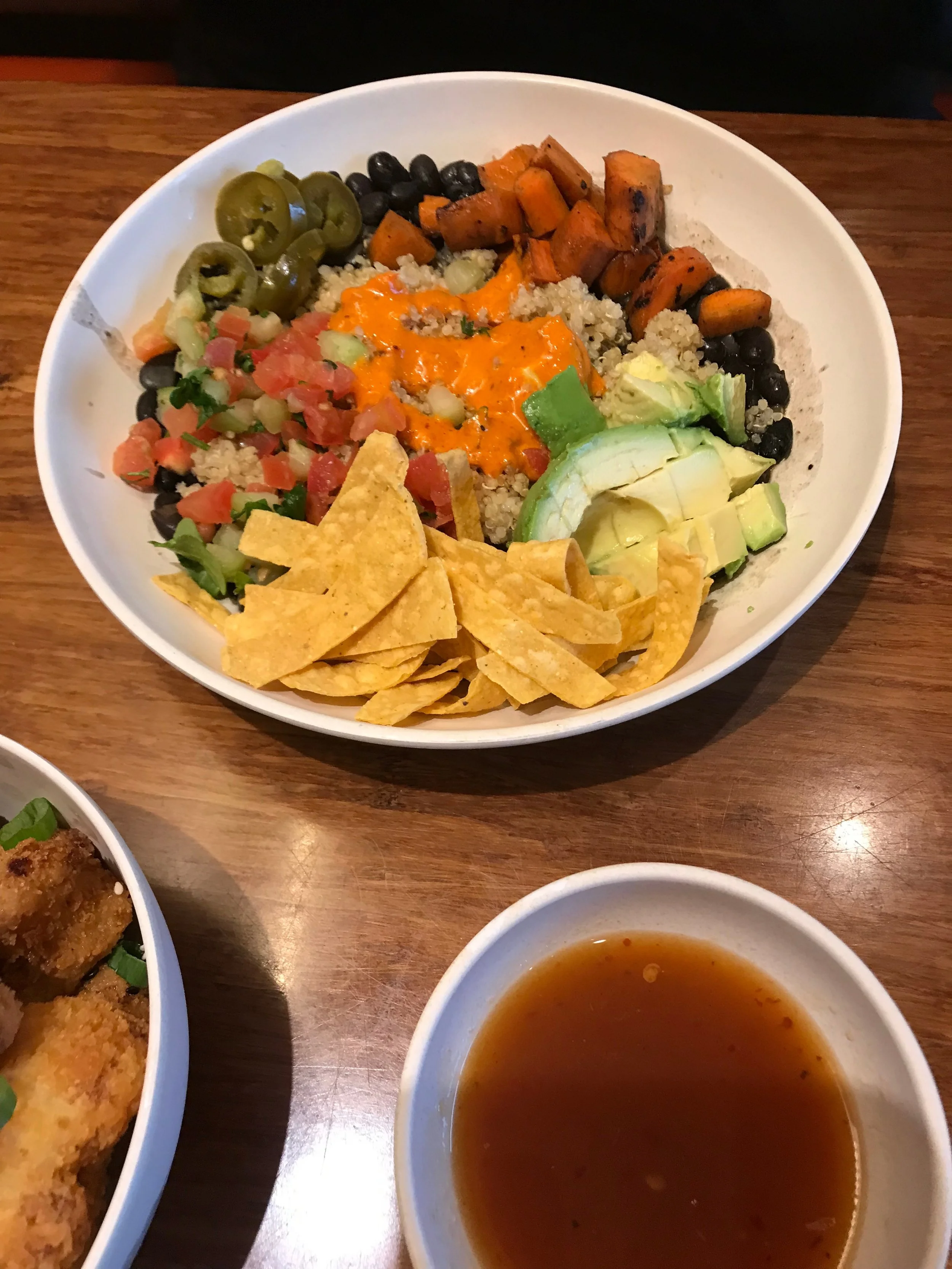
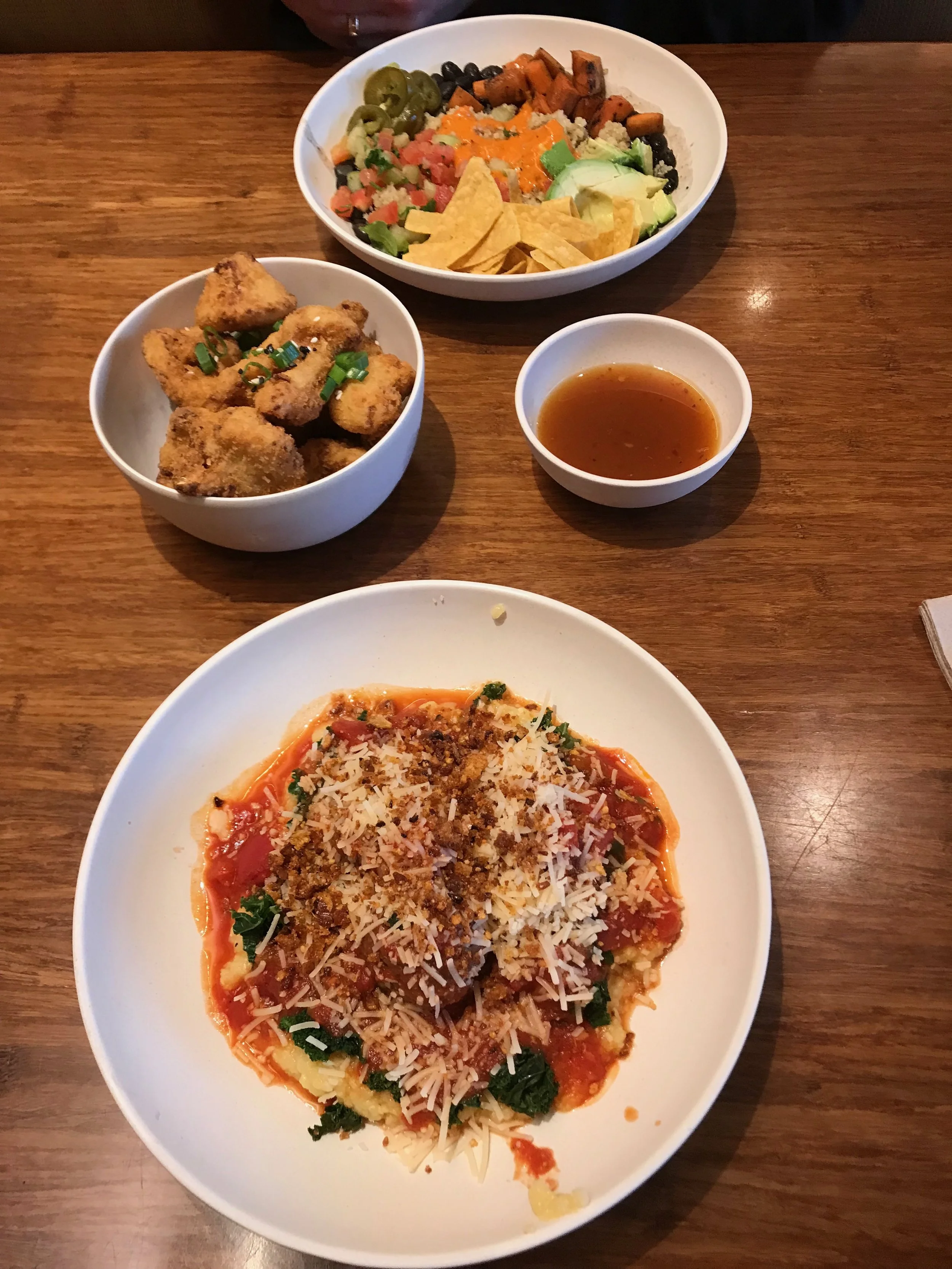
Sometimes, due to distance, time and circumstance, one becomes separated from friends and acquaintances from our past. It had been about 20 years since I last saw Brian Kosinski, and I was amazed how we were able to pick up where we left off. He saw me on Facebook and contacted me to get together to rekindle our friendship. I recommended lunch at the Veggie Grill in San Jose. He ordered the Sonora Bowl that I recommended, I had Meatballs and Polenta and we shared a dish of crispy Cauliflower.

Brian, an electrical engineer is Vice President of Mission Assurance at Space Systems Loral in Palo Alto. He is responsible for quality control to ensure satellites are designed, built and tested to approved standards before they are certified to launch. 

It has been said that, “Good health does not always come from medicine or scientific breakthroughs. Most of the time it comes from peace of mind, peace in the heart—through love and laughter, and peace in the soul. ” There have been times, when medicine and science has failed to recognize that the wisdom of the ages were onto something.

Brian's favorite hobby and part time business is distributing books on healing, meditation and spirituality. The company he created back in the day is called “Namaste," which in Sanskrit roughly translated means "The light in me recognizes the light in you."

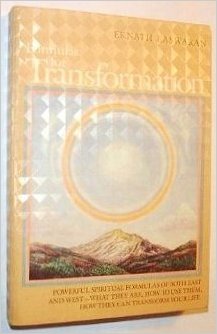
He and I met in the mid 90s after my book: “Invisible Means of Support: A Transformational Journey" was published. He had seen references in my book attributed to the late Eknath Easwaran, an Indian born spiritual teacher, Fulbright scholar and author of more than 20 books including “Formulas for Transformation," a pocket-sized version of the book I used to carry everywhere. His main teaching was using focusing techniques to calm the mind to reduce stress and negative emotions. Some years later I did a day retreat in Los Gatos led by some of Easwaran’s students. Brian used to drive to Petaluma every Tuesday night to hear the gifted teacher give talks at the Blue Mountain Center of Meditation, a non-profit organization Eswaran founded in 1961. 

What I always liked about Brian, is we shared similar interests in spirituality even though we were both trained in the scientific method. He is an Electrical Engineer and I was a retired Podiatric Physician and Surgeon. We both believed in the parallels between science and Eastern mysticism. 
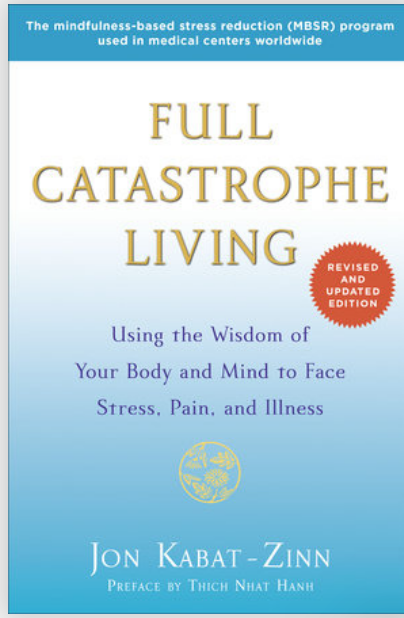
Brian still owns Namaste’, and currently distributes Jon Kabat-Zinn’s book: "Full Catastrophe Living," to the Palo Alto Medical Foundation, Stanford Medical Center and the Center of Integrative Medicine and UCSF. 
The book is based on a mindfulness-based stress reduction program on how to use medically proven mind-body approaches with roots in meditation and yoga to counteract stress, and establish greater balance in one’s life. Another classic book he wrote that I read in 2001 is called “Wherever You Go, There You Are: Mindfulness Meditation in Everyday Life.”Zinn is a scientist, writer, gifted meditation teacher in his own right, and professor of medicine at the University of Massachusettes Medical School, where he was the founding director of the Center of Mindfulness in Medicine.

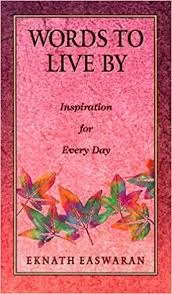
Postscript: Another classic book written by Easwaran, who was a professor of literature and taught the first accredited course on the theory and practice of meditation at UC Berkeley is called “Words to Live By.” Each page comments on a penetrating quote by the world’s best-known philosophers, saints, writers and scientists.


A Middle Eastern Feast with Persian-American Friends at Negeen Restaurant

“Iran was mind-blowing. My crew has never been treated so well-by total strangers everywhere. We had heard that Persians were nice. But Nicest? Didn’t see that coming.”
—Anthony Bourdain

It’s always a pleasure to go out to dinner with our dear friends, Simin Malek and Mohssen (Mo) Rastegar, successful real estate professionals with Coldwell Banker.
They decided to treat us to Negeen Restaurant in Campbell, CA. Negeen in Persian means “precious gem.” It was our first time there. Mo recommended we sit at a cozy corner table near the entrance so we can view the entire room with ease. The place was bubbling with so much joy and excitement we felt we were at a private reception.
Negeen is considered one of Silicon Valley’s finest and authentic Persian restaurants. I love good Persian food and I can say Negeen did not disappoint. Meals come with a complimentary basket of lavash bread accompanied by fresh mint and basil leaves, half of raw onion and feta cheese. Then we had Kashk-e-Bademjan which is cooked pureed eggplant topped mint and creamy yogurt sauce. We also had stewed meat and kidney beans atop of crispy rice.

At the heart of Persian cooking are kabobs and there are many options to choose from. Mo and Simin ordered a tender, juicy platter of kabobs (without the skewers) to share. It included chicken breast, lamb, ground beef (Koobideh), filet of beef, salmon fillet, accompanied by grilled tomatoes and a platter of fluffy, fragrant basmati rice.
For dessert, we shared Bastani, a flavored Persian ice cream with saffron, rose water, chunks of pistachios and a cold Persian noodle dish called Faloodeh: tiny thin, Vermicelli rice noodles mixed with a semi-frozen syrup of sugar, lemon and rose water with optional cherry juice on the side.
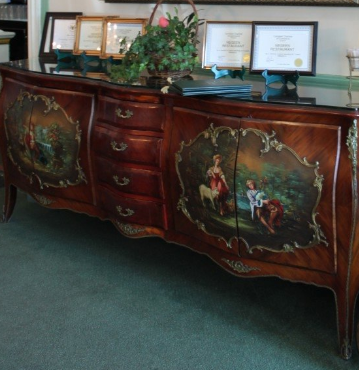
The room looks like a medium size banquet hall, with gold chandeliers, heavy upholstered chairs and mint green tablecloths. It also has a fine looking chest with decorative Persian art, a full-bar and dance floor. On the weekends, there is a live entertainment with Soroosh and his band, and exotic belly dancers that roam around the tables entertaining guests. Mo and Simin invited one of them to our table and I got to dance with her. All I can say is thank God for yoga to help me keep those hips moving.

There are misconceptions about belly dancers being of a lower social standing. Nothing can be further than the truth. Most women have studied the art of belly dancing for years, and are software developers, lawyers, mothers, barristers, etc. They love what they do and love to share their performance art with others. Of course it is customary to tip the dancer by gently slipping dollar bills into their waist band which can be challenging at times when their hips are bouncing up and down, and moving to and fro, and its enough to make one blush. Once the band played Cecile, Simin, Mo and I made our way to the dance floor. 

During dinner, Mo and Simin shared photos of their recent trip to Iran. Simin always dreamed of opening an orphanage for young girls in her native country that she left in her mid-teens to pursue the American Dream. This past year she realized that dream when she attended the grand opening of the orphanage that was covered by local Iranian TV. She gave a speech to the 200 plus people who attended and greeted each child as if they were her own-letting them know they were loved. The orphanage named after her, was built one-hour away from where she was born in Isfahan, considered one of the most beautiful cities in the world. It is not easy opening an orphanage in a country thousands of miles away. But with a deep passion, and an open heart, the generosity of donors and the help of friends with contacts in the building trade, she persevered. 

The late Maya Angelou once wrote: “Love recognizes no barriers. It jumps hurdles, leaps fences, penetrates walls to arrive at its destination full of hope.” Being a deeply compassionate and loving person, Simin has given hope to young girls with the desire to provide them with a better future. Like her loving husband Mo, son Navid and daughter Mozhdeh, Cecile and I are proud of Simin’s desire to “give back” and we are happy and honored to have played a part in assisting her to realize her dream. Though her name in Persian means "Silver," we know her as the woman with a golden heart.

Fun Belly Dancing Video Clip link to Facebook: https://www.facebook.com/dennis.augustine.18/posts/10155975183631668?comment_id=10155979272731668&notif_id=1516667274540550&notif_t=feed_comment&ref=notif

A Thai Pan-Asian Delight to get us in the Groove for our Upcoming Trip to Southeast Asia

“Sometimes happiness is as simple as getting together with friends and sharing a meal together.”

It didn’t exactly begin as the best of days. Cecile and I had our Typhoid shots for our upcoming trip to Southeast Asia. She awoke with pain in her arm and feeling fatigued and I found myself feeling anxious and sniffly—all side effects from the injections. But, an afternoon nap made it possible to keep our plans for the evening. 

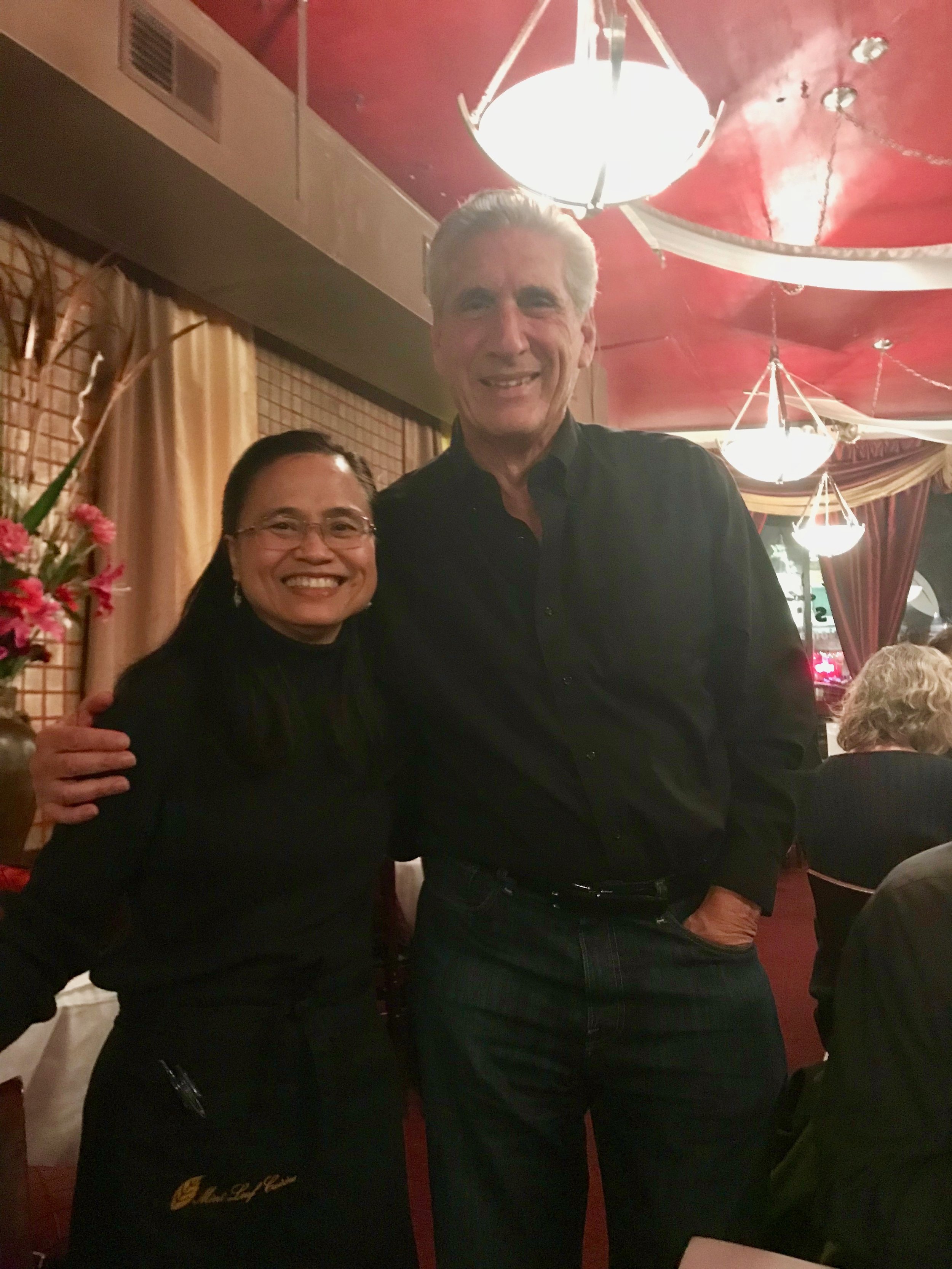
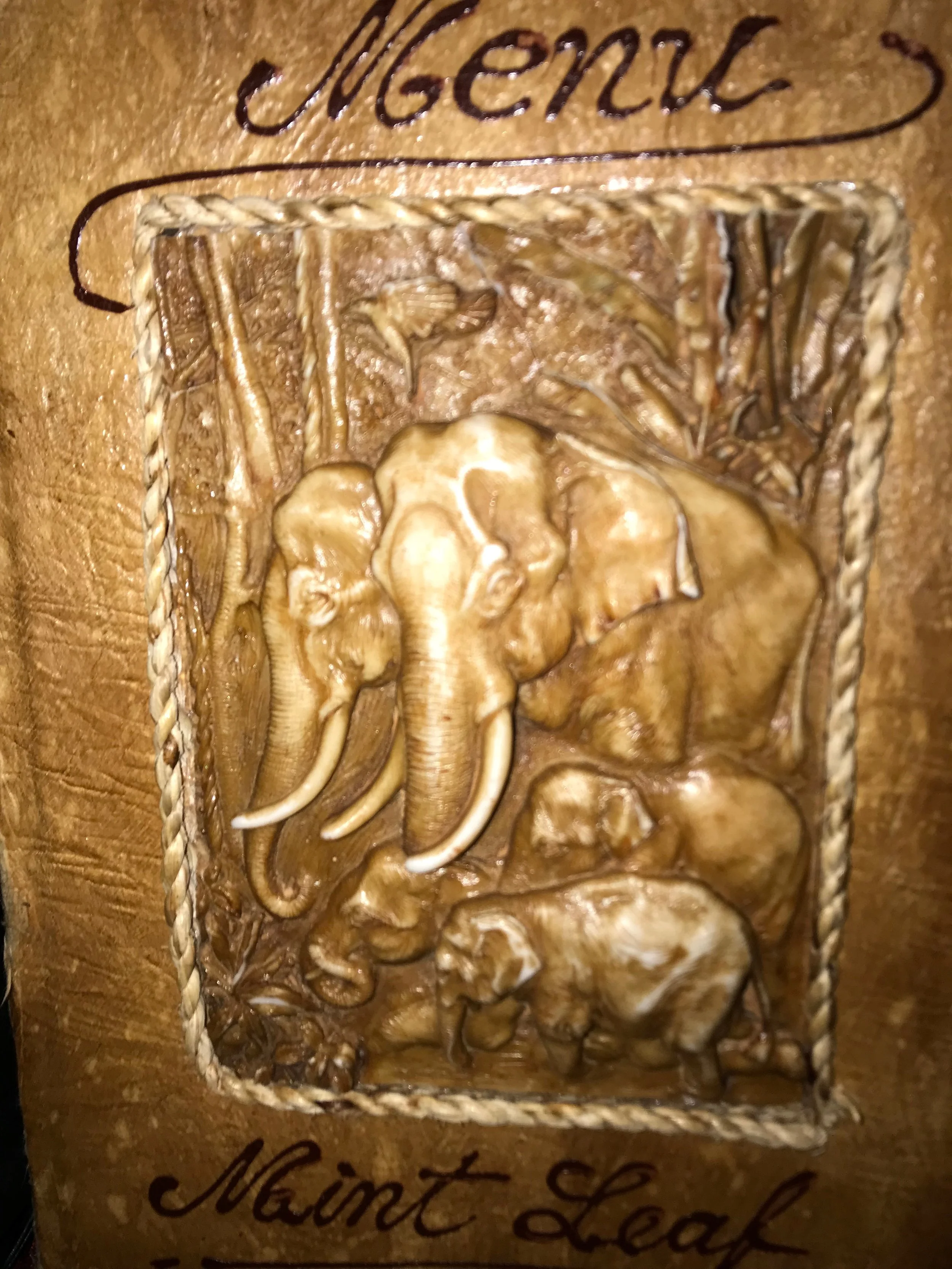
Cecile and I had dinner at the Mint Leaf with friends, Mark and Marleen  Brodsky and Lori and Rob Chaykin. It was a congenial group, the conversations were fun and flowing—as was the wine. Over the last few years Mint Leaf—which officially Opened for business in 2010—has become one of our favorite Southeast Asian eateries. This storefront restaurant in the historic downtown area of Saratoga has become a popular venue for Thai and Pan-Asian cuisine. Thai owners Mint Sirisawad and Laksana Churangpia struck a chord with patrons by providing an extensive offering of delicious food—including an array of vegetarian options—from different parts of Asia and beyond.
Aside from the exotic food dishes, one feature that draws people in, is inviting them to bring their own wine without charging exorbitant corkage fees. We brought three bottles. The atmosphere has a cozy elegance about it. The decor reminds us of the ornate Thai temples Cecile and I have visited in Thailand and are about to do so again. Colorful silk pillows and tapestries adorn and soften the chairs and wood benches, crimson and gold leaf sculptures catch the eye and draping white banners hang from the ceiling.

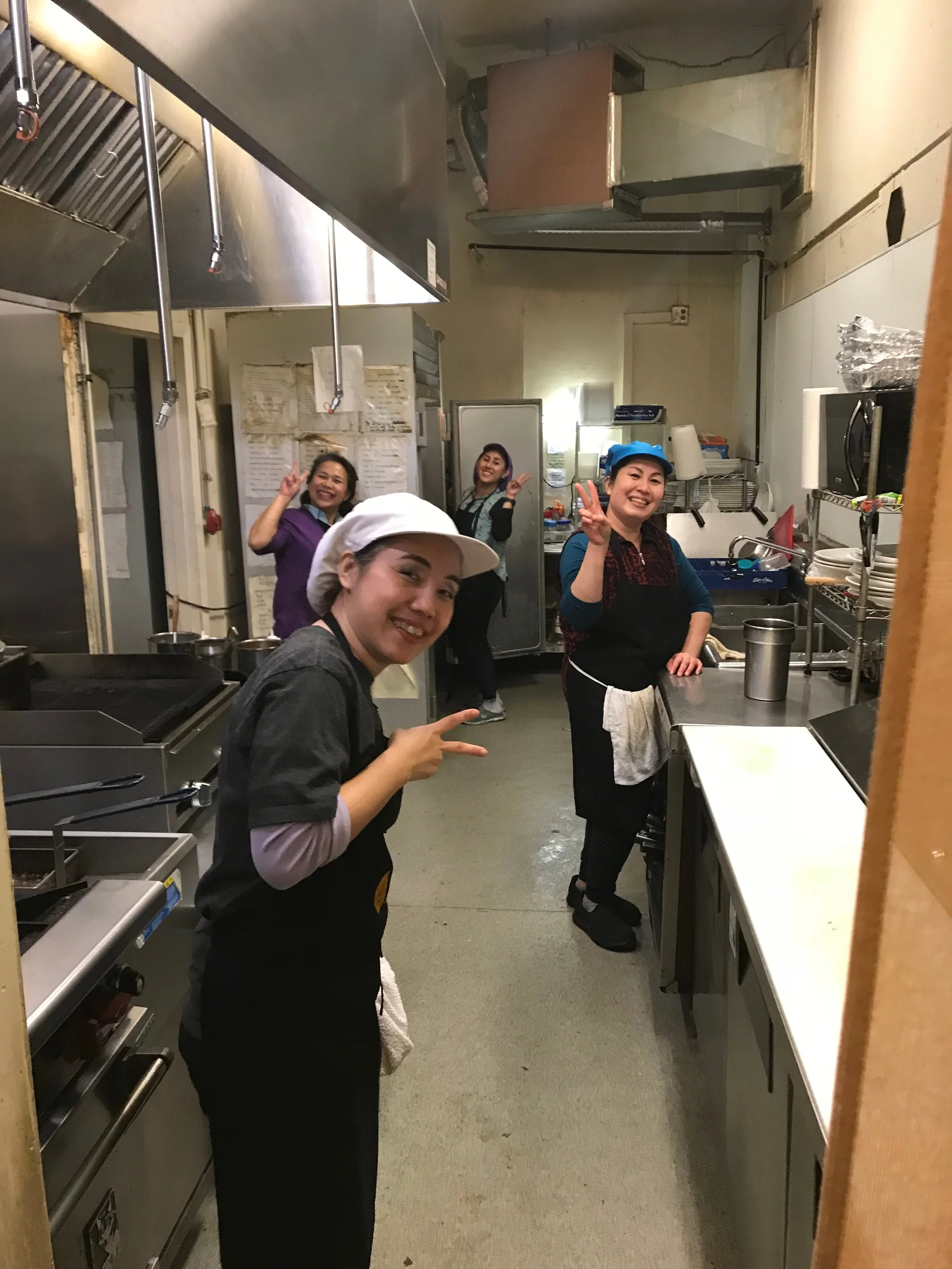
Our food servers were Souwani (unsure of the spelling) whose family is from Bangkok and a San Jose State student called “Music,” a nickname given to her partly because she would rock out to music when she was a kid, and; her Chinese name is difficult to pronounce. They were cheerful and attentive. I had met Souwani before and struck up a conversation with her about meditation. I even visited the kitchen where the cooks joyfully flashed me the peace sign.

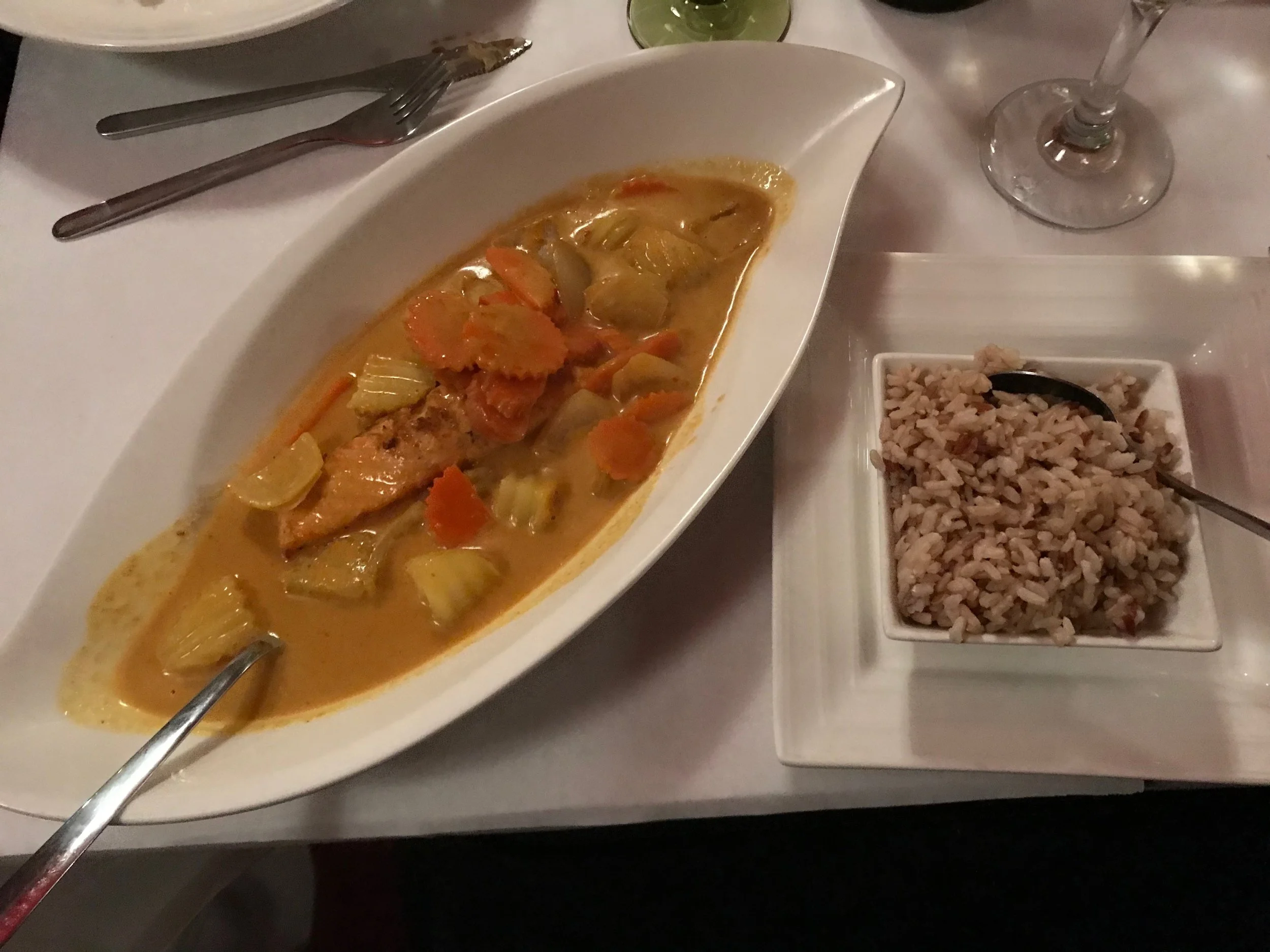
We began with our culinary feast with Thai style chicken Satay with peanut sauce and cucumber salad and Chicken Pot Stickers. For the entrees we enjoyed Spicy Garlic Noodles with New York Steak, and my very favorite Yellow curry with carrots, potatoes, and onion with a juicy filet of salmon. As we left the restaurant I noticed a table with a bowl of plastic wrapped fortune cookies next to the business cards and a vase of red flowers. I took one.
I ate part of it and slipped the rest into my pocket. When I got home I read the familiar white strip which said: "Pack your bags. You are bound for an exciting and exotic destination.”

Hmmm…how did they know that?


Return Visit to The Blue Door Restaurant With Good Friends: An American Greek Dining Experience

“So long as you have food in your mouth, you have solved all questions for the time being.”—Franz Kafka

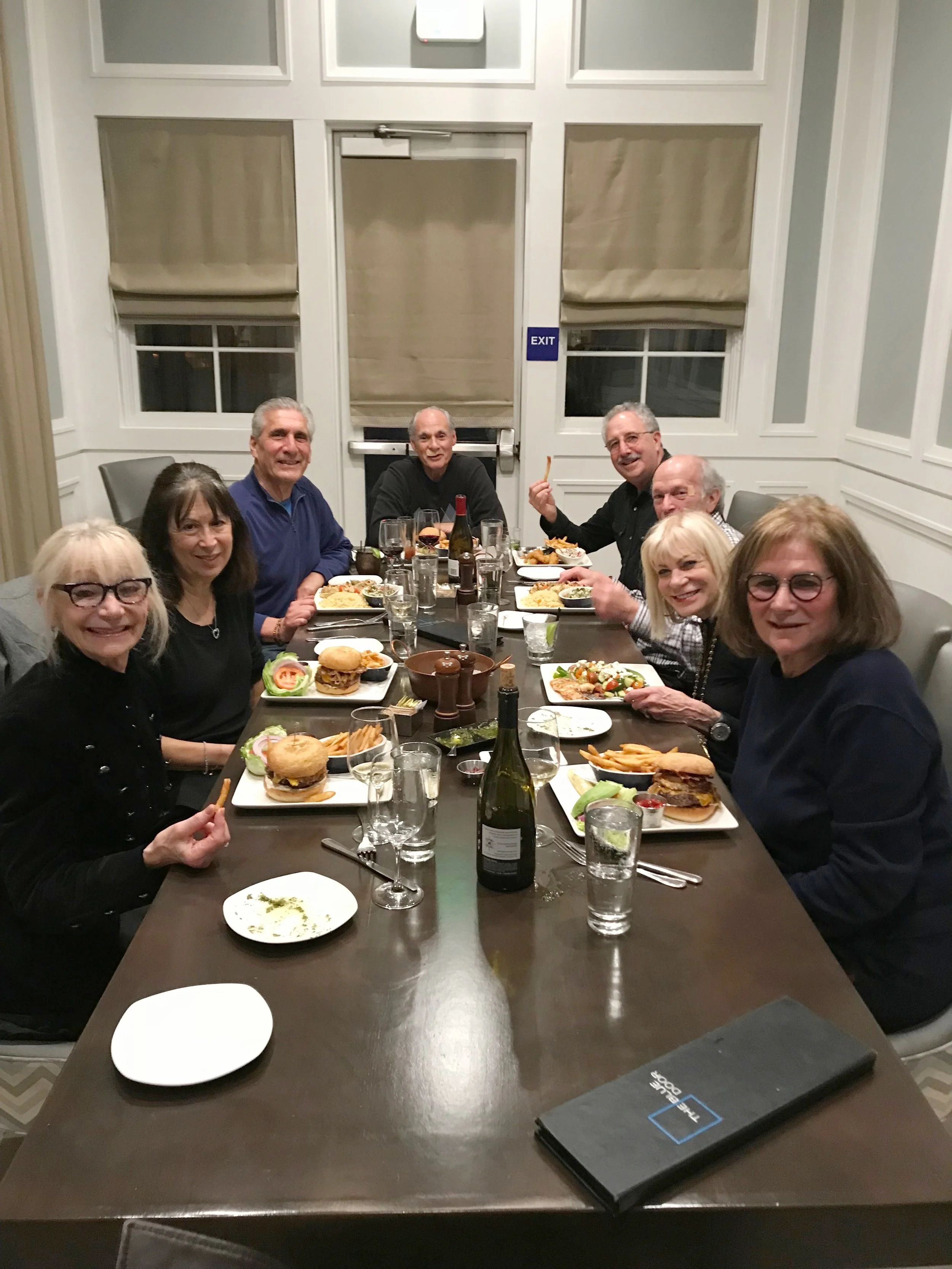
The evening began at the beautiful home of our good friends and neighbors, Mark and Marleen Brodsky that overlooks Silicon Valley. We were joined by Ruth and Stan Litwin and Tina and Wayne Levenfeld. We had wine and an assorted tasty appetizer plate.

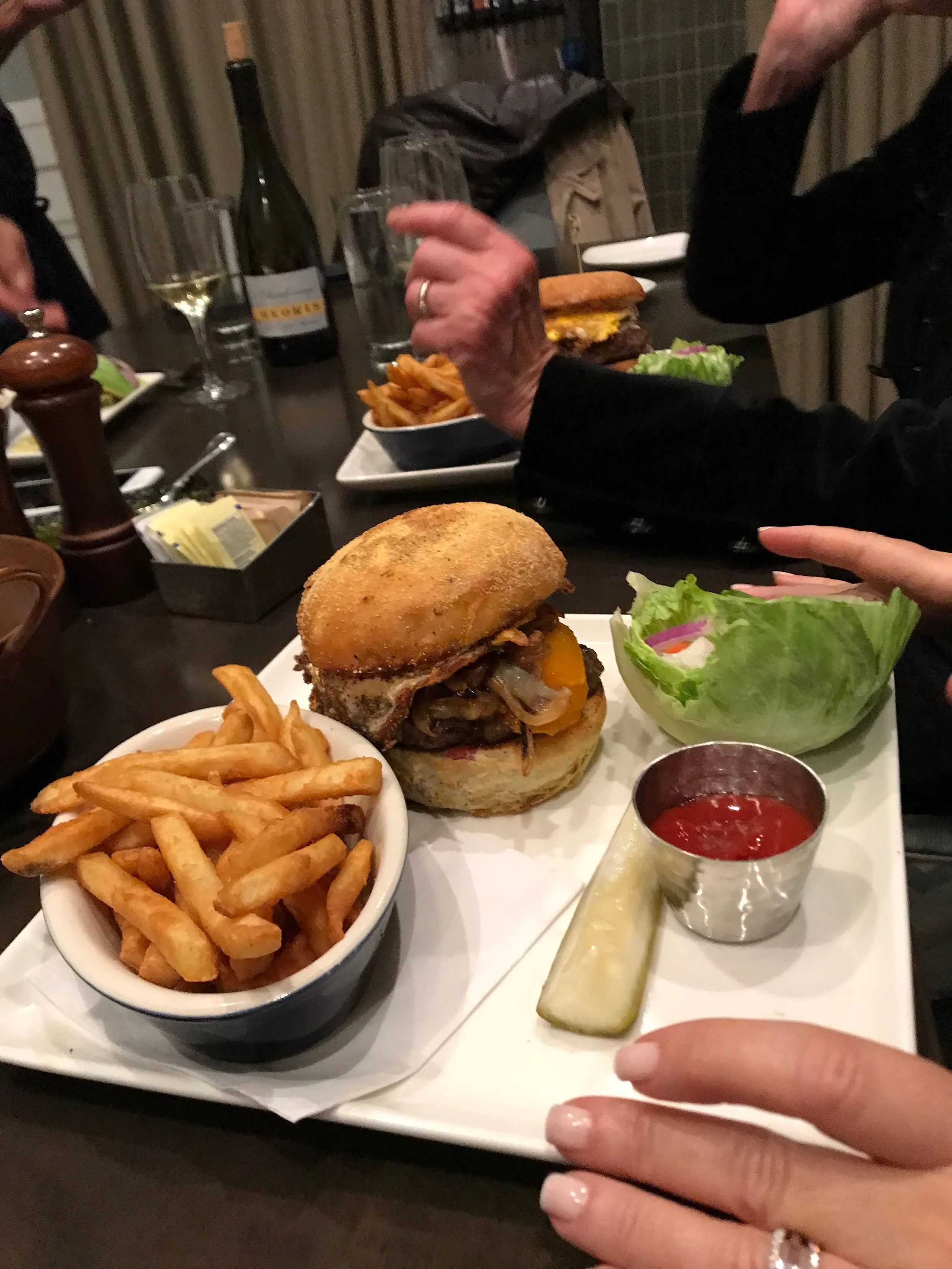
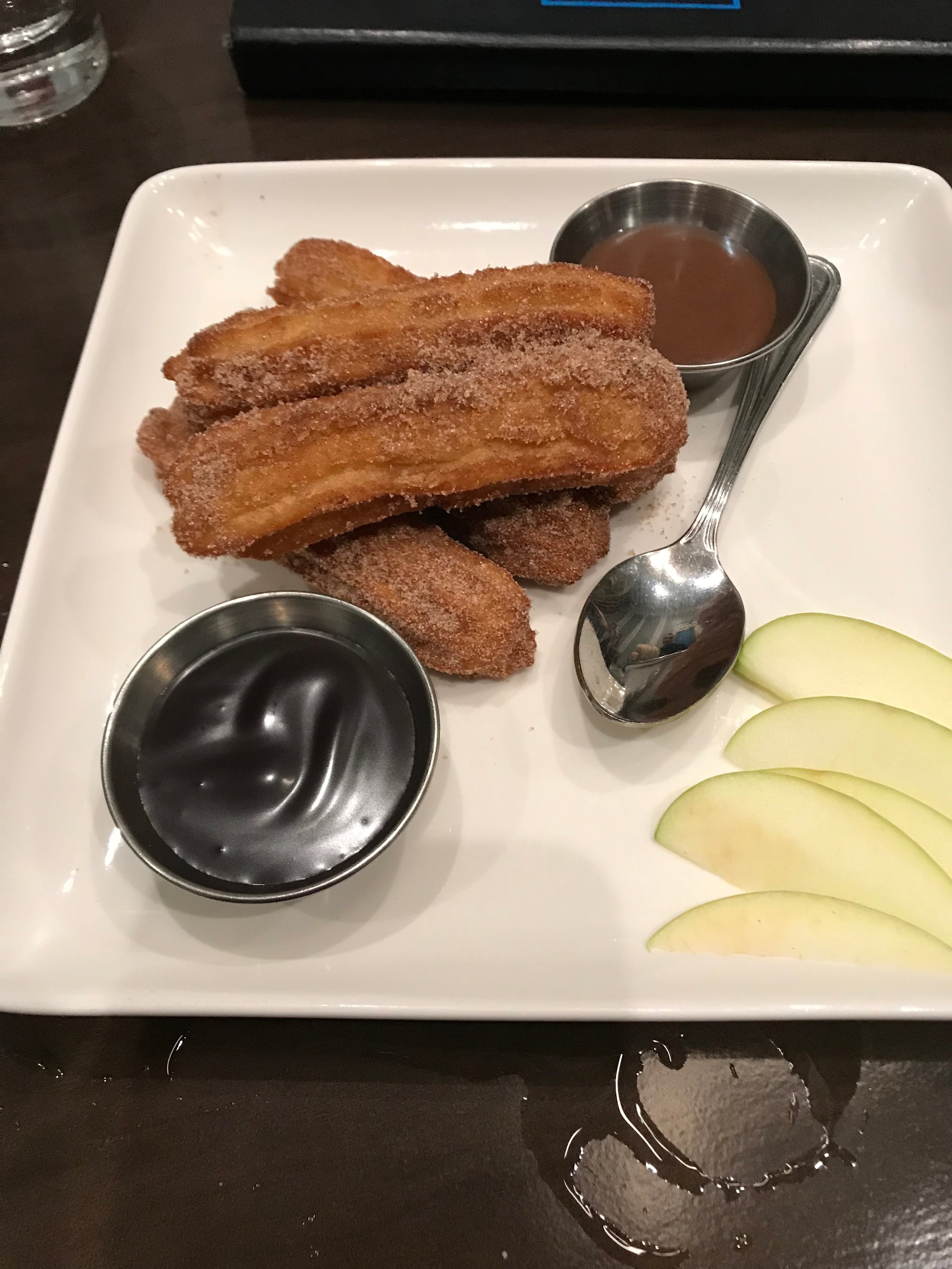
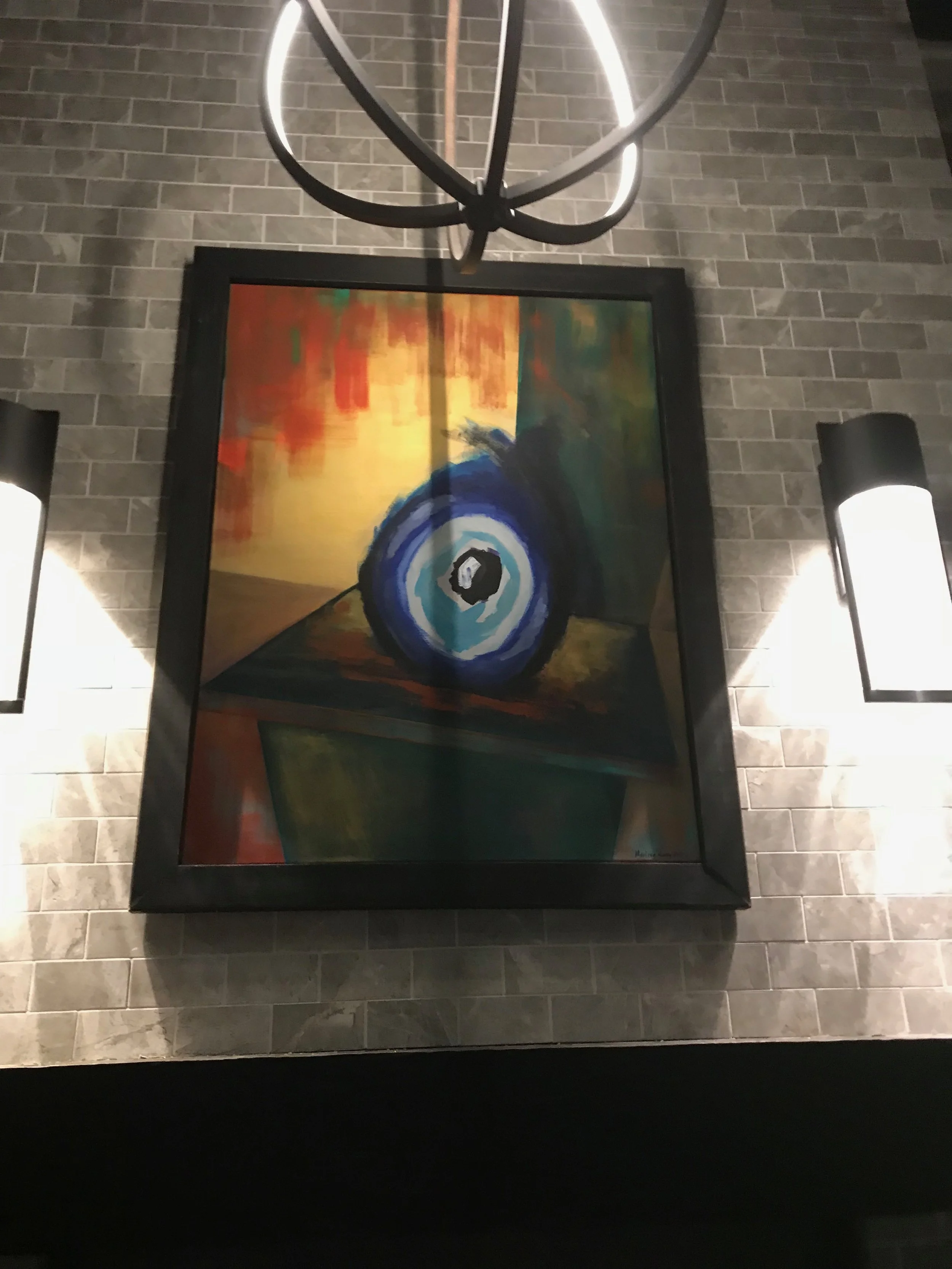
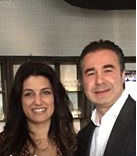
For dinner my wife Cecile had recommended The Blue Door Restaurant in San Jose which offers up classic American favorites with a Greek inspired twist. After doing a review of our experience here last year and publishing it on my blog: enjoyyourlifenow.net I emailed it to Sylvia Foundas who along with her husband Pete founded the restaurant. Responding to my review she thanked me and added that she believed it spoke to the essence of what they were trying to achieve when coming up with the concept, design, and theme for their eatery and bar, which was to create an environment where guests could feel comfortable and “feel the soul of the restaurant in order to capture…it’s essence.” Being first-generation Greek Americans, and having traveled several times to southern Greece, they wanted to bring a “little slice” of it to San Jose. Apparently, they succeeded. In 2016, The Eater Staff listed The Blue Door as one of “The 15 Hottest New Restaurants in Silicon Valley.” Following that first review Sylvia had invited us to ask for her whenever we returned. Since Cecile and I arrived first we asked the receptionist to let Sylvia know we were here. After welcoming us back we informed her that we recommended the Blue Door to our friends who would be joining us shortly. We were escorted into one of the private dining rooms. It turned out to be a perfect venue to relax and enjoy the evening. Tina and Wayne generously brought two bottles of wine, while some of us ordered cocktails. Our charming young waiter, Wesley was attentive and his overall service was excellent. We ordered lamb burgers, Natural Cheeseburger topped with a friend egg, Chicken Kebabs with rice pilaf and tabbouleh salad and Fish and Chips. Following our dinner Wesly brought us Churros with caramel and chocolate dipping sauce, compliments of the manager.

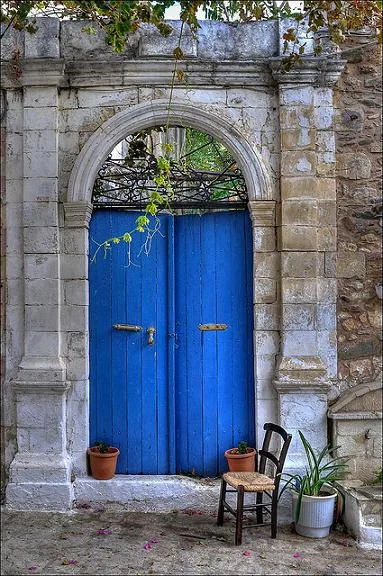
As I mentioned in my earlier review last year, choosing the name: The Blue Door had always puzzled me. But, I came to find out that the color blue reflects the shimmering, deep blue color of the Mediterranean, the azure sky and the colors of the Greek flag. It also is the color that the wives of Greek fisherman painted on the front doors of their homes to protect their husbands from misfortune so they can return home safely. As we left the Blue Door, there was a Live Latin Jazz band playing in their swanky bar as there is every Friday at 7:30 PM. Mark and Marleen, the dancers in the group, gave it a whirl that inspired other patrons to get up and dance. We couldn’t have asked for a better evening amongst friends.

The Foundas Restaurants include the Pinecrest Diner in San Francisco and the Boulevard Cafe' in Daly City.

Photo Credit: Sylvia and Pete Foundas, The Blue Door website
Photo Credit: A blue door in Greece by romtomtom